

Analytical Instrument Qualification: Strategy, Lifecycle, and Regulatory Framework
Analytical instrument qualification establishes documented evidence that a laboratory instrument or analytical system is fit for its intended use. It connects the analytical purpose of the instrument with its design, configuration, installation, operating functions, measurement performance, software, data controls, and ongoing lifecycle management.
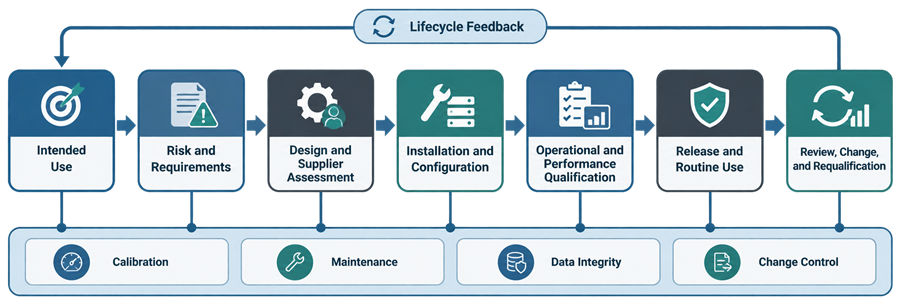
Qualification is not limited to executing vendor IQ/OQ protocols. It begins with a defined intended use and continues through requirements, risk assessment, supplier evaluation, design review, installation and configuration verification, functional testing, performance qualification, release, routine monitoring, change control, periodic review, and requalification when warranted.
A defensible analytical instrument qualification program must also distinguish instrument qualification from calibration, analytical procedure validation, system suitability testing, and computerized-system validation. These controls are related, but none substitutes for the others.
Purpose and Scope
This article establishes the governing framework for analytical instrument qualification in regulated pharmaceutical, biotechnology, medical-device, and laboratory operations. It applies to instruments and analytical systems used for activities such as:
- Raw-material and component testing
- In-process testing
- Product release testing
- Stability testing
- Environmental and utility testing
- Cleaning validation sample analysis
- Process validation support
- Microbiological and biological testing
- Development work supporting regulated decisions
- Generation of data included in regulatory submissions
The principles apply across a broad range of laboratory technologies, including balances, pH meters, spectrophotometers, dissolution apparatus, chromatography systems, particle analyzers, spectroscopic systems, automated analyzers, and other instrument platforms.
The required qualification scope depends on intended use. The presence of an instrument in a regulated laboratory does not, by itself, determine qualification rigor. The critical question is how the instrument is used, what data it generates, how that data affects regulated decisions, and which failures could remain undetected.
What Analytical Instrument Qualification Demonstrates
Analytical instrument qualification, commonly abbreviated AIQ, demonstrates that the instrument or system:
- Has an approved and sufficiently specific intended use
- Is capable of supporting the required analytical procedures
- Has been selected and configured appropriately
- Is installed in a suitable environment
- Operates correctly across defined ranges and functions
- Produces acceptable performance under representative conditions
- Protects electronic data and associated metadata
- Is supported by appropriate calibration and maintenance controls
- Can be operated consistently by trained personnel
- Remains fit for use throughout its operational lifecycle
Qualification should result in an evidence-based conclusion about fitness for intended use. Completion of documents or vendor service activities without a documented technical conclusion is not sufficient.
Regulatory and Compendial Framework
US regulations do not prescribe a single universal DQ/IQ/OQ/PQ format for every analytical instrument. They establish broader requirements for scientifically sound laboratory controls, suitable equipment, reliable performance, complete records, calibration, and controlled computerized systems.
21 CFR 211.160, General Requirements requires scientifically sound laboratory controls and appropriate specifications, standards, sampling plans, and test procedures. It also requires calibration of instruments, apparatus, gauges, and recording devices at suitable intervals under an established written program.
21 CFR 211.194, Laboratory Records requires complete laboratory data and records of periodic calibration of laboratory instruments and apparatus.
21 CFR 211.68, Automatic, Mechanical, and Electronic Equipment addresses the routine calibration, inspection, or checking of automatic, mechanical, electronic, and computer-related equipment according to written programs designed to assure proper performance.
When electronic records or electronic signatures are used to satisfy FDA record requirements, applicability of 21 CFR Part 11, Electronic Records and Electronic Signatures must be assessed.
FDA’s Data Integrity and Compliance With Drug CGMP guidance further explains expectations for complete data, metadata, audit trails, access control, record review, retention of original information, and investigation of data-integrity deficiencies.
USP General Chapter <1058>, Analytical Instrument Qualification, provides a recognized compendial framework for classifying analytical instruments and establishing qualification activities based on intended use and complexity. Because pharmacopeial content may be revised, the laboratory should verify the currently official version through the USP–NF Analytical Instrument Qualification chapter record before establishing or revising its program.
These sources support a risk-based qualification lifecycle. They do not eliminate the laboratory’s responsibility to determine and justify what must be tested for the specific instrument, configuration, analytical use, and data environment.
Intended Use as the Foundation of Qualification
Qualification begins with a specific intended-use statement. A statement such as “the system will be used for laboratory testing” is too broad to support instrument selection, risk assessment, or qualification design.
The intended use should define, as applicable:
- Materials, products, or sample types to be analyzed
- Analytical procedures or technique families to be supported
- Required measurement ranges
- Required accuracy, precision, sensitivity, and resolution
- Expected sample throughput
- Applicable laboratory environment
- Whether the instrument supports release, stability, validation, development, or other decisions
- Required instrument modules and accessories
- Software-controlled functions
- Data processing and calculation requirements
- Electronic-record and metadata requirements
- Interfaces with LIMS, chromatography data systems, or other platforms
- Required record-retention period
- Expected operating and support model
The intended use determines which functions are critical. For example, detector wavelength accuracy may be critical for one application, while flow accuracy, temperature control, carryover, resolution, or automated calculation functions may be more important for another.
If intended use changes, the existing qualification must be reassessed. Qualification performed for development work does not automatically support later use for commercial product release.
Detailed requirements are developed through the Analytical Instrument User Requirements.
Instrument, System, and Qualification Boundary
Modern analytical instruments are frequently systems rather than isolated pieces of hardware. The complete analytical system may include:
- Instrument hardware and replaceable modules
- Sensors, detectors, pumps, autosamplers, or sample-handling components
- Embedded firmware
- Control and data-acquisition software
- Workstations and operating systems
- Local or network databases
- Calculations and processing methods
- User accounts and security configuration
- Audit trails
- Network connections
- Interfaces with LIMS or other systems
- Backup, recovery, and archival arrangements
- Controlled procedures and trained users
Analytical instrument qualification establishes documented evidence that a laboratory instrument or analytical system is fit for its intended use throughout its lifecycle. It begins with a defined analytical purpose and continues through requirements, risk assessment, supplier evaluation, design review, installation and configuration verification, functional testing, performance qualification, release, routine monitoring, change control, periodic review, and requalification when warranted. The qualification scope must address the instrument’s hardware, software, data controls, operating environment, and supporting systems rather than rely solely on execution of vendor IQ/OQ protocols.
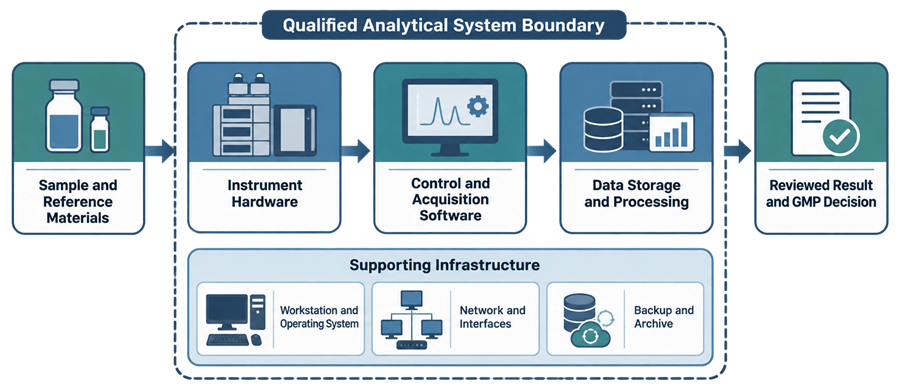
The boundary should also identify elements outside the qualification package that remain essential to reliable results, including:
- Qualified or characterized reference standards
- Controlled reagents and solutions
- Approved analytical procedures
- Sample preparation controls
- Environmental conditions
- Qualified supporting utilities
- Laboratory procedures
- Training and authorization
- External data platforms
Dependencies outside the immediate instrument boundary do not need to be duplicated in every protocol. They must be identified, controlled, and linked to the qualification strategy.
Instrument Categorization and Risk Classification
Instrument categorization supports consistency, but category alone should not determine qualification scope.
A simple apparatus with no configurable software may require limited documented verification. A measurement instrument may require calibration, installation checks, and intended-use performance verification. A configurable analytical system with software, calculations, security roles, audit trails, and interfaces requires a broader qualification and data-integrity strategy.
Risk classification should consider:
- GMP impact of the generated data
- Effect on product release or other quality decisions
- Instrument complexity
- Degree of configuration
- Software and data-processing complexity
- Detectability of instrument failure
- Dependence of results on instrument performance
- Availability of independent checks
- Interface and data-transfer risks
- Novelty of the technology or application
- Supplier capability and available evidence
- History of similar instruments at the site
A high-complexity instrument does not automatically require every possible test. A technically simple instrument can still require strong control when it directly supports a critical GMP decision and failure would be difficult to detect.
The combined categorization and risk-classification approach is addressed in Instrument Categories, while qualification-scope selection is addressed in the Risk-Based Analytical Instrument Qualification Strategy.
Analytical Instrument Qualification Lifecycle
The qualification lifecycle converts intended use into controlled operation and continued fitness for use. The analytical instrument qualification lifecycle connects intended use and risk-based requirements with qualification, controlled operation, and evidence-based requalification.
Intended Use and Requirements
The laboratory defines what the instrument must accomplish, the analytical applications it must support, the required performance characteristics, data expectations, system boundaries, and operating environment.
Requirements should be testable or otherwise verifiable. They provide the basis for supplier selection, design assessment, qualification testing, acceptance, and traceability.
Risk and Qualification Strategy
A documented risk assessment identifies critical functions, measurement parameters, software controls, data risks, interfaces, and credible failure modes.
The qualification strategy then defines:
- Applicable lifecycle activities
- Required documentation
- Supplier-document use
- Required DQ, IQ, OQ, and PQ activities
- Test depth and challenge conditions
- Acceptance criteria
- Traceability approach
- Software-validation responsibilities
- Required calibration and maintenance controls
- Release requirements
- Continued verification and requalification strategy
Risk-based qualification means concentrating effort on functions that matter. It does not mean omitting testing without a documented technical basis.
Design Qualification and Supplier Assessment
Analytical Instrument Design Qualification confirms that the proposed instrument, configuration, software, infrastructure, and support model can satisfy the approved requirements.
Design assessment should address:
- Measurement technology and operating principle
- Required range and performance capability
- Instrument modules and accessories
- Materials and sample compatibility
- Software functions and configuration
- Electronic records and data architecture
- Security and audit-trail capability
- Infrastructure and interface compatibility
- Calibration and maintenance provisions
- Supplier documentation
- Service and technical support
- Parts and software obsolescence
- Supplier change-notification practices
Supplier assessment should be proportional to risk and dependency. The laboratory remains responsible for the adequacy of qualification even when vendor protocols, certificates, or test evidence are used.
Installation Qualification
Analytical Instrument Installation Qualification verifies the delivered and installed system against the approved design and configuration.
IQ typically addresses:
- Manufacturer, model, serial number, and equipment identification
- Delivered components, modules, and accessories
- Physical installation
- Electrical, gas, environmental, and other service requirements
- Computer and network installation
- Software, firmware, and operating-system versions
- Licenses and enabled options
- Configuration settings
- Security setup
- Interfaces
- Manuals and controlled documentation
- Calibration certificates
- Initial configuration baseline
IQ establishes what was installed. It does not demonstrate that all functions operate correctly or that the system performs adequately for its intended analytical use.
Operational Qualification
Analytical Instrument Operational Qualification verifies that critical functions operate as intended across applicable operating ranges and conditions.
OQ may include:
- Instrument function challenges
- Measurement range testing
- Alarm and error handling
- Interlocks
- Module communication
- Calculation and processing functions
- User roles and access restrictions
- Audit-trail operation
- Electronic-record controls
- Date and time functions
- Data export and interfaces
- Backup and restore functions
- Boundary and adverse-condition testing
The appropriate OQ scope depends on intended use and risk. Vendor testing can be used when it is relevant to the installed configuration, adequately documented, performed using suitable standards and equipment, and formally assessed and accepted by the regulated company.
Performance Qualification
Analytical Instrument Performance Qualification confirms that the complete system performs acceptably under representative routine-use conditions.
PQ should be linked to the intended analytical application and may use:
- Certified or characterized reference materials
- Representative samples
- Approved analytical procedures
- Defined performance checks
- Site personnel
- Routine configurations
- Normal operating conditions
PQ is not simply a repetition of OQ. OQ challenges functions and operating ranges; PQ demonstrates that the integrated system can support its intended laboratory use.
Release for Routine Use
Release should occur only after:
- Required qualification activities are complete
- Acceptance criteria are met
- Deviations are resolved or acceptably justified
- Required calibration is complete
- Procedures are approved
- Users are trained and authorized
- Maintenance requirements are established
- Software and data controls are operational
- Backup and recovery arrangements are available
- The approved configuration baseline is documented
- Quality approval is obtained where required
A status label alone does not constitute release. The release decision must be supported by approved evidence.
Continued Qualification
Qualification continues after initial release through coordinated lifecycle controls, including:
- Calibration and routine performance verification
- System suitability testing
- Preventive maintenance
- Performance monitoring and trending
- Deviation and failure investigation
- Change control
- Repair impact assessment
- Software and firmware control
- User-access review
- Audit-trail review
- Backup and recovery verification
- Periodic review
- Requalification when justified
The objective is continued fitness for intended use, not repetitive testing without consideration of operating evidence.
Roles and Responsibilities
Effective qualification requires clear ownership across laboratory, quality, validation, metrology, IT, and supplier functions.
Laboratory or System Owner
The laboratory or system owner:
- Defines intended use
- Approves operational and performance requirements
- Identifies critical analytical functions
- Provides subject-matter expertise
- Ensures procedures and training are available
- Reviews ongoing performance
- Initiates changes and lifecycle assessments
Validation or Qualification Function
The validation or qualification function:
- Develops or reviews the qualification strategy
- Ensures traceability to requirements and risks
- Evaluates supplier documentation
- Defines testing and documentation expectations
- Reviews deviations
- Supports release and requalification decisions
Quality Unit
The quality unit provides independent oversight appropriate to the instrument’s use and risk. Responsibilities may include:
- Approval of qualification strategies and protocols
- Review of significant deviations
- Approval of release
- Review of changes and requalification decisions
- Oversight of data-integrity controls
- Confirmation that records are complete and controlled
Metrology and Maintenance
Metrology and maintenance functions:
- Define calibration and maintenance requirements
- Maintain standards and traceability
- Document as-found and as-left conditions
- Report failures and adverse trends
- Coordinate post-maintenance testing
- Support impact assessments
Information Technology and System Administration
For computerized analytical systems, IT and authorized system administrators support:
- Infrastructure
- Account administration
- Security configuration
- Network services
- Backup and recovery
- Time synchronization
- Database management
- Interface support
- Controlled software deployment
Administrative privileges should be assigned and governed to preserve independence, traceability, and segregation of duties.
Supplier
The supplier may provide specifications, installation services, qualification protocols, certificates, software documentation, training, maintenance, and technical support. Supplier participation does not transfer regulatory responsibility from the regulated company.
Use of Supplier Qualification Evidence
Supplier documentation can reduce duplicate testing when it is technically relevant and adequately controlled. It should not be accepted solely because it carries a vendor logo or qualification label.
Assessment should confirm:
- The tested configuration matches the installed system
- Test methods are technically suitable
- Acceptance criteria are defined
- Reference equipment is appropriately calibrated
- Results are complete and attributable
- Deviations are documented
- Software and firmware versions are identified
- Test records are available for review
- Responsibilities between supplier and user are defined
- Site-specific requirements are addressed separately
Factory testing, supplier development testing, certificates, and vendor IQ/OQ packages can contribute to the qualification evidence. Site-specific configuration, interfaces, security, data governance, analytical use, and release responsibilities normally require additional user assessment or verification.
Software and Data Integrity Within Analytical Instrument Qualification (AIQ)
Software cannot be treated as an accessory when it controls the instrument, acquires data, processes results, performs calculations, maintains methods, transfers records, or supports GMP decisions.
The qualification strategy should determine:
- What software is included in the system boundary
- Which functions are configurable
- Which electronic records and metadata are created
- Where original data are stored
- How records are processed and reported
- Whether data can be modified, deleted, overwritten, or reprocessed
- Which actions are captured in audit trails
- How users and administrators are controlled
- How data are backed up, restored, archived, and retrieved
- How interfaces are monitored and reconciled
- How software changes and patches are controlled
Instrument qualification and software validation should form an integrated evidence set. Hardware qualification without adequate software and data controls does not demonstrate fitness of the complete analytical system.
Detailed computerized controls are addressed in Analytical Instrument Software Validation, 21 CFR Part 11 Compliance and Checklist, and Audit Trails and Data Change Control in Computerized Systems.
Qualification, Calibration, Method Validation, and System Suitability
These activities provide different forms of assurance.
| Control | Primary question | Typical evidence |
|---|---|---|
| Instrument qualification | Is the instrument or analytical system fit for its intended use? | Requirements, risk assessment, DQ, IQ, OQ, PQ, release record |
| Calibration | Are critical measurements acceptably related to traceable reference values? | Calibration procedure, standards, results, uncertainty or tolerance evaluation |
| Analytical procedure validation | Is the analytical procedure fit for its intended analytical purpose? | Specificity, accuracy, precision, range, response, robustness, and other applicable validation characteristics |
| System suitability | Is the analytical system performing acceptably for this run or sequence? | Method-defined checks performed before or during analysis |
| Data-integrity control | Are analytical records complete, attributable, accurate, protected, and reviewable? | Security, audit trails, metadata, review, retention, backup, and procedural controls |
Reliable analytical results depend on several complementary controls, each addressing a different source of risk.
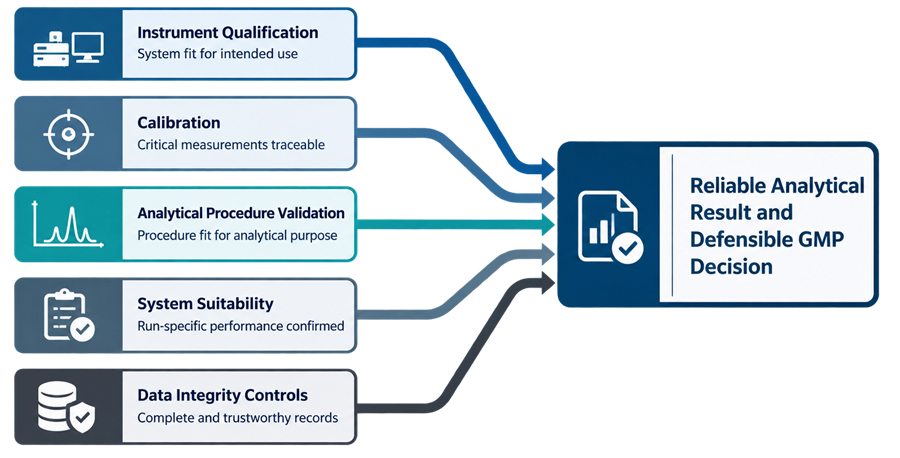
Instrument qualification does not validate the analytical procedure. Analytical procedure validation does not qualify the instrument. Calibration of individual parameters does not demonstrate that the integrated system is fit for use. A passing system-suitability test does not replace lifecycle qualification.
Detailed lifecycle control of analytical instrument calibration, routine verification, intervals, traceability, and out-of-tolerance response is addressed in Calibration and Routine Performance Verification of Analytical Instruments.
FDA’s Q2(R2) Validation of Analytical Procedures addresses evidence that an analytical procedure is fit for its intended purpose. Q14 Analytical Procedure Development addresses science- and risk-based analytical procedure development and lifecycle management. These analytical-procedure activities depend on suitable instruments, but they remain distinct from AIQ.
Change Control and Requalification
Changes must be evaluated against the qualified system boundary, intended use, critical functions, approved configuration, and previously generated data.
Changes requiring assessment may include:
- New analytical use
- Instrument relocation
- Module replacement
- Detector or sensor replacement
- Major repair
- Software or firmware update
- Operating-system change
- Database or server migration
- Interface modification
- Security configuration change
- New calculation or processing method
- Change to calibration or maintenance intervals
- New supplier or service provider
- Facility or utility change
- Adverse performance trend
- Repeated system-suitability failure
The response may range from documented assessment with no additional testing to targeted verification, calibration, partial requalification, or comprehensive requalification.
The decision should be based on technical impact, not merely the administrative category assigned to the change. Repair and change decisions are further addressed in Repair Impact Assessment for Analytical Instruments and Analytical Instrument Requalification.
Periodic Review and Lifecycle Governance
Periodic review evaluates whether the instrument remains suitable for its approved use and whether the qualification strategy and routine controls remain effective.
Review inputs should include:
- Current intended use
- Approved configuration
- Qualification and requalification history
- Calibration history and out-of-tolerance events
- Maintenance and repair history
- Deviations and investigations
- OOS and OOT events potentially related to the instrument
- System-suitability and performance trends
- Software and firmware changes
- User and administrator access
- Audit-trail review findings
- Backup and recovery evidence
- Interface failures
- Supplier notifications
- Recurring technical issues
- Obsolescence and support status
- Open corrective actions
Possible conclusions include:
- Continued use without additional action
- Procedural or training improvement
- Calibration or maintenance-program adjustment
- Targeted testing
- Partial or comprehensive requalification
- Software remediation
- Increased monitoring
- Replacement or retirement
Periodic review is an evaluation of accumulated evidence. It should not be reduced to checking whether documents are present or whether the next scheduled qualification date has arrived.
Qualification Documentation and Traceability
The qualification record should permit a reviewer to reconstruct why the instrument was selected, what was required, what was tested, what evidence was accepted, how deficiencies were resolved, and why the system was released.
A complete evidence set may include:
- Intended-use statement
- Instrument category and GMP-impact assessment
- System-boundary and data-flow description
- User Requirements Specification
- Risk assessment
- Qualification plan or strategy
- Supplier assessment
- Design Qualification
- Installation Qualification
- Operational Qualification
- Performance Qualification
- Software-validation evidence
- Calibration records
- Traceability matrix
- Deviations and resolutions
- Qualification summary report
- Procedures and training records
- Release authorization
- Configuration baseline
- Change and requalification records
- Periodic-review records
The documentation model should be proportional to risk. Proportionality can change the format and depth of the evidence; it does not remove the need for a defensible conclusion.
Common Qualification Deficiencies
Common weaknesses include:
- Intended use defined too broadly
- Qualification based only on instrument type
- Failure to define the complete system boundary
- Automatic acceptance of vendor IQ/OQ documentation
- Testing that is not traceable to requirements or risk
- Acceptance criteria copied from vendor specifications without assessing analytical need
- Confusion between calibration and qualification
- Use of system suitability as the only ongoing performance control
- Failure to qualify software-controlled functions
- Inadequate user-access and audit-trail controls
- Local data storage without controlled backup
- Incomplete interface testing
- Uncontrolled software, firmware, or configuration changes
- Repairs returned to service without impact assessment
- Requalification performed by calendar without review of lifecycle evidence
- Failure to assess previously generated data after an instrument failure
- Qualification records that do not support a clear release decision
These deficiencies arise when qualification is treated as a one-time documentation exercise rather than an integrated lifecycle control.
Conclusion
Analytical instrument qualification provides documented assurance that the complete analytical system is suitable for its intended regulated use. A strong program begins with intended use, defines the system boundary, applies risk-based requirements and testing, evaluates supplier evidence critically, integrates hardware with software and data controls, and maintains qualification through calibration, maintenance, change control, performance monitoring, periodic review, and requalification.
The objective is not to produce the largest qualification package. It is to establish a complete, technically justified, and traceable body of evidence showing that the analytical system can generate reliable data for its defined GMP purpose throughout its lifecycle.