

Analytical Data Storage, Backup, Recovery, Archival, and Migration
Analytical laboratory systems generate more than final reported results. The complete electronic record may include raw data, processed data, metadata, methods, sequences, calculations, audit trails, electronic signatures, instrument configuration, sample relationships, reports, and system-generated status information.
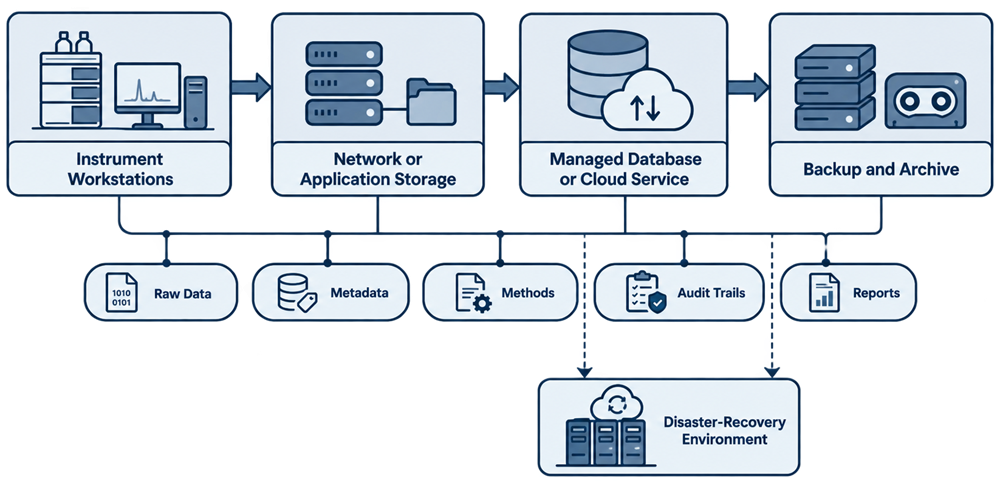
These records may initially reside on an instrument workstation, a local controller, a network server, an application database, a scientific data-management platform, a laboratory information management system (LIMS), or a hosted cloud service. Their location may change repeatedly during the required retention period.
A controlled analytical-data lifecycle must ensure that records remain complete, accurate, protected, readable, retrievable, and understandable for as long as they are required. Backup, disaster recovery, archival, migration, and system retirement support different objectives. One control should not be assumed to satisfy the others.
This article extends the controls established through the analytical instrument software validation lifecycle, Analytical Laboratory Audit Trails, User Access, and Data Review, LIMS validation and laboratory data lifecycle control, and analytical instrument–LIMS interface validation.
Regulatory and Data-Integrity Context
Applicable US requirements commonly include:
- 21 CFR 211.68, which requires appropriate controls over computerized systems and maintenance of backup data that are exact, complete, and protected from alteration, inadvertent erasure, or loss;
- 21 CFR 211.180, which establishes retention, availability, and reproduction requirements for CGMP records;
- 21 CFR 211.194, which requires complete laboratory records; and
- 21 CFR Part 11, where electronic records are maintained in systems subject to electronic-record and electronic-signature requirements.
FDA’s Data Integrity and Compliance With Drug CGMP guidance explains that backup data should include the associated metadata and remain in the original format or a format compatible with the original. It also distinguishes a retained true copy from a temporary disaster-recovery copy.
The regulatory objective is not merely possession of files. Records must remain sufficiently complete and accessible to reconstruct the laboratory activity and support review, investigation, inspection, and regulated decisions throughout the retention period.
Defining the Analytical Data Record
The organization should define the complete regulated record for each analytical system and workflow.
Depending on the technology and intended use, the record may include:
- original acquisition files;
- chromatograms, spectra, images, or instrument readings;
- sample and injection identifiers;
- sequence and run information;
- acquisition and processing methods;
- integration events;
- calibration data;
- calculations;
- processed results;
- metadata;
- user identities;
- instrument identities;
- date and time information;
- audit trails;
- electronic signatures;
- review and approval history;
- invalidated or superseded results;
- reports;
- result transfers;
- configuration needed to interpret the record; and
- investigation or exception information.
A printed report or exported PDF may reproduce selected results without preserving the dynamic electronic record, underlying metadata, processing history, or audit trail. It should not automatically be treated as a complete substitute for the source electronic record.
The record definition should be documented before backup, archival, migration, or retirement controls are designed. Otherwise, the organization may protect visible reports while losing the information required to reconstruct how those reports were produced.
Storage Architecture and System Boundaries
The storage architecture should identify every location where regulated analytical data are created, modified, temporarily held, transferred, backed up, archived, or retrieved.
Common storage locations include:
- instrument internal memory;
- embedded controllers;
- local workstation drives;
- removable media;
- vendor application folders;
- network file shares;
- application servers;
- relational databases;
- laboratory data repositories;
- scientific data-management systems;
- LIMS databases;
- middleware queues;
- cloud applications;
- cloud object storage;
- backup repositories;
- disaster-recovery environments; and
- long-term archives.
The system boundary should include the hardware, software, databases, network services, authentication services, time services, backup applications, cloud services, and administrative processes that affect the availability or integrity of regulated records.
Data-flow documentation should show:
- where the original record is created;
- when it is written to storage;
- whether local temporary copies remain;
- how data move to network or cloud storage;
- which system is authoritative;
- where metadata and audit trails reside;
- how backup copies are created;
- where archives are maintained;
- which application is required for retrieval; and
- what happens when the source system is unavailable or retired.
Instrument Workstations and Local Storage
Instrument workstations frequently present a high data-integrity and availability risk because they combine data acquisition, processing, configuration, and local storage in a single physical device.
Controls should address:
- whether regulated data may be stored locally;
- authorized local storage locations;
- automatic transfer to managed storage;
- protection against deletion or overwriting;
- local-drive capacity monitoring;
- operating-system permissions;
- administrator access;
- antivirus and security controls;
- time synchronization;
- temporary files;
- failed-transfer handling;
- workstation replacement;
- disk failure;
- local backup; and
- recovery after workstation loss.
Users should not be permitted to choose uncontrolled storage locations for regulated data. Desktop folders, personal directories, unmonitored shared folders, and removable media can bypass established backup, access-control, and retention mechanisms.
Where local storage is unavoidable, the organization should define:
- how quickly data are copied to protected storage;
- how successful transfer is confirmed;
- how untransferred records are detected;
- how local and network copies are reconciled;
- whether the local copy remains authoritative;
- when local copies may be removed; and
- who authorizes removal.
A workstation should not be decommissioned, reformatted, replaced, or returned to a supplier until its regulated data and required configuration have been identified, transferred, verified, and formally dispositioned.
Network Storage and Application Databases
Network storage can provide centralized administration, controlled permissions, managed backup, capacity monitoring, and separation from the instrument workstation. These benefits depend on correct configuration and continuing operational control.
File-based storage should address:
- folder structure;
- naming conventions;
- write, modify, and delete permissions;
- inheritance of access permissions;
- user and service-account access;
- file locking;
- version behavior;
- capacity;
- monitoring;
- network interruption;
- path changes;
- retention; and
- backup coverage.
Database-based applications require protection of more than visible output files. The regulated record may depend on related tables, indexes, database objects, audit-trail tables, configuration, attachments, encryption keys, and application-specific relationships.
Copying selected database tables or exporting final results may not create a complete recoverable record. The backup and archival strategy should be based on the application’s data model and supported recovery method.
Direct user access to database tables should be restricted. Changes made outside the validated application can bypass business rules, audit trails, electronic signatures, and application-level security.
Cloud and Hosted Services
Cloud services may provide application hosting, managed databases, object storage, automated backup, geographic redundancy, and disaster-recovery capabilities. Use of a cloud service does not transfer the regulated company’s responsibility for record integrity, retention, retrieval, and validated use.
Responsibilities should be defined for:
- data ownership;
- storage location;
- tenant separation;
- encryption;
- access administration;
- privileged provider access;
- backup frequency;
- backup retention;
- restoration;
- disaster recovery;
- service monitoring;
- incident notification;
- security events;
- subcontractors;
- system changes;
- data export;
- legal hold;
- service termination; and
- supplier failure.
Supplier claims such as “continuously backed up,” “highly available,” or “geo-redundant” are not adequate specifications. The regulated company should understand what is backed up, how often copies are created, how long they are retained, what restoration point is available, how restoration is requested, and how successful recovery is demonstrated.
The service agreement should preserve the organization’s ability to obtain its data in a complete and usable form before contract termination, platform change, supplier acquisition, or business failure.
Backup, Archival, and Disaster Recovery Are Different Controls
These terms should be defined consistently.
| Control | Primary purpose | Typical characteristic |
|---|---|---|
| Operational backup | Recover data after deletion, corruption, equipment failure, or technical incident | Repeated copies retained for defined recovery periods |
| Disaster recovery | Restore critical services following major infrastructure or site disruption | Alternate infrastructure, recovery procedures, and defined recovery objectives |
| Archive | Preserve regulated records for their required retention period | Controlled, readable, retrievable, protected long-term record |
| Migration | Transfer records and required context between systems, platforms, or formats | Verified completeness, accuracy, relationships, and usability |
| Retention copy | Maintain the required record or true copy throughout the retention period | Exact, complete, secure, and available |
| High availability | Reduce interruption through redundant components or services | Supports continuity but does not replace backup or archival |
A replicated database is not necessarily a backup. Corruption, deletion, or malicious activity can be replicated to the secondary environment.
A disaster-recovery copy may be overwritten frequently and may not satisfy long-term record-retention requirements.
An archive may preserve records but may not support rapid restoration of an operating system.
The control strategy should identify which mechanism supports each business and regulatory objective.
Backup Scope and Design
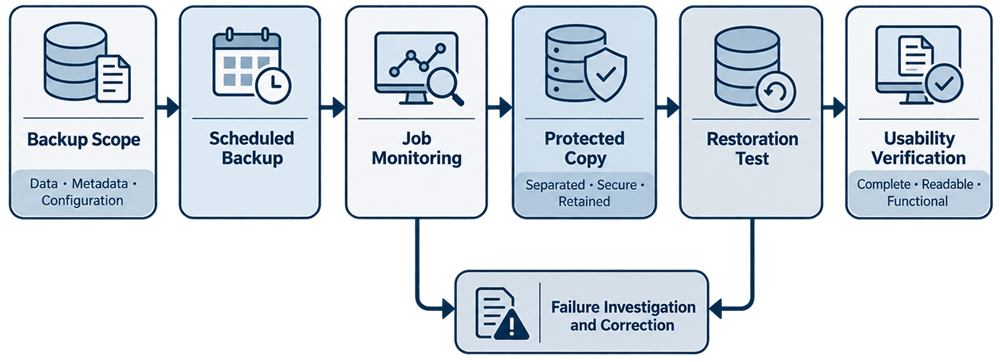
The backup specification should identify everything required to restore the system and reconstruct regulated activity.
The scope may include:
- raw and processed data;
- metadata;
- application databases;
- audit trails;
- electronic signatures;
- methods and templates;
- calculations;
- sequences;
- reports;
- attachments;
- configuration;
- code tables;
- user and role configuration;
- interface configuration;
- encryption keys;
- certificates;
- application software;
- operating-system configuration;
- middleware;
- scripts;
- system documentation; and
- license information.
Backup design should define:
- backup method;
- full, incremental, differential, or snapshot strategy;
- frequency;
- retention;
- destination;
- encryption;
- compression;
- access restrictions;
- physical or logical separation;
- off-site or cross-region protection;
- immutability where appropriate;
- monitoring;
- failure notification;
- restoration procedure; and
- periodic testing.
The backup frequency should be based on the amount and criticality of data that could be lost, not merely on a default information-technology schedule.
Systems that generate high volumes of critical analytical data may require frequent backup or continuous protection. A once-daily backup could permit the loss of an entire day of laboratory activity if the system fails shortly before the scheduled copy.
Backup Monitoring and Failure Handling
Backup jobs should be monitored to confirm that expected systems, data locations, and databases were included and that the jobs completed without unresolved errors.
Monitoring should detect:
- missed jobs;
- incomplete jobs;
- unavailable agents;
- inaccessible folders;
- database errors;
- insufficient capacity;
- expired credentials;
- encryption failures;
- damaged media;
- communication failures;
- excluded new data paths;
- excessive backup duration; and
- repeated warnings.
A “successful” status should be interpreted carefully. A job can complete while omitting a newly created folder, disconnected instrument, failed database component, or unsupported file type.
Backup failures should be:
- detected promptly;
- assigned to responsible personnel;
- investigated;
- corrected;
- evaluated for data impact;
- escalated when recovery protection was compromised; and
- documented through closure.
Repeated failures or dependence on manual intervention should be evaluated during periodic review.
Restoration Testing
Successful backup creation does not demonstrate successful recovery. Restoration testing should verify that protected data can be recovered completely and used for their intended purpose.
The test scope should represent the backup architecture and risk. It may include restoration of:
- individual files;
- complete analytical data sets;
- database records;
- audit trails;
- deleted records;
- application configuration;
- complete databases;
- virtual servers;
- instrument workstations; and
- an integrated application environment.
Verification should confirm:
- the correct recovery point;
- completeness;
- file and database integrity;
- metadata preservation;
- audit-trail availability;
- record relationships;
- access controls;
- application functionality;
- readability;
- search and retrieval;
- report generation; and
- reconciliation with expected records.
Testing should use documented acceptance criteria. Merely opening one restored file or confirming that a database service starts is insufficient when the regulated record depends on multiple related components.
Restoration testing should occur before initial release and periodically thereafter. It should also be considered after material changes to the application, database, infrastructure, encryption, storage, backup software, or service provider.
Recovery Objectives and Disaster Recovery
Disaster-recovery planning should define how critical analytical systems and records will be restored following a major disruption.
Two useful operational measures are:
- Recovery point objective (RPO): the maximum acceptable period of data loss measured backward from the disruption; and
- Recovery time objective (RTO): the targeted time for restoring the required service or capability.
RPO and RTO values should be based on laboratory operations, product decisions, data criticality, and business-continuity needs. They should not be assigned solely by infrastructure personnel without process-owner and quality input.
The disaster-recovery plan should address:
- declared disaster conditions;
- decision authority;
- alternate infrastructure;
- application and database restoration;
- network and identity services;
- required personnel;
- supplier responsibilities;
- communication;
- system prioritization;
- data reconciliation;
- testing;
- return to normal operation; and
- retained execution evidence.
Disaster-recovery tests should challenge a realistic loss of service. A discussion-based review of the procedure may support preparedness but does not replace technical recovery testing where recovery depends on complex infrastructure or application restoration.
Business Continuity During System Unavailability
Business-continuity procedures should define laboratory operation when analytical systems, repositories, networks, or cloud services are unavailable. Procedures should address:
- whether testing may continue;
- control of samples and work assignments;
- instrument operation without network services;
- temporary data storage;
- prevention of uncontrolled local records;
- manual calculations or transcription;
- review and approval;
- product-disposition restrictions;
- interface queues;
- delayed data transfer;
- reconciliation after restoration; and
- entry of downtime information.
Temporary records should remain attributable, contemporaneous, controlled, and linked to the final electronic record.
The organization should define which activities must stop during an outage. Continuing acquisition may be unacceptable when data cannot be saved to a controlled location, required methods cannot be verified, audit trails are unavailable, or records cannot later be reconciled.
Data Retention Requirements
Retention requirements should be established for each analytical record category based on applicable regulations, product requirements, stability commitments, legal obligations, quality agreements, and company procedures. The retention schedule should define:
- record category;
- initiating event;
- required duration;
- authoritative system;
- archive location;
- responsible owner;
- access restrictions;
- legal-hold requirements;
- permitted disposition; and
- destruction authorization.
Related elements of a record should not be assigned incompatible retention periods if loss of one element would make the remaining data uninterpretable.
For example, retaining a result while deleting the associated raw data, method, metadata, audit trail, or processing context may prevent reconstruction of the analytical activity.
Retention controls should also prevent automated storage-tier rules, database cleanup routines, log rotation, cloud lifecycle policies, or supplier defaults from deleting regulated data prematurely.
Readable and Retrievable Archival
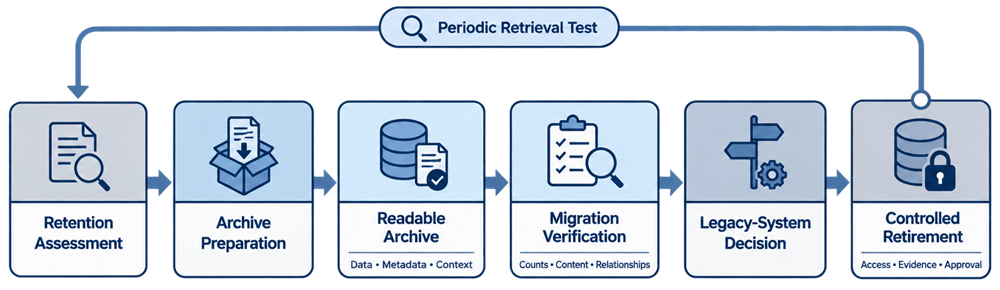
Archival should preserve the record in a form that remains readable, retrievable, and understandable throughout its required retention period. An archival strategy should define:
- archive content;
- archive format;
- metadata;
- indexing;
- search capability;
- access control;
- integrity protection;
- encryption;
- media;
- geographic location;
- redundancy;
- retrieval procedure;
- retrieval time;
- periodic verification;
- technology refresh; and
- disposition.
Records may remain in the active production system, be transferred to an archive application, or be exported into a controlled long-term format. The appropriate approach depends on the record structure, required functionality, vendor support, and retention period.
A human-readable export may support viewing but may not preserve dynamic relationships, audit trails, electronic signatures, or reprocessing capability. Native-format retention may preserve functionality but create dependence on legacy software and infrastructure.
The archival strategy should therefore determine what must remain:
- viewable;
- searchable;
- reportable;
- reprocessable;
- linked;
- attributable;
- exportable; and
- available with its audit history.
Archive Retrieval Testing
Archived data should be retrieved periodically to confirm continuing accessibility and usability.
Retrieval testing should use representative records from different:
- systems;
- instruments;
- analytical techniques;
- record types;
- archive periods;
- storage tiers;
- file formats; and
- regulatory categories.
Testing should verify:
- successful search;
- correct record selection;
- complete retrieval;
- readability;
- metadata;
- audit trails;
- relationships;
- signatures;
- report reproduction;
- checksum or integrity verification where used; and
- availability of required software.
The test should be capable of detecting deterioration, missing indexes, lost encryption keys, unsupported formats, broken links, inaccessible storage, or dependence on obsolete software.
Failures should be investigated and may require archive repair, technology refresh, migration, or restoration from another protected copy.
Data Migration Planning
Migration may be required during:
- system replacement;
- software upgrade;
- database conversion;
- server consolidation;
- cloud adoption;
- acquisition or divestiture;
- archive-platform change;
- supplier transition;
- infrastructure modernization; or
- retirement of unsupported technology.
Migration should be managed as a controlled project with approved requirements, risk assessment, mapping specifications, testing, reconciliation, deviations, and release authorization.
The migration plan should define:
- source and target systems;
- record scope;
- inclusion and exclusion rules;
- source-data condition;
- field and object mappings;
- transformation rules;
- date ranges;
- data cleansing;
- duplicate handling;
- null values;
- legacy codes;
- metadata;
- audit trails;
- signatures;
- attachments;
- relationships;
- migration tools;
- security;
- exception handling;
- reconciliation;
- acceptance criteria;
- rollback;
- source-system disposition; and
- responsibilities.
Migration should not be used to conceal or silently correct poor-quality source data. Required remediation should remain documented and traceable.
Migration Verification
Verification should demonstrate that the records transferred to the target are complete, accurate, correctly related, and usable. Depending on risk and data volume, verification may include:
- total record counts;
- counts by record type or date range;
- control totals;
- hash or checksum comparison;
- field-by-field comparison;
- sampling;
- critical-field verification;
- exception reports;
- duplicate checks;
- orphan-record checks;
- relationship verification;
- audit-trail comparison;
- attachment verification;
- user-access verification;
- report comparison; and
- end-to-end retrieval.
Count reconciliation alone is inadequate. Equal source and target counts do not prove that the same records were transferred or that values, metadata, and relationships were preserved.
Risk-based sampling may be appropriate when supported by complete automated reconciliation and targeted verification of critical or transformed data. Records affected by complex mappings, format conversions, truncation risks, unsupported characters, time-zone changes, or legacy code translation should receive greater scrutiny.
Migration testing should include boundary and exception conditions such as:
- maximum field lengths;
- special characters;
- leading zeros;
- null fields;
- historical dates;
- daylight-saving transitions;
- superseded records;
- invalidated results;
- large attachments;
- missing relationships;
- obsolete user accounts; and
- records with incomplete legacy metadata.
Legacy Software and Technical Obsolescence
Long-term retention may depend on software, operating systems, databases, hardware, licenses, encryption technologies, or proprietary formats that are no longer supported. Obsolescence monitoring should consider:
- vendor support dates;
- operating-system compatibility;
- database support;
- license availability;
- hardware availability;
- security vulnerabilities;
- browser or client compatibility;
- encryption and certificate support;
- file-format support;
- backup compatibility;
- specialist knowledge; and
- supplier viability.
Keeping an obsolete system powered off in storage is not a reliable archival strategy. Hardware may fail, credentials may be lost, licenses may expire, and replacement components may be unavailable.
Options may include:
- maintaining a controlled legacy environment;
- virtualization;
- application encapsulation;
- exporting records to a durable format;
- migrating records to a supported repository;
- retaining both native and human-readable copies; or
- maintaining a validated read-only application.
The selected strategy should preserve the information and functionality required for inspection, investigation, review, and regulated use.
System Retirement
System retirement should be planned before the production system becomes unsupported or inaccessible. The retirement plan should address:
- data inventory;
- record ownership;
- retention requirements;
- legal holds;
- archival or migration;
- verification;
- unresolved deviations;
- open investigations;
- audit trails;
- electronic signatures;
- reports;
- interfaces;
- user access;
- service accounts;
- infrastructure;
- licenses;
- encryption keys;
- backup disposition;
- physical equipment;
- cybersecurity;
- supplier obligations; and
- approval.
The source system should remain available until the migrated or archived records have been accepted and the organization has demonstrated that required information can be retrieved and interpreted.
Retirement verification should confirm:
- all required records were addressed;
- exceptions were resolved or accepted;
- retrieval is successful;
- required metadata and relationships are preserved;
- access responsibilities are assigned;
- procedures are effective;
- the archive or replacement system is released;
- residual backups are controlled;
- regulated data are removed from returned or repurposed equipment; and
- retirement is formally approved.
Security and Access Control
Analytical data should remain protected during active storage, backup, restoration, archival, migration, and retirement.
Controls should address:
- authorized users;
- privileged administrators;
- service accounts;
- backup operators;
- archive administrators;
- cloud-provider access;
- encryption keys;
- removable media;
- transfer locations;
- migration utilities;
- test environments;
- temporary files;
- restored copies; and
- retired equipment.
Restored or migrated data should not be placed in uncontrolled locations merely because the activity is temporary. Test restorations may contain complete regulated records and should receive appropriate security protection.
Administrative access should be limited, attributable, periodically reviewed, and separated from routine laboratory record ownership where practicable.
Requirements and Risk Assessment
Requirements should define observable and testable behavior for:
- storage locations;
- data transfer;
- record completeness;
- backup scope;
- backup frequency;
- monitoring;
- restoration;
- recovery objectives;
- disaster recovery;
- business continuity;
- retention;
- archival;
- retrieval;
- migration;
- legacy access;
- security;
- system retirement; and
- evidence retention.
Risk assessment should evaluate failures such as:
- loss of local workstation data;
- incomplete backup scope;
- undetected backup failure;
- inability to restore;
- loss of metadata or audit trails;
- corrupted database relationships;
- premature deletion;
- inaccessible cloud data;
- unsupported proprietary formats;
- incorrect migration mapping;
- missing migrated records;
- loss of electronic signatures;
- inability to reproduce reports;
- loss of encryption keys;
- unauthorized access to backup copies; and
- retirement before archive acceptance.
The assessment should determine preventive controls, detection mechanisms, testing depth, monitoring, recovery measures, and escalation requirements.
Qualification and Testing Strategy
Testing should verify the configured storage, backup, recovery, archival, and migration controls within the operating environment. Testing may include:
- verification of approved storage paths;
- access-permission challenges;
- local-to-network transfer;
- interrupted transfers;
- capacity alarms;
- backup inclusion;
- backup failure detection;
- notification;
- file restoration;
- database restoration;
- audit-trail restoration;
- application recovery;
- disaster-recovery execution;
- retrieval from archive;
- record readability;
- migration reconciliation;
- transformed-field verification;
- exception handling;
- rollback;
- and controlled retirement.
Negative testing should challenge unauthorized deletion, prohibited storage locations, missing metadata, invalid archive indexes, expired credentials, unavailable storage, corrupted files, incomplete migrations, and attempts to access records without appropriate permissions.
Evidence should demonstrate not only that the infrastructure operated but that representative regulated records remained complete, correct, readable, and usable.
Change Control
Changes affecting analytical-data protection may include:
- new instruments;
- additional data paths;
- application upgrades;
- database changes;
- server replacement;
- storage expansion;
- network changes;
- backup-software changes;
- revised schedules;
- new cloud regions;
- encryption changes;
- new archive formats;
- migration scripts;
- retention-policy changes;
- supplier changes;
- and retirement of legacy components.
The change assessment should determine effects on:
- backup coverage;
- restoration procedures;
- recovery objectives;
- security;
- record readability;
- archive retrieval;
- data relationships;
- audit trails;
- validated interfaces;
- and retention.
A storage-path change can cause regulated data to fall outside the established backup scope even when the analytical application continues operating normally. Changes should therefore include verification of the complete data-protection path.
Periodic Review
Periodic review should determine whether analytical data remain protected, recoverable, readable, and accessible. Review inputs should include:
- backup success and failure trends;
- unresolved warnings;
- restoration-test results;
- disaster-recovery tests;
- storage capacity;
- access reviews;
- privileged activity;
- security incidents;
- archive retrieval tests;
- retention schedules;
- legal holds;
- migration projects;
- reconciliation exceptions;
- data-loss events;
- supplier performance;
- cloud-service changes;
- infrastructure support;
- software obsolescence;
- hardware obsolescence;
- encryption and certificate status;
- and planned retirements.
The review should identify adverse trends, unsupported dependencies, records approaching migration need, overdue retrieval testing, and corrective or requalification actions.
Maintaining the Validated State
A controlled analytical-data lifecycle depends on coordinated ownership by laboratory operations, quality, system owners, information technology, information security, records management, and service providers. The validated state is maintained through:
- defined record ownership;
- controlled storage locations;
- monitored data transfers;
- complete backup scope;
- backup-failure response;
- periodic restoration testing;
- tested disaster recovery;
- controlled retention schedules;
- readable archival;
- periodic archive retrieval;
- verified migration;
- obsolescence monitoring;
- change control;
- periodic review; and
- approved system retirement.
The central question is not whether a copy of the analytical data exists. It is whether the organization can retrieve the correct complete record, preserve its context and integrity, and use it reliably throughout the required retention period.