

Pharmaceutical Refrigerators and Freezers: Design and Qualification
Pharmaceutical refrigerators and freezers provide controlled storage for materials whose identity, strength, quality, purity, stability, or suitability may be affected by temperature. Applications include drug products, biological materials, vaccines, raw materials, laboratory reagents, reference standards, retention samples, cell banks, and process intermediates.
The required storage range must be established from the approved material, product, study, or process requirements. A refrigerator is not automatically a 2–8 °C unit, and freezers are not universally assigned −20 °C or −80 °C limits. The equipment must be selected, configured, qualified, monitored, and operated for its approved intended use.
This article addresses equipment design, refrigeration architecture, airflow, control behavior, loading, qualification testing, alarms, failure challenges, routine controls, and equipment-specific requalification. General thermal-mapping methodology is addressed in Thermal Mapping Study Design and Qualification Strategy. Sensor selection, calibration, and measurement uncertainty are addressed in Thermal Mapping Sensors, Data Loggers, and Measurement Uncertainty.
Types of Pharmaceutical Refrigerators and Freezers
Temperature-controlled storage units differ substantially in architecture, operating range, capacity, redundancy, defrost behavior, airflow, and failure response.
Common equipment categories include:
- Controlled-temperature refrigerators
- Laboratory and pharmaceutical refrigerators
- Undercounter refrigerators
- Upright and chest freezers
- Conventional low-temperature freezers
- Ultra-low-temperature freezers
- Pass-through refrigerators and freezers
- Explosion-resistant or flammable-material storage units
- Dual-compressor or redundant refrigeration systems
- Portable or temporary controlled-storage units
Typical applications may use:
- Refrigerated conditions such as 2–8 °C
- Controlled cool conditions outside the conventional 2–8 °C range
- Freezer conditions near −20 °C
- Low-temperature conditions near −40 °C
- Ultra-low-temperature conditions near −70 °C to −86 °C
These examples do not establish universal requirements. The approved range and associated alarm limits should be based on the materials stored, allowable excursion, operating procedures, monitoring strategy, and contingency arrangements.
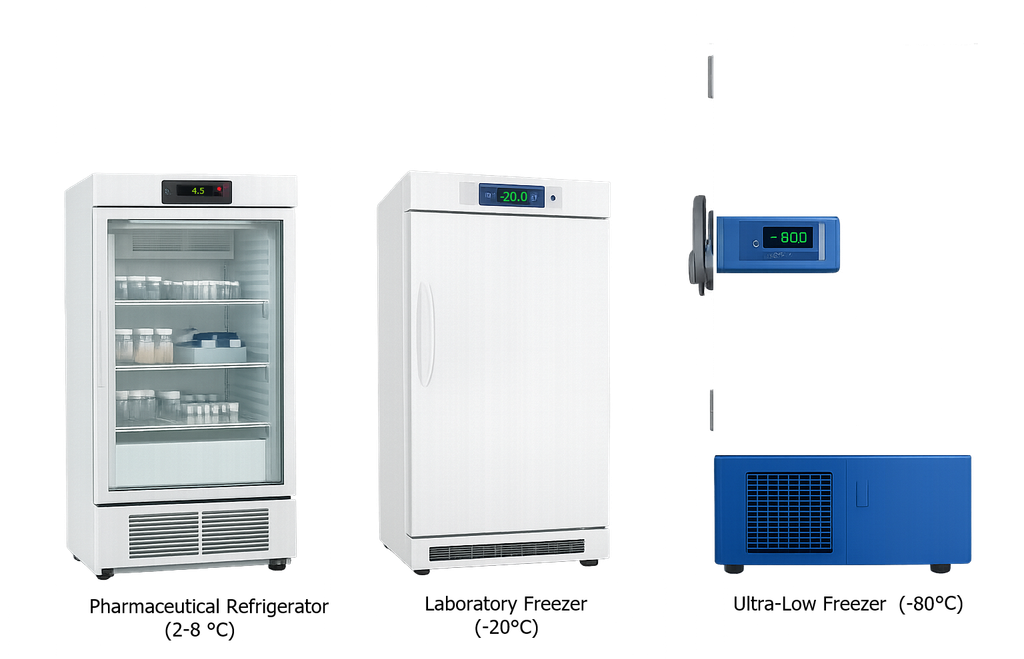
Pharmaceutical refrigerators, conventional freezers, and ultra-low-temperature freezers use different refrigeration arrangements and should not be qualified as though their operating characteristics were identical.
Intended Use and User Requirements
Qualification begins with a clear intended-use statement. The statement should identify:
- Materials or products to be stored
- Required temperature range
- Allowable short-duration operating variation
- Required storage capacity
- Anticipated loading configurations
- Maximum and minimum routine load
- Frequency and duration of door openings
- Required recovery performance
- Required alarms
- Local and remote notification requirements
- Independent monitoring requirements
- Data-recording requirements
- Backup power expectations
- Contingency-storage arrangements
- Required access control
- Cleaning requirements
- Installation environment
- Required refrigeration redundancy
- Expected holdover time during failure or power loss
The User Requirements Specification should distinguish requirements that protect stored materials from features that are merely desirable.
A selected unit should provide adequate usable storage volume without requiring materials to be placed against walls, doors, evaporator covers, air outlets, return paths, or other areas prohibited by the manufacturer or qualification results.
Equipment size should account for expected growth, but excessive unused capacity can also affect operating behavior and may complicate representative-load qualification. The selected capacity should be justified against intended use rather than based only on nominal chamber volume.
21 CFR 211.63 requires equipment used in manufacturing, processing, packing, or holding drug products to be appropriately designed, adequately sized, and suitably located for its intended use, cleaning, and maintenance.
Pharmaceutical-Grade and General-Purpose Equipment
The designation “pharmaceutical grade” does not by itself demonstrate suitability. Equipment should be assessed according to documented design and performance characteristics.
Relevant characteristics may include:
- Forced-air circulation
- Temperature-control capability
- Controller resolution and configuration
- Independent monitoring interface
- High- and low-temperature alarms
- Door-open alarm
- Power-failure alarm
- Remote alarm contacts
- Access-controlled settings
- Continuous temperature recording
- Battery-backed alarm functions
- Defined defrost behavior
- Suitable shelving and storage geometry
- Cleanable internal surfaces
- Service access
- Availability of spare parts
- Vendor technical support
- Refrigeration redundancy
- Documented recovery after power restoration
Domestic refrigerators may contain uncontrolled compartments, cooling plates, internal geometries, and defrost functions that create unsuitable storage conditions. They may also lack appropriate alarms, monitoring interfaces, configuration protection, or service documentation.
A general-purpose unit is not automatically unacceptable, but its design and performance must satisfy the approved requirements. Qualification cannot compensate for a fundamentally unsuitable design.
Refrigeration-System Architecture
Most refrigerators and conventional freezers use a vapor-compression refrigeration cycle. The primary components are:
- Compressor
- Condenser
- Expansion device
- Evaporator
- Refrigerant piping
- Circulation fans where provided
- Temperature controller
- Control sensor
- Defrost components where provided
The compressor raises the pressure and temperature of the refrigerant vapor. The condenser rejects heat to the surrounding environment and condenses the refrigerant. The expansion device reduces refrigerant pressure, and the evaporator absorbs heat from the storage chamber as the refrigerant evaporates.
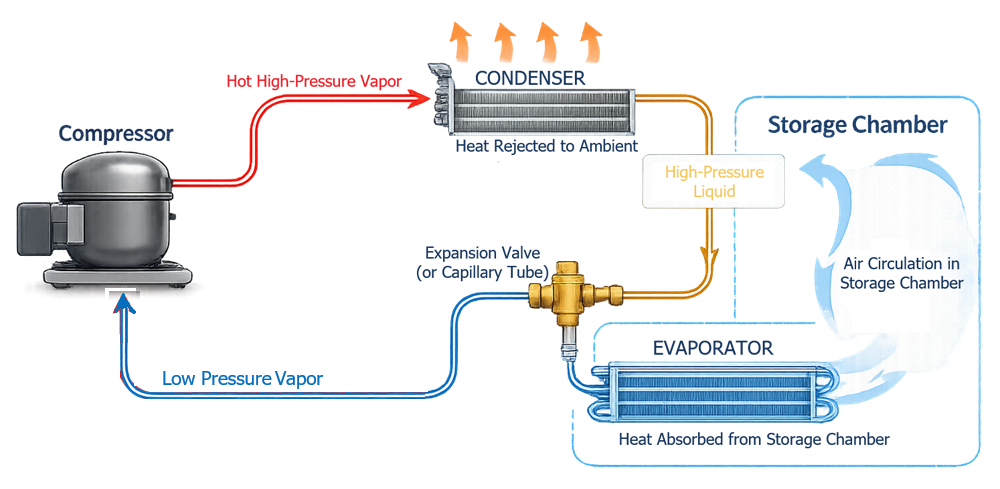
The installation environment is part of the operating boundary. Inadequate clearance, restricted ventilation, excessive room temperature, dust accumulation, or obstruction of condenser airflow can reduce heat-rejection capacity and cause poor temperature control, prolonged compressor operation, or equipment failure.
Conventional Freezers
Many conventional freezers use one refrigeration circuit. Their behavior depends on compressor capacity, evaporator arrangement, chamber insulation, defrost method, control strategy, ambient conditions, and loading.
Ultra-Low-Temperature Freezers
Ultra-low-temperature freezers may use cascade refrigeration, auto-cascade refrigeration, or another manufacturer-specific architecture. A cascade system typically uses two interconnected refrigeration stages to achieve temperatures that a conventional single-stage system cannot maintain efficiently.
The additional complexity introduces more components and failure modes, including:
- High-stage compressor failure
- Low-stage compressor failure
- Interstage heat-exchanger problems
- Refrigerant leakage
- Condenser overheating
- Control-sequence failure
- Extended recovery after access
- Increased sensitivity to ambient conditions
Some units use multiple compressors to provide capacity or limited redundancy. The actual failure response must be understood. The presence of two compressors does not necessarily mean that either compressor can independently maintain the approved storage range.
Chamber Airflow and Temperature Distribution
Temperature within a refrigerator or freezer is influenced by heat removal, air circulation, chamber geometry, insulation, door design, shelf arrangement, stored materials, and the location of heat gains.
Forced-air units use fans to distribute conditioned air through the chamber. Natural-convection units depend more heavily on density-driven air movement and may exhibit greater vertical stratification.
Potential temperature differences may occur:
- Between upper and lower shelves
- Between front and rear locations
- Near the door
- Near evaporator surfaces
- Near supply-air outlets
- In restricted corners
- Around densely loaded containers
- Above or below solid shelving
- Near cabinet penetrations
- Within drawers, baskets, or storage boxes
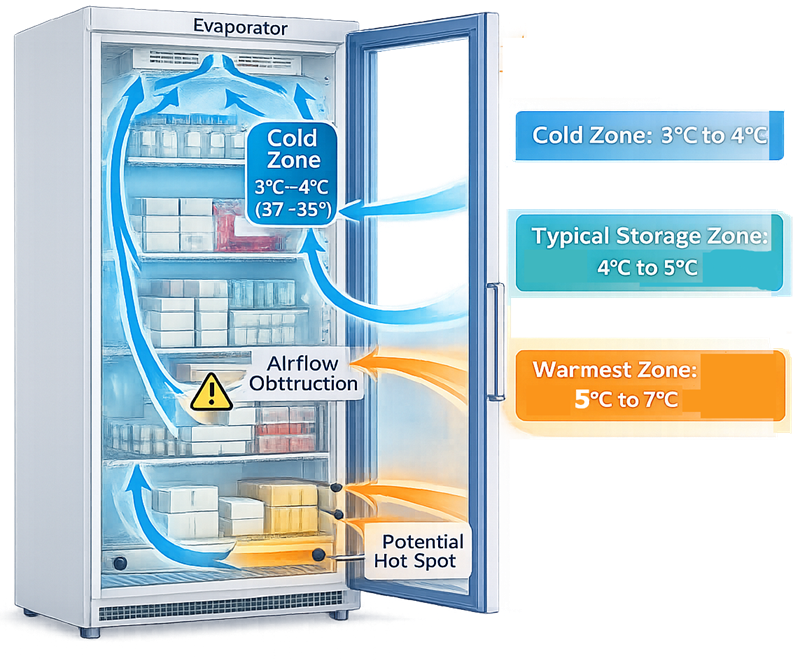
Chamber airflow can be redirected or obstructed by shelving and stored materials, producing warmer or colder locations within the usable storage volume.
Uniformity should not be assumed from the controller display. The controller normally receives a signal from one sensor at one location. It does not directly demonstrate conditions throughout the chamber.
Qualification should establish the usable storage volume and any loading restrictions needed to maintain acceptable conditions. Locations that cannot maintain the required conditions should be physically or procedurally excluded from storage.
Temperature-Control Behavior
A refrigeration system normally operates within a control band rather than maintaining one constant temperature.
In a basic cycling system:
- Chamber temperature rises toward the controller’s cooling-start threshold.
- The compressor starts.
- Cooling continues until the lower control threshold or stopping condition is reached.
- The compressor stops.
- Heat gain causes the temperature to rise again.
- The cycle repeats.
More advanced units may use variable-speed compressors, staged compressors, proportional control, modulating valves, or manufacturer-specific control logic.
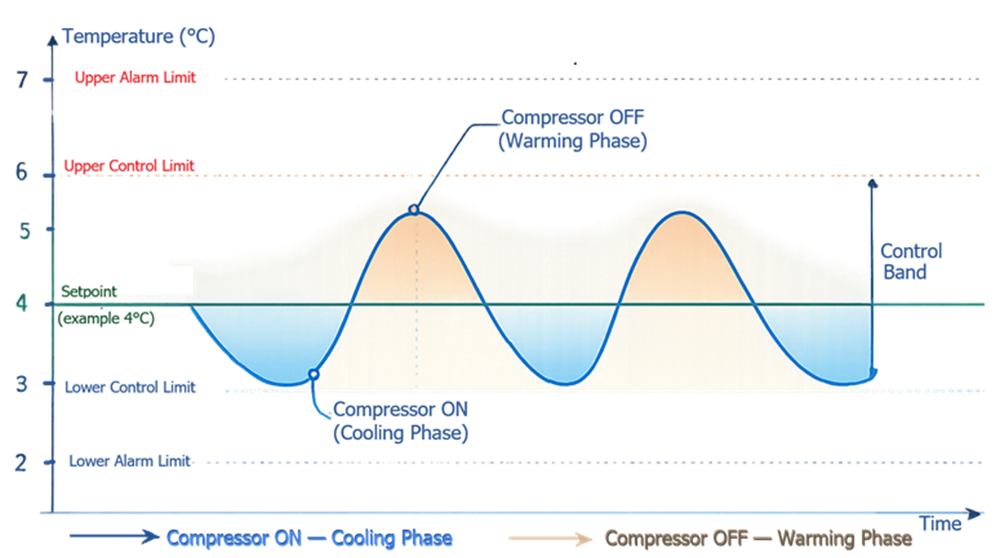
Normal compressor operation produces a repeating temperature profile within the established control band rather than a perfectly constant chamber temperature.
Mapping data should be reviewed as a time series. An overall minimum, maximum, or average alone may conceal cyclic behavior, defrost events, spatial differences, unstable control, or progressive deterioration.
Review should consider:
- Cycle amplitude
- Cycle frequency
- Differences between mapping locations
- Controller display relative to reference measurements
- Changes during door openings
- Defrost-related behavior
- Recovery after disturbances
- Operation near acceptance limits
- Evidence of short cycling
- Evidence of continuous compressor operation
- Stability after initial pull-down
Short cycling may indicate control, sensor, refrigerant, airflow, or capacity problems. Continuous compressor operation may indicate high heat load, inadequate condenser cooling, refrigerant loss, door-seal leakage, excessive loading, or insufficient equipment capacity.
Control Sensors and Independent Monitoring Sensors
The control sensor and independent monitoring sensor serve different purposes.
The control sensor provides feedback to the refrigeration controller. Its signal determines compressor, fan, heater, damper, or other control actions. Manufacturers may place the sensor where it supports stable control rather than at the warmest or coldest product-storage location.
The independent monitoring sensor provides evidence of storage conditions and supports alarm notification, excursion assessment, and record retention. Its placement should be based on intended use and mapping results.
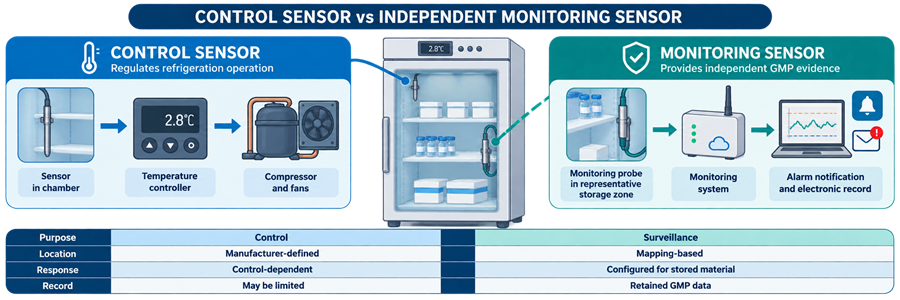
ALT Comparison of a refrigeration control sensor and an independent GMP monitoring sensor, showing their different functions and data paths.
CAP The control sensor regulates refrigeration operation, while the independent monitoring sensor supports surveillance, alarms, excursion assessment, and GMP records. The two sensors may be installed close together, but proximity does not make their functions equivalent. They may also have different:
- Locations
- Sensor technologies
- Response times
- Calibration requirements
- Sampling intervals
- Alarm delays
- Data-retention functions
- Failure dependencies
A monitoring sensor should not be placed automatically at the absolute warmest or coldest point without evaluating whether that location is representative, permitted for storage, stable across studies, and capable of providing meaningful warning.
Buffered and Unbuffered Probes
A monitoring probe may be placed in glycol, glass beads, a solid thermal block, or another buffering medium. Buffering slows the probe’s response to short air-temperature changes and may approximate the thermal behavior of certain stored materials more closely than an exposed air sensor.
Buffering also creates limitations:
- Alarm response may be delayed.
- The buffer may not represent every stored material.
- Buffer quantity and container geometry affect response.
- A slowly responding probe may conceal a rapid equipment failure.
- Different buffer arrangements cannot be treated as interchangeable without evaluation.
Unbuffered probes respond more rapidly to chamber-air changes. This can provide earlier warning but may produce alarms from brief door openings or normal cycling that do not represent a material excursion.
Probe configuration, setpoints, and delays should be designed together. Buffering should not be used merely to suppress nuisance alarms.
Loading and Storage Configuration
Stored materials influence thermal behavior in two competing ways.
Thermal mass can reduce the rate of temperature change during door openings or power loss. At the same time, excessive or poorly arranged loading can obstruct airflow and create localized gradients.
Qualification and operating procedures should define:
- Approved shelf locations
- Maximum loading height
- Required clearances
- Prohibited storage zones
- Distance from air outlets and returns
- Restrictions near evaporator covers
- Door-shelf use where applicable
- Container and rack arrangements
- Use of drawers or internal boxes
- Maximum loading density
- Minimum representative load where relevant
- Requirements for thermal ballast
- Treatment of temporary or mixed loads
A nominally full chamber does not necessarily represent the most challenging configuration. A densely packed load may challenge airflow, while a lightly loaded chamber may respond more rapidly to door openings and power loss.
The qualification strategy should identify credible challenging conditions based on actual operating practices.
Unapproved stacking, blocked air returns, open containers, or storage against cooling surfaces should not be used as qualification challenges if routine procedures prohibit those arrangements. Qualification should challenge the most difficult approved configuration, not an invalid operating condition.
Door Openings and Temperature Recovery
Opening the door introduces warm ambient air and increases the heat load. The effect depends on:
- Door-opening duration
- Number and frequency of openings
- Ambient temperature and humidity
- Chamber volume
- Door size
- Internal airflow
- Load mass
- Load arrangement
- Equipment operating range
- Location and response time of each sensor
- Time required to remove or place materials
For freezers, warm humid air can also contribute to frost and ice formation. Repeated access may affect door seals, internal doors, evaporator performance, and long-term recovery.
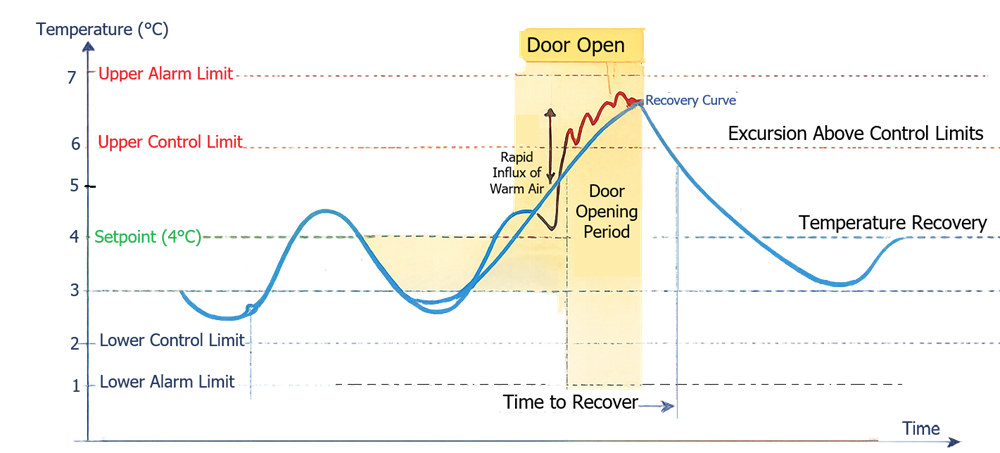
Door-opening testing evaluates the temperature response during a representative access event and the time required to restore acceptable storage conditions.
A recovery test should define:
- Initial stabilized condition
- Load configuration
- Door-opening duration
- Door position
- Simulated handling activity
- Ambient conditions
- Measurement locations
- Recovery criterion
- Maximum permitted recovery time
- Alarm response
- Required operator action
Recovery should not be defined only as the controller display returning to setpoint. The criterion should reflect the qualified storage volume and the actual purpose of the test.
An unrealistic door-opening challenge can produce misleading results. A very short opening may not represent routine material handling, while an excessively long opening prohibited by procedure does not demonstrate routine suitability.
Defrost Systems
Frost can reduce heat transfer and restrict airflow across evaporator surfaces. Freezers and some refrigerators use periodic defrost functions to control frost accumulation. Common approaches include:
- Off-cycle defrost
- Electric-heater defrost
- Hot-gas defrost
- Manual defrost
- Manufacturer-specific controlled warming sequences
Defrost behavior is equipment-specific. During a defrost event, cooling may stop temporarily, fans may change state, or heaters may operate. Air temperature can rise even when the temperature of stored materials changes slowly.
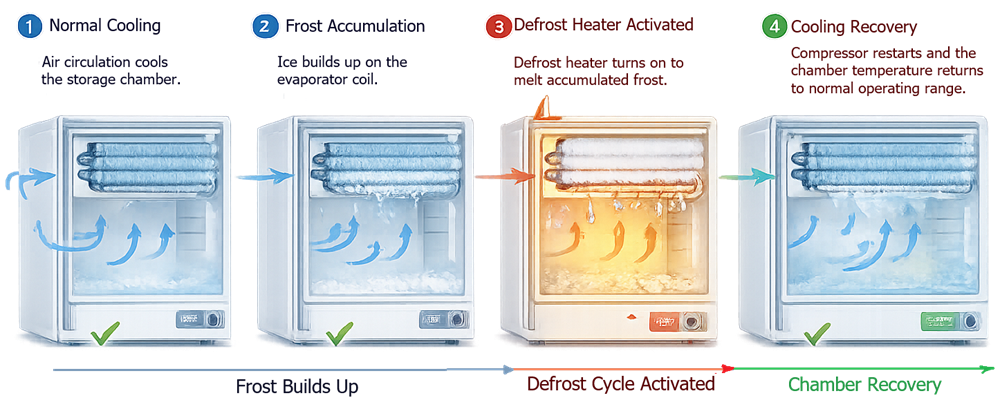
Defrost qualification should determine how the programmed defrost sequence affects chamber-air temperature, monitored conditions, alarms, and recovery.
Testing or data review should address:
- Defrost frequency
- Defrost initiation method
- Defrost duration
- Heater operation where applicable
- Fan behavior
- Controller indication
- Alarm suppression or delay
- Temperature response at mapped locations
- Recovery after defrost
- Effect of loading
- Drainage of defrost water
- Frost accumulation between cycles
- Behavior after power restoration
Defrost alarm inhibition should be limited, justified, configured, and tested. An alarm delay should not mask an abnormal or extended defrost condition.
Changing defrost frequency, duration, termination criteria, heater output, or control logic can affect the qualified temperature profile and requires impact assessment.
Installation and Environmental Conditions
The equipment location can materially affect performance.
Installation assessment should address:
- Room temperature range
- Room humidity where relevant
- Clearance around heat-rejection surfaces
- Condenser ventilation
- Proximity to heat sources
- Direct sunlight
- Airflow from HVAC outlets
- Dust or process contamination
- Floor loading
- Equipment leveling
- Seismic restraint where applicable
- Electrical supply
- Emergency-power connection
- Network and alarm connections
- Drain connection where required
- Noise and heat rejection
- Service accessibility
- Door swing and material handling
- Ability to transfer stored materials during failure
Electrical circuits should be identified and controlled. Where backup power is required, the complete path should be assessed, including receptacles, transfer equipment, generators, uninterruptible power supplies, monitoring devices, and alarm systems.
A backup generator does not provide instantaneous continuity. Qualification should consider transfer delay, restart behavior, compressor protective delays, and the equipment’s condition after power returns.
Qualification Strategy
Qualification should be based on intended use, equipment design, stored-material risk, monitoring capability, and credible failure modes.
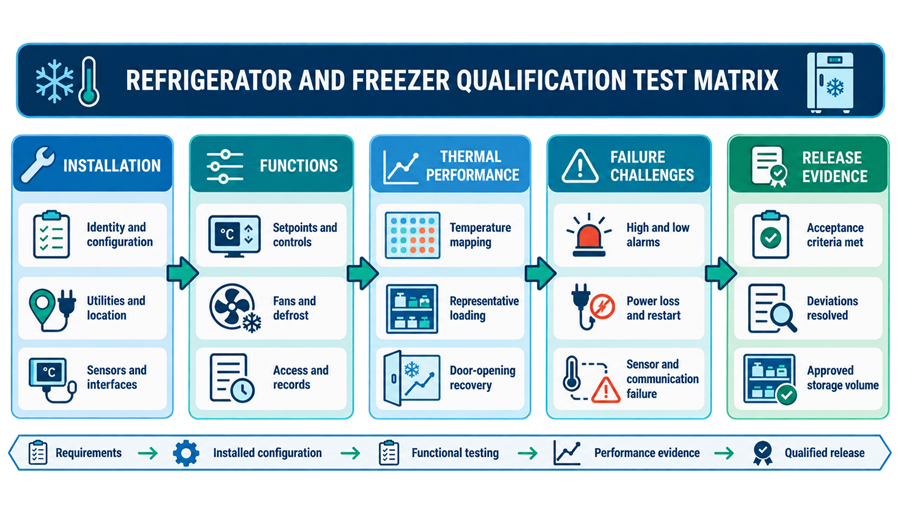
The general qualification lifecycle is addressed in Validation Life Cycle. For a refrigerator or freezer, the qualification package should specifically demonstrate that:
- The installed configuration matches approved requirements.
- Critical components and utilities are correctly installed.
- Controls and settings operate as intended.
- Temperature distribution is acceptable throughout the defined storage volume.
- Normal operating cycles remain controlled.
- Representative access and loading conditions are supported.
- Alarms and notifications operate correctly.
- Power-loss and restart behavior are understood.
- Records required for GMP decisions are complete and retrievable.
- Operating and contingency procedures are effective.
Qualification terminology should follow the site validation program. Required activities may be organized as Design Qualification, Installation Qualification, Operational Qualification, and Performance Qualification or through another approved risk-based structure.
Design Review and Design Qualification
Design assessment should occur before purchase or before the configuration becomes difficult to change.
The assessment should verify:
- Intended storage range
- Required usable capacity
- Refrigeration architecture
- Cooling capacity at expected ambient conditions
- Chamber insulation
- Air-circulation design
- Shelf and rack configuration
- Door construction and seals
- Defrost method
- Controller capabilities
- Control-sensor arrangement
- Independent monitoring provisions
- Alarm functions
- Remote notification interface
- Configuration security
- Electronic-record requirements
- Backup power compatibility
- Failure recovery
- Maintenance access
- Cleaning compatibility
- Spare-parts availability
- Refrigerant support
- Vendor service and obsolescence risk
Vendor performance claims should be evaluated against the actual installation and intended use. A manufacturer’s uniformity specification may have been established under different ambient, loading, sensor, duration, or operating conditions and should not automatically replace site qualification.
Installation Qualification
Installation Qualification should verify the approved equipment and its installed configuration.
Typical verification includes:
- Manufacturer
- Model
- Serial number
- Equipment identification
- Installation location
- Chamber dimensions
- Usable storage arrangement
- Shelves, drawers, racks, and baskets
- Compressor and refrigeration configuration
- Refrigerant identification where required
- Door orientation and seals
- Internal doors for ultra-low freezers
- Control sensor
- Independent monitoring sensor
- Local alarm components
- Remote alarm connection
- Electrical supply
- Emergency-power connection
- Network connection
- Drainage where applicable
- Condenser clearances
- Required ambient conditions
- Manuals and drawings
- Spare-parts information
- Calibration status
- Preventive-maintenance requirements
- Software or firmware version where relevant
- Configured setpoints and parameters
- Backup and recovery provisions for electronic records
The IQ record should distinguish observed configuration from unverified vendor documentation.
Operational Qualification
Operational Qualification should challenge critical functions across the approved operating conditions.
Potential OQ testing includes:
- Startup and pull-down
- Temperature setpoint verification
- Controller-display comparison
- Temperature distribution study
- Compressor cycling
- Fan operation
- Defrost operation
- High-temperature alarm
- Low-temperature alarm
- Door-open alarm
- Power-failure alarm
- Monitoring-system alarm
- Alarm delay
- Audible and visual annunciation
- Remote notification
- Alarm acknowledgment
- Sensor failure
- Communication failure
- Power interruption
- Automatic restart
- Manual restart where required
- Compressor protective delay
- Recovery after door opening
- Access-control verification
- Configuration protection
- Electronic-record generation
- Data retention and retrieval
- Backup and recovery where applicable
Testing should verify the full alarm response, not merely the appearance of a message. The test should confirm detection, annunciation, transmission, receipt, acknowledgment, escalation, recording, and reset as applicable.
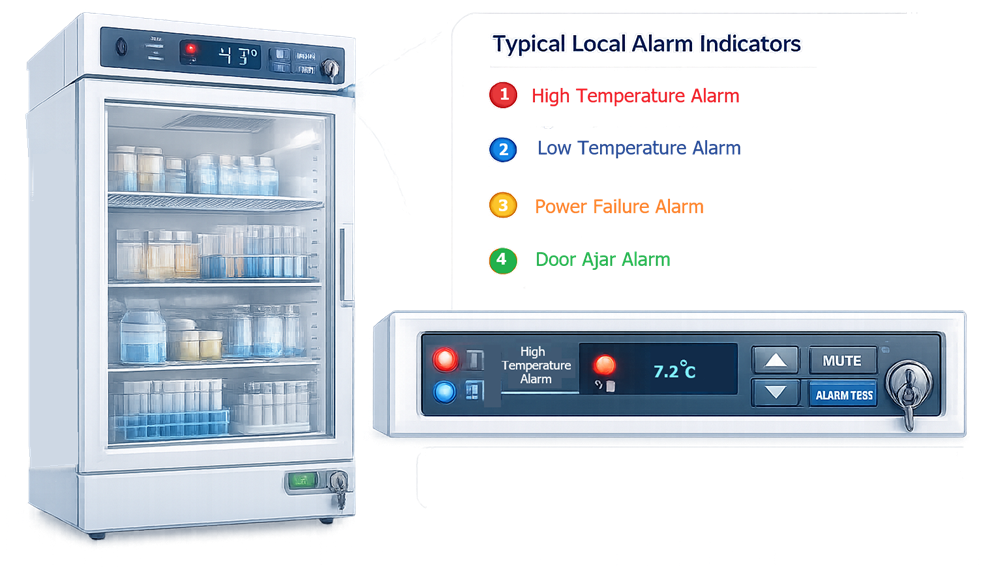
Local alarm testing should verify the initiating condition, configured threshold, delay, audible and visual indication, recovery, and interface with remote notification where provided.
Where the equipment contains programmable settings, electronic records, audit trails, or network interfaces, the qualification scope should reflect the intended use of those functions. 21 CFR 211.68 establishes requirements applicable to automatic, mechanical, and electronic equipment. FDA’s Data Integrity and Compliance With Drug CGMP guidance supports the expectation that GMP data remain complete, consistent, reliable, and accurate.
Temperature Mapping
Temperature mapping evaluates spatial and temporal temperature behavior throughout the defined storage volume. The study design should consider:
- Chamber geometry
- Usable storage volume
- Airflow
- Shelving
- Loading
- Door location
- Evaporator location
- Supply and return paths
- Control-sensor location
- Monitoring-sensor location
- Defrost
- Compressor cycles
- Ambient conditions
- Expected access
- Study duration
- Sampling interval
- Sensor accuracy
- Measurement uncertainty
The number and location of sensors should be justified. No universal sensor count applies to every refrigerator or freezer.
Mapping should capture sufficient operating time to evaluate relevant cycles and disturbances. A fixed duration such as 24 hours may be appropriate for some equipment but is not automatically adequate or necessary for every unit.
The study should establish:
- Whether all required locations remain within acceptance criteria
- Warmest and coldest locations
- Spatial gradients
- Cyclic variation
- Effect of defrost
- Effect of loading
- Effect of door opening
- Recovery behavior
- Suitability of the control sensor
- Suitability of the independent monitoring location
- Qualified storage boundaries
- Required loading restrictions
General study design is addressed in Thermal Mapping Study Design and Qualification Strategy.
Empty, Loaded, and Representative Configurations
Empty and loaded mapping serve different purposes.
An empty study can:
- Characterize inherent air-temperature distribution
- Reveal airflow patterns without load obstruction
- Challenge low thermal-mass conditions
- Support initial engineering assessment
A loaded or representative-load study can:
- Evaluate routine storage configuration
- Assess airflow obstruction
- Demonstrate performance with thermal mass
- Challenge densely occupied shelves
- Confirm monitoring-sensor suitability
- Support operating restrictions
Neither condition is universally sufficient by itself. The required configurations should be based on intended use, operating variability, equipment design, prior knowledge, and risk.
Simulated loads should reproduce relevant thermal and airflow characteristics. Water containers may provide thermal mass for some refrigerator studies but may not represent frozen products, insulated packages, racks of small vials, or ultra-low-temperature inventory boxes.
Load diagrams should identify:
- Shelf positions
- Container types
- Load density
- Clearances
- Sensor locations
- Prohibited areas
- Doors, drawers, or internal compartments used during the study
Power-Loss and Restart Testing
Power-loss testing evaluates equipment and alarm behavior during loss and restoration of electrical power.
The study objective should be defined before execution. It may include:
- Alarm activation
- Remote notification
- Temperature holdover
- Monitoring-system continuity
- Data buffering
- Controller restart
- Compressor restart delay
- Recovery after power restoration
- Effect of emergency-power transfer
- Need for material transfer
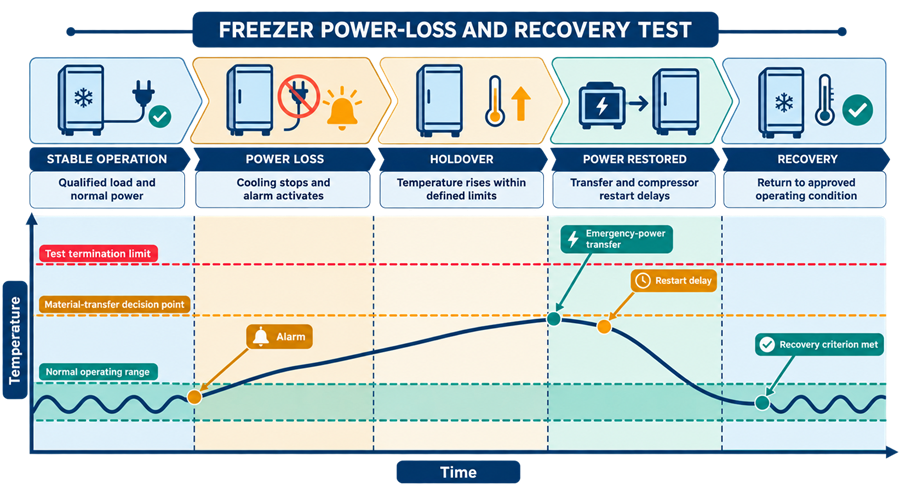
Testing should specify:
- Initial stabilized condition
- Load configuration
- Ambient conditions
- Duration of power interruption
- Whether the door remains closed
- Sensors and sampling interval
- Alarm expectations
- Maximum acceptable temperature
- Recovery criterion
- Material-protection decision point
- Conditions requiring termination of the test
Power-loss testing should not place valuable GMP material at uncontrolled risk. Representative or simulated loads may be used when justified.
The result should not be converted into a universal allowable outage time. Actual response depends on ambient conditions, load, equipment condition, door access, monitoring response, and the thermal characteristics of the stored materials.
Performance Qualification
Performance Qualification should demonstrate acceptable operation under approved routine or simulated-use conditions.
The scope may include:
- Representative loading
- Approved shelf arrangement
- Routine door-opening pattern
- Typical operator activities
- Normal defrost operation
- Independent monitoring
- Alarm response
- Cycle and trend review
- Repeatability
- Execution by trained personnel
- Use of approved operating procedures
The number and duration of studies should be justified. A default requirement for three runs is not scientifically appropriate for every refrigerator or freezer. Repeat testing should be based on variability, operating cycles, study objectives, risk, and available design and OQ evidence.
Performance Qualification should confirm that the approved storage configuration remains within defined limits. It should not be used to approve uncontrolled combinations of loads merely because the equipment has available physical space.
Acceptance Criteria and Data Evaluation
Acceptance criteria should be approved before execution and traceable to requirements.
Potential criteria include:
- Installed equipment matches the approved design.
- Required components and interfaces are present.
- Instruments are calibrated over their required ranges.
- Temperature remains within the approved criterion at required locations.
- The defined storage volume is supported by mapping results.
- Control behavior is stable and repeatable.
- Defrost does not create an unacceptable storage condition.
- Door-opening recovery meets the approved criterion.
- High- and low-temperature alarms operate at approved settings.
- Alarm delays and escalation operate as configured.
- Power-failure response is acceptable.
- Data remain complete and retrievable.
- Settings are protected against unauthorized change.
- Required procedures and contingency arrangements are effective.
Data evaluation should address:
- Individual sensor results
- Spatial differences
- Time-dependent behavior
- Minimum and maximum values
- Cycling patterns
- Defrost events
- Door-opening events
- Recovery
- Missing data
- Sensor drift
- Measurement uncertainty
- Deviations
- Differences between controller and reference measurements
Averages should not be used to conceal an unacceptable individual location. Mean kinetic temperature should not be used automatically to justify an excursion or an unsuitable storage location.
Qualification Deviations and Release
Qualification deviations should be assessed for:
- Test validity
- Data integrity
- Effect on related tests
- Effect on the defined storage volume
- Effect on alarm or monitoring strategy
- Root cause
- Corrective action
- Need for repeat testing
- Effect on release
Testing should not be repeated merely to obtain a passing result. The cause of the original failure and the effect of any adjustment must be documented.
Release should occur only after:
- Required qualification activities are complete
- Deviations are resolved or acceptably dispositioned
- Approved storage boundaries are established
- Operating setpoints are approved
- Alarm settings are approved
- Monitoring probes are installed and calibrated
- Required procedures are effective
- Operators and responders are trained
- Contingency storage is available where required
- The final qualification report is approved
- Quality approval is obtained where required
Conditional release should be limited to open items that do not compromise storage control, alarm response, data integrity, material protection, or regulatory compliance.
Routine Operation and Monitoring
Routine operation should maintain the qualified configuration. Controls may include:
- Approved storage range
- Defined alarm limits
- Approved shelving
- Loading restrictions
- Required air clearances
- Door-opening practices
- Access control
- Continuous monitoring
- Daily or periodic review
- Alarm response
- Excursion investigation
- Cleaning
- Frost and ice inspection
- Door-seal inspection
- Condenser cleaning
- Preventive maintenance
- Calibration
- Backup-power testing
- Contingency-storage verification
21 CFR 211.142 requires written warehousing procedures that include storage under appropriate temperature, humidity, and light conditions so drug-product quality is not affected.
Monitoring records should be reviewed according to defined procedures. Review should identify:
- Excursions
- Repeated short-duration alarms
- Slow recovery
- Increasing cycle amplitude
- Extended compressor operation
- Changing defrost behavior
- Sensor disagreement
- Missing data
- Repeated door-open events
- Communication failures
- Delayed response
- Recurring operator intervention
An alarm that returns to normal without intervention may still require review. Repeated self-correcting alarms can indicate deteriorating refrigeration performance, poor operating practices, inappropriate alarm settings, or an emerging failure.
Temperature Excursions and Failure Response
A temperature excursion should trigger a documented response appropriate to the stored materials and event severity.
The response should address:
- Event start and end
- Maximum or minimum temperature
- Duration
- Affected equipment
- Affected storage locations
- Materials present
- Monitoring-data completeness
- Equipment condition
- Door-opening history
- Defrost status
- Power status
- Alarm and notification history
- Immediate containment
- Material transfer
- Product or material impact assessment
- Root cause
- Corrective action
- Qualification impact
Material disposition should be based on approved stability information, scientific evidence, applicable procedures, and Quality review. Returning the chamber to its normal range does not resolve the impact on stored materials.
The contingency procedure should define:
- Who responds
- When transfer begins
- Which backup unit is used
- How capacity is confirmed
- How materials are identified
- How exposure is controlled during transfer
- How transfer temperatures are documented
- How inventory reconciliation is performed
- Who authorizes return to service
Calibration and Maintenance
Calibration should cover instruments that support control, monitoring, alarm, and qualification decisions.
The program should define:
- Instrument identification
- Calibration range
- Calibration points
- Accuracy requirements
- Tolerance
- Frequency
- Reference standards
- As-found and as-left data
- Adjustment control
- Out-of-tolerance assessment
- Labeling
- Record retention
Calibration points should represent the operating and alarm ranges. A single ambient-temperature calibration may be inadequate for a freezer or ultra-low-temperature application.
Maintenance activities may include:
- Condenser cleaning
- Fan inspection
- Door-seal inspection
- Hinge and latch adjustment
- Frost removal
- Defrost-system maintenance
- Drain inspection
- Compressor service
- Refrigerant-system repair
- Battery replacement
- Alarm testing
- Internal-door inspection
- Air-filter replacement
- Firmware or controller maintenance
Maintenance should be assessed for potential qualification impact before return to GMP service.
Change Control and Requalification
Changes that may affect the qualified state include:
- Equipment relocation
- Change in intended use
- New storage range
- New material or load family
- Shelf or rack modification
- Loading-density change
- Control-sensor replacement
- Monitoring-sensor replacement
- Controller replacement
- Setpoint change
- Alarm-setting change
- Defrost change
- Compressor replacement
- Fan replacement
- Evaporator or condenser repair
- Refrigerant change
- Door or seal replacement
- Firmware update
- Monitoring-system change
- Network or interface change
- Emergency-power modification
- Extended shutdown
The impact assessment should determine whether existing evidence remains valid and whether additional verification is needed.
Potential requalification may include:
- Installation verification
- Calibration
- Alarm testing
- Controller verification
- Targeted temperature mapping
- Door-opening recovery
- Defrost evaluation
- Power-loss testing
- Representative-load testing
- Data-interface testing
- Comprehensive requalification
A component should not be classified as like-for-like solely because it has the same general description. Capacity, range, accuracy, response, materials, control behavior, software, installation, and effect on airflow or heat transfer should be compared.
Recurring excursions, adverse temperature trends, calibration failures, extended recovery, or repeated repairs can also trigger requalification even when no formal design change occurred.
Risk-Based Requalification of GMP Equipment, Systems, and Utilities addresses the general trigger-to-scope decision process.
Common Qualification Weaknesses
Common weaknesses include:
- Treating every refrigerator as a 2–8 °C unit
- Selecting equipment without a defined intended use
- Relying on the controller display as proof of chamber uniformity
- Using a universal mapping-sensor count
- Using a fixed study duration without justification
- Assuming empty mapping represents routine loading
- Assuming loaded mapping represents every approved load
- Ignoring airflow obstruction
- Storing materials outside the mapped storage volume
- Placing the monitoring probe without using mapping evidence
- Using buffered probes only to suppress nuisance alarms
- Testing alarm display without testing notification and escalation
- Omitting defrost from qualification
- Omitting power-loss and restart behavior
- Treating dual compressors as full redundancy without testing
- Failing to qualify emergency-power transfer
- Using averages to conceal unacceptable individual locations
- Repeating failed tests without investigating the original failure
- Returning equipment to service after repair without impact assessment
- Failing to trend recurring alarms and slow recovery
- Treating calibration as proof of temperature distribution
These weaknesses disconnect equipment design, mapped performance, monitoring, alarms, operating practices, and material-protection decisions.
Conclusion
Pharmaceutical refrigerators and freezers should be selected and qualified according to their intended storage application, refrigeration architecture, operating behavior, loading configuration, monitoring strategy, and credible failure modes.
A defensible qualification demonstrates more than the ability to reach a setpoint. It establishes the usable storage volume, characterizes temperature distribution and normal cycling, evaluates loading and access, verifies defrost and power-loss behavior, challenges alarms and notifications, and confirms that required records are complete and reliable.
Routine monitoring, alarm review, calibration, maintenance, excursion management, change control, and risk-based requalification then provide continuing evidence that the equipment remains suitable for its approved GMP use.