

ASTM Distribution and Package Performance Test Methods
ASTM package-performance standards provide a structured set of practices and test methods for evaluating whether shipping containers, packaged products, and unit loads can withstand hazards encountered during storage, handling, and transportation. They are widely used in pharmaceutical, biotechnology, medical-device, and other regulated-product distribution studies because they provide standardized equipment, procedures, terminology, and challenge conditions that can be incorporated into a controlled qualification program.
ASTM standards should not, however, be treated as a menu of tests that every package must complete. Some ASTM documents define complete performance-test sequences, while others measure only one hazard or package characteristic. A technically defensible validation strategy begins with the distribution profile and identified failure risks developed in Distribution Simulation Strategy and Transport Testing, then selects the ASTM practice or individual methods appropriate to those risks.
The most important distinction is between ASTM D4169, which provides an overall performance-testing framework for shipping units, and individual ASTM methods such as D4728 for random vibration, D5276 for free-fall drop, D642 for compression, or D6653/D6653M for altitude effects. ASTM D4169 integrates applicable hazard elements into a defined sequence; the individual methods establish how particular elements are executed. ASTM currently lists D4169-23e1 as the active edition and specifically directs users to D7386 for packages intended for single-parcel delivery.
Key Principles
- ASTM standards provide standardized test methods and performance practices, but the applicable standard should be selected from the actual distribution environment and package risk.
- ASTM D4169 and D7386 are performance-testing practices that combine multiple hazard elements; they should not be confused with individual vibration, drop, compression, or impact methods.
- The current commercial packaging configuration and justified worst-case test article should be defined before the ASTM test sequence is selected.
- Environmental conditioning can materially influence mechanical package performance and should be included where relevant.
- The same shipping unit should generally remain unopened throughout a formal D4169 or D7386 performance sequence unless the protocol has a justified development objective.
- Test severity should represent the intended distribution environment rather than being increased arbitrarily to create an excessively conservative challenge.
- Post-test package, product, integrity, and functional acceptance criteria should be established before testing begins.
- ASTM test completion does not by itself establish validation; qualification requires documented rationale, representative samples, controlled execution, acceptance criteria, investigation of failures, and a defined conclusion.
ASTM Practices Versus Test Methods
ASTM terminology is useful because it identifies the role of a standard. A practice generally provides a framework or procedure that can incorporate other methods. ASTM D4169, for example, establishes a system for evaluating shipping units through sequences of anticipated distribution hazards. ASTM D7386 serves a similar performance-testing role specifically for single-parcel delivery systems.
A test method normally addresses a more specific measurement or hazard. ASTM D4728 addresses random vibration, D5276 addresses free-fall drops, and D642 evaluates compression resistance. These methods can be used within a larger performance-testing strategy or for focused engineering investigations.
This distinction matters during validation. A protocol stating only that “ASTM testing will be performed” is incomplete. The study should define whether the objective is a complete distribution-performance qualification, a focused evaluation of a particular hazard, or package-development testing.
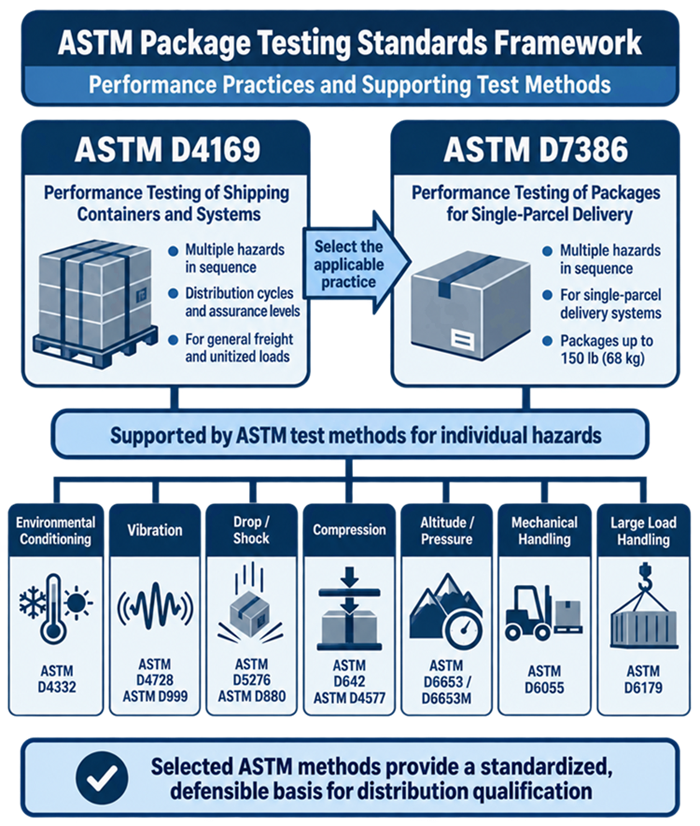
ASTM D4169 — Overall Distribution Performance Testing
ASTM D4169, Standard Practice for Performance Testing of Shipping Containers and Systems, is the principal ASTM framework for laboratory evaluation of shipping units exposed to anticipated distribution hazards. ASTM describes the practice as a uniform system using established test methods at levels representative of actual shipping and handling environments. The hazards are combined into a test plan rather than treated as unrelated standalone tests.
The current active version is D4169-23e1. The practice uses distribution cycles and associated hazard schedules to represent different transportation and handling environments. The qualification team selects a distribution cycle consistent with the intended logistics pathway and establishes the required test intensity and acceptance criteria before execution.
D4169 also uses three predefined assurance levels to modify test severity. Level I represents the more severe condition, Level II is the generally suggested default unless circumstances justify otherwise, and Level III provides a less severe challenge. Selection should reflect product value, damage tolerance, shipping environment, shipment volume, and related risk considerations rather than simply defaulting to the harshest level.
From a validation perspective, the selected distribution cycle and assurance level should be justified in the protocol. Merely documenting “ASTM D4169 testing” without identifying the applicable distribution assumptions, sequence, severity, test article, and acceptance criteria is insufficient.
Sequence Is Fundamental to D4169
ASTM D4169 requires the applicable tests to be performed sequentially because package damage can accumulate and earlier stresses can influence later performance. For a formal performance test, ASTM requires the shipping unit to remain unopened until the test sequence is completed. Opening packages between elements can be useful during development work, but doing so changes the nature of the study and may prevent evaluation of accumulated package and closure performance.
This directly supports the approach described in Distribution Simulation Strategy and Transport Testing: transport qualification should evaluate the complete system after the defined sequence rather than treating every laboratory test as an independent pass/fail exercise.
Development studies may intentionally interrupt the sequence to identify when damage occurs. Formal qualification should distinguish such diagnostic work from the final performance study.
ASTM D7386 — Single-Parcel Delivery Systems
ASTM D4169 specifically advises consideration of ASTM D7386 for single-parcel shipments. The current active edition is D7386-25, which applies to shipping units weighing up to 150 lb (68 kg) intended for single-parcel delivery systems.
Parcel distribution differs materially from many freight pathways because individual packages can experience repeated manual handling, automated sorting, orientation changes, drops, impacts, vibration, and compression while moving through hubs and transfer points. A small medical-device carton shipped individually by parcel carrier should therefore not automatically be qualified using assumptions appropriate to a palletized truckload.
Like D4169, D7386 uses a sequence of anticipated hazards and requires the same performance-test container to remain unopened throughout the sequence. ASTM distinguishes this formal performance application from package-development testing, where interim inspection may be useful.
Selection between D4169 and D7386 should therefore be based primarily on the actual distribution system, not simply on which procedure the laboratory normally performs.
ASTM D4332 — Environmental Conditioning
ASTM D4332-22 establishes standard and special conditioning atmospheres for containers, packages, and packaging components before or during testing. ASTM notes that packaging materials, particularly cellulosic materials such as corrugated fiberboard, can change their physical properties significantly with temperature and relative humidity.
Conditioning is important because the package should be mechanically challenged in a material state representative of the condition being evaluated. Corrugated cases tested only under favorable laboratory humidity may exhibit greater compression strength than packages exposed to humid storage or transportation.
D4332 should not be confused with qualification of a temperature-controlled shipping system. Its purpose is to establish package/material conditioning conditions for physical performance testing. Thermal maintenance of a pharmaceutical or biological payload is addressed separately in Temperature-Controlled Packaging System Qualification.
ASTM D4728 — Random Vibration
ASTM D4728-17(2022) covers random vibration testing of filled shipping units. The method evaluates the shipping container, internal packaging, closure system, and their ability to protect the contents when exposed to random vibration inputs. ASTM specifically recognizes that different vibration levels can be used in different axes where the field environment warrants it.
Random vibration is frequently relevant because vehicle transportation does not produce a single repetitive frequency. Trucks, aircraft, and other transport modes generate energy across a spectrum of frequencies. Package and product components can respond differently across that spectrum, and resonant behavior can magnify movement or mechanical stress.
Potential effects include product migration, abrasion, loosening of components, cushioning degradation, vial-to-vial contact, seal stress, or fatigue. The relevant evaluation should therefore address the failure mechanism identified before testing rather than simply reporting that the programmed vibration duration was completed.
ASTM D999 — Repetitive Shock and Resonance Vibration
ASTM D999-08(2023) also addresses vibration of filled shipping containers, but its methods differ from D4728. The current standard includes repetitive shock methods and resonance-testing approaches for individual containers and palletized or unitized loads.
This makes D999 particularly useful where resonance, repetitive shock, or specific package-response behavior is the intended engineering question. ASTM itself notes that the results of its different vibration methods can differ, reinforcing that D999 and D4728 should not be treated as interchangeable merely because both involve vibration testing.
The qualification plan should therefore identify why random vibration, repetitive shock, resonance testing, or some combination is technically relevant.
ASTM D5276 — Free-Fall Drop Testing
ASTM D5276-19(2023) covers free-fall drop testing of loaded boxes, cylindrical containers, bags, and sacks. ASTM identifies the method as particularly suitable for packages that are manually handled during at least part of their distribution cycle.
Drop orientation matters because impacts on faces, edges, and corners can produce different stress paths. A package that survives a flat-face drop can still be vulnerable to concentrated corner or edge impact. Product mass, center of gravity, internal clearance, cushioning, and orientation all influence the resulting damage mechanism.
For large or heavy shipping units that are not normally manually handled, ASTM identifies other methods—including D880, D6055, and D6179—as potentially more appropriate.
Drop-test acceptance should examine the internal package and product, not merely the outer corrugated case. Product breakage, closure movement, sterile-barrier damage, or device displacement can occur with little visible external evidence.
ASTM D880 — Impact Testing
ASTM D880-92(2021) addresses impact testing for shipping containers and systems. ASTM describes the method as useful for simulating certain shocks encountered during handling and transportation and for evaluating how effectively the packaging system protects its contents.
Impact testing differs from a simple free-fall drop because the package may be challenged horizontally or through controlled impact equipment. It can be relevant to palletized freight, mechanical handling, rail or truck impacts, and other distribution conditions where the primary mechanical event is not a manually dropped package.
Selection between D5276 and D880 should therefore reflect the expected physical event rather than using “drop” and “impact” as interchangeable terminology.
ASTM D642 — Compression Resistance
ASTM D642-25 evaluates the compressive resistance of shipping containers, components, and unit loads. The method can be used with filled or empty containers and can apply loads to faces, opposite edges, or corners depending on the intended evaluation.
Compression testing is particularly relevant to warehousing, stacking, palletization, and transportation environments where cases are exposed to sustained or transient vertical loads. Corrugated package performance can also be affected by conditioning, making the relationship between D4332 and D642 important when humidity or temperature can change container strength.
The study should distinguish between determining the maximum compressive resistance of a package and demonstrating that the package can withstand a defined distribution load. These are different engineering objectives and can require different acceptance criteria.
ASTM D4577 — Constant Compression Load
Where the concern is sustained stacking rather than short-duration compression resistance, ASTM D4577-19(2023) provides a method for subjecting a shipping container or unitized load to a predetermined vertical constant load for a defined period or until failure.
This can be useful where creep behavior is relevant. Corrugated and polymer packaging can deform progressively under constant load even when the initial load is below the short-duration compression failure point.
Accordingly, D642 and D4577 should not automatically be substituted for one another. D642 characterizes compressive resistance, while D4577 addresses performance under sustained load.
ASTM D6653/D6653M — High Altitude and Pressure Differential
ASTM D6653/D6653M-13(2021) evaluates the effects of reduced atmospheric pressure on packaging systems using a vacuum method. ASTM notes that packages transported through feeder-aircraft networks can experience altitudes approaching 19,000 ft and that resulting pressure differentials can adversely affect the package, product, or both.
Relevant failure mechanisms include flexible-package expansion, seal stress, closure leakage, container distortion, or loss of containment. The method can also be relevant to ground transportation across high-altitude routes.
Altitude testing should be risk-based. A package transported only through low-altitude ground distribution does not require the same assessment as a sealed liquid package routinely transported by air.
ASTM D6055 — Mechanical Handling of Unitized Loads
ASTM D6055-96(2019) addresses mechanical handling of unitized loads and large shipping cases or crates using equipment such as forklifts, clamp trucks, spade lifts, push-pull devices, grabhooks, and slings. ASTM states that these methods are intended to evaluate whether the shipping unit remains suitable under the actual or specified mechanical-handling equipment.
These hazards can be important for palletized pharmaceutical and medical-device distribution because package damage may result from material-handling systems rather than from vehicle vibration or manual drops.
The need for D6055 should therefore originate from the actual logistics process. If clamp trucks or slip sheets are used commercially, qualification should consider whether those handling operations create credible package risks.
ASTM D6179 — Rough Handling of Large Loads
ASTM D6179-20(2025) addresses rough handling of unitized loads and large shipping cases or crates. The current active edition includes methods for drop, tip, tipover, and rolling-type events and is intended to evaluate load integrity, stability, and protection of the contents.
The standard is particularly relevant to large cases and unit loads for which normal hand-drop testing is inappropriate. It can support evaluation of top-heavy systems, large crates, or unitized loads exposed to rough material handling.
D6179 also references D6055 for mechanical handling and D880 for incline impact, reinforcing that ASTM package-performance qualification is a connected system of methods rather than isolated standards.
Core ASTM Distribution Standards
A practical method map for regulated packaging is shown below.
| ASTM standard | Primary application | Validation question |
|---|---|---|
| D4169-23e1 | Sequential distribution performance | Can the shipping unit withstand the defined distribution cycle? |
| D7386-25 | Single-parcel performance | Can the package withstand parcel-delivery hazards? |
| D4332-22 | Temperature/RH conditioning | Is the package tested in the appropriate environmental condition? |
| D4728-17(2022) | Random vibration | Can the packaged product tolerate transportation vibration? |
| D999-08(2023) | Repetitive shock/resonance vibration | Is the package vulnerable to repetitive shock or resonance? |
| D5276-19(2023) | Free-fall drop | Can manually handled packages tolerate drops? |
| D880-92(2021) | Controlled impact | Can the package tolerate handling/transport impacts? |
| D642-25 | Compression resistance | Can the container or unit load withstand compression? |
| D4577-19(2023) | Constant compression load | Can the package tolerate sustained stacking load? |
| D6653/D6653M-13(2021) | Altitude / pressure differential | Can reduced atmospheric pressure damage the system? |
| D6055-96(2019) | Mechanical handling | Can unitized loads withstand forklift, clamp, or related handling? |
| D6179-20(2025) | Rough handling of large loads | Can large cases or unit loads survive rough handling? |
The edition should always be confirmed against ASTM’s current active standard before protocol approval because ASTM standards are periodically revised or reapproved. ASTM’s packaging-standard catalog currently identifies these methods within Committee D10’s shipping-container and system standards.
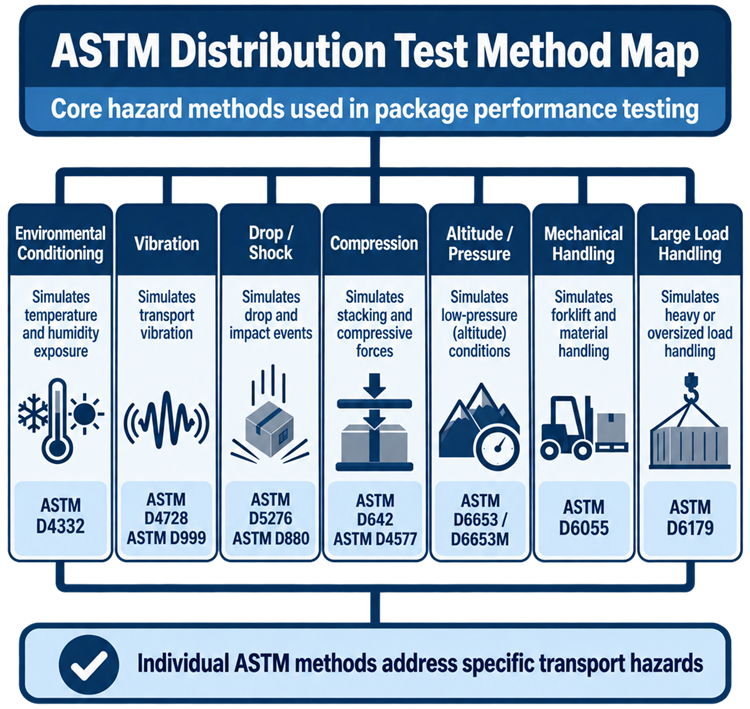
Do Not Select Every Available ASTM Test
A common validation weakness is to create an oversized test program by including every recognizable ASTM package test. More testing does not necessarily produce stronger evidence if the additional challenge is unrelated to the expected distribution environment.
A ground-distributed palletized product may require vibration, compression, and mechanical-handling assessment but have little technical justification for high-altitude simulation. An individual parcel shipment may require D7386 rather than a test sequence developed around palletized freight. A large reusable crate may require D6179 or D6055 rather than D5276 free-fall testing.
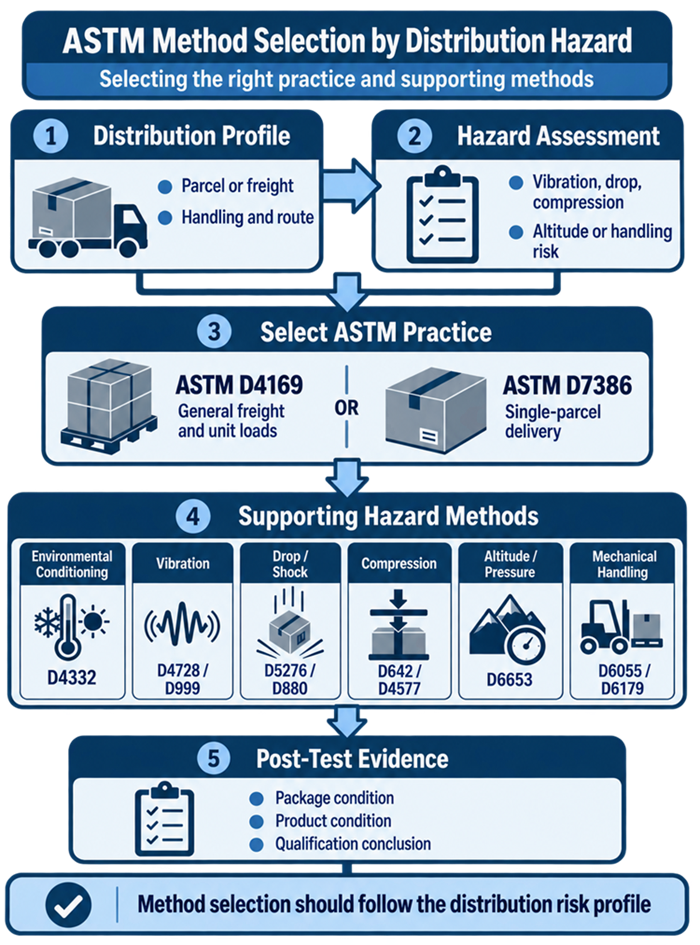
The distribution risk assessment should therefore determine the applicable hazard set first. ASTM methods are then selected to challenge those identified hazards.
Test Levels Must Be Justified
ASTM standards establish test procedures and, in some cases, defined levels or options, but validation still requires a rationale for the chosen severity.
Selecting the highest available assurance level or extending test duration without technical basis does not automatically produce a better qualification. Excessive severity can create damage mechanisms that are not representative of commercial distribution and may lead to unnecessary package redesign.
Conversely, selecting lower severity simply because previous packages passed can underchallenge the system.
The test level should reflect known distribution information, the selected ASTM framework, package risk, product sensitivity, and the intended qualification claim.
The Test Article Must Match the Commercial System
ASTM testing is only as representative as the test article.
The protocol should define the product or simulant, primary and secondary packaging, protective components, shipping case, internal dividers, cushioning, quantity, orientation, palletization, wrapping, and other distribution elements that affect performance.
Where a product family is represented by selected configurations, the worst-case or bracketing justification should follow Packaging Qualification Strategy and Worst-Case Configuration.
A qualified ASTM laboratory cannot compensate for testing a configuration that does not represent the marketed package.
Product Simulants Require Technical Equivalence
Simulants can be useful when actual product is unavailable, expensive, hazardous to handle, or unnecessary for the test objective. The simulant should reproduce the characteristics relevant to the expected failure mechanism.
Mass alone may be sufficient for some compression evaluations, while geometry, center of gravity, rigidity, liquid movement, fragility, thermal mass, or sharp features may be important in other studies.
A sterile medical-device pouch, for example, should not be challenged with a smooth weight block when actual device geometry creates the puncture or abrasion risk.
The rationale should identify which product characteristics matter and how the simulant reproduces them.
ASTM Testing and Package Aging
Distribution performance can change with package age. Materials, adhesives, closures, and seals may become more brittle, weaker, or otherwise different after sterilization and storage.
The test program should therefore determine whether newly manufactured or aged package configurations are required. This relationship is addressed in Packaging Aging, Shelf-Life, and Stability Integration.
For terminally sterilized medical devices, a package challenged after sterilization and aging may provide more meaningful end-of-shelf-life distribution evidence than an unsterilized new package, depending on the identified risk.
ASTM Testing and Package Integrity
Completion of an ASTM transport test sequence is normally followed by defined package and product evaluation. The appropriate evaluation depends on the function being protected.
For sterile barrier systems, this may include visual inspection, seal-strength assessment, or package-integrity testing. For pharmaceuticals, it may include container breakage, leakage, closure condition, label condition, or appropriately justified container-closure integrity evaluation. Detailed method selection is addressed in Package Seal Strength, Integrity, and Sterile Barrier Testing.
The transport standard creates the challenge; the post-test assessment determines whether the package continued to perform its required function.
Acceptance Criteria Must Exist Before Testing
ASTM execution should not be followed by retrospective discussion of whether observed damage is “acceptable.” The protocol should define product and packaging acceptance criteria before samples are challenged.
Criteria can distinguish cosmetic package damage from functional failure. Minor scuffing of a shipping case may have no quality impact, while a small puncture of a sterile barrier can be unacceptable despite an otherwise pristine shipper.
The qualification conclusion should therefore be based on the required protective function rather than appearance alone.
ASTM Testing During Package Development
ASTM methods can also be used before formal qualification to compare packaging designs, identify failure locations, optimize cushioning, investigate resonance, or establish operating margins.
Development testing may intentionally use configurations or test severities outside the eventual commercial qualification plan. Packages may also be opened between hazard elements to identify the point at which damage occurs. ASTM D4169 and D7386 recognize this distinction between development use and formal performance testing.
Development results should remain clearly identified as development evidence. Final qualification should use the approved configuration and controlled protocol appropriate to the commercial claim.
ASTM Versus ISTA
ASTM and ISTA provide different frameworks for transport simulation, and one should not automatically be characterized as more rigorous than the other.
ASTM D4169 combines established ASTM methods into distribution cycles and hazard schedules. ISTA uses its own procedure families, including general simulation procedures tailored to specific distribution systems. The appropriate selection depends on the shipping model, package type, customer requirements, available distribution data, and qualification objective.
The companion article ISTA Distribution Simulation Protocols and Test Selection addresses the ISTA framework in detail.
A packaging qualification program generally does not need to run equivalent ASTM and ISTA procedures merely to demonstrate that both standards were considered. Duplicate testing should have a technical purpose.
Qualification Failures
Failure during ASTM testing should trigger documented investigation. The investigation should consider whether the failure resulted from package design, product-package interaction, packaging-process variability, sample configuration, test setup, incorrect distribution assumptions, or actual vulnerability to the selected challenge.
Repeating the ASTM sequence with replacement samples without understanding the failure weakens the validation conclusion.
If the package is redesigned or the shipping configuration changes, the revised test article should be clearly identified. The extent of repeat testing should correspond to the failure mechanism and the elements of the prior qualification affected by the change.
ASTM Test Report Requirements
The final qualification documentation should identify more than the ASTM designation. It should record the exact standard edition, selected options or distribution cycle, assurance or test level where applicable, package configuration, conditioning, sample quantity, test sequence, equipment, orientations, deviations, acceptance criteria, post-test evaluations, and results.
The report should also define the qualification boundary and any limitations. A passing D4169 study on one palletized configuration does not automatically support parcel distribution, different case quantities, new package materials, or shipping modes not represented by the original study.
The conclusion should state exactly what product-package configurations and distribution assumptions are supported.
Lifecycle Use of ASTM Evidence
ASTM qualification data should remain connected to actual commercial distribution experience. Complaints, damaged shipments, carrier claims, package failures, handling observations, and route changes can reveal hazards not adequately represented by the original test program.
Changes to package materials, product mass, case quantity, cushioning, pallet configuration, shipping mode, or distribution network should be assessed against the original ASTM test basis.
Where the revised condition remains bounded by the qualified configuration, complete retesting may not be necessary. Where the change introduces a new failure mechanism or materially different distribution environment, focused or full requalification may be appropriate.
Validation Perspective
ASTM standards are most valuable when they are used as controlled engineering tools rather than treated as validation requirements in themselves. ASTM D4169 and D7386 provide structured performance-test frameworks, while individual methods such as D4332, D4728, D5276, D642, and D6653 address specific environmental and mechanical hazards.
The validation logic should remain:
Distribution risk → applicable ASTM framework → relevant hazard methods → justified test levels → representative test article → sequential challenge → post-test evaluation → qualification conclusion
That approach preserves the central distinction between following an ASTM procedure and validating a packaging system. The procedure standardizes how the challenge is applied; the validation program establishes why the challenge is relevant, what configuration is represented, what constitutes acceptable performance, and what commercial distribution conditions are supported by the resulting evidence.