

Temperature-Controlled Packaging System Qualification
Temperature-controlled packaging systems are used when product quality can be adversely affected by exposure outside defined temperature conditions during transportation. Qualification must demonstrate that the complete shipping system—including the container, insulation, refrigerants or phase-change materials, payload configuration, pack-out method, and monitoring strategy—can maintain the required product temperature for the defined shipment duration and environmental challenge.
The required temperature range should come from approved product stability data and storage requirements rather than from a generic definition of “cold chain.” Depending on the product, the required condition may be refrigerated, controlled room temperature, frozen, deep frozen, or another product-specific range. The qualification strategy should therefore begin with the product’s allowable temperature exposure and distribution requirements, then establish a packaging system capable of controlling the thermal hazards expected during shipment.
For drug products, 21 CFR §211.142 requires storage under appropriate temperature, humidity, and light conditions so that identity, strength, quality, and purity are not affected. FDA’s ICH Q1A(R2) guidance provides the stability basis from which labeled storage conditions and product temperature requirements are established. WHO’s technical guidance for time- and temperature-sensitive pharmaceutical products provides a particularly useful engineering framework for qualification of shipping containers, including Design Qualification, Operational Qualification, Performance Qualification, and requalification of reusable systems.
Key Principles
- Product stability data should define the allowable temperature conditions and excursion limits that the packaging system must protect.
- Qualification should evaluate the complete shipping system, not insulation or refrigerants independently.
- The qualified pack-out must define payload quantity, payload arrangement, refrigerant configuration, conditioning state, container orientation, and assembly method.
- Minimum and maximum payloads can create different thermal challenges and should be evaluated when both are permitted commercially.
- Summer and winter conditions may require different pack-outs or separate qualification challenges.
- Ambient temperature profiles should represent the intended distribution environment and shipment duration.
- Temperature logger locations should be selected from thermal risk and development data rather than placed arbitrarily.
- OQ should challenge defined thermal worst cases; PQ should demonstrate performance under representative operational shipping conditions.
- Mechanical distribution performance and thermal performance should be coordinated because physical damage can affect insulation, closures, or refrigerant positioning.
- Pre-qualified commercial shippers can reduce development work, but supplier qualification data should be demonstrated applicable to the user’s product, payload, pack-out, and distribution requirements.
- Changes to packaging materials, payload, refrigerants, route duration, shipping mode, or storage requirements should be evaluated against the established qualification envelope.
Product Requirements Define the Qualification Target
Temperature-controlled packaging qualification should begin with a clear definition of what the product requires. The qualification acceptance range should not be selected because it is a commonly used industry temperature band.
For a pharmaceutical or biological product, the labeled storage condition and scientifically supported excursion limits are derived from stability information. FDA’s ICH Q1A(R2) framework requires stability evaluation under defined storage conditions and provides the regulatory basis for determining the conditions under which product quality remains acceptable.
The packaging requirement should therefore identify the normal allowable temperature range, minimum and maximum permitted temperatures, duration of shipment, any time-out-of-range allowance supported by stability data, sensitivity to freezing, sensitivity to excessive heat, humidity considerations where applicable, and any special handling restrictions.
A product labeled for refrigerated storage, for example, should not automatically be treated as having unlimited tolerance to temperatures slightly outside the labeled range. Conversely, a transient excursion should not automatically be classified as product failure if scientifically justified stability data demonstrate acceptable exposure.
The qualification protocol should distinguish between the packaging-system acceptance criterion and the product excursion-assessment process. Qualification should normally demonstrate that the shipping system maintains its defined thermal performance; unexpected excursions during commercial distribution are subsequently evaluated against product-specific stability knowledge.
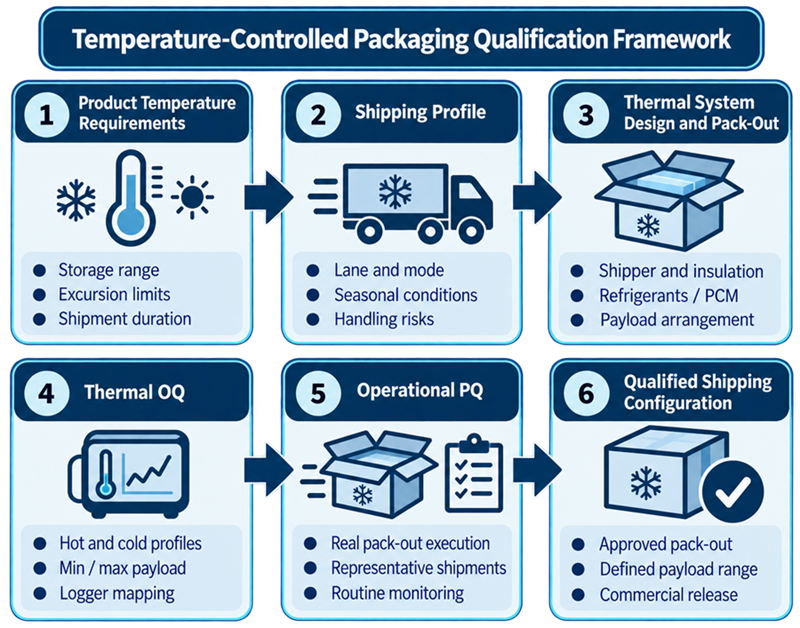
Defining the Temperature-Controlled Packaging System
The qualification boundary should include every component necessary to achieve the claimed thermal performance.
For a passive shipping system, this can include the outer container, insulation, refrigerants or phase-change materials, refrigerant quantities, barriers or spacers, payload box, dunnage, internal dividers, product containers, labels, and closure configuration. The way these components are assembled is part of the qualified system.
For active systems, the boundary can additionally include powered temperature-control equipment, battery capacity, control systems, alarms, power management, operating setpoints, software, and contingency arrangements.
A nominal shipper model number is not enough to define the qualified configuration. Thermal performance can change when refrigerant mass, product quantity, product location, conditioning temperature, orientation, internal spacing, or assembly sequence changes.
The approved configuration should therefore be documented through a controlled pack-out specification or equivalent record showing exactly how the system is prepared and assembled.
Passive and Active Shipping Systems
Passive packaging controls temperature through insulation and thermal energy stored in conditioned refrigerants or phase-change materials. Examples include expanded polymer shippers, vacuum-insulated panels, gel packs, water-based refrigerants, dry ice, and engineered phase-change materials.
Active systems use powered heating, cooling, or both. These systems are more common for larger shipments, reusable containers, air-freight units, or distribution where active temperature control provides operational advantages.
The qualification philosophy is similar for both, but the failure mechanisms differ. Passive systems depend heavily on pack-out configuration, material performance, conditioning, payload thermal mass, and ambient exposure. Active systems introduce additional risks involving power supply, batteries, sensors, control-system failure, setpoint management, alarms, mechanical refrigeration, and recovery after interruption.
The risk assessment should therefore reflect the specific technology rather than applying a generic cold-chain checklist.
Design Qualification
WHO’s technical supplement on qualification of shipping containers describes Design Qualification as the first of three qualification stages. In practical validation terms, DQ establishes that the proposed system is capable in principle of meeting the user requirements before formal challenge testing is completed.
DQ should define the product requirement, intended shipment duration, expected ambient conditions, payload range, container technology, refrigerant strategy, conditioning requirements, handling constraints, and applicable monitoring.
Thermal design work may involve mathematical modeling, engineering calculations, prototype chamber studies, supplier data, material characterization, and comparative pack-out testing.
The purpose is to establish a technically justified design suitable for formal OQ. OQ should not become the first occasion on which the thermal behavior of the shipper is explored experimentally.
Thermal Fundamentals and Heat Flow
A temperature-controlled shipper works by controlling heat transfer between the external environment and the payload.
Heat can enter or leave the system through conduction, convection, radiation, air leakage, and direct contact among payload and thermal-control components. Insulation slows heat transfer but does not eliminate it. Refrigerants or phase-change materials provide a thermal buffer by absorbing or releasing heat during the shipment period.
Payload thermal mass is also important. A full shipper containing many liquid vials can respond very differently from the same shipper containing a small number of lightweight units.
This is why pack-out qualification should not consider only the insulation R-value or supplier-stated hold time. System performance depends on the interaction among insulation, ambient temperature, refrigerant, payload, geometry, conditioning, and duration.
Refrigerants and Phase-Change Materials
The thermal-control material should be selected according to the product temperature requirement and the intended operating strategy.
Water-based frozen packs may be suitable for some refrigerated applications but can create freezing risk if placed directly against freeze-sensitive product. Conditioned gel packs can provide different thermal behavior. Engineered phase-change materials can maintain temperatures closer to a defined transition point. Dry ice is commonly used for frozen shipments but introduces very low local temperatures, sublimation, pressure, handling, and transportation considerations.
Qualification should define not only the refrigerant type but also its quantity, location, conditioning temperature, conditioning duration, and acceptable handling time before final pack-out.
Terms such as frozen, conditioned, or refrigerated pack should be translated into controlled operational requirements. If thermal performance depends on a refrigerant reaching a particular temperature range, that condition should be specified and controlled.
Pack-Out Configuration
The pack-out is one of the most critical elements of qualification.
A qualified configuration may specify the sequence in which refrigerants, spacers, payloads, and insulation components are installed; orientation of each component; minimum separation between product and frozen material; refrigerant quantity; payload quantity; empty-space management; and closure method.
Small changes can have significant thermal consequences. Removing one refrigerant panel, changing a divider, relocating product, reversing a phase-change panel, or substituting a cushioning material can alter heat transfer.
The pack-out should therefore be controlled similarly to other validated manufacturing or assembly processes. Clear instructions, diagrams, component identification, training, and verification should be used where operator assembly can affect performance.
Payload Range and Worst-Case Selection
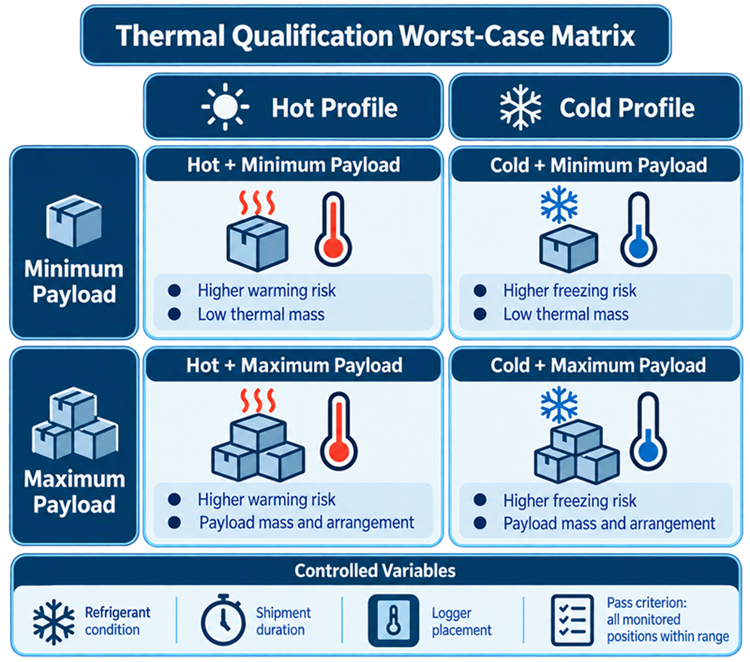
Minimum and maximum payload should be evaluated separately when both configurations are permitted. A minimum payload often has less thermal mass and may respond more quickly to ambient extremes. This can make it more challenging under some hot or cold conditions. A maximum payload may reduce internal space for refrigerants, alter airflow, change heat distribution, or increase the time required for the payload itself to reach the required pre-shipment temperature.
Intermediate configurations can also create challenges if they change product placement or create large air spaces.
The worst case should therefore be determined from thermal behavior rather than by assuming either minimum or maximum payload is universally most severe.
Where a range of payload sizes is qualified by bracketing, the rationale should establish why the tested configurations bound the permitted commercial conditions.
Product and Payload Conditioning
Initial temperature has a major effect on thermal performance. The qualification protocol should therefore define the starting condition of the payload and all thermal-control components.
If product is routinely loaded at refrigerated temperature, qualification using payload equilibrated to room temperature may not represent the process. Conversely, preconditioning test product more aggressively than occurs commercially can produce artificially favorable results. Relevant conditions can include product temperature before packing, refrigerant temperature, shipper component temperature, staging environment, duration outside controlled storage during assembly, and elapsed time between pack-out and initiation of transport.
These conditions should become part of the qualified operating procedure where they materially affect performance.
Ambient Temperature Profiles
The external chamber profile should represent the thermal challenge expected during distribution. A profile can be based on actual route data, standardized industry profiles, historical distribution information, climate data, or a justified combination. The objective is to expose the shipper to conditions that adequately represent the intended shipping environment, including appropriate duration and temperature cycling.
ISTA Standard 7E provides thermal profiles developed from field data for parcel delivery and includes heat and cold profiles intended to represent seasonal environmental extremes. ISTA states that the 7E profiles can be used independently or within its Standard 20 process for design and qualification of insulated shipping containers.
ISTA Procedure 7D is an older development procedure. ISTA states that its 7D profiles are general simulations and specifically encourages consideration of 7E because 7E was developed from measured parcel-distribution temperature data.
Neither profile should be used automatically. The test environment should correspond to the shipment being qualified.
ISTA Standard 20 and 7E
ISTA Standard 20 provides a structured design and qualification process for insulated shipping containers. ISTA describes it as a pharma-industry-developed process covering design, testing, verification, and certification of insulated shippers, with Standard 7E thermal profiles included in the qualification framework.
The Standard 20 framework separates several activities, including design testing, thermal qualification, physical qualification, and field thermal verification. The 7E overview describes thermal qualification as laboratory confirmation of design performance and thermal verification as field testing intended to confirm that laboratory performance can be reproduced under real distribution conditions.
This distinction aligns well with a validation lifecycle. Laboratory testing establishes controlled thermal capability; real-world shipment evidence then confirms that the qualified system can be implemented successfully within the distribution process.
ISTA currently categorizes 7D and 7E under its 7-Series development testing family, so use of 7E alone should not be presented as an automatic regulatory qualification. The stronger approach is to use it within an established qualification strategy such as Standard 20 or a scientifically justified company methodology.
Operational Qualification
OQ should challenge the thermal operating limits of the defined shipping system. The objective is to determine whether the approved pack-out maintains the required product temperature when exposed to justified worst-case ambient conditions and operational variables.
OQ can include hot and cold ambient profiles, minimum and maximum payload, worst-case payload arrangement, permitted shipment duration, conditioning variability, pack-out timing, and other parameters identified by risk assessment.
The test should use calibrated temperature-measurement equipment and controlled environmental chambers capable of reproducing the specified profile.
Repeated OQ runs can be appropriate to demonstrate reproducibility and distinguish stable system performance from a single favorable result.
Summer and Winter Qualification
Hot and cold ambient challenges should be considered separately because the failure mechanisms can be different.
A summer profile generally challenges the system’s ability to prevent excessive warming. A winter profile can create both warming and freezing concerns depending on the package design and product sensitivity.
A refrigerated product can actually be more difficult to protect in winter when frozen refrigerants, cold external exposure, and low payload mass combine to create temperatures below the allowable minimum.
Some systems therefore use different summer and winter pack-outs. If the commercial process permits seasonal configurations, both should be separately defined, qualified, and controlled.
The procedure should also establish how personnel determine which pack-out is applicable—for example, by shipping date, destination, forecast, route, or an approved seasonal calendar.
Duration and Operational Margin
The qualified duration should cover the expected shipment time with an appropriate allowance for foreseeable delay.
A system designed around a typical 24-hour shipment should not automatically be considered suitable for a 48-hour delay simply because the product normally arrives overnight.
Qualification should consider transit time, pickup delays, weekend or holiday holds, missed connections, customs delays where applicable, distribution-center dwell, and other realistic operational conditions.
The final qualified duration should be clearly stated. Supplier language such as “maintains temperature for up to 96 hours” should not be accepted without understanding the ambient profile, payload, initial conditions, acceptance definition, and test configuration used to generate that claim.
Temperature Sensor Placement
Sensor placement should be developed from expected thermal gradients and package behavior.
A single sensor in the geometric center of the payload may fail to detect product locations close to the outer wall, refrigerant, lid, base, or other thermal boundary. Conversely, placing many sensors without a defined rationale can produce a large dataset without improving qualification confidence.
Development testing should identify locations likely to experience the highest and lowest temperatures. OQ can then monitor those positions together with representative internal locations.
Depending on the package, relevant positions may include top, bottom, corners, center, positions adjacent to refrigerants, locations near closures, and areas identified as hot or cold spots during development.
Ambient chamber temperature should also be measured independently to confirm that the required external profile was actually achieved.
Sensors and Data Loggers
Temperature-monitoring devices used in qualification should be calibrated and appropriate for the expected range, accuracy, resolution, response time, and recording interval.
The data-logging interval should be short enough to detect excursions or transitions relevant to the product and chamber profile. An excessively long interval can hide brief but significant temperature events.
Sensor accuracy should also be considered when establishing acceptance. If the allowable product temperature range is narrow, measurement uncertainty can become significant relative to the specification.
Qualification documentation should identify logger model, serial number, calibration status, sensor location, recording interval, start time, and synchronization where multiple instruments are used.
Thermal Mapping Within the Payload
Qualification data should demonstrate the spatial temperature distribution of the payload, not merely a single representative trace.
The objective is to identify whether all product locations remain within the required range and whether a consistent thermal gradient exists during the challenge.
The hottest location during a summer profile and the coldest location during a winter profile may be different. These locations should be understood because they can influence both qualification acceptance and the placement of routine shipment monitors.
Thermal mapping results can also help establish whether one routine data logger is representative or whether additional monitoring is justified for certain shipment configurations.
Acceptance Criteria
Acceptance criteria should be established before qualification begins.
The primary criterion is typically maintenance of product temperature within the approved range for the defined qualification period. Where stability data support defined excursions, the protocol should state how those allowances are incorporated rather than leaving interpretation until after testing.
Other criteria may address physical package condition, refrigerant condition, closure integrity, logger performance, chamber-profile conformance, or system assembly.
A qualification should not be accepted solely because the average payload temperature remained within range. Individual product locations and the actual time-temperature history should be evaluated.
The acceptance decision should reflect the product requirement, not simply an overall mean or nominal setpoint.
Performance Qualification
WHO’s shipping-container guidance identifies PQ as the third qualification stage after DQ and OQ. PQ should demonstrate that the qualified thermal system can perform successfully under representative operational conditions.
Depending on the strategy, PQ may use actual shipments, controlled field trials, representative routes, or operational simulations involving trained personnel, normal pack-out procedures, logistics providers, and routine monitoring.
The purpose is not to repeat chamber OQ under less controlled conditions. PQ confirms that the system can be executed reproducibly in the actual distribution process.
Variables can include real operators, packing locations, pickup procedures, transport providers, route duration, handling, and seasonal conditions.
Laboratory Qualification Versus Lane Qualification
Thermal packaging qualification and shipping-lane qualification should remain distinct.
The package qualification asks whether the defined system can maintain the required temperature when challenged appropriately. Lane qualification evaluates whether the actual transportation route, carriers, handling points, dwell times, seasonal exposures, and logistics controls are adequately understood and controlled. The broader distribution-risk and validation framework is addressed in Shipping Validation Strategy and Distribution Risk Assessment.
WHO maintains separate technical supplements for qualification of shipping containers and transport route profiling, reflecting this distinction.
Detailed route and field-shipment strategy belongs in Shipping Lane Qualification and Real-World Shipment Studies, while this article focuses on qualification of the thermal packaging system itself.
Qualification of Pre-Qualified Shipping Systems
Commercial suppliers frequently offer pre-qualified or pre-engineered temperature-controlled shippers supported by chamber-test data.
These systems can substantially reduce internal development effort, but the term pre-qualified should not be interpreted as universally qualified for every product or distribution route.
The user should evaluate whether supplier data adequately represent the required product range, payload, ambient profile, duration, refrigerant conditioning, package configuration, and handling conditions.
Supplier qualification can provide strong supporting evidence where the proposed use falls within the demonstrated envelope. Additional user testing may be required when the application differs materially from the supplier’s qualification basis.
The final responsibility is to demonstrate that the shipping system is suitable for the regulated product and intended distribution process.
Mechanical and Thermal Qualification Must Be Coordinated
Thermal performance cannot always be separated from physical package performance.
Vibration can move refrigerants. Drops can crack insulation. Compression can deform lids or internal spacing. Repeated handling can damage vacuum-insulated panels or closures. These changes can reduce thermal performance even when the package initially passed chamber testing.
The qualification strategy should therefore determine whether thermal testing and Distribution Simulation Strategy and Transport Testing need to be integrated.
ISTA Standard 20 explicitly distinguishes thermal qualification and physical qualification within its insulated-shipper process.
For some systems, mechanical challenge followed by thermal testing provides useful evidence that distribution damage does not compromise thermal capability. In other cases, parallel mechanical and thermal studies may be adequate. The sequence should follow the identified risk.
Routine Shipment Monitoring
Qualification establishes system capability; monitoring provides evidence of actual shipment conditions.
WHO emphasizes temperature and humidity monitoring as an important component of good distribution practice and states that supply-chain stakeholders should be able to provide documentary evidence that applicable time-temperature limits have not been exceeded.
Routine monitoring strategy should consider product risk, confidence in the qualified system, route variability, regulatory requirements, customer requirements, and accumulated commercial experience.
A temperature logger placed in every shipment may be appropriate for high-risk or variable distribution, while a risk-based reduced monitoring strategy may be justified for a highly controlled and well-characterized system.
The monitoring location should relate to qualification data. Placing a logger wherever it is easiest to retrieve can result in data that do not represent the product’s thermal worst case.
Temperature Excursions
A shipment temperature excursion should not be adjudicated solely by comparing the highest or lowest recorded temperature with the labeled range.
The evaluation should consider temperature magnitude, duration, product stability data, location of the logger, shipment configuration, cumulative prior exposure where relevant, and the reliability of the measurement.
The packaging-system qualification and product excursion assessment therefore perform different roles. Qualification establishes the intended control strategy; stability knowledge determines the impact of an unexpected exposure on product quality.
Repeated excursions should also be treated as a signal that the packaging or distribution strategy may no longer be adequately controlled even if individual product lots can be scientifically released.
Active Shipping Systems
Active containers require additional qualification of their control functions and operational dependencies.
Relevant factors can include temperature setpoints, sensor performance, alarm limits, battery endurance, backup power, heating and cooling capacity, controller performance, door-open events, recovery time, external power connection, communication systems, and failure modes.
The qualification should challenge conditions relevant to the intended transportation duration and ambient environment, including credible loss-of-power or delayed-connectivity scenarios where those risks are controlled by the system design.
For leased active containers, supplier qualification evidence should be reviewed together with user-specific route, payload, setup, monitoring, and operational requirements.
Frozen and Ultra-Low-Temperature Systems
Frozen and ultra-low-temperature distribution introduces additional considerations. Dry ice systems depend on sublimation rate, dry-ice mass, container insulation, ambient exposure, duration, and safe gas venting. Replenishment may be required on extended routes and should be included within the controlled shipping process where applicable.
Ultra-low systems can also be sensitive to short handling periods during packing, transfer, and unpacking because the temperature difference between product and ambient environment is large.
Qualification should address the actual product requirement and shipping process rather than extrapolating performance from conventional refrigerated-packaging data.
Reusable Thermal Packaging
Reusable shipping systems require lifecycle controls beyond initial qualification. Repeated use can result in insulation damage, contamination, worn closures, degraded seals, cracked components, damaged vacuum panels, lost refrigerants, altered phase-change materials, or changes in physical fit.
WHO’s qualification guidance specifically addresses requalification of reusable container systems.
The lifecycle program should define inspection, cleaning, component replacement, maximum service life where appropriate, acceptance criteria, maintenance, and requalification triggers.
A reusable system should not be considered qualified indefinitely simply because the original design passed thermal OQ.
Qualification Documentation
The qualification record should establish the complete technical basis for commercial use.
A typical documentation package includes the product temperature requirements, shipping-system specification, pack-out instructions, risk assessment, DQ rationale, thermal development data, OQ protocol and report, chamber-profile definition, logger configuration, payload rationale, PQ or field-verification evidence, deviation handling, and the final approved operating envelope.
A concise qualification matrix can be useful:
| Qualification element | Examples of defined conditions |
|---|---|
| Product requirement | Approved temperature range and shipment duration |
| Pack-out | Refrigerant type, quantity, location, assembly |
| Payload | Minimum and maximum configurations |
| Ambient challenge | Hot and cold profiles |
| Initial conditions | Payload and refrigerant conditioning |
| Monitoring | Logger type, locations, interval |
| OQ | Controlled chamber challenge |
| PQ | Representative operational shipment |
| Acceptance | All required payload positions meet defined criteria |
| Lifecycle | Monitoring, changes, reusable-system controls |
The final report should state exactly what has been qualified, including allowable payload configurations, pack-out, seasonal conditions, qualified duration, ambient profiles, and any limitations.
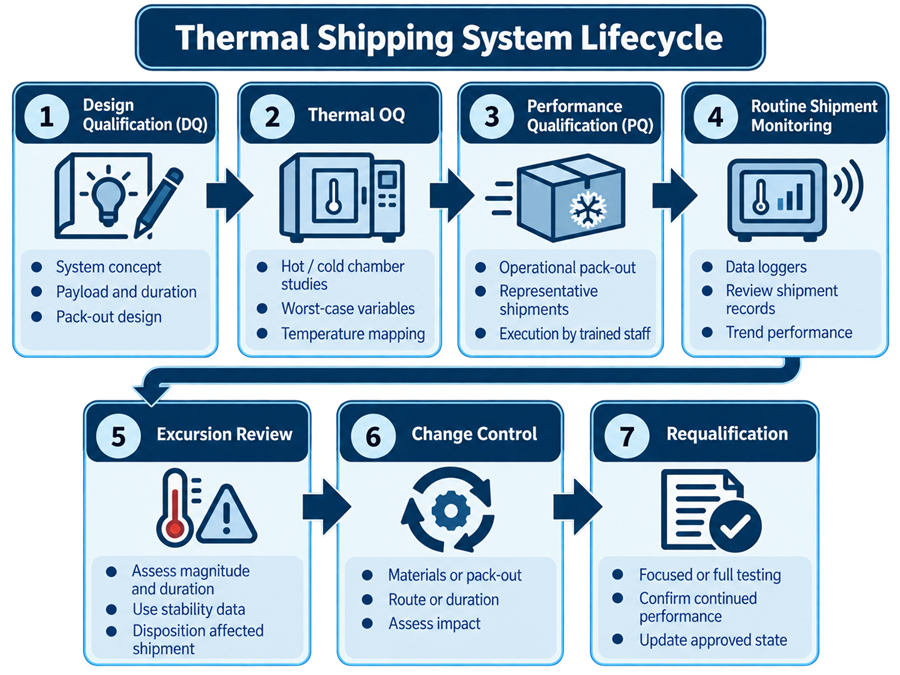
Change Control and Requalification
Changes should be assessed against the thermal qualification basis rather than treated only as component substitutions. Relevant changes include insulation material, container dimensions, refrigerant type or supplier, phase-change formulation, quantity or placement of thermal material, payload quantity, product container, pack-out instructions, shipping duration, route, carrier, seasonal strategy, storage requirement, or monitoring configuration.
A seemingly small change can alter system performance. Replacing a spacer with a different material can change thermal conductivity; reducing payload can alter thermal mass; changing the refrigerant-conditioning procedure can change the initial energy available to the system.
Not every change requires complete DQ/OQ/PQ repetition. Requalification should focus on the thermal assumptions affected by the change.
ISTA’s general testing guidance similarly recommends retesting when changes to product, package, or process can affect packaged-product performance.
Periodic Review and Continued Performance
Long-term performance should be reviewed using actual distribution data.
Useful information includes shipment-temperature records, excursions, package failures, delayed shipments, seasonal performance, route changes, complaints, pack-out deviations, reusable-container inspection history, and corrective actions.
If commercial data consistently show large thermal margin, qualification assumptions can be confirmed. If excursions become more frequent or the margin narrows, the review should determine whether routes, ambient exposure, pack-out execution, materials, or other conditions have changed.
The objective is to confirm that the approved thermal packaging system remains capable and that actual distribution continues to operate within the qualified envelope.
Validation Perspective
Temperature-controlled packaging qualification is not a chamber test of an insulated box. It is validation of a defined product–package–pack-out–distribution system.
A defensible qualification should answer the following questions:
- What temperature conditions must the product maintain?
- What ambient exposures and shipment duration must the packaging system withstand?
- What pack-out and payload configurations are permitted?
- Which thermal conditions represent the relevant worst cases?
- Where are the actual hot and cold locations within the payload?
- Can trained personnel reproduce the qualified configuration during normal operations?
- How will commercial shipment performance, excursions, changes, and requalification be controlled?
The resulting qualification chain should be clear: Product stability requirement → thermal packaging design → controlled pack-out → hot/cold OQ → operational PQ → routine monitoring → lifecycle review and requalification
This approach connects thermal engineering directly to product stability and the validated distribution process rather than treating cold-chain qualification as a standalone temperature-chamber study.