

Shipping Change Control, Periodic Review, and Requalification
Shipping validation remains valid only while the product, packaging system, distribution routes, environmental controls, monitoring strategy, logistics providers, and operating procedures continue to operate within the assumptions established during qualification. Because commercial distribution systems change frequently, lifecycle control is essential to maintaining the validated state.
A change does not automatically require repetition of the complete shipping-validation program. The appropriate response depends on whether the proposed condition remains within the established qualification envelope and whether it introduces a new or more severe failure mechanism. Some changes can be supported by documented technical assessment, while others require focused verification, partial requalification, or complete requalification of the affected distribution system.
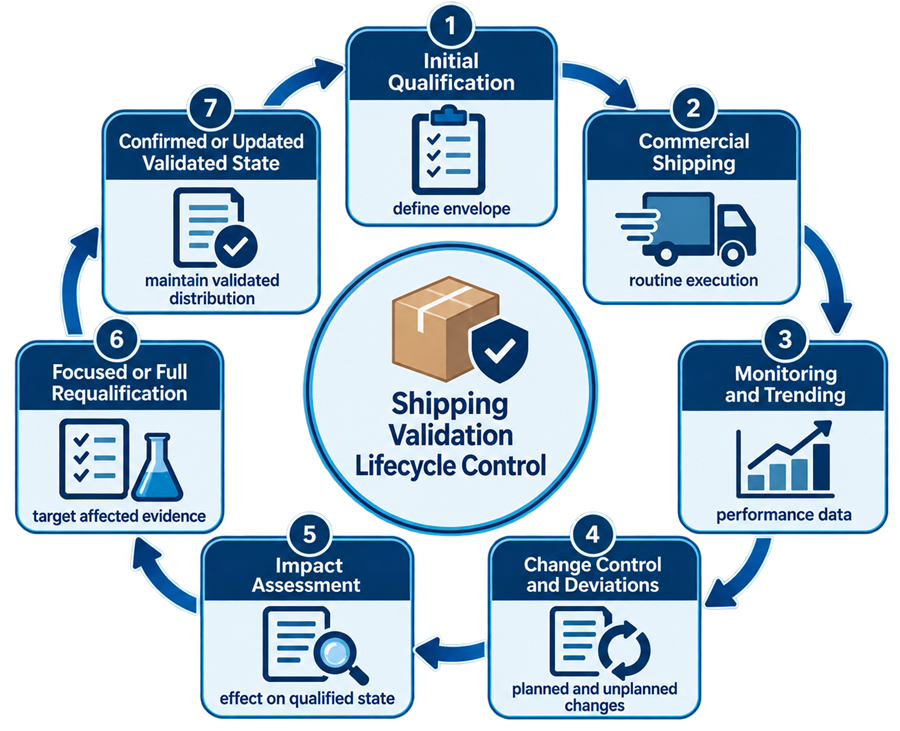
The overall lifecycle should connect directly with Shipping Validation Strategy and Distribution Risk Assessment. Initial qualification defines the approved distribution envelope; change control protects that envelope; periodic review confirms that actual commercial performance remains consistent with it; and requalification generates new evidence when existing qualification no longer provides sufficient assurance.
For pharmaceutical operations, FDA’s ICH Q10 guidance describes a formal pharmaceutical change-management system in which proposed changes are evaluated using science and quality risk management, prospective evaluation criteria are established, appropriate expertise is applied, and implemented changes are subsequently evaluated to confirm that their objectives were achieved without adverse impact on product quality. WHO’s Good Storage and Distribution Practices similarly expects quality systems covering changes, deviations, CAPA, outsourced activities, qualification, audits, and risk management throughout the supply chain.
Key Principles
- Shipping validation should be maintained as a lifecycle system rather than considered complete after initial qualification.
- Every change should first be evaluated against the assumptions and operating limits established by existing qualification.
- The need for requalification should be based on technical impact and risk rather than on whether a change appears administratively large or small.
- Different changes can affect different portions of the validation package; focused requalification is often more appropriate than repeating every study.
- Temporary and emergency changes require the same technical assessment of product risk as permanent changes.
- Deviations, temperature excursions, package failures, complaints, lane deterioration, and carrier problems can become requalification triggers even when no planned change has occurred.
- Periodic review should integrate actual commercial distribution performance with the original validation assumptions.
- Repeated reliance on excursion assessments can indicate that the shipping process is operating too close to its qualified limits.
- Changes to suppliers or logistics providers should be assessed according to the function they perform and their potential impact on the qualified distribution process.
- Existing qualification evidence may remain applicable when equivalence or bounding conditions are scientifically demonstrated.
- The final change or periodic-review conclusion should clearly state whether the validated state remains acceptable and what additional action, if any, is required.
Shipping Validation as a Lifecycle System
Initial shipping qualification establishes the conditions under which the product can be distributed with adequate assurance of protection. Those conditions can include packaging components, qualified payload range, seasonal configuration, thermal hold time, transportation modes, approved lanes, carriers, monitoring devices, shipping procedures, and receiving requirements.
Commercial distribution subsequently generates information that can either confirm or challenge those assumptions.
A lifecycle model therefore follows: Initial qualification → routine commercial shipping → monitoring and trending → changes and deviations → impact assessment → focused or full requalification where required → revised qualified state
This approach avoids two common weaknesses. The first is treating validation reports as permanently applicable despite changes to the distribution system. The second is automatically repeating complete validation studies for changes that remain clearly within an established qualification envelope.
What the Change Assessment Should Protect
A useful change assessment begins by identifying the specific validated assumptions that could be affected.
For example, a thermal shipping system may be qualified for a particular insulation design, phase-change material, payload range, hot and cold ambient profiles, logger position, and 96-hour shipping duration. A proposed change should be evaluated against those established conditions rather than against a generic question such as whether the new component is “similar.”
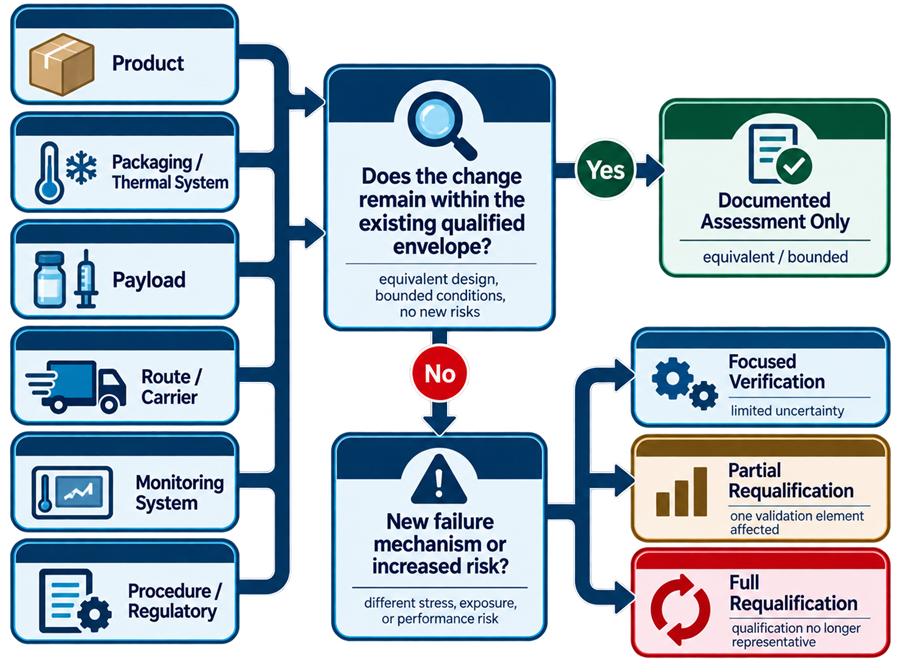
The key question is: Does the proposed change remain within the demonstrated qualification envelope, or can it alter the mechanism by which the product is protected during distribution?
This keeps the assessment connected to validation science.
Product Changes
Changes to the product itself can affect shipping requirements even when the packaging and logistics process remain unchanged.
Relevant examples include formulation changes, concentration changes, fill-volume changes, new dosage strengths, revised storage conditions, new freeze sensitivity, revised allowable excursion data, modified container-closure systems, or changes in product thermal mass.
A larger liquid fill volume can alter the thermal behavior of a qualified shipper. A new formulation may be more sensitive to temperature or agitation. Revised stability information may reduce or expand the acceptable shipping envelope.
Product changes should therefore be assessed for their effect on both product vulnerability and the existing qualification assumptions.
Primary and Secondary Packaging Changes
Changes to primary or secondary packaging can affect containment, mechanical protection, thermal response, or interaction with the shipping system.
Examples include:
- new vial or bottle dimensions;
- different stopper or closure;
- changed blister structure;
- modified pouch material;
- new carton dimensions;
- altered inserts or dividers;
- different cushioning;
- revised sterile-barrier materials;
- changes to label materials where temperature or humidity resistance matters.
Existing Packaging Qualification Strategy and Worst-Case Configuration data should be reviewed to determine whether the revised configuration remains bounded by the original test articles.
A dimensional change may remain within an established bracket, while a new packaging material or geometry can introduce a different failure mechanism and require focused package or distribution testing.
Shipping Container and Thermal Packaging Changes
Temperature-controlled shipping systems are particularly sensitive to seemingly minor component changes.
Potentially significant changes include insulation material, container dimensions, vacuum-insulated panel design, refrigerant or phase-change material, refrigerant quantity, refrigerant supplier, PCM transition temperature, spacer material, internal geometry, closure method, or component placement.
The thermal effect cannot always be inferred from dimensional or material equivalence.
For these changes, existing Temperature-Controlled Packaging System Qualification and Thermal Mapping, Seasonal Profiles, Payload, and Hold-Time Qualification data should be evaluated to determine whether thermal modeling, focused chamber testing, mapping, or full OQ is required.
Payload Changes
Payload is part of the qualified thermal and mechanical configuration. Changes can include different product quantity, altered placement, new minimum or maximum load, revised void-space management, different dunnage, changed case quantity, or a new product family using the same shipper.
The change assessment should determine whether the new payload remains within the originally qualified range.
A configuration falling numerically between qualified minimum and maximum payloads can often be supported by bracketing, but only when its arrangement and heat-transfer characteristics remain appropriately bounded. A new intermediate configuration that relocates product close to a cold source or creates large air gaps may not be represented simply because its total weight falls between the tested extremes.
Seasonal Pack-Out Changes
Seasonal strategies require particularly clear change control because the summer and winter configurations can depend on different refrigerant quantities, conditioning states, or pack-out arrangements.
Changes to seasonal transition dates, climate assumptions, forecast logic, destination classification, or pack-out selection criteria should be assessed for impact on the original qualification basis.
A warmer-than-historical distribution environment can create a requalification issue even when the physical packaging components have not changed.
Commercial data should therefore be used to determine whether the qualified seasonal profiles remain representative.
Shipping Duration Changes
Increasing the allowable shipping duration directly challenges the existing qualification envelope. If a thermal system is qualified for 96 hours, extending the commercial operating limit to 108 hours should not be justified solely because earlier studies were still trending within specification at 96 hours.
The existing study demonstrated the tested duration. Extension beyond that period requires appropriate supporting evidence.
The impact assessment should consider thermal hold time, routine transit duration, operational margin, seasonal profile, product stability, and delays characterized through Shipping Lane Qualification and Real-World Shipment Studies.
A longer route can require new chamber testing, route qualification, additional refrigerant, or a revised shipping configuration.
Route and Shipping-Lane Changes
A route change can alter distribution risk without changing the origin or destination. Examples include a new airport, additional carrier hub, different customs entry, new consolidation center, increased number of transfers, altered service level, or change from direct to indirect routing.
Shipping Lane Qualification and Real-World Shipment Studies should be used to determine whether the revised lane remains comparable to qualified routes.
A lane can remain acceptable without new field studies when the change is clearly less challenging than existing qualified conditions. A route introducing longer duration, more extreme climate, different infrastructure, or new handling conditions may require focused profiling or prospective shipment verification.
Transportation-Mode Changes
Changing the transportation mode can fundamentally alter the hazard profile.
Examples include: FTL → parcel, ground → air, air → ocean, or dedicated refrigerated vehicle → passive parcel shipper.
These changes can affect vibration, impact, compression, altitude, handling frequency, transit duration, thermal environment, security, and monitoring requirements.
Existing Distribution Simulation Strategy and Transport Testing evidence should be reviewed because the laboratory qualification may have been based on a specific transport environment.
A mode change frequently requires more than administrative carrier approval because the actual physical hazards can change.
Carrier and Logistics Provider Changes
Replacing a carrier or logistics provider should be evaluated according to how the provider affects the validated process. Important considerations include routing, hubs, transportation equipment, subcontracting, temperature-control capability, monitoring, handling procedures, maintenance, security, excursion response, delivery performance, and historical reliability.
A provider change may require only supplier qualification and limited operational verification when the service remains within the existing distribution envelope.
A provider that uses materially different transportation modes, routes, transfer points, temperature controls, or subcontractors can require additional lane qualification or field studies.
WHO GDP specifically expects systems for management of outsourced distribution activities, including defined responsibilities and appropriate controls.
Environmental Monitoring Changes
Changes to monitoring devices or monitoring strategy can affect the evidence used to verify commercial shipping performance.
Examples include changing data logger manufacturer, model, calibration provider, logging interval, alarm limits, sensor location, cloud platform, communication system, or monitoring frequency.
The impact should be evaluated against Distribution Environmental Monitoring and Data Logger Qualification.
A logger replacement should not be assessed only by comparing stated accuracy. Response time, operating range, configuration logic, clock behavior, software, calibration, alarm algorithms, and data format may also influence its suitability.
Where the monitoring system provides GMP records used for excursion or disposition decisions, software and electronic-record impacts should also be assessed.
Shipping Procedure Changes
Operational changes can affect validated performance even when no physical component changes.
Examples include:
- different refrigerant conditioning time;
- revised product staging limits;
- new pack-out sequence;
- altered seasonal-selection procedure;
- new logger activation step;
- changed receiving process;
- extended pickup window;
- changed storage before carrier collection;
- different acceptance or excursion criteria.
21 CFR §211.150 requires written pharmaceutical distribution procedures to be established and followed. More generally, FDA CGMP requirements establish quality-unit oversight of procedures affecting product quality and require controlled handling of changes to applicable procedures.
The change assessment should therefore determine whether a procedural revision changes an assumption used during qualification.
Regulatory and Stability Changes
New scientific or regulatory information can itself trigger reassessment. Relevant changes can include revised stability data, new excursion limits, altered labeled storage conditions, changed product shelf life, new regulatory commitments, or updated market requirements.
A shipping process originally considered acceptable may no longer remain valid if the allowable product temperature range becomes narrower.
Conversely, newly generated stability information can sometimes support greater operational flexibility, but the corresponding shipping requirements and validation documents should be formally updated before that new flexibility is used routinely.
Risk-Based Change Assessment
ICH Q9(R1) supports quality risk management as a systematic process for assessing, controlling, communicating, and reviewing risks to product quality. FDA’s final revision emphasizes science-based decision-making and reducing subjectivity in QRM activities.
For shipping changes, the risk assessment should determine:
- Which validated assumptions are affected?
- What product or packaging failure mechanism could change?
- Does existing qualification adequately bound the proposed condition?
- What new uncertainty does the change introduce?
- What additional evidence is needed before implementation?
- How will effectiveness be confirmed after implementation?
This produces a much stronger decision than assigning a generic low/medium/high score without connecting the result to the qualification evidence.
Levels of Validation Response
A practical change-control program can use four basic responses.
Documented Assessment — No Additional Testing
This is appropriate when the proposed condition is demonstrably within the existing qualification envelope and does not introduce a new failure mechanism.
Examples can include a new destination clearly bounded by an already qualified lane family or an administrative change with no effect on the actual distribution process. The rationale should identify the evidence supporting equivalence.
Focused Verification
Focused verification is appropriate when a change has limited impact but some confirmation is needed.
Examples can include a replacement logger model, modest procedural change, new but comparable carrier, or packaging component with demonstrated equivalence. Testing should target the specific uncertainty created by the change.
Partial Requalification
Partial requalification is appropriate when one major element of the shipping validation package is affected but the remainder remains valid.
Examples include repeating hot-season thermal OQ after a PCM change, conducting a new distribution simulation after changing the shipping case, or performing new lane studies after introducing a significantly different carrier network.
Full Requalification
Full requalification is appropriate when the existing qualification no longer represents the proposed distribution process or when multiple fundamental assumptions change simultaneously.
Examples can include a major new packaging platform, substantially changed product requirements, a new temperature range, new transportation mode, or complete redesign of the distribution process.
Example Requalification Matrix
| Change | Likely affected evidence | Potential response |
|---|---|---|
| Administrative carrier name change only | Provider documentation | Assessment only |
| Equivalent logger model | Monitoring qualification | Focused verification |
| New domestic lane within qualified family | Lane qualification | Assessment or field verification |
| Longer commercial shipment duration | Thermal qualification / lane evidence | Partial requalification |
| New PCM formulation | Thermal OQ / mapping | Partial requalification |
| Different shipping case construction | Distribution simulation | Focused or partial requalification |
| New minimum payload configuration | Thermal mapping / OQ | Partial requalification |
| Ground shipping changed to parcel network | Transport simulation / lane evidence | Significant requalification |
| Product storage changed from 2–8 °C to narrower range | Thermal system / procedures / monitoring | Major requalification |
| New packaging platform and new transport mode | Multiple validation elements | Full requalification |
The table provides a decision framework, not predetermined outcomes. The actual response should follow technical impact.
Change Approval Before Implementation
Where possible, qualification requirements should be defined and completed before the change becomes effective.
ICH Q10 specifically describes prospective evaluation of proposed changes and states that evaluation criteria should be established before implementation. It also calls for assessment after implementation to confirm that the objectives were achieved and that product quality was not adversely affected.
The change record should therefore define: change → impact assessment → required qualification → acceptance criteria → implementation approval → post-implementation verification
This avoids implementing a distribution change first and attempting to justify it retrospectively.
Post-Implementation Effectiveness Verification
Completion of the required qualification is not always the end of the change.
Commercial evidence can be used to confirm that the revised process performs as expected. Depending on risk, this may include monitoring the first several shipments, reviewing transit duration, evaluating temperature profiles, confirming carrier performance, checking complaint rates, or performing focused route verification.
The purpose is to determine whether assumptions made during the change assessment were correct.
A successful chamber study does not necessarily prove that a new logistics provider will execute the revised process correctly in routine operation.
Temporary Changes
Temporary changes should be controlled with the same technical discipline as permanent changes. Examples include temporary use of an alternate carrier, substitute packaging material, emergency shipment route, temporary warehouse, alternate monitoring device, or modified pack-out during a supply interruption.
The temporary nature of the change does not reduce product risk.
The assessment should define the scope, duration, affected products or shipments, compensating controls, monitoring, approval, and conditions for return to the validated configuration.
Where the temporary condition remains outside the established qualification envelope, appropriate verification or quality justification is still required.
Emergency Changes
Emergency distribution changes may sometimes need to be implemented before the normal change-control process can be completed—for example, during severe weather, carrier interruption, natural disaster, airport closure, or equipment failure.
The organization should still document the technical basis for the decision, assess product risk, define compensating controls, obtain appropriate authorization, and perform retrospective review.
Emergency status should not become a mechanism for bypassing validation requirements.
Recurring emergency changes indicate that the normal distribution strategy may lack adequate contingency capability.
Deviations as Requalification Triggers
Not all requalification begins with a planned change. Shipping deviations can demonstrate that an existing validated assumption is no longer reliable.
Potential triggers include:
- repeated temperature excursions;
- shipping durations approaching the thermal hold-time limit;
- recurring package damage;
- repeated logger failures;
- changes in route performance;
- carrier delays;
- unexpected customs dwell;
- failure of security controls;
- repeated pack-out errors;
- increasing receiving delays.
Shipping Excursion Assessment and Product Disposition determines whether individual affected product remains acceptable. The lifecycle assessment should separately determine whether recurrence indicates a weakness in the validated shipping process.
Complaints and Distribution Failures
Product complaints can provide evidence that shipping qualification no longer adequately represents commercial conditions. Examples include broken containers, crushed cartons, damaged sterile barriers, melted or frozen product, unreadable labels, leaking packages, or repeated evidence of rough handling.
A trend in distribution-related complaints should trigger review of the relevant package, route, carrier, or shipping configuration.
The absence of formal environmental excursions does not eliminate the need for reassessment when physical performance indicates deterioration.
Periodic Review of the Shipping Validation Program
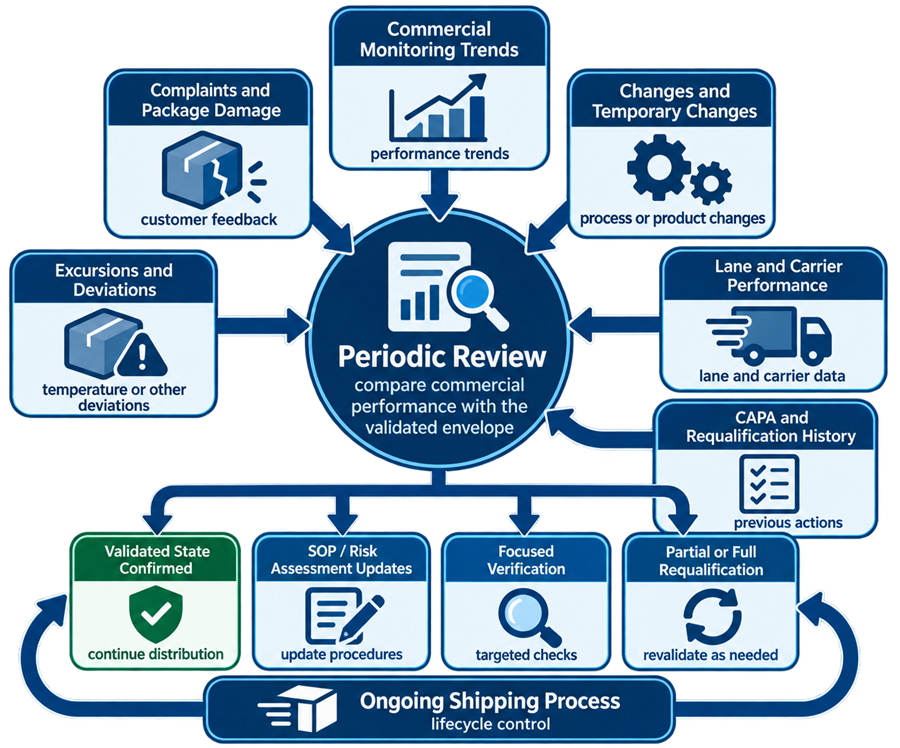
Periodic review provides the formal mechanism for confirming that the shipping-validation basis remains current. The review should compare the approved validation envelope with actual commercial performance and determine whether changes have accumulated that individually appeared minor but collectively alter the risk profile.
The review should not be a checklist confirming that reports still exist. Its purpose is to answer:
Does current commercial distribution remain adequately represented by the existing validation evidence?
WHO GDP expects a quality system with risk management, change control, deviations, CAPA, outsourced-activity management, audits, and review of supply-chain risks.
Periodic Review Inputs
A useful review can integrate:
- approved shipping-validation strategy;
- changes implemented since the previous review;
- temporary and emergency changes;
- shipping-lane additions or modifications;
- carrier and logistics-provider performance;
- thermal monitoring trends;
- excursion investigations;
- shipment duration trends;
- package damage and complaints;
- distribution deviations;
- CAPA;
- logger calibration failures;
- reusable shipper maintenance or failures;
- route-profile changes;
- new stability information;
- revised product requirements;
- regulatory changes;
- supplier changes;
- requalification studies;
- changes to applicable procedures.
The review should focus on information capable of challenging the qualification assumptions.
Periodic Review Frequency
The appropriate review frequency should reflect distribution risk and the site’s quality-system structure. For pharmaceutical products, 21 CFR §211.180(e) requires records to support at least annual evaluation of each drug product’s quality standards and specifically requires review of representative batch records, complaints, recalls, returned or salvaged products, and investigations. This regulation does not independently mandate an annual standalone shipping-validation review, but relevant distribution events can feed the annual product-quality evaluation when they affect product quality or associated records.
A company can therefore integrate shipping lifecycle review into the annual product review/PQR or use a separate periodic shipping review, provided the arrangement effectively evaluates continued distribution control.
High-risk or rapidly changing distribution systems can justify more frequent review.
Shipping Performance Trending
Periodic review should look at trends rather than only individual failures.
Useful indicators include:
| Indicator | What it can reveal |
|---|---|
| Transit duration | Reduction in available qualification margin |
| Temperature margin | Movement toward qualified thermal limits |
| Excursion frequency | Weakening route or package performance |
| Carrier delay rate | Provider deterioration |
| Package damage | Mechanical qualification mismatch |
| Logger failures | Monitoring-system weakness |
| Customs dwell | Increasing international lane risk |
| Complaint frequency | Product-impact signal |
| CAPA recurrence | Ineffective corrective actions |
| Emergency-route use | Insufficient contingency planning |
| Seasonal performance | Change in environmental assumptions |
A distribution system can remain formally within specification while showing a progressive reduction in performance margin. That trend can justify intervention before a formal failure occurs.
Review of Thermal Margin
Thermal qualification should not be reviewed only as pass/fail history. For temperature-controlled shipments, the periodic review should consider the available margin between actual commercial exposure and the qualified thermal limits.
For example, a system qualified for 96 hours may initially operate with typical shipments of 30–40 hours. If commercial duration gradually increases to 75–85 hours, the shipping system still technically remains inside the validated envelope but has lost substantial operational robustness.
The review should determine whether that narrowing margin warrants lane changes, additional qualification, greater monitoring, or increased packaging capacity.
Review of Shipping Lanes
Lane performance can evolve even when no formal internal change has been initiated. Carriers can alter hubs, schedules, subcontractors, service patterns, or routing algorithms. Customs processes can change. New regional distribution centers can be introduced. Seasonal climate patterns can also produce conditions more severe than those represented by historical data.
The periodic review should therefore compare current commercial lane performance with the original Shipping Lane Qualification and Real-World Shipment Studies evidence.
Where the actual route no longer resembles the qualified route, reassessment is required even if the lane name has not changed.
Review of Logistics Providers
Provider performance should be reviewed using evidence relevant to the service performed. Useful information can include deviations, delivery reliability, temperature excursions, equipment failures, subcontracting changes, quality-agreement compliance, audit findings, complaints, corrective actions, and communication performance.
A provider that consistently requires product-specific excursion assessments may no longer be adequately controlling the service despite formally meeting contractual delivery requirements.
The review should distinguish logistics performance from quality performance.
Review of Environmental Monitoring
Monitoring systems should also be included in periodic review. Relevant signals include calibration failures, missing records, logger battery problems, data-download failures, incorrect placement, alarm-setting errors, software changes, cloud-system changes, and changes in routine monitoring frequency.
Distribution Environmental Monitoring and Data Logger Qualification provides the device lifecycle basis.
Repeated monitoring failures can undermine confidence in the commercial verification program even if no product excursion has been confirmed.
Periodic Review Outcomes
The review should result in an explicit conclusion rather than simply documenting the data examined.
Potential outcomes include:
- Validated state confirmed — existing qualification continues to represent commercial operations adequately.
- Minor updates required — procedures, risk assessments, documentation, or monitoring controls require revision without new qualification testing.
- Focused verification required — emerging uncertainty requires targeted studies.
- Partial requalification required — a specific element such as thermal performance, transport simulation, lane qualification, or monitoring requires new evidence.
- Full requalification required — cumulative changes or new conditions make the original qualification basis no longer representative.
The conclusion should identify responsibilities and due dates for required follow-up.
Requalification Should Target the Affected Evidence
Requalification does not necessarily mean repeating every historical validation protocol.
A useful modular structure is:
- Package change → packaging or distribution simulation
- Thermal component or payload change → thermal mapping/OQ
- Route or carrier change → lane qualification
- Monitoring-system change → logger qualification
- Operating-procedure change → focused operational verification
- Fundamental system redesign → integrated requalification
This preserves unaffected qualification evidence and focuses testing on the actual change.
Requalification of Mechanical Package Performance
Changes affecting package geometry, materials, cushioning, shipping case, palletization, product weight, or transport mode should be evaluated against existing mechanical qualification.
Where the change affects distribution hazards, ASTM Distribution and Package Performance Test Methods or ISTA Distribution Simulation Protocols and Test Selection can provide the appropriate focused test framework.
The test should address the affected failure mechanism rather than automatically repeating every prior test element.
Requalification of Thermal Systems
Thermal requalification should be considered when changes affect heat transfer, thermal mass, seasonal profile, refrigerant condition, or allowable shipping duration. The required work can range from a limited confirmatory chamber run to complete mapping and hot/cold OQ.
Reusable thermal systems may also require requalification when aging, repeated use, repaired components, insulation damage, or service-life data indicate possible performance deterioration.
The requalification rationale should identify exactly which earlier conclusions remain valid and which require new evidence.
Requalification of Shipping Lanes
Lane requalification can be required following carrier changes, significant route changes, repeated delays, new hubs, revised customs processes, increased environmental severity, or evidence that commercial conditions exceed earlier assumptions.
Focused field studies can often verify the changed portion of the route rather than repeating the entire original program.
For a mature lane family, a newly introduced lane that remains demonstrably bounded by existing worst-case data may require only documented assessment.
Requalification of Monitoring Systems
Monitoring-system requalification can be triggered by new logger models, software changes, cloud-platform upgrades, altered alarm algorithms, changed sensor locations, or major changes in monitoring strategy.
Calibration alone may not be sufficient where the change affects functionality, data integrity, configuration, reporting, or quality decision logic.
The scope should correspond to the intended use of the monitoring system.
Legacy Qualification Evidence
Older qualification data should not be rejected automatically because a newer standard revision or procedure exists. The question is whether the legacy evidence remains scientifically applicable to the current commercial configuration and current distribution risks.
A periodic review should consider:
- whether the tested package still matches commercial configuration;
- whether routes remain comparable;
- whether actual exposure remains bounded;
- whether current product requirements differ;
- whether major standard changes reveal an unaddressed hazard;
- whether field experience supports the original conclusions.
Where the evidence remains applicable, documented continued use may be appropriate. Where material gaps exist, focused requalification should close them.
Changes to ASTM or ISTA Standards
Revision of an ASTM or ISTA procedure does not automatically invalidate previous qualification. The change should be assessed to determine whether the revised standard introduces new hazards, test severity, sequence, methodology, or knowledge relevant to the existing shipping configuration.
If the revised procedure corrects or materially changes an aspect directly relevant to the product’s distribution environment, additional testing may be justified.
If the revision does not materially alter the basis of the existing qualification, the prior study can remain acceptable with documented rationale.
This approach prevents unnecessary routine retesting solely because a standard edition number changed.
CAPA Effectiveness and Requalification
Requalification is frequently part of CAPA following shipping failure. The new study should verify the specific corrective action.
If a thermal excursion was caused by insufficient refrigerant capacity, the requalification should demonstrate that the revised pack-out provides adequate thermal margin. If package damage resulted from inadequate cushioning, mechanical performance testing should verify the revised configuration.
Repeating the original study without challenging the identified failure mechanism can produce a passing report without demonstrating CAPA effectiveness.
Documentation
A controlled lifecycle should maintain traceability among change records, risk assessments, qualification evidence, periodic reviews, and the current approved shipping configuration.
A useful documentation structure includes:
| Lifecycle record | Purpose |
|---|---|
| Shipping validation plan/report | Defines validated distribution envelope |
| Change control | Assesses proposed modification |
| Risk assessment | Determines potential impact |
| Qualification protocol/report | Generates required new evidence |
| Temporary change | Controls limited-duration exceptions |
| Deviation / excursion investigation | Evaluates unintended departure |
| CAPA | Addresses cause and recurrence |
| Periodic review | Confirms continued applicability |
| Requalification report | Updates affected validation evidence |
| Approved SOP/specification | Defines current operating state |
The objective is to maintain a clear connection between the commercial process being used today and the evidence that supports it.
Relationship to Pharmaceutical Quality System
Shipping lifecycle control should not operate as an isolated validation program.
ICH Q10 describes change management, process and product monitoring, CAPA, and management review as interconnected elements of the pharmaceutical quality system. It specifically expects a formal change-management system for commercial manufacturing and post-implementation evaluation of changes.
FDA’s May 2026 final Q8, Q9, and Q10 Questions and Answers (R5) also remains part of the current implementation framework for these ICH quality-system concepts.
Shipping validation should therefore feed the same site quality systems used for change control, deviations, CAPA, supplier management, product review, and management review rather than creating a parallel lifecycle system.
Validation Perspective
The purpose of shipping change control and periodic review is not to create recurring administrative work. It is to ensure that the commercial distribution process being used today is still represented by the qualification evidence generated previously.
A defensible lifecycle asks:
- What changed or what performance signal was observed?
- Which validated shipping assumptions could be affected?
- Does existing evidence still bound the current condition?
- What focused evidence is necessary to resolve remaining uncertainty?
- After implementation, does commercial performance confirm the intended result?
- At periodic review, does the complete distribution system remain in a validated state?
The resulting lifecycle is:
Validated shipping system → change and performance monitoring → risk-based impact assessment → targeted verification or requalification → controlled implementation → effectiveness verification → periodic review → confirmed or updated validated state
This approach preserves useful qualification evidence while ensuring that product protection remains aligned with actual packaging, routes, carriers, environmental exposure, monitoring systems, and commercial distribution conditions.