

Thermal Mapping, Seasonal Profiles, Payload, and Hold-Time Qualification
Thermal shipping qualification must demonstrate more than the nominal capability of an insulated container. It must establish where temperature extremes occur within the payload, how the system responds to realistic hot and cold ambient conditions, how payload quantity and arrangement affect performance, and how long the complete pack-out can maintain the product within its defined temperature requirements.
The companion article Temperature-Controlled Packaging System Qualification establishes the overall DQ/OQ/PQ framework for temperature-controlled shipping systems. This article addresses the technical design of the qualification studies themselves: thermal mapping, seasonal ambient profiles, payload selection, sensor placement, test duration, and establishment of a defensible qualified hold time.
WHO guidance for qualification of shipping containers explicitly identifies ambient profiles, minimum and maximum product loads, required transport duration, allowable product temperature range, and complete pack-out configuration as fundamental qualification variables. WHO also recommends challenging heat and cold profiles with both minimum and maximum product loads.
Key Principles
- Thermal mapping should characterize temperature distribution throughout the permitted payload volume rather than relying on a single centrally located sensor.
- The warmest and coldest product locations may differ by season, payload quantity, pack-out configuration, and time within the profile.
- Seasonal qualification should represent dynamic ambient exposure, not merely constant high and low chamber temperatures.
- Minimum and maximum payloads should both be evaluated when both are permitted commercially; neither should automatically be assumed to represent every thermal worst case.
- Product simulants should reproduce thermal characteristics relevant to the study, including thermal mass, physical configuration, and where applicable freezing behavior.
- Refrigerant or phase-change-material conditioning is part of the qualified pack-out and should be controlled as a study variable.
- Hold time should have an explicit definition, starting point, ending criterion, and relationship to the approved commercial shipping duration.
- Qualification should not extrapolate a shipping duration beyond the duration actually demonstrated by the study.
- Operational shipping duration should retain appropriate margin relative to demonstrated thermal capability.
- OQ establishes performance under controlled chamber conditions; field studies confirm whether those assumptions remain representative of actual distribution.
Thermal Mapping Is Spatial Characterization of the Payload
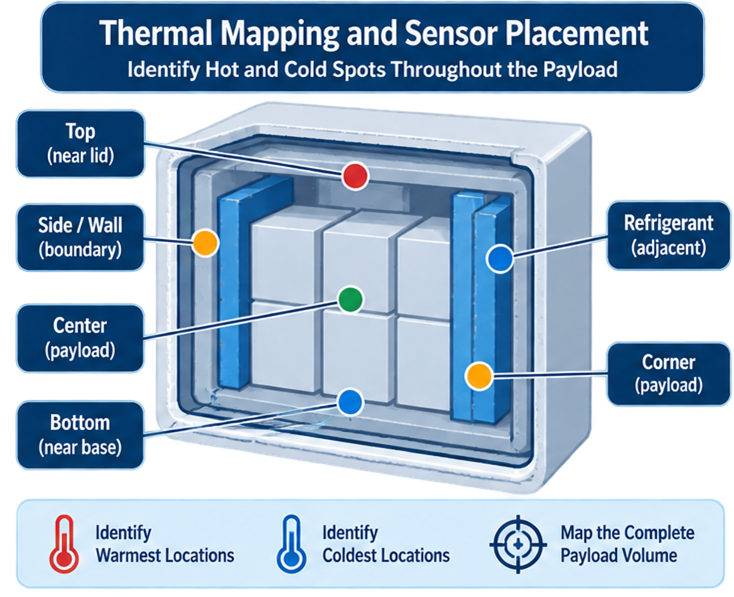
Thermal mapping determines how temperature varies within the usable product space of a shipping system while the package is subjected to a defined external temperature profile. Its purpose is to identify product locations most likely to experience the highest and lowest temperatures and to establish whether all permitted payload positions remain within the required range.
The geometric center of a shipper is not automatically the thermal worst case. Locations near the walls, lid, base, corners, refrigerants, phase-change materials, void spaces, or interfaces between insulation components can respond differently. Heat flow also changes with time, so the position that reaches the highest temperature during the latter part of a summer profile may not be the position that experiences the lowest temperature during the initial portion of a winter profile.
Mapping should therefore evaluate the three-dimensional payload volume, including boundary locations and representative internal positions. Sensor placement should reflect actual positions in which commercial product can be loaded rather than artificial locations that cannot occur under the approved pack-out.
Mapping Before Formal Qualification
Exploratory thermal mapping should normally occur during development before the formal OQ configuration is finalized. Development studies can use a larger number of temperature probes than will eventually be necessary in routine qualification because the objective is to understand system behavior and locate the thermal extremes.
Once the thermal pattern is understood, formal OQ sensor locations can be concentrated at known or suspected hot and cold positions together with representative interior locations. This produces a more defensible test than distributing probes symmetrically without knowledge of heat-flow behavior.
The mapping study should also evaluate whether extreme positions remain consistent across replicates. If the apparent hot or cold spot changes substantially between tests, that can indicate sensitivity to pack-out execution, material variation, payload positioning, chamber conditions, or system instability.
Sensor Placement Strategy
The sensor plan should be justified in the protocol or supporting development report. A useful configuration commonly includes sensors near the top, bottom, corners, outer payload boundaries, center of the payload, and positions close to thermal-control materials where product is permitted to reside.
The ambient chamber temperature should be recorded independently from payload temperatures. This establishes that the external challenge was correctly applied and distinguishes packaging performance from chamber-profile deviation.
Sensors should be positioned so that they measure the temperature representative of the product location rather than the surface temperature of a refrigerant or insulation panel unless that interface is itself the subject of the study. Direct physical contact between a thermocouple and a frozen refrigerant can produce an artificially extreme reading that does not represent actual product exposure.
For qualification, the configuration should be reproducible. Probe numbering, position diagrams, photographs, package orientation, product location, and logger identification should be recorded sufficiently to reconstruct the setup.
Temperature Measurement System
Qualification data are only useful when the measurement system is adequate for the temperature range and decision being made.
WHO’s shipping-container guidance calls for multi-channel temperature logging capable of creating a permanent time-temperature record and provides an example tolerance of approximately ±0.5 °C for temperatures above −18 °C, with wider tolerances considered for lower-temperature applications.
The specific qualification program should establish appropriate requirements for logger accuracy, calibration, resolution, response characteristics, operating range, and recording interval. Narrow product acceptance ranges require particular attention to measurement uncertainty because logger uncertainty can represent a meaningful portion of the available operating margin.
The recording interval should be short enough to capture significant thermal transitions. Excessively long intervals can obscure short-duration excursions or the point at which the package approaches its thermal limit.
Product Temperature Versus Air Temperature
The temperature of the air inside a shipping container and the temperature of the product are not necessarily equivalent.
Air temperature can respond rapidly to external exposure, opening events, or refrigerant conditions, while liquid or solid product responds according to its thermal mass and heat-transfer characteristics. Qualification acceptance should therefore be based on the variable relevant to the product requirement.
For many pharmaceutical shipping studies, sensors are associated with representative product units or product simulants rather than left freely suspended in air. The protocol should define exactly what temperature is being measured and why that measurement represents the product exposure being qualified.
This distinction becomes increasingly important for small payloads, high thermal gradients, frozen systems, or products with substantial thermal inertia.
Seasonal Ambient Profiles
Seasonal qualification should represent the external thermal environment that the shipping system is expected to experience. A realistic profile normally changes with time and can include exposure during pickup, vehicle transportation, terminals, aircraft or freight transfer, distribution centers, temporary storage, and final delivery.
A constant chamber temperature can be useful for development or comparative testing but generally does not reproduce the changing thermal load experienced in distribution. A dynamic profile can expose different aspects of package performance because the system may experience heating, cooling, recovery, and thermal reversal during the same shipment.
The seasonal strategy should distinguish at least the relevant hot-season and cold-season challenges when the distribution environment produces materially different conditions.
ISTA 7E Seasonal Profiles
ISTA Standard 7E provides heat and cold thermal profiles developed from measured parcel-distribution data. ISTA describes the profiles as representing annual seasonal heat maxima and cold minima in a parcel shipping environment. The standard includes both 72-hour and 144-hour heat and cold profiles.
ISTA Standard 20 incorporates the 7E profiles within its insulated-shipping-container design and qualification process. ISTA describes Standard 20 Revision 2 as a structured process for designing, testing, verifying, and qualifying insulated shipping containers.
These profiles can provide a standardized qualification basis where parcel-distribution conditions are appropriately represented. They should not be treated as universal representations of every route, region, transportation mode, or distribution system. ISTA itself distinguishes its 7E profiles from customized shipping-lane data and customized worst-case qualification.
Route-Specific Profiles
Where commercial distribution differs materially from a standardized profile, actual route data can provide a stronger technical basis.
WHO maintains separate guidance for transport route profiling qualification, reflecting the principle that actual routes should be characterized when route-specific conditions are important. WHO’s shipping-container qualification guidance also recommends selecting the most challenging shipping lane and transport method when a container will be used on multiple routes, with emphasis on combinations of extreme temperatures and long duration.
Route data can identify conditions that a generic seasonal profile may not reproduce, such as prolonged airport dwell, desert ground handling, winter loading docks, customs delays, regional temperature extremes, or unusual combinations of temperature and duration.
A route-specific profile should be constructed from sufficient representative data rather than from one unusually severe or unusually mild shipment unless that shipment has been intentionally selected as a justified worst-case event.
Summer and Winter Are Not Simply Two Constant Temperatures
A summer qualification should not be reduced to placing a shipper at a constant high temperature, nor should winter qualification necessarily consist of one continuous low temperature.
A dynamic hot profile may include moderate initial conditions, peak daytime exposure, cooler overnight periods, terminal exposure, and renewed heating. A winter profile can similarly alternate between cold external exposure and warmer indoor handling environments.
These changes matter because the thermal-control system can recharge, deplete, or change heat-flow direction during the profile. Phase-change materials in particular can behave differently under cyclic conditions than under constant exposure.
The protocol should therefore preserve the time-temperature structure of the selected profile when that structure is part of the qualification basis.
Seasonal Pack-Outs
Some shipping systems use different refrigerant configurations for hot and cold seasons. This can be technically appropriate but creates two separately controlled pack-outs.
The qualification should establish the permitted configuration for each season and the operational method used to select it. Seasonal selection should not depend on informal operator judgment.
The control strategy may use predefined calendar periods, qualified regional rules, route-specific criteria, forecast-based logic governed by an approved procedure, or another validated decision method. Whatever method is selected should prevent the wrong configuration from being used during seasonal transition periods.
If one universal pack-out is used year-round, qualification must demonstrate that the same configuration controls both excessive warming and excessive cooling.
Payload Is a Thermal Variable
Payload quantity changes the thermal response of a shipping system because the product itself contributes thermal mass.
A large refrigerated liquid payload can absorb substantial heat before its temperature changes appreciably. A minimum payload contains less thermal mass and may respond much faster to the external environment or nearby refrigerants. This often makes low payload a challenging condition, particularly where freeze-sensitive products are close to conditioned or frozen thermal material.
However, maximum payload can also create a worst case. A full payload can reduce air space, alter internal heat-transfer paths, reduce the available space for refrigerants, move product closer to insulation boundaries, or require a different physical arrangement.
The appropriate worst case should therefore be demonstrated rather than assumed.
Minimum and Maximum Payload Qualification
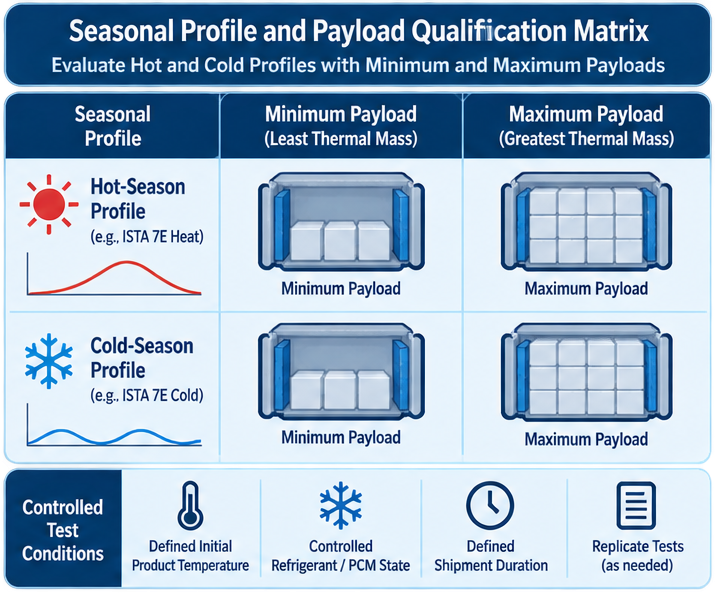
WHO explicitly identifies minimum and maximum product load as qualification variables and recommends testing heat and cold profiles against both conditions. Its DQ example includes four basic combinations: hot profile with maximum load, hot profile with minimum load, cold profile with maximum load, and cold profile with minimum load.
WHO’s PQ example expands the same logic to replicate testing. For one container type, two load configurations, and two ambient profiles, the example contains three tests per condition, producing a 12-test matrix. WHO presents this as an example rather than a universal fixed sample-size requirement.
A practical qualification matrix is therefore:
| Ambient challenge | Minimum payload | Maximum payload |
|---|---|---|
| Hot-season profile | Required where permitted | Required where permitted |
| Cold-season profile | Required where permitted | Required where permitted |
Intermediate payloads can be bracketed only when the qualification evidence demonstrates that the selected extremes adequately bound the permitted configurations.
Partial Payloads and Void Space
Partial payloads deserve particular attention because they can change internal geometry rather than merely reduce thermal mass.
If empty product positions are replaced with dunnage, thermal ballast, spacers, or empty air volume, the heat-transfer behavior can differ. The approved minimum-load configuration should therefore specify how unused payload space is managed.
A commercial procedure that permits operators to place a few units anywhere within a large qualified payload cavity creates a much broader thermal configuration than one that requires a defined minimum-load position.
The qualification claim should cover the actual flexibility permitted by the pack-out instructions.
Actual Product and Product Simulants
Actual product provides the strongest representation of commercial thermal behavior, but qualification frequently uses product simulants for practical reasons.
WHO recommends using actual product during PQ where possible. When a substitute is used, WHO recommends a representative payload with similar thermal mass, freezing point, and packaging characteristics. ISTA 7E similarly states that substitute products should be as close as possible to the actual product with respect to composition, thermal mass, physical consistency, primary packaging, and relevant physical properties.
A bottle filled with water is therefore not automatically an adequate surrogate for every pharmaceutical product. Suitability depends on whether its heat capacity, mass, geometry, container, phase behavior, and arrangement adequately represent the thermal response of the actual payload.
The simulant justification should identify the characteristics that matter rather than merely state that the substitute has the same weight.
Initial Payload Temperature
The starting temperature of the payload is part of the qualification condition.
WHO recommends conditioning the payload at its standard storage temperature sufficiently to achieve a uniform initial condition before testing. The same principle applies to refrigerants, phase-change materials, insulation components, and the shipping container where their starting condition affects performance.
A shipper loaded with product at 5 °C can behave differently from one loaded with product at 8 °C, even though both values may fall within a nominal 2–8 °C storage range.
If the commercial process permits product to be loaded anywhere within a range, the qualification strategy should determine whether the upper or lower initial product temperature represents a relevant challenge.
Refrigerant and PCM Conditioning
Qualification should define the conditioning state of all thermal-control materials.
For conventional refrigerants this can include frozen, refrigerated, or conditioned states. For engineered phase-change materials, it can include the required phase, conditioning temperature, conditioning time, and allowed staging time before pack-out.
A thermal system that performs correctly only when operators judge refrigerant condition visually or by touch is difficult to maintain in a validated state.
The conditioning procedure should therefore specify measurable conditions and, where needed, provide enough time for the refrigerant or PCM to reach an appropriate uniform state.
Pack-Out Assembly Time
The time required to assemble the shipper can affect thermal performance, particularly for frozen, ultra-low-temperature, or highly temperature-sensitive products.
The qualification strategy should determine whether the clock begins before, during, or after pack-out. More importantly, the commercial process should distinguish between product handling time, shipper qualification exposure time, and total logistics duration.
This prevents an apparently qualified 72-hour shipper from being used for a 72-hour transportation process after several additional hours have already been consumed during staging, courier pickup, or post-arrival handling.
Define “Hold Time” Precisely
The term hold time is frequently used inconsistently in thermal shipping studies. A protocol should define it explicitly.
Three different time quantities are often involved:
| Term | Meaning |
|---|---|
| Test profile duration | The programmed chamber or field-test duration |
| Demonstrated thermal hold time | The period during which all required payload positions remain within the defined product temperature acceptance range under the tested conditions |
| Approved commercial shipping duration | The maximum operational shipment period permitted by procedure, normally within the demonstrated qualification envelope |
These values should not automatically be identical.
If a 96-hour study completes with all product sensors still inside specification, the study demonstrates at least 96 hours of performance under that test condition. It does not establish the exact thermal failure time and should not be extrapolated to 108 or 120 hours without supporting evidence.
If the study intentionally continues until a product position exits the required range, the resulting time-to-limit can provide direct information about thermal hold time and available margin.
Define Time Zero
The starting point for hold-time calculations should be stated before execution.
For a laboratory chamber study, time zero may be defined as placement of the completed pack-out into the programmed ambient profile. For commercial shipping, operational exposure can begin earlier, such as when the product is removed from controlled storage or when the package is closed and released for carrier pickup.
These definitions should not be mixed.
A practical approach is to document both the qualification exposure period and the total permitted operational window. This allows staging, courier pickup, distribution delay, and unpacking allowances to be incorporated into the logistics procedure without altering the interpretation of the thermal qualification study.
Establishing Qualified Duration
The qualified shipping duration should be supported by the most limiting relevant configuration.
Where several hot and cold tests are performed using minimum and maximum payloads, the commercial duration should not exceed the shortest duration demonstrated across the conditions that define the approved qualification envelope.
If all studies are terminated at a predetermined duration while still passing, then that duration—not an estimated extrapolation—is the demonstrated basis.
An operational margin between normal expected transit time and qualified duration is prudent because commercial distribution contains variability not perfectly reproduced in a laboratory. The magnitude of that margin should be risk-based rather than adopted as a universal percentage.
WHO requires the qualification protocol to define both the required product temperature range and the minimum required transport duration.
Hold-Time Margin
A useful system has more capability than the nominal expected transit time.
If routine transportation normally takes 36 hours and the qualified system is demonstrated only through 36 hours, there is effectively no demonstrated allowance for delayed pickup, missed connection, severe traffic, customs delay, terminal hold, or other routine variability.
Qualification should therefore establish a duration appropriate to expected shipping time plus the delay scenarios considered credible for the distribution system.
The qualification report should distinguish between the demonstrated test duration and the approved operating duration so that the remaining margin is visible and controlled.
Chamber Profile Execution
The programmed chamber profile itself is part of the qualification evidence.
The actual ambient temperature trace should be compared with the approved profile, including applicable tolerances. ISTA’s 7E overview states that Standard 20 uses a tolerance band around hourly profile values and also controls the average achieved profile temperature.
A thermal shipper should not be declared passing if the chamber substantially underchallenged the intended profile. Likewise, minor short-duration deviations in chamber control should be evaluated according to predetermined protocol rules rather than automatically invalidating the study.
The test report should overlay or otherwise compare programmed and actual ambient exposure.
OQ Study Design
Formal OQ converts development knowledge into a controlled worst-case test matrix.
The study should identify the shipping-system configuration, seasonal profile, payload configuration, initial product temperature, thermal-control material condition, allowed assembly time, chamber exposure duration, sensor positions, acceptance criteria, and number of replicate tests.
Not every variable needs to be crossed with every other variable. The design should use development data and risk assessment to identify combinations that meaningfully challenge the system.
The objective is to demonstrate a defined qualification envelope, not create the largest possible matrix.
Replicate Testing and Variability
A single passing run provides limited information about reproducibility.
Thermal packaging is affected by material tolerances, PCM condition, pack-out execution, sensor placement, payload arrangement, insulation fit, chamber control, and other variables. Replicate tests can therefore demonstrate whether performance margin is stable or dependent on one unusually favorable run.
WHO’s example qualification schedule uses three tests for each hot/cold and minimum/maximum load combination. This should be treated as a useful model rather than a mandatory universal sample size.
The number of replicates should reflect risk, variability, development knowledge, system complexity, and the intended qualification claim.
Data Analysis
Thermal qualification analysis should evaluate the complete time-temperature dataset rather than only the final reading or average temperature.
For each study, useful outputs include the maximum temperature observed at each payload position, minimum temperature, time of occurrence, duration within the required range, time to any limit, identification of the warmest and coldest locations, chamber-profile conformance, and comparison among replicate tests.
Plots showing the ambient profile together with product sensor traces are particularly valuable because they reveal thermal lag, gradient development, PCM transitions, and changes in the identity of the limiting sensor.
The analysis should also compare performance across minimum and maximum payloads and across hot and cold profiles.
Acceptance Criteria
A thermal OQ should normally require all defined product-monitoring locations to satisfy the temperature criterion for the full required qualification duration.
Additional acceptance criteria can include chamber-profile compliance, correct pack-out, acceptable initial temperatures, acceptable refrigerant conditioning, complete logger data, valid calibration status, no significant physical package failure, and successful execution of required replicates.
Where stability data allow specific time-temperature excursions, those allowances should be incorporated prospectively into the protocol if they are intended to support qualification. They should not be introduced retrospectively merely to rescue a failing study.
WHO’s PQ guidance specifically calls for recording the total period during which the product remains within the required temperature range.
Performance Qualification and Seasonal Field Studies
Laboratory OQ demonstrates controlled thermal capability. PQ establishes whether the system performs effectively in the real distribution environment.
WHO describes PQ as field testing and recommends selecting representative hot- and cold-season shipment origins and the most challenging destination routes, typically considering the longest duration combined with the most extreme temperatures.
PQ should use the approved commercial pack-out, trained personnel, actual logistics processes, and representative payload. Temperature monitors should be located according to knowledge developed during OQ rather than arbitrarily placed.
The field results should confirm that actual transportation remains within or is adequately represented by the qualification assumptions.
Thermal Mapping Versus Routine Shipment Monitoring
Qualification mapping and commercial monitoring serve different purposes. Thermal mapping uses multiple sensors to characterize spatial performance and identify thermal extremes. Routine shipment monitoring usually uses fewer devices and is intended to verify actual shipment exposure.
A routine logger should therefore be placed where qualification evidence demonstrates that its reading is meaningful. Convenience of retrieval alone is not sufficient justification.
Where one logger cannot reliably represent the relevant thermal risk, additional monitoring locations may be required.
Mechanical Stress and Thermal Mapping
Thermal and mechanical performance can interact. Drops, vibration, compression, or rough handling can shift refrigerants, damage insulation, change internal gaps, or alter lid closure.
For systems where these effects are credible, thermal qualification should be coordinated with Distribution Simulation Strategy and Transport Testing.
The sequence depends on the risk being investigated. A mechanically challenged shipper followed by a thermal profile can determine whether physical distribution damage reduces thermal performance, while separate thermal and mechanical qualification may be adequate where the two functions are demonstrably independent.
Deviations During Thermal Qualification
A thermal excursion during qualification should be investigated against the entire test system.
Potential causes include insufficient system capacity, incorrect refrigerant condition, payload error, incorrect sensor placement, chamber-profile deviation, damaged insulation, assembly error, logger malfunction, or an incorrect assumption about the worst-case configuration.
Retesting should follow documented investigation rather than replacement of the failing run.
A failure that occurs consistently at the same mapped location can provide strong design information. A failure that moves between runs may indicate process or assembly variability requiring better pack-out control.
Qualification Report
The final report should define the thermal envelope actually demonstrated. It should identify the shipping-system revision, pack-out configuration, permitted payload range, product or simulant, initial conditions, refrigerant or PCM condition, hot and cold profiles, sensor positions, test duration, replicate results, hot and cold locations, deviations, acceptance results, and approved commercial duration.
The report should also state important limitations. For example, qualification based on ISTA 7E parcel profiles should not automatically be interpreted as route-specific qualification for every international lane.
A concise summary table can make the qualified state unambiguous:
| Parameter | Qualified condition |
|---|---|
| Product temperature | Approved product-specific range |
| Pack-out | Defined controlled configuration |
| Payload | Qualified minimum through maximum |
| Hot profile | Identified profile and duration |
| Cold profile | Identified profile and duration |
| Initial payload condition | Defined temperature range |
| Refrigerant / PCM | Defined conditioning state |
| Thermal mapping | Identified limiting locations |
| Demonstrated duration | Supported by passing qualification data |
| Approved shipping duration | Within demonstrated qualification envelope |
Changes Requiring Assessment
Thermal qualification assumptions should be reassessed when changes affect heat transfer, payload response, ambient exposure, or duration.
Examples include changes to insulation, shipper dimensions, PCM or refrigerant, refrigerant quantity, component supplier, payload range, product container, product fill volume, pack-out arrangement, initial product temperature, seasonal profile, route, shipment duration, carrier, monitoring location, or allowable product-temperature range.
WHO specifically recommends considering requalification when shipping-container components, routes, or shipping duration change.
A change can remain within the established qualification envelope, require focused confirmation, or require a new thermal qualification depending on its technical impact.
Relationship to Shipping Lane Qualification
Thermal mapping establishes how the package performs internally. Seasonal chamber profiles establish capability against defined external conditions. Shipping-lane qualification determines whether those external conditions adequately represent actual distribution.
These activities should therefore remain connected to Shipping Lane Qualification and Real-World Shipment Studies.
As commercial temperature data accumulate, the company should compare actual shipment duration and ambient exposure with the assumptions used during qualification. A lane that consistently becomes longer or thermally more severe can eventually exceed an otherwise successful shipping-container qualification.
Validation Perspective
A technically defensible thermal qualification should establish a direct relationship between space, temperature, payload, and time.
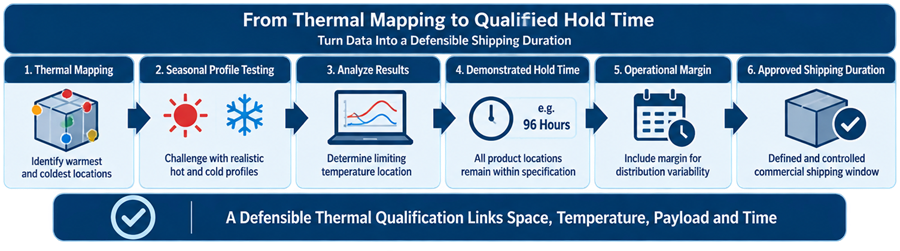
Thermal mapping identifies where the system is most vulnerable. Seasonal profiles determine how the external environment challenges it. Minimum and maximum payload studies define how commercial load variability affects performance. Hold-time analysis establishes how long the system can maintain every required product position within the approved range.
The validation logic can therefore be summarized as: Product temperature requirement → thermal mapping → seasonal ambient profiles → payload worst cases → controlled OQ → time-temperature analysis → demonstrated hold time → operational shipping duration → seasonal PQ and lifecycle verification
This approach prevents a thermal shipping system from being qualified merely because one centrally located logger remained within range during one chamber test. Instead, qualification demonstrates that the complete commercial payload remains controlled across the spatial, seasonal, load, and duration conditions that define actual use.