

Packaging Qualification Strategy and Worst-Case Configuration
Packaging qualification provides documented evidence that a defined packaging system can perform its required functions under the manufacturing, storage, aging, handling, and distribution conditions applicable to the product. It should not begin by selecting a familiar ASTM, ISTA, seal-strength, or leak-test protocol. Qualification should begin with approved packaging requirements, identified failure risks, the commercial packaging configuration, and a technically justified definition of what must be demonstrated.
The qualification strategy therefore connects the design basis established in Packaging System Requirements, Design, and Risk Assessment with the specific verification studies performed later. Depending on the product and packaging system, those studies can include material and dimensional verification, package integrity testing, aging or stability studies, distribution simulation, packaging-process validation, thermal qualification, and actual shipping studies.
A central part of this strategy is worst-case configuration selection. Packaging families frequently include multiple product sizes, fill volumes, package dimensions, materials, case quantities, payloads, and distribution configurations. Testing every possible combination may provide little additional scientific value. Conversely, testing a convenient configuration without demonstrating that it represents the relevant challenge can leave significant qualification gaps.
Worst-case selection should therefore be based on the failure mechanism being evaluated. The package presenting the greatest challenge to seal integrity may not be the worst case for drop resistance, compression, moisture protection, thermal performance, or vibration. A robust qualification strategy may consequently require several different representative configurations rather than one nominal “worst-case package.”
Key Principles
- Packaging qualification should demonstrate defined packaging requirements, not merely completion of standard tests.
- Qualification boundaries should represent the commercial packaging system and include components whose failure could affect product quality, sterility, device performance, labeling, or distribution protection.
- Test methods, challenge conditions, sample configurations, and acceptance criteria should be traceable to packaging requirements and identified risks.
- Worst-case selection should be based on characteristics that challenge the specific function being evaluated.
- A single configuration should not automatically be designated worst case for every packaging test.
- Bracketing and representative testing should be supported by technical justification rather than package size alone.
- Qualification samples should represent production materials, manufacturing processes, sterilization conditions, and final packaging configuration as closely as practical.
- Preconditioning, aging, sterilization, environmental exposure, and distribution simulation should be sequenced according to the question the study is intended to answer.
- Acceptance criteria should be established before testing and should address both package condition and product or device performance where applicable.
- Successful qualification establishes evidence for a defined configuration and operating envelope; it does not permanently qualify future changes outside that basis.
Define the Qualification Objective First
The first question in a packaging qualification is not “Which test standard should be used?” It is what must the study demonstrate?
Qualification objectives can differ substantially. One study may need to demonstrate that a sterile barrier remains intact after simulated distribution. Another may evaluate whether a vial system survives transportation without breakage. A third may establish that an insulated shipper maintains a required temperature range for a defined duration. Another may demonstrate that a family of pouch sizes can be represented by selected worst-case configurations.
The objective should be stated in terms of the packaging function being verified. Examples include:
- maintain product containment;
- preserve container-closure or sterile-barrier integrity;
- protect against physical damage;
- maintain required moisture, oxygen, or light protection;
- withstand defined distribution hazards;
- maintain label legibility and identification;
- preserve device function after distribution;
- maintain required temperature conditions;
- support the claimed shelf life;
- provide acceptable aseptic presentation;
- maintain package performance following sterilization.
This approach prevents qualification from becoming a collection of unrelated test reports.
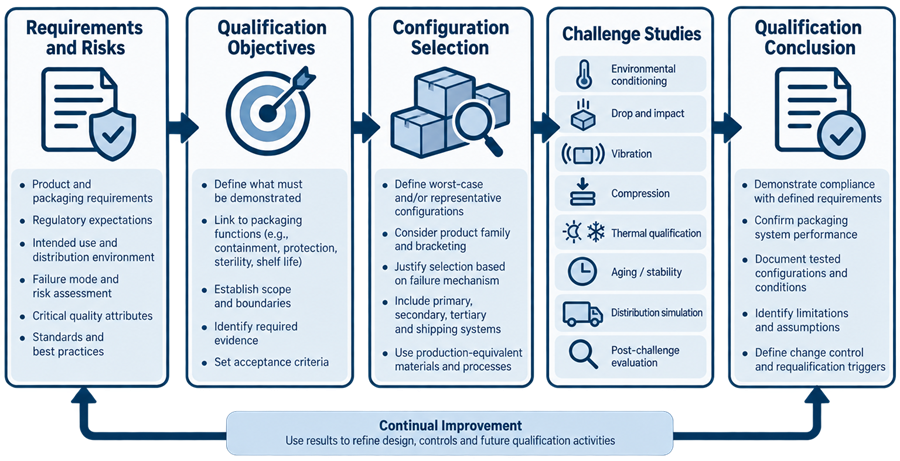
Establish the Qualification Boundary
The qualification boundary determines exactly what system is being evaluated. It should correspond to the configuration intended for routine production and distribution.
The packaging hierarchy defined in Packaging System Types and Sterile Barrier Systems is useful for establishing this boundary. Depending on the study objective, the qualified system may include primary packaging, functional secondary packaging, sterile-barrier and protective packaging, tertiary packaging, pallet configuration, or temperature-controlled shipping components.
The complete configuration should be documented sufficiently to reproduce the tested system. Relevant information can include component part numbers, materials, dimensions, closure or seal configuration, package orientation, quantities per carton or case, inserts, dividers, cushioning, shipper type, pallet pattern, stretch wrap, refrigerant quantities, and payload arrangement.
This detail is particularly important when packaging qualification is performed before commercial launch. Development packaging that is “similar” to the proposed commercial package may not provide representative evidence if material thickness, seal geometry, component tolerances, case dimensions, internal restraints, or pallet configuration later change.
Qualification Is a System of Evidence
There is no single packaging test that demonstrates overall package suitability. Different studies answer different technical questions.
A qualification strategy can therefore be considered a matrix of evidence:
| Qualification question | Typical evidence |
|---|---|
| Are materials and components suitable? | Material characterization, specifications, compatibility data |
| Can the package be manufactured consistently? | Packaging-process validation |
| Can the package maintain required integrity? | Seal, leak, CCI, or sterile-barrier testing |
| Can package performance be maintained through shelf life? | Stability and aging studies |
| Can the packaged product withstand distribution? | ASTM/ISTA or justified distribution simulation |
| Can a temperature-controlled system maintain required conditions? | Thermal qualification |
| Does the product/device remain acceptable after package challenges? | Post-test functional, visual, chemical, or microbiological evaluation |
| Is actual distribution adequately represented? | Shipping-lane or real-world shipment studies where required |
These studies should be coordinated rather than executed independently. The qualification plan should define which evidence is already available, which studies are required, how they relate to one another, and what constitutes an acceptable overall conclusion.
Requirements-to-Test Traceability
Each qualification test should have a reason for being performed.
The traceability path should be: Packaging requirement → credible failure mode → control characteristic → qualification method → acceptance criterion → result
For example, if the requirement is to maintain sterility throughout distribution, credible failures may include pouch puncture, seal separation, abrasion, or material damage. Qualification can therefore include simulated distribution followed by appropriate sterile-barrier integrity assessment.
If the requirement is protection of a lyophilized vial from breakage, the relevant risks may instead include impact, vibration, vial-to-vial contact, and case compression. The test strategy should challenge those mechanisms and evaluate both package and product condition.
This is preferable to selecting a standard because it is commonly used and then attempting to justify its relevance afterward.
Risk-Based Qualification Strategy
Risk assessment determines the depth of evidence required and helps focus qualification on packaging characteristics whose failure could affect product quality, sterility, safety, performance, or usability.
For medical-device sterile packaging, ISO 11607-1:2019 remains current and was confirmed in 2024; its 2023 amendment specifically addresses application of risk management. The standard applies to materials, sterile barrier systems, and packaging systems intended to maintain sterility of terminally sterilized devices until use.
Risk assessment should consider:
- severity of the potential package failure;
- likelihood or plausibility of the failure mechanism;
- detectability before product use;
- variability of materials or packaging processes;
- distribution severity;
- product sensitivity;
- shelf-life duration;
- sterilization effects;
- dimensional or configuration variability;
- dependence on external protective packaging;
- historical performance or available platform data.
Risk ranking alone is not the objective. The useful output is identification of the packaging characteristics and conditions that require verification.
Defining Worst Case
A worst-case configuration is the configuration expected to present the greatest challenge to the specific packaging function or test condition under evaluation.
This definition is important because the term is frequently used too broadly. The largest package is not automatically the worst case. The smallest package is not automatically the worst case. Maximum fill is not necessarily worst case. Minimum fill is not necessarily worst case.
The correct configuration depends on the failure mechanism.
For example:
- greater mass may increase drop and impact energy;
- lower payload mass may create greater movement within a shipper;
- longer seal perimeter may increase opportunities for seal defects;
- smaller seal area may create higher localized stress;
- larger surface area can increase moisture or gas transmission;
- low thermal mass can challenge temperature retention;
- high thermal mass can make preconditioning or cooling more difficult;
- maximum case quantity can increase compression load;
- minimum case quantity can increase movement and impact;
- sharp or heavy devices can increase sterile-barrier puncture or abrasion risk.
The qualification plan should state why each selected configuration represents the challenge rather than simply labeling it worst case.
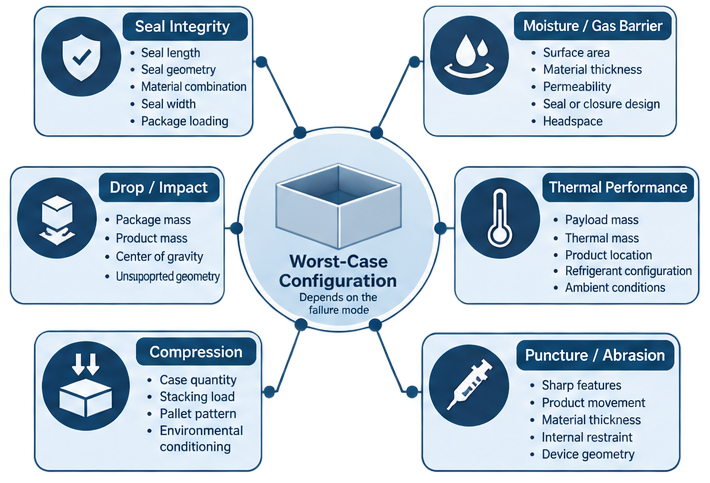
Worst-Case Factors by Qualification Function
A useful selection framework is shown below.
| Qualification function | Potential worst-case variables |
|---|---|
| Seal integrity | Seal length, seal geometry, material combination, seal width, package loading |
| Closure integrity | Closure dimensions, engagement, torque, stopper position, headspace |
| Drop / shock | Package mass, product mass, center of gravity, unsupported geometry |
| Vibration | Free movement, resonance characteristics, product restraint, case quantity |
| Compression | Maximum stacking load, case strength, pallet pattern, environmental conditioning |
| Puncture / abrasion | Sharp features, device movement, material thickness, restraint |
| Moisture barrier | Surface area, material thickness, closure interface, headspace |
| Oxygen barrier | Surface area, material permeability, seal or closure configuration |
| Thermal qualification | Payload mass, thermal mass, product location, refrigerant configuration |
| Aging | Material sensitivity, seal configuration, sterilization exposure, shelf-life duration |
| Aseptic presentation | Package dimensions, opening method, product orientation, handling sequence |
The variables should be evaluated for the actual packaging family rather than adopted automatically from this table.
Bracketing Packaging Families
Bracketing can reduce unnecessary testing when a family of packaging configurations shares common design characteristics and the selected configurations reasonably bound the relevant challenge.
For example, a family containing five pouch sizes may be represented by selected smallest and largest configurations when seal materials, sealing process, seal geometry, sterilization exposure, and device characteristics are sufficiently comparable and those sizes bound the relevant mechanical challenge.
However, dimensional extremes alone may not provide an adequate bracket. An intermediate device may have a sharp feature, greater mass, unusual center of gravity, or different orientation that creates a more severe package challenge.
A scientifically defensible bracket therefore requires evaluation of both:
- package characteristics, and
- product or device characteristics within the package.
The justification should document why untested configurations are expected to perform no worse than the configurations included in qualification.
Representative Configurations Versus Worst Case
Not every qualification study requires a strict worst-case configuration. In some situations, a representative configuration is more appropriate.
A representative configuration reflects normal commercial production and may be selected when the objective is to demonstrate typical system performance rather than bound a variable. Examples may include actual shipping-lane studies, packaging equipment qualification using nominal production materials, or studies evaluating user handling.
The terms should not be used interchangeably. A useful qualification strategy can include:
- worst-case configurations to challenge known performance limits;
- representative configurations to confirm routine performance;
- bracket configurations to justify coverage of a product family.
Each selection should have a defined technical purpose.
Product and Package Familying
Packaging families should be created only when configurations are sufficiently similar in characteristics relevant to the qualification objective.
Potential familying attributes include:
- common packaging materials;
- common component suppliers;
- equivalent seal or closure design;
- common packaging equipment and process parameters;
- equivalent sterilization processes;
- similar dimensions;
- similar product mass;
- comparable product geometry;
- common secondary and tertiary packaging;
- similar distribution pathways;
- comparable shelf-life requirements.
Familying should not be based solely on marketing product family, catalog grouping, or common brand name. Products grouped commercially may impose substantially different packaging stresses.
A family justification should identify which characteristics are common, which vary, and how selected qualification units cover the variation.
Qualification Samples
Qualification samples should represent the commercial system as closely as practical. Production-equivalent materials, components, assembly processes, sealing or closure conditions, sterilization processes, labeling, secondary packaging, and shipping configuration should be used where these characteristics can influence the study outcome.
The qualification protocol should define:
- configuration and part numbers;
- manufacturing lot or lots;
- packaging-process conditions;
- sterilization status where applicable;
- aging status;
- sample quantity;
- conditioning requirements;
- test sequence;
- inspections and measurements;
- destructive versus nondestructive testing;
- acceptance criteria.
Sample quantity should be justified by the purpose of the study, expected variability, test method, risk, and statistical considerations. A fixed number such as three packages or three runs should not be treated as automatically sufficient merely because it has been used historically.
Production Variability and Edge Conditions
Qualification should account for credible sources of variability that can influence package performance.
These can include component dimensional tolerances, material thickness, sealing temperature, pressure or dwell time, closure torque, equipment setup, line speed, environmental conditions, product loading, and assembly method.
Where package performance depends strongly on a manufacturing process, qualification of the package itself should be coordinated with validation of that process. For terminally sterilized medical devices, ISO 11607-2:2019 specifically addresses validation of forming, sealing, and assembly processes and remains current following ISO’s 2024 review.
Package-performance qualification should not be used as a substitute for demonstrating that the packaging process can repeatedly produce acceptable units.
Sterilization as a Packaging Challenge
For terminally sterilized products, the qualification strategy should evaluate packaging in the condition in which it will actually be distributed and used.
Sterilization can affect:
- seal strength;
- material brittleness;
- dimensional stability;
- permeability;
- adhesive performance;
- color or opacity;
- closure properties;
- puncture resistance;
- package opening characteristics.
Where multiple sterilization cycles can occur, such as permitted resterilization or maximum processing exposure, the strategy should determine whether the maximum justified exposure represents the appropriate challenge.
The sequence of sterilization, aging, conditioning, distribution simulation, and integrity testing should reflect the study objective. Testing pristine unsterilized packaging may not demonstrate performance of the marketed configuration.
Aging and Qualification Sequence
Shelf-life claims and distribution performance interact. Packaging materials and seals can change over time, and distribution stress can occur at any point during the commercial shelf life.
The qualification strategy should therefore determine whether distribution testing is performed on:
- unaged packages;
- accelerated-aged packages;
- real-time-aged packages;
- or an appropriately justified combination.
Accelerated aging can provide earlier evidence, but real-time aging remains important for confirming actual long-term package performance. Detailed aging strategy belongs in Packaging Aging, Shelf-Life, and Stability Integration rather than being duplicated here.
The sequence should be documented. For example: Manufacture → sterilize → age → environmental condition → distribution simulation → integrity/functional testing
may answer a different question than: Manufacture → sterilize → distribution simulation → age → integrity testing
Neither sequence should be selected automatically. The correct sequence depends on the claimed performance and risk being investigated.
Environmental Preconditioning
Temperature and humidity can substantially affect corrugated packaging, polymer films, adhesives, cushioning, labels, and other packaging materials.
Preconditioning may therefore be required before distribution testing when environmental exposure can influence performance. The selected conditions should correspond to the applicable test method, distribution environment, product requirements, or identified worst-case condition.
Preconditioning should not be confused with thermal qualification of a temperature-controlled shipper. Environmental conditioning is generally used to establish the physical condition of the packaging system before mechanical testing. Thermal qualification demonstrates maintenance of a defined product-temperature range through an external ambient challenge.
Distribution Simulation as Qualification Evidence
Laboratory distribution simulation is frequently a major element of packaging qualification. ASTM D4169 provides a structured approach for evaluating shipping units using sequential anticipated hazard elements at levels representative of distribution conditions. ASTM states that, when used as a performance test, the test sequence is performed on the same shipping unit and the unit remains unopened until the sequence is completed.
The appropriate distribution cycle, assurance level, test severity, sequence, and applicable alternatives should be justified from the expected distribution system rather than selected automatically.
Detailed design of vibration, shock, compression, drop, conditioning, and transport-simulation programs is addressed in Distribution Simulation Strategy and Transport Testing. The role of Article 120 is to establish why that testing is required, which configurations it covers, and how its results contribute to the packaging qualification conclusion.
Post-Challenge Evaluation
Passing the mechanical or environmental challenge does not by itself demonstrate that the packaging system remains suitable.
The qualification strategy should define what will be evaluated after challenge. Depending on the system, this can include:
- visual package inspection;
- seal inspection;
- package integrity testing;
- container-closure integrity;
- sterile-barrier integrity;
- seal strength;
- dimensional inspection;
- product leakage;
- container breakage;
- device functional testing;
- particulate or cosmetic damage;
- label condition and readability;
- product chemical or physical attributes.
The post-test examination should correspond to the risks identified before testing.
A sterile pouch that appears visually acceptable may still require an appropriate integrity assessment. Conversely, performing an elaborate leak test may add little value when the qualification requirement relates only to crushing of a nonsterile secondary carton.
Specific methods are addressed in Package Seal Strength, Integrity, and Sterile Barrier Testing.
Acceptance Criteria
Acceptance criteria should be predetermined, measurable where practical, and traceable to packaging requirements.
Poor acceptance criteria include statements such as:
- “package acceptable”;
- “no significant damage”;
- “no major defects”;
- “test passed.”
Unless these terms are formally defined, they permit subjective interpretation after testing.
More useful criteria define the actual required condition, such as:
- no container breakage;
- no product leakage;
- no loss of package integrity;
- seal strength meets approved specification;
- sterile-barrier system shows no defined integrity failure;
- device remains functional within approved requirements;
- label information remains legible and attached;
- no product-temperature excursion beyond defined limits;
- case deformation does not compromise primary or secondary packages.
Not every cosmetic change should automatically constitute a failure. Acceptance criteria should distinguish between defects that affect product quality or package function and cosmetic effects that do not.
Qualification Test Matrix
A controlled test matrix is an effective way to integrate the qualification program.
| Configuration | Risk / function | Challenge | Post-test evaluation | Rationale |
|---|---|---|---|---|
| Configuration A | Seal integrity | Sterilization + aging | Seal/integrity testing | Worst-case seal geometry |
| Configuration B | Distribution protection | Conditioning + transport simulation | Visual + product functional testing | Maximum package mass |
| Configuration C | Compression | Pallet/load challenge | Package and product inspection | Maximum stacking load |
| Configuration D | Thermal protection | Summer/winter ambient profiles | Temperature data | Minimum thermal payload |
The actual matrix can contain several studies, but every row should ultimately trace back to a requirement or risk.
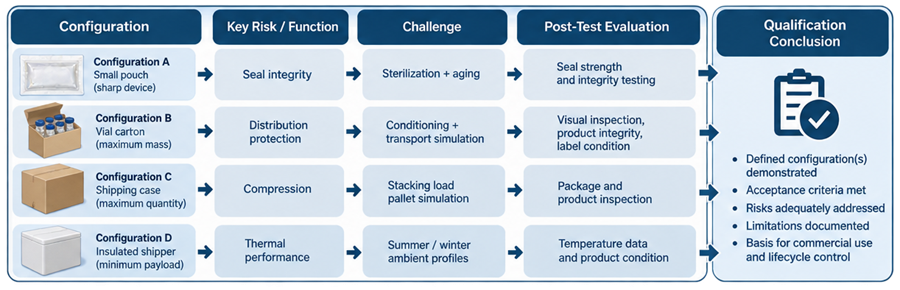
Deviations and Qualification Failures
Qualification failures should not be resolved by repeating the study until a passing result is obtained.
The first task is to determine whether the event resulted from:
- execution error;
- test-equipment malfunction;
- incorrect sample configuration;
- manufacturing defect;
- packaging-design weakness;
- incorrect worst-case assumption;
- inappropriate acceptance criterion;
- underestimated distribution or environmental challenge.
A confirmed packaging failure can require design modification, additional controls, revised specifications, changed protective packaging, process adjustment, or reevaluation of the qualification family.
Retesting should be based on documented investigation and defined corrective action. The original failure remains part of the qualification history.
Qualification Report and Overall Conclusion
The final qualification report should integrate the evidence rather than simply attach individual test reports.
The conclusion should identify:
- qualified packaging configuration or family;
- packaging components and revisions covered;
- representative and worst-case configurations tested;
- qualification studies performed;
- applicable sterilization and aging conditions;
- distribution configuration;
- acceptance criteria and results;
- deviations and investigations;
- limitations of the qualification;
- assumptions supporting bracketing or familying;
- conditions requiring reassessment or requalification.
The conclusion should make clear what has been demonstrated and what has not.
A statement such as “packaging qualification passed” is much less useful than a defined conclusion establishing that specified configurations, materials, manufacturing conditions, shelf-life assumptions, and distribution configurations are supported by the completed evidence.
Relationship to Shipping Validation
Packaging qualification and shipping validation should remain distinct.
Packaging qualification demonstrates that the defined package can perform required protective functions under specified challenges. Shipping validation considers the broader distribution process, including routes, carriers, transportation modes, handling, seasonal conditions, transit duration, monitoring, and actual logistics controls.
A package that passes laboratory distribution simulation can still be exposed to shipping conditions outside the assumptions used for qualification. Conversely, real-world shipments alone may not provide reproducible exposure to the worst mechanical hazards needed to challenge packaging performance.
The two programs therefore complement each other. Packaging qualification establishes package capability; Shipping Validation Strategy and Distribution Risk Assessment establishes whether the distribution process operates within an adequately controlled and justified environment.
Lifecycle Application
Packaging qualification remains valid only while the assumptions supporting it remain applicable.
Changes requiring assessment can include:
- packaging material or supplier changes;
- dimensional changes;
- new package sizes;
- different product mass or geometry;
- closure or seal changes;
- packaging-process changes;
- sterilization changes;
- revised shelf life;
- altered case quantity;
- different cushioning or inserts;
- pallet-pattern changes;
- new distribution modes or lanes;
- changed temperature requirements.
The change assessment should determine which qualification assumptions are affected and whether existing worst-case studies still bound the revised configuration.
Not every change requires complete requalification. A scientifically justified assessment may demonstrate that the change remains within the established qualification envelope. Conversely, a seemingly minor dimensional or material change may require focused testing if it affects a critical failure mechanism.
Validation Perspective
A defensible packaging qualification strategy should answer six questions:
- What packaging function or requirement is being demonstrated?
- What failure mechanisms could prevent that function from being maintained?
- Which configuration presents the relevant worst case or representative condition?
- What challenge will demonstrate adequate performance?
- What objective acceptance criteria determine success?
- What configurations and lifecycle conditions are covered by the resulting evidence?
When these questions are answered before testing begins, worst-case selection becomes an engineering justification rather than a convenient sample choice. The result is a qualification program that supports the entire commercial packaging system with traceable, risk-based evidence rather than an accumulation of unrelated test reports.