

Shipping Excursion Assessment and Product Disposition
A shipping excursion occurs when a distributed product is exposed to conditions outside the approved or otherwise defined transportation limits established for the product and shipping system. Temperature excursions are the most common example, but distribution deviations can also involve excessive shipment duration, freezing, humidity, mechanical damage, loss of package integrity, incorrect orientation, pressure exposure, security breaches, data loss, or other events capable of affecting product quality.
An excursion should not automatically result in product rejection, but neither should successful delivery or an apparently acceptable package be interpreted as evidence that product quality was unaffected. The appropriate decision requires a documented assessment of what occurred, the reliability of the available evidence, the product attributes potentially affected, and whether existing stability, packaging, qualification, or other scientific data adequately support continued use.
WHO defines a temperature excursion as exposure of a time- and temperature-sensitive pharmaceutical product outside the prescribed storage or transport range, with those ranges established by the manufacturer based on stability data. WHO further states that pharmaceutical products should be transported so that excursions outside the labeled temperature range do not adversely affect product quality and that stability data should demonstrate acceptable excursion time during transportation.
For U.S. pharmaceutical operations, 21 CFR §211.192 requires unexplained discrepancies and failures to meet specifications to be thoroughly investigated, including evaluation of potentially associated batches and documented conclusions and follow-up. Although a transportation excursion is not necessarily an OOS result, the same investigation principle is relevant when the event can challenge product quality or an approved distribution condition.
Key Principles
- Excursion detection and product-impact assessment are separate activities. A logger alarm identifies an event; it does not determine product disposition.
- Product disposition should be based primarily on product-specific scientific evidence, particularly stability data, rather than on generic temperature rules.
- Magnitude and duration should be evaluated together. Maximum or minimum temperature alone is usually insufficient.
- The complete time-temperature profile should be reviewed rather than relying only on an alarm indicator or summary value.
- The reliability of the monitoring record, logger calibration, location, and shipment association should be confirmed before the data are used.
- Previous temperature exposure may need to be considered when cumulative degradation is scientifically plausible.
- Qualification data demonstrate shipping-system capability but should not automatically be interpreted as product stability data.
- Mechanical damage, package-integrity failures, freezing, excessive duration, and security events may require different assessment pathways from ordinary temperature excursions.
- Additional product testing can support an investigation when scientifically meaningful, but passing selected tests should not automatically override inadequate stability evidence.
- Quality should retain final responsibility for disposition and should document the technical rationale for release, continued hold, rejection, or other action.
- Recurring excursions should trigger assessment of the shipping system, lane, carrier, packaging, procedures, and qualification assumptions even when individual affected shipments remain releasable.
What Constitutes a Shipping Excursion
The excursion criterion should be established before commercial distribution begins. For temperature-sensitive products, this commonly includes an approved transport or storage range derived from product labeling and stability data. The shipping specification may sometimes be more restrictive than the underlying product stability capability because it serves as an operational control.
For example, a refrigerated product may have an approved shipping control of 2–8 °C while development or stability data demonstrate that defined temporary exposure outside that range does not adversely affect product quality. A logger reading of 9 °C therefore represents an operational excursion, but it does not automatically establish a product failure.
This distinction is fundamental: Shipping limit exceeded ≠ product quality automatically compromised
The excursion initiates an assessment. The scientific evidence determines the disposition.
FDA’s Q1A(R2) stability guidance establishes the broader principle that product shelf life and storage conditions should be supported by stability data. FDA also notes that excursions affecting formal stability-study conditions should be assessed for their impact on the resulting stability information.
Excursion Detection Versus Product Impact
The monitoring system answers: What environmental condition was recorded?
The quality assessment answers: Could that condition have adversely affected this product?
These are not the same question. A logger can accurately demonstrate that a shipment reached 12 °C for 45 minutes. Whether that exposure matters depends on the formulation, dosage form, product concentration, container-closure system, remaining shelf life, previous exposure history, and product-specific stability information.
Likewise, a shipment can remain technically within a temperature range while another uncontrolled event—such as freezing, package puncture, broken container closure, or excessive transportation duration—creates a different product-quality risk.
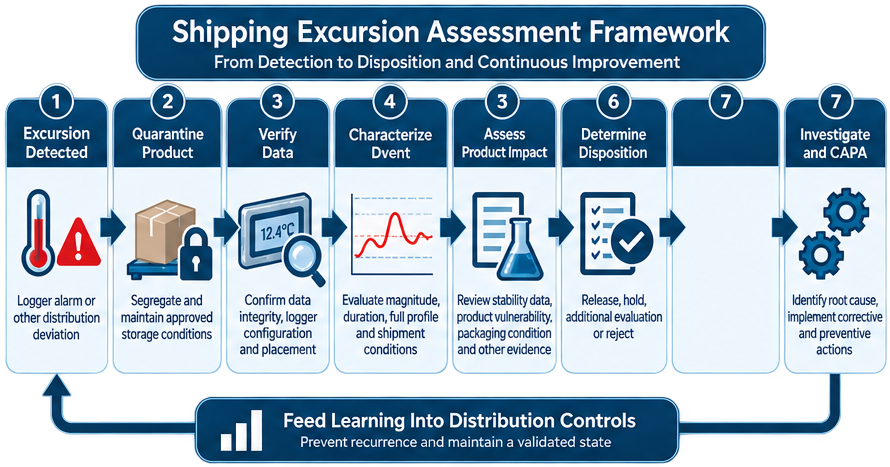
Immediate Actions After an Excursion
The affected shipment should remain under controlled status until the excursion has been assessed. For product already transferred to the receiving organization, the disposition process should ensure that it is not inadvertently released or used before the necessary review is complete.
Immediate actions normally include identifying and segregating the affected product, maintaining appropriate storage conditions, preserving logger and shipping records, documenting the shipment condition, notifying the responsible quality unit, and collecting information that may become unavailable later.
The purpose is to preserve both the product and the evidence.
The shipment should not remain unnecessarily at ambient conditions while personnel debate the excursion. Product should normally be moved promptly into the appropriate approved storage environment unless another action is specifically required.
Preserve the Original Evidence
Environmental data should be retained before devices are reset, discarded, returned, or reused. The assessment should preserve the complete time-temperature record where available, logger serial number or unique identifier, calibration status, alarm configuration, placement location, shipment identification, route information, pickup and delivery times, packaging configuration, and relevant handling records.
Where the logger depends on software or a cloud platform, the original electronic record and associated metadata should be retained according to the site’s record-management procedure.
The integrity of these records should remain consistent with the ALCOA Data Integrity Principles: data supporting the excursion assessment should remain attributable, legible, contemporaneous, original, and accurate.
Distribution Environmental Monitoring and Data Logger Qualification addresses the qualification, calibration, placement, configuration, and lifecycle controls required for these monitoring devices.
Verify the Monitoring Data Before Assessing Product Impact
A product-impact assessment based on unreliable data can lead to either unnecessary rejection or inappropriate release.
Before interpreting the event, confirm that the logger was associated with the correct shipment, activated correctly, located in the intended position, calibrated within the required interval, and operating within its specified range.
The review should also determine whether there were missing data, logger failure, communication failure, clock error, incorrect alarm programming, direct contact with refrigerant, or placement inconsistent with the qualified pack-out.
An invalid logger result should not automatically be discarded without further assessment. It creates uncertainty that may need to be resolved using other evidence such as redundant loggers, carrier records, real-time monitoring, qualified packaging hold time, ambient conditions, or receiving observations.
Characterize the Complete Excursion
An excursion should be described using more than the highest or lowest recorded temperature.
Relevant characteristics include:
| Characteristic | Assessment question |
|---|---|
| Maximum temperature | How high did the product or monitoring location reach? |
| Minimum temperature | Was the product exposed to freezing or excessive cold? |
| Duration | How long was the applicable limit exceeded? |
| Total profile | Was exposure continuous, intermittent, or cyclic? |
| Time of occurrence | At what point in the shipment did it occur? |
| Rate of change | Was exposure gradual or abrupt? |
| Shipment duration | Was the qualified shipping-time limit exceeded? |
| Logger location | Does the reading represent product exposure? |
| Packaging condition | Was the thermal or protective system compromised? |
| Previous exposure | Has the product experienced earlier excursions? |
This characterization converts a logger alarm into a technically useful exposure profile.
Magnitude and Duration Must Be Evaluated Together
Temperature severity depends on both how far the product moved outside its intended condition and how long the condition persisted.
A 20-minute exposure to 10 °C is not scientifically equivalent to 20 hours at 10 °C. Similarly, one minute at −1 °C can be more consequential for some freeze-sensitive biological products than several hours slightly above a refrigerated range.
A useful representation is: Excursion impact = function of temperature × time × product sensitivity
This is not intended as a universal mathematical equation. It expresses the scientific principle that temperature and duration cannot normally be interpreted independently. WHO specifically expects acceptable excursion time during transportation to be supported by product stability data.
Stability Data Are the Primary Scientific Basis
Product-specific stability data should normally be the principal evidence used to determine whether a temperature excursion can be accepted.
Relevant information can come from long-term stability studies, accelerated stability studies, intermediate studies, development studies, temperature-cycling studies, freeze-thaw studies, thermal-stress studies, excursion studies, and other scientifically controlled experiments applicable to the product.
FDA’s Q1A(R2) guidance establishes the formal stability framework used to support storage conditions and product shelf life. FDA also states that expiration dates represent the period during which the product is known to maintain strength, quality, and purity when stored according to labeled conditions.
The excursion assessment should identify which available data actually represent the observed exposure rather than simply citing the existence of a stability program.
Labeled Storage Conditions Are Not the Same as Absolute Failure Limits
A labeled storage range defines the approved conditions under which the product should normally be maintained. It should not automatically be interpreted as the exact temperature at which degradation begins.
Stability programs frequently contain information demonstrating that products can tolerate limited temporary exposure outside their labeled conditions. FDA notes, for example, that many refrigerated biological products have manufacturer data supporting limited exposure to somewhat elevated temperatures.
That information should be used scientifically and within an approved quality process. It should not become an informal justification for allowing routinely uncontrolled transportation.
Repeated reliance on excursion tolerance indicates weakness in the distribution control strategy even when individual product dispositions remain acceptable.
Use Product-Specific Excursion Data Where Available
The strongest excursion-support package contains predefined product-specific data covering realistic transportation deviations.
An excursion study may intentionally evaluate conditions such as:
- defined periods above the labeled range;
- elevated-temperature cycling;
- low-temperature exposure;
- freeze-thaw cycles;
- repeated excursions;
- temperature recovery;
- exposure at different points in shelf life.
These studies can establish an internal excursion-assessment matrix or scientifically justified decision boundaries.
For example, the assessment may demonstrate that a product remains within specification following defined exposure at 15 °C for a particular duration. Such data can substantially reduce the uncertainty of future investigations if the study configuration represents the commercial product.
Accelerated Stability Data Require Appropriate Interpretation
Accelerated stability data can provide useful evidence about temperature sensitivity, but they should not be applied mechanically to every shipping excursion. An accelerated study may expose product continuously to elevated temperature for months. A commercial excursion can involve a shorter period, changing temperatures, or a different humidity environment.
The assessment should evaluate whether the degradation mechanism represented by the accelerated data remains relevant to the actual event.
FDA’s final Q1E guidance provides principles for evaluating stability datasets and extrapolation, but it should not be interpreted as granting unrestricted extrapolation of commercial excursion tolerances beyond available scientific evidence.
Do Not Extrapolate Beyond the Available Evidence Without Scientific Basis
An excursion assessment should remain within the scientific boundaries of the available stability knowledge. If a study supports 24 hours at a particular elevated temperature, it does not automatically establish acceptability for 36 or 48 hours.
Likewise, evidence at one temperature should not automatically be converted to a different temperature by simple proportional calculation unless an appropriate degradation model has been established and justified for the product.
Mathematical models can be useful, but the assumptions underlying them should be valid for the formulation, degradation mechanism, temperature range, and quality attribute being protected.
Mean Kinetic Temperature Has Limited Applications
Mean kinetic temperature (MKT) can be useful for characterizing certain cumulative thermal exposures, particularly where temperature effects follow a suitable kinetic relationship. It should not be used as a universal method for converting every temperature excursion into an acceptable equivalent exposure.
An acceptable MKT can conceal a short but damaging low-temperature or freeze event. It can also obscure a high-temperature exposure that triggers a degradation mechanism not adequately represented by the assumed model.
MKT should therefore be applied only when scientifically appropriate and supported by the stability characteristics of the product. It is a supplemental analytical tool, not an automatic product-release criterion.
Freezing Requires Separate Consideration
Freeze-sensitive products should not be assessed solely from their subsequent recovery to the approved temperature range.
Freezing can cause irreversible physical changes such as protein aggregation, precipitation, emulsion instability, container stress, altered particle size, or loss of biological activity.
The critical information can include the minimum temperature reached, duration below the freezing threshold, number of freeze-thaw cycles, actual product freezing point, container geometry, and available freeze-thaw stability data.
A temperature trace indicating possible freezing should therefore trigger a product-specific evaluation rather than being averaged with the rest of the shipment profile.
Biological Products Can Require Different Assessment
Biologics may be particularly sensitive to temperature, freezing, agitation, interfacial stress, or combinations of shipping hazards.
An excursion assessment can therefore require evaluation of potency, aggregation, particulate formation, protein conformation, biological activity, or other product-specific critical quality attributes.
The relevant stability evidence should reflect the type of biological product and known degradation pathways.
Generic assumptions derived from small-molecule products should not be applied automatically to vaccines, monoclonal antibodies, cell-based products, gene therapies, or other biologically complex materials.
Consider Remaining Shelf Life
The remaining shelf life of the affected lot can be relevant to the assessment. A temperature excursion may consume some portion of the product’s stability margin without causing immediate failure. The same exposure can therefore have different lifecycle implications depending on whether the product is early or late in its shelf life and on the available stability evidence.
This does not mean that remaining shelf life should be reduced automatically after every excursion. Any revised expiration date or restriction should have a scientifically and procedurally justified basis.
Where the existing stability dataset directly supports continued conformance through the labeled expiry despite the excursion, no adjustment may be necessary.
Cumulative Exposure
Repeated excursions can create a different risk from one isolated event.
If degradation is cumulative, the assessment should consider whether the affected lot has previously experienced temperature deviations during manufacturing, storage, distribution, return, or prior shipment.
A quality system that assesses every event as though the product had never been exposed previously can underestimate cumulative risk.
Tracking cumulative exposure becomes especially important for reusable distribution cycles, returned goods, depot transfers, clinical-supply networks, and products shipped through multiple storage locations.
Excessive Shipping Duration
Not every excursion is a temperature excursion. A shipping system may be qualified to maintain product temperature for 96 hours. If delivery occurs after 110 hours but the available logger shows product still within temperature limits, the event should still be evaluated because the approved shipping process exceeded its validated duration.
The immediate product-quality risk may be low when monitored product temperatures remained acceptable, but the distribution deviation challenges the validated operating envelope and can indicate insufficient hold-time margin or route control.
Shipping Lane Qualification and Real-World Shipment Studies and Thermal Mapping, Seasonal Profiles, Payload, and Hold-Time Qualification define how lane duration and thermal hold-time limits should be established.
Packaging Damage and Physical Excursions
Distribution excursions can also involve conditions that compromise packaging rather than temperature. Examples include crushed shipping containers, broken vials, punctured flexible packages, displaced closures, damaged sterile barriers, compromised tamper seals, wet packaging, shock events, or excessive compression.
The assessment should determine whether the damage is cosmetic or can affect product quality.
A damaged outer shipping case can remain acceptable when all protective functions remain intact. A seemingly small puncture through a sterile barrier or loss of container-closure integrity can be critical.
Relevant evidence may include Package Seal Strength, Integrity, and Sterile Barrier Testing, mechanical package qualification, container-closure integrity studies, product examination, and distribution simulation data.
Transportation Shock and Vibration Events
Electronic impact or shock indicators can identify severe handling events, but activation should not automatically mean the product is damaged. The assessment should compare the recorded event with the qualified mechanical limits and known product vulnerability.
If Distribution Simulation Strategy and Transport Testing demonstrated that the packaged product withstands a more severe controlled impact without functional or integrity failure, that evidence can support the investigation.
Conversely, absence of visible damage does not automatically demonstrate that a highly sensitive device, glass system, or sterile barrier remained unaffected.
Security and Tampering Events
Loss of shipment control can create a disposition issue even when temperature remains acceptable. A broken security seal, unexplained shipment opening, route diversion, missing product, unexplained delay, or evidence of tampering can raise questions about identity, integrity, traceability, and possible substitution.
These events should follow the site’s security and quality procedures and may require different evidence from a normal environmental excursion.
Temperature data cannot establish product integrity when chain of custody has been compromised.
Initial Excursion Classification
The organization can use a preliminary classification system to determine the appropriate level of investigation, provided the classification does not predetermine disposition.
For example, events might be classified according to:
| Classification basis | Example |
|---|---|
| Minor operational deviation | Brief, well-characterized event comfortably within established excursion data |
| Significant excursion | Exposure requiring detailed stability assessment |
| Critical excursion | Exposure beyond available data, freezing, package-integrity failure, or potentially severe quality impact |
| Data uncertainty | Missing, invalid, or conflicting environmental record |
The classification should drive investigation depth and escalation.
It should not become a shortcut for declaring a shipment acceptable without reviewing the supporting evidence.
Product Impact Assessment
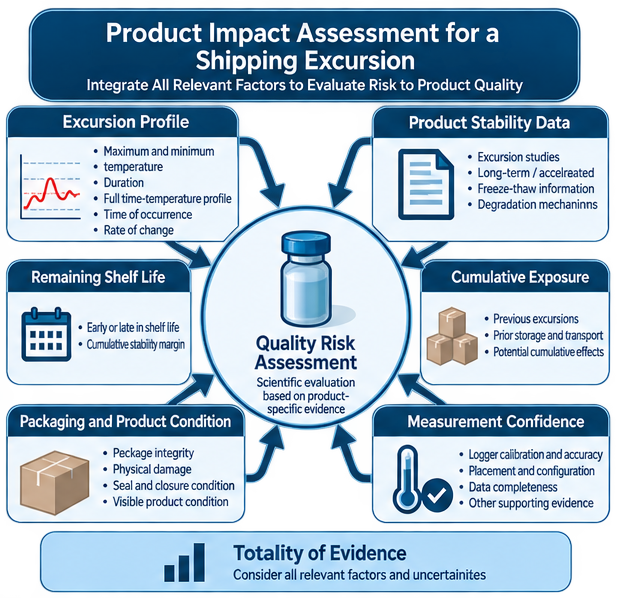
The product-impact assessment should connect the recorded event to the quality attributes potentially affected.
A useful assessment sequence is: What happened? → What product attribute could be affected? → What scientific evidence represents that exposure? → Does the evidence support continued conformance through the required shelf life?
Relevant quality attributes can include assay, degradation products, potency, physical appearance, pH, dissolution, particle size, aggregation, sterility assurance, container integrity, viscosity, preservative effectiveness, device functionality, or other characteristics specific to the product.
The assessment should avoid listing every possible test generically. It should identify the mechanisms that are scientifically plausible for the observed excursion.
Use of Additional Laboratory Testing
Additional product testing can sometimes provide useful evidence, but it should be selected according to the anticipated degradation mechanism. Testing can be appropriate when the excursion could affect a measurable attribute and the analytical method is capable of detecting the expected change.
However, passing release tests after an excursion does not necessarily prove that the product remains suitable through its remaining shelf life. Routine release methods may not detect every stability-related change, and one test point cannot replace the long-term information provided by an established stability program.
Additional testing should therefore supplement rather than casually replace stability evidence.
Testing Should Answer a Defined Question
Before additional testing is ordered, the investigation should state what uncertainty the test is intended to resolve.
For example:
- Does possible freezing produce visible or subvisible aggregation?
- Did excessive heat increase a known degradant?
- Did mechanical impact compromise container integrity?
- Did shock affect device functionality?
- Did package damage compromise sterility protection?
Testing without a defined technical hypothesis can generate results that look reassuring but do not address the relevant risk.
Avoid “Test Into Compliance”
Repeated testing should not be used to convert an inadequately supported excursion into an acceptable disposition. If stability evidence does not support the exposure and the proposed additional tests do not establish the affected lifecycle risk, repeatedly generating passing measurements does not create scientific assurance.
The product disposition should reflect the total weight of evidence and the limitations of that evidence.
Investigation Requirements
A significant shipping excursion should be investigated not only for product impact but also for cause.
21 CFR §211.192 requires thorough investigation of unexplained discrepancies and specification failures, including conclusions and follow-up. WHO’s Good Storage and Distribution Practices similarly treat transportation as part of the controlled quality system and identify deviations, CAPA, risk management, monitoring, and outsourced activities as lifecycle responsibilities.
The investigation should determine whether the excursion resulted from package failure, incorrect pack-out, wrong refrigerant conditioning, logger placement, carrier delay, route change, refrigeration malfunction, weather, customs hold, receiving delay, operator error, inadequate qualification margin, or another mechanism.
The product-impact decision and the root-cause investigation should remain connected but distinct.
Root Cause Is Not Required Before Product Can Always Be Assessed
In some cases, sufficient scientific information is available to determine product disposition before the complete logistics root-cause investigation has concluded. For example, a well-characterized two-hour exposure may be clearly supported by product-specific stability data even though the carrier investigation into the delay is still open.
Quality can therefore distinguish: Is the product acceptable?
from: Why did the distribution system leave its approved state?
The latter still requires appropriate follow-up because recurring use of excursion tolerance is not an adequate distribution control strategy.
Product Disposition Options
Disposition should reflect the available scientific evidence and applicable quality-system requirements.
Potential outcomes include:
- Release / accept — evidence demonstrates that the excursion did not adversely affect product quality through the required period of use.
- Continue quarantine / hold — available information is insufficient and additional investigation or scientifically justified testing is required.
- Restricted disposition — use may be acceptable under specifically justified conditions, such as revised remaining shelf life, market restriction, or controlled return to the manufacturer, where permitted and scientifically supported.
- Reject — evidence indicates that product quality may have been compromised or available evidence is insufficient to assure suitability.
The outcome should not be determined by economic value, supply pressure, or the inconvenience of replacement.
Quality Unit Decision
The final pharmaceutical disposition should be approved by the responsible quality unit according to established procedures. 21 CFR §211.165 requires drug products to conform to applicable specifications and quality-control criteria as a condition for approval and release and requires rejection when those criteria are not met.
For an excursion occurring after original batch release, the quality unit’s task is to determine whether the new distribution event changes the scientific basis for continued product suitability.
The decision should identify the evidence reviewed, limitations, assumptions, conclusion, and any required follow-up.
A Structured Disposition Decision
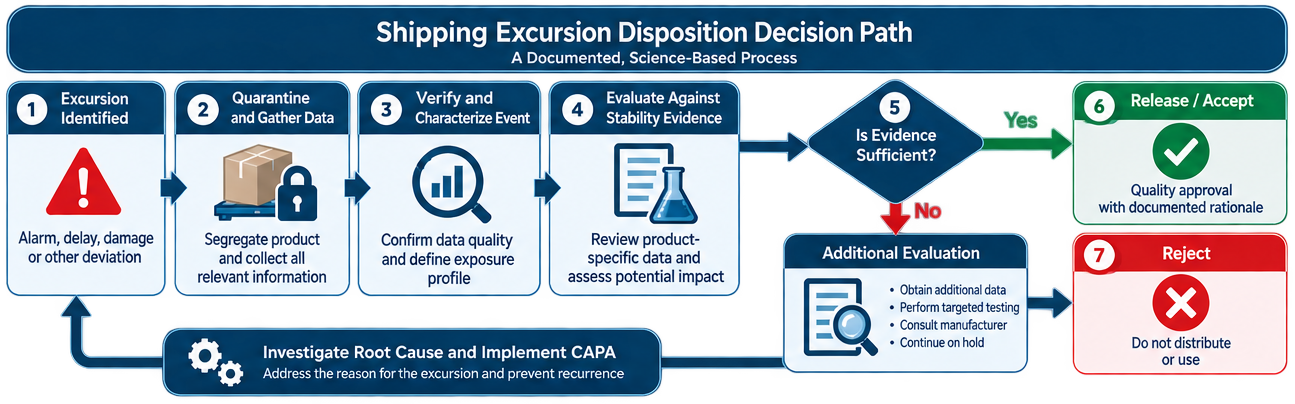
A practical decision pathway is: Excursion detected → product quarantined → monitoring data verified → event characterized → available stability/qualification evidence reviewed → product impact assessed → evidence sufficient?
- If yes, Quality determines whether the evidence supports release or another scientifically justified disposition.
- If no, the product remains on hold while appropriate additional evidence is generated or the lot is rejected when product suitability cannot be assured.
Measurement Uncertainty Near the Limit
Logger results close to an acceptance boundary should be interpreted with knowledge of the measurement system. A displayed temperature of 8.1 °C does not necessarily mean that the actual temperature was exactly 8.1 °C. Logger accuracy, calibration results, resolution, response time, placement, and other measurement uncertainties can become material when the recorded value lies near the decision threshold.
This does not mean automatically subtracting the logger tolerance from every excursion. The company’s procedure should define how measurement capability is considered in borderline cases.
Distribution Environmental Monitoring and Data Logger Qualification establishes the measurement-control framework needed to support these decisions.
Qualified Shipping System Data
Thermal and packaging qualification reports can provide valuable evidence during an excursion investigation. For example, a package qualified for 96 hours under a severe hot-season profile can provide supporting information when a commercial shipment experiences a 55-hour delay under milder measured conditions.
However, shipping-system qualification should not be confused with product stability. A package qualification demonstrates what the packaging system can do; stability data demonstrate what the product can tolerate.
Both can be used in an investigation, but they answer different questions.
Lane Qualification Data
Shipping Lane Qualification and Real-World Shipment Studies can help determine whether the excursion represents an isolated abnormal event or a recurring characteristic of the commercial route.
Historical lane data can identify normal duration, seasonal exposure, high-risk transfer points, carrier performance, and frequency of similar events.
If an allegedly “unexpected” excursion repeatedly occurs on the same lane, the issue should no longer be treated only as a shipment-specific deviation. The lane qualification or distribution strategy may need revision.
Recurring Excursions
Repeated excursions are a control-system signal. A company should not rely indefinitely on product-specific stability data to disposition repeated events caused by an inadequately controlled shipping process.
Even when every affected shipment can scientifically be released, recurrence may demonstrate that the route, packaging, carrier, thermal hold time, monitoring strategy, seasonal pack-out, receiving process, or operating procedure requires improvement.
Trend review should therefore distinguish between: product disposition success and distribution-system performance.
A shipment can be acceptable while the distribution system still requires CAPA.
CAPA
Corrective and preventive action should address the cause and risk of recurrence. Potential CAPA can include revised pack-out instructions, increased refrigerant quantity, different packaging, expanded qualification, additional thermal margin, carrier changes, lane restrictions, customs pre-clearance, alternative transfer hubs, improved training, alarm escalation, real-time monitoring, revised seasonal criteria, or strengthened receiving controls.
The CAPA should correspond to the identified failure mechanism.
Adding another logger is not an adequate corrective action when the true problem is insufficient package hold time.
Carrier and Logistics Provider Investigation
When an excursion originates with a logistics provider, the external investigation should provide enough information to support the manufacturer’s internal quality decision.
Relevant information can include actual routing, pickup and delivery times, terminal dwell, refrigeration status, vehicle records, missed connections, handling events, weather delays, subcontractors, and corrective actions.
WHO guidance on temperature-controlled transport specifically anticipates go/no-go decision-making in response to temperature excursions and recommends defining these service requirements through user requirements and service agreements.
Responsibility for final product disposition should remain with the appropriate product owner or quality authority rather than being delegated automatically to the carrier.
Receiving-Site Responsibilities
Receiving personnel should know what to do when a logger alarms, packaging is damaged, delivery is late, or another shipping deviation is identified. The receiving procedure should define segregation, storage, notification, logger handling, documentation, and restrictions on product use. The receiver should not discard packaging, reset devices, or destroy evidence before the investigation requirements are understood.
Prompt movement into appropriate controlled storage remains important even when the product is placed on quality hold.
Supplier or Manufacturer Stability Statements
Organizations sometimes obtain manufacturer statements confirming that a particular excursion is acceptable. These can provide useful product-specific evidence when they are supported by appropriate stability information and identify the affected product, exposure, and conclusion clearly.
A generic statement that “the product is stable at room temperature” may be insufficient if it does not address the actual time, temperature, packaging, shelf-life stage, or product configuration involved.
Where reliance on supplier excursion assessments is routine, responsibilities and response expectations should be incorporated into quality or technical agreements.
Documentation of the Assessment
The final excursion record should create a traceable link from the detected event to the disposition decision.
A useful report structure includes:
| Assessment element | Content |
|---|---|
| Shipment identification | Product, lot, quantity, route, carrier |
| Event description | Type of excursion and detection method |
| Environmental data | Full profile, magnitude, duration |
| Monitoring system | Logger ID, calibration, placement |
| Packaging | Configuration and physical condition |
| Shipment duration | Actual versus qualified duration |
| Stability evidence | Applicable studies and limits |
| Previous exposure | Relevant cumulative history |
| Product impact | Quality attributes and scientific rationale |
| Additional testing | If performed, rationale and results |
| Root cause | Distribution-system investigation |
| Disposition | Release, hold, reject, other |
| CAPA | Corrective and preventive actions |
| Approval | Quality authorization |
The documentation should permit an independent reviewer to understand how the conclusion was reached without reconstructing the entire investigation from disconnected records.
Data Integrity
Excursion assessments can involve data from loggers, cloud platforms, transportation records, carriers, warehouse systems, stability databases, and manual documentation. The resulting evidence should remain reliable throughout the assessment.
Electronic records should be controlled according to their regulatory role and intended use. Where logger data become GMP records used to support product disposition, they should remain attributable, complete, protected from inappropriate alteration, retrievable, and consistent with the ALCOA Data Integrity Principles.
Manual transcription should be minimized when reliable electronic records are available.
Returned Product
A product returned after distribution requires particular attention because its complete environmental history may not be known. If a returned shipment has reliable monitoring records demonstrating acceptable conditions, disposition can be evaluated against those data and applicable procedures.
Where product has left controlled custody without adequate environmental information, uncertainty can be substantially greater.
The decision to reintroduce returned pharmaceutical product into saleable inventory should follow applicable GMP procedures and should not be based solely on visual appearance or an assumption that the product was handled correctly.
Medical-Device Considerations
For medical devices, the excursion may affect function, sterile barrier integrity, electronics, reagents, adhesives, batteries, dimensional stability, or other product-specific attributes.
Temperature excursion assessment should therefore be connected to device specifications, risk management, packaging qualification, and available aging or environmental data.
A sterile device whose package has been punctured or otherwise compromised generally requires a different assessment than a device whose secondary carton is cosmetically damaged.
The event should be evaluated according to the function that the affected component performs.
Pharmaceutical Considerations
For pharmaceuticals and biologics, the disposition rationale should remain grounded in product stability and applicable GMP control.
FDA’s Q1A(R2) remains the current final ICH stability guidance in the United States; FDA issued a consolidated revised ICH Q1 document as draft guidance in June 2025, explicitly designated Draft — Not for Implementation.
For current implementation, product-specific approved stability information, applicable final guidance, registered storage conditions, internal supporting studies, and scientifically justified excursion data should therefore remain the primary basis.
The 2025 draft can be monitored as evolving regulatory thinking but should not be presented as an implemented requirement.
Excursion Trending
Shipping excursions should be trended as part of continued distribution verification.
Useful metrics include excursion type, temperature magnitude, duration, lane, carrier, packaging configuration, season, root cause, product disposition, logger failure, delay duration, receiving-site performance, and recurrence.
Trends can reveal a route that is becoming less reliable, a carrier whose performance is deteriorating, insufficient seasonal packaging margin, repeated operator errors, or monitoring-device problems.
This information should feed the periodic review of the shipping-validation program established in Shipping Validation Strategy and Distribution Risk Assessment.
Change Control and Requalification
An excursion investigation can reveal that previously validated assumptions are no longer adequate.
Potential triggers include longer actual transit time, new temperature extremes, changed routes, different transfer hubs, carrier changes, insufficient thermal margin, packaging damage, revised stability information, or repeated monitoring failures.
The change assessment should determine whether existing qualification remains applicable.
Corrective actions can require focused lane verification, additional thermal OQ, package redesign, new carrier qualification, modified monitoring, or broader shipping-process revalidation.
Validation Perspective
Shipping excursion assessment should not be treated as a paperwork exercise performed after a data logger changes color or produces an alarm. It is a structured scientific evaluation connecting an actual distribution event with product stability, packaging capability, monitoring reliability, qualification evidence, and GMP quality decisions.
The essential logic is: Excursion detected → product controlled → data verified → exposure characterized → product-specific evidence evaluated → quality risk assessed → disposition approved → cause investigated → CAPA and lifecycle impact assessed
The most important distinction is between whether the affected product remains acceptable and whether the shipping system remained in a validated state.
A scientifically supportable product release does not erase the excursion. The shipment may remain acceptable while the route, carrier, package, monitoring strategy, or qualification envelope requires corrective action.