

ISTA Distribution Simulation Protocols and Test Selection
International Safe Transit Association (ISTA) procedures provide standardized laboratory approaches for evaluating how packaged products respond to transportation and handling hazards. They are widely used in package development and distribution qualification because they organize testing according to the type of distribution system being represented rather than requiring the user to assemble individual mechanical tests independently.
For validation purposes, however, selecting an ISTA procedure is not the starting point. The distribution profile, packaged-product configuration, expected hazards, product sensitivity, and qualification objective should first be established through the strategy described in Distribution Simulation Strategy and Transport Testing. The appropriate ISTA procedure can then be selected according to the commercial distribution pathway it is intended to represent.
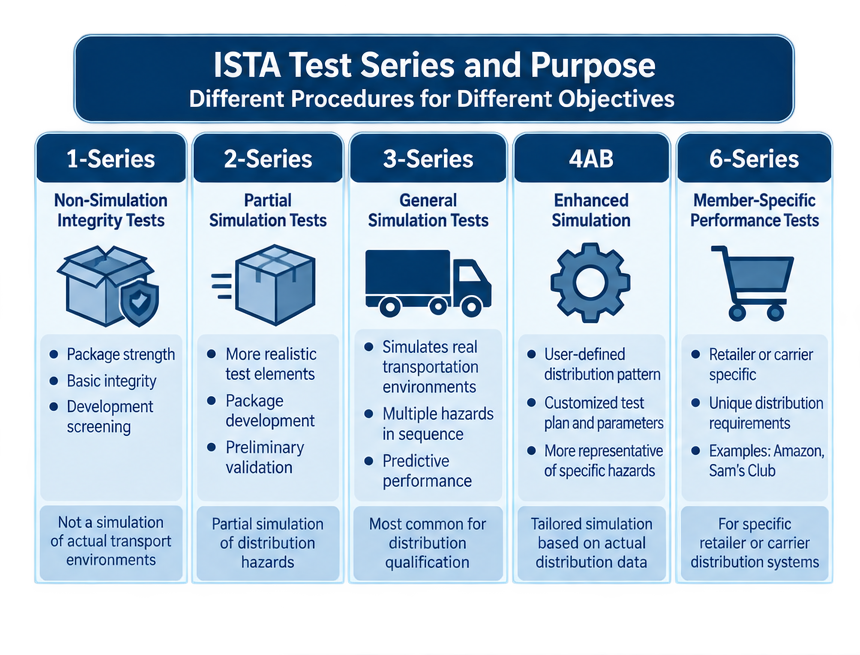
ISTA currently organizes its protocols into several families. The 1-Series provides non-simulation integrity or screening tests, the 2-Series provides partial simulation, and the 3-Series provides general simulation of transportation environments. Project 4AB provides enhanced simulation based on a user-defined distribution pattern, while 6-Series procedures represent particular retailer or carrier distribution systems. ISTA also maintains specialized development and thermal procedures.
For regulated pharmaceutical and medical-device products, the validation objective remains broader than completion of an ISTA test. The protocol should establish why the selected procedure represents the commercial distribution system, which package configurations are covered, how test samples represent production, what constitutes acceptable product and package condition, and how the resulting evidence supports the qualification claim.
Key Principles
- ISTA procedure selection should follow the actual distribution pathway and identified hazards rather than company preference or laboratory familiarity.
- ISTA 1-Series, 2-Series, and 3-Series procedures have different purposes and should not be treated as interchangeable levels of severity.
- General simulation procedures such as 3A, 3B, and 3E represent different distribution systems rather than progressively more difficult versions of the same test.
- Product and package are evaluated as a combined packaged-product system.
- Product-damage tolerance, acceptable package degradation, and the method used to determine pass or fail should be defined before testing begins.
- Production-representative packaging should be used for final qualification whenever practical.
- Test sequence matters because damage can accumulate and earlier challenges can influence response to later hazards.
- Laboratory performance should eventually be compared with actual commercial shipping experience.
- Current procedure revisions should be verified before protocol approval because ISTA periodically changes test sequences, levels, and methodology.
- Changes to product, package, or distribution conditions should be assessed for their impact on the existing ISTA qualification.
Understanding the ISTA Test Series
ISTA deliberately separates its procedures according to the objective of the testing. This is important because a package that passes a screening test has not necessarily demonstrated predictive performance in a commercial distribution environment.
The 1-Series consists of non-simulation integrity tests. These procedures challenge the strength and robustness of the packaged-product system and are useful during early package development, but ISTA states that they are not designed to simulate actual environmental occurrences.
The 2-Series provides partial simulation testing. These procedures add more realistic elements than the 1-Series and can be useful for refining preliminary package designs, but ISTA does not characterize them as predictive simulations of actual shipping performance.
The 3-Series contains general simulation performance tests. ISTA describes these procedures as laboratory simulations of the damage-producing motions, forces, conditions, and sequences associated with broad transportation environments. They are intended to provide more predictive package-performance evidence.
Project 4AB provides enhanced simulation. Instead of applying a broad predefined distribution model, 4AB generates a test plan that more closely reflects a user-defined distribution pattern using specific hazard profiles and parameters.
The 6-Series consists of member performance tests developed for particular retailer or carrier distribution systems whose characteristics are considered sufficiently distinctive that a general industry procedure may not adequately represent them. Current ISTA examples include Amazon and Sam’s Club procedures.
ISTA Is a Test Framework, Not a Regulatory Requirement
Pharmaceutical and medical-device regulations generally do not require use of a particular ISTA procedure. ISTA testing is one way to generate controlled evidence that packaging can withstand distribution hazards identified through risk assessment.
For terminally sterilized medical devices, ISO 11607-1 requires the packaging system to remain suitable through processing, storage, handling, and distribution, but it does not mandate ISTA 3A, 3B, 3E, or another specific transport test. The manufacturer must select and justify an appropriate performance-testing approach. FDA currently recognizes ISO 11607-1:2019 including Amendment 1:2023. (iso.org)
For pharmaceutical products, the qualification rationale similarly derives from product protection, container-closure suitability, stability, and distribution risks rather than from an independent requirement to conduct an ISTA test.
The correct validation question is therefore not “Which ISTA test is required?” but “Which procedure best represents the distribution hazards applicable to this packaged product?”
Selecting an ISTA Procedure From the Distribution Pathway
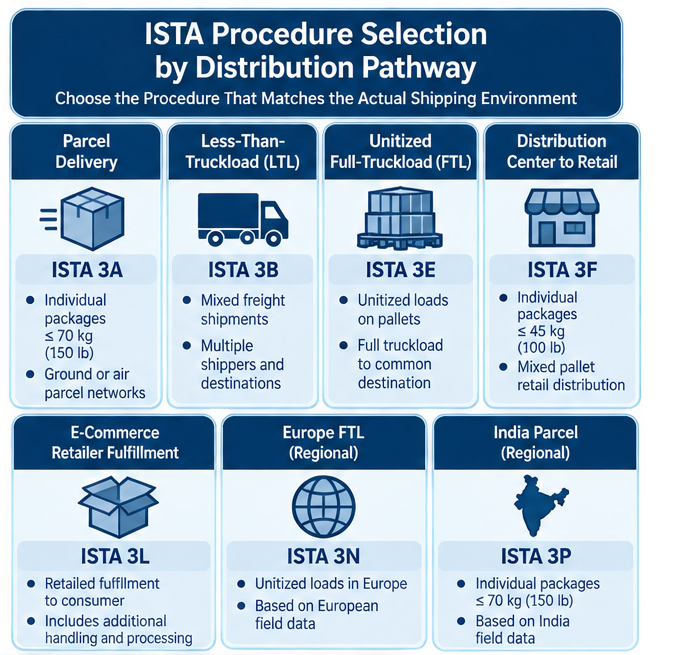
ISTA’s current selection guidance directly connects procedure selection with the distribution mode and package type. Parcel delivery, less-than-truckload freight, unitized full-truckload shipment, distribution-center-to-retail shipment, e-commerce fulfillment, European consumer distribution, reusable bulk systems, and other pathways can require different procedures.
A practical selection sequence is to characterize the shipping route first, identify whether the package moves individually or as part of a unit load, determine how it will be handled, and then select the procedure intended for that environment.
For example, an individual carton shipped through a parcel carrier generally aligns with 3A. The same product shipped on a mixed LTL freight load may align with 3B. A unitized pallet moving as part of a full truckload from manufacturing to a distribution center may align with 3E. A package fulfilled through a retailer’s e-commerce network may be better represented by 3L.
This distinction prevents the common mistake of choosing a test based primarily on package weight while ignoring the logistics system.
ISTA 3A — Parcel Delivery
ISTA Procedure 3A is intended for individual packaged products weighing 70 kg (150 lb) or less shipped through parcel-delivery systems by ground or air. ISTA identifies standard, small, flat, and elongated package types within the procedure. The current ISTA store lists Procedure 3A as edition 18-22.
The test is intended to challenge package performance against parcel-distribution hazards such as atmospheric conditioning, vibration, shock, and handling events. ISTA specifically states that the package and product are evaluated together and that general test levels may not represent every individual carrier or distribution system.
This limitation is important for validation. Passing 3A supports performance within the procedure’s simulated environment; it does not establish that every possible parcel network, route, carrier, or handling severity has been reproduced.
ISTA’s 3A overview also emphasizes sample variability. For fragile or liquid packaged products, ISTA recommends testing two or more samples and encourages repetition of the procedure with additional new samples to improve statistical confidence. Sample strategy should nevertheless remain connected to product risk, variability, and the intended qualification claim.
ISTA 3B — Less-Than-Truckload Distribution
ISTA Procedure 3B applies to packaged products shipped through a Less-Than-Truckload (LTL) system. In LTL distribution, packages from different shippers and for different destinations are consolidated into common loads and may experience repeated loading, unloading, transfer, mechanical handling, and mixed freight conditions. ISTA’s current store lists Procedure 3B as edition 17-22.
ISTA identifies standard, cylindrical, palletized, and skidded packaged-product configurations within the scope of 3B. The procedure can include atmospheric conditioning, shock, impact, random vibration with top load, tipping or tipover, and mechanical handling depending on the applicable package configuration.
The shipper is required to determine before testing what constitutes product damage, what degree of damage is allowable, how product condition will be evaluated after the test, and what package condition is acceptable. This is directly aligned with GMP validation practice: acceptance criteria should be predetermined rather than interpreted after the challenge is completed.
ISTA 3E — Unitized Full-Truckload Distribution
ISTA Procedure 3E addresses unitized loads of similar packaged products transported through a Full-Truckload (FTL) distribution system, typically between a manufacturing location and a distribution center. ISTA released a materially updated 3E procedure in 2026; its current store lists Procedure 3E (26-26_ANS).
The procedure applies where an entire trailer contains unitized packaged products intended for a common destination. The current overview states that the unitized load can contain single or multiple products or packages of similar products.
ISTA’s 2026 update addressed compression practices, impact sequencing, and improved alignment with real-world distribution hazards. This matters when maintaining legacy validations because an older 3E protocol may not reflect the current procedure.
For palletized pharmaceutical or medical-device shipments, 3E can be particularly useful where load stability, compression, vibration, and handling of the complete unit load are relevant. The qualified configuration should include the pallet, case pattern, stretch wrap or other load containment, and any components that materially influence transport performance.
ISTA 3F — Distribution Center to Retail
ISTA Procedure 3F applies to individual packaged products weighing 45 kg (100 lb) or less that move from a distribution center to a retail outlet as part of a mixed pallet configuration.
This environment differs from direct parcel or full-truckload shipment because the packaged product may be incorporated into mixed retail loads and exposed to regional distribution-center handling.
For pharmaceutical or medical-device products that move through this type of retail supply chain, 3F may represent the actual distribution pattern better than 3A or 3E. Again, the test should be selected from the commercial pathway rather than from familiarity with a more common ISTA procedure.
ISTA 3L — E-Commerce Retailer Fulfillment
ISTA Project 3L is a generalized e-commerce retailer fulfillment test. It was developed using field observations, existing test data, industry feedback, and correlation between laboratory and actual shipping damage. The current ISTA store lists Project 3L as edition 23-24.
Unlike 3A, which focuses primarily on parcel delivery, 3L includes the additional hazards introduced when products enter an e-commerce retailer fulfillment system before final shipment to the consumer. ISTA states that 3L covers retailer processing and fulfillment followed by outbound parcel or LTL delivery.
This distinction is increasingly important because an e-commerce package may undergo additional handling, sorting, storage, and fulfillment operations before entering the final carrier network.
ISTA also requires production-representative packaged products for formal 3L testing whenever possible. Its current overview warns that hand-built prototypes or one-off development samples may not adequately represent actual production packaging. This principle is directly applicable to regulated package qualification.
Emerging Regional Procedures: ISTA 3N and 3P
ISTA expanded the 3-Series significantly in 2026 with new procedures based on regional field data.
ISTA Project 3N addresses unitized loads shipped by Full-Truckload carriers within Europe. ISTA developed a new vibration profile from European FTL field data and incorporated fundamental elements of 3E where appropriate. The project was introduced in March 2026.
ISTA Project 3P addresses individual packaged products weighing 70 kg (150 lb) or less shipped through parcel-delivery systems within India. ISTA states that the procedure was developed from field data showing handling, vibration, shock, and atmospheric conditions not fully represented by existing procedures. Project 3P was also introduced in March 2026.
These additions illustrate an important qualification principle: distribution environments are not necessarily interchangeable across regions. A global packaging program should not automatically assume that a test developed around one transport environment adequately represents another.
ISTA 3M — International Direct Import Distribution
ISTA also lists Project 3M as a general simulation test for packaged products shipped internationally from Asia-Pacific manufacturing locations to a U.S. distribution center or retailer fulfillment center.
ISTA specifically notes that 3M addresses the international inbound supply-chain leg and is not intended to represent air-freight environments or every specific event that may occur while an ocean vessel is underway.
This limitation is significant because a standard procedure should never be assumed to represent hazards explicitly outside its scope. Where additional air, ocean, or regional transport stages materially affect risk, the validation strategy may require another procedure or supplementary testing.
ISTA 4AB — Enhanced Simulation
ISTA Project 4AB differs from fixed general-simulation procedures because it generates a customized test plan based on a user-defined distribution system.
The project can incorporate atmospheric conditioning, handling shock, random vibration, and compression using hazard profiles and parameters matched more closely to the selected distribution pattern. ISTA describes vibration duration as related to user-defined transit time and allows compression calculations to account for factors such as time, temperature, humidity, and stacking configuration.
4AB is therefore useful when a broad general-simulation procedure such as 3A or 3E does not sufficiently represent the known logistics environment but a standardized enhanced-simulation framework is still preferred.
A customized test should not be interpreted automatically as more rigorous. Its value is increased relevance to the distribution system being modeled.
Member Performance Tests
ISTA 6-Series protocols address supply-chain conditions associated with specific retailers or carriers. Current examples include 6-Amazon.com-SIOC, 6-Amazon.com-Over Boxing, and 6-SAMSCLUB.
These procedures can be appropriate when the product is specifically required to comply with or be qualified for that distribution network. They should not automatically replace a general simulation procedure for shipments that move through different carriers or retail systems.
For a validation program covering multiple distribution channels, it can therefore be necessary to distinguish between the general package-performance qualification and customer- or retailer-specific qualification requirements.
Thermal Procedures and Cold-Chain Applications
ISTA also provides thermal development procedures, including 7D and 7E. ISTA’s current selection guidance lists these for thermal testing of transport packaging systems.
Thermal testing addresses a different qualification question from mechanical distribution simulation. A cold-chain shipper must maintain the required thermal environment, while mechanical testing evaluates physical transport hazards such as vibration, shock, and compression.
These programs should be integrated where interaction is plausible but should not be considered interchangeable. Detailed thermal qualification is addressed in Temperature-Controlled Packaging System Qualification.
Defining Damage and Package Degradation Before Testing
ISTA places substantial responsibility on the shipper or manufacturer to define what constitutes product damage and acceptable package condition before testing.
This principle appears throughout the procedures. For example, the 3B and current 3E overviews require the shipper to determine the product-damage tolerance, the correct methodology for evaluating product condition, and the acceptable package condition before the test.
In regulated validation work, these requirements should be translated into explicit protocol acceptance criteria. Depending on the product, evaluation may include container breakage, leakage, sterile-barrier integrity, device function, seal condition, label legibility, closure position, dimensional damage, or other product-specific attributes.
A generic criterion such as “package acceptable after testing” is not sufficiently defined.
Product and Package Are Tested Together
ISTA repeatedly emphasizes the packaged-product concept. The protective performance of the package cannot be separated from the physical characteristics of the product inside it.
The product may contribute mass, center of gravity, rigidity, liquid movement, sharp edges, vibration response, or internal loading. Likewise, cushioning, dividers, orientation, and package geometry determine how the product responds to transportation stresses.
This is particularly important for medical-device sterile barriers. A package material may perform adequately by itself but fail when device movement creates abrasion or concentrated loading.
Where a product simulant is used, its relevant physical characteristics should therefore reproduce the failure mechanism being challenged rather than merely matching nominal weight.
Production-Representative Test Samples
Final qualification should use samples representative of routine production. ISTA 3L specifically states that actual production products and packages are preferred and warns that handmade or one-off prototypes may not produce meaningful final performance evidence.
The same engineering principle should be applied broadly to ISTA validation studies. Relevant variables include packaging materials, forming or sealing process, case configuration, cushioning, pallet type, orientation, labels, sterilization where applicable, and aging condition.
Development samples can be appropriate for screening and package optimization, but formal qualification should clearly identify when production-equivalent configuration has been achieved.
Sample Quantity and Replicate Testing
ISTA sample requirements differ by procedure and packaged-product type. The applicable current procedure should therefore control the minimum test quantity.
ISTA also generally encourages replicate testing because package and product performance can be variable. For 3A, the organization recommends two or more samples for fragile and liquid products and encourages testing five or more new samples to improve statistical confidence.
ISTA’s general guidance also states that failure of any required sample means the test is considered failed.
For validation purposes, the sampling rationale should consider regulatory risk, product fragility, manufacturing variability, destructive post-test evaluation, and the strength of existing evidence rather than relying only on the minimum protocol quantity.
Test Sequence and Accumulated Damage
ISTA general simulation procedures are designed around sequences of distribution hazards because transportation damage is cumulative.
Atmospheric conditioning can weaken corrugated packaging before compression. Vibration can allow components to migrate or abrade before a later impact. Repeated handling can reduce package margin before a drop event.
The test sequence should therefore be preserved as required by the selected procedure. Individual test elements should not be rearranged or omitted without a documented technical rationale.
Where development work intentionally interrupts the sequence to identify when failure occurs, that study should be identified separately from formal qualification.
Post-Test Evaluation
The final test event does not determine whether the qualification passed. The packaged product must be evaluated against the predefined acceptance criteria after the required sequence is complete.
Post-test evaluation can include visual inspection, package integrity, seal strength, container condition, leakage, product or device function, label condition, and other requirements identified by risk assessment.
For sterile-barrier systems, the distinctions among visual inspection, seal strength, and integrity testing are addressed in Package Seal Strength, Integrity, and Sterile Barrier Testing.
A successful ISTA sequence means little if the protocol does not establish whether the packaged product continued to perform its required function.
ISTA Versus ASTM
ISTA and ASTM should not be presented as competing systems where one is inherently better or more stringent.
ASTM D4169 constructs distribution-performance testing from ASTM hazard methods using distribution cycles and assurance levels. ISTA procedures instead provide predefined or customized test sequences associated with particular types of distribution systems.
The correct choice depends on the commercial distribution pathway, customer requirements, available field data, existing platform qualification, and the specific evidence required.
The companion article ASTM Distribution and Package Performance Test Methods addresses the ASTM framework in detail. Running both an ISTA and ASTM sequence is generally unnecessary unless the two studies answer different qualification questions or a contractual requirement makes both necessary.
Current Procedure Revision Control
ISTA procedures are actively maintained. This is particularly important in 2026 because ISTA introduced 3N and 3P and materially revised Procedure 3E.
ISTA states that reports generated using a previous procedure revision are accepted for up to one year after a new revision is published, but the organization strongly encourages use of the most current procedure to avoid retesting or claim issues.
Validation protocols should therefore identify the exact procedure and revision being used. A generic reference such as “ISTA 3E” is insufficient when the technical content of the procedure has changed.
ISTA’s 2026 Resource Book Version 4.0 currently includes 1-, 2-, and 3-Series procedures including 3A, 3B, 3E, 3F, 3H, 3K, 3L, 3N, and 3P, as well as current 6-Series and 7-Series materials.
Failures and Retesting
An ISTA failure should be investigated before testing is repeated. Potential causes include inadequate packaging design, package-process variation, product movement, insufficient cushioning, material weakness, inappropriate package configuration, incorrect procedure selection, or a genuine transportation vulnerability.
Repeating the test with new samples without understanding the failure does not establish package capability.
Where the packaging system is modified, the revised configuration should be documented and the scope of retesting should correspond to the failure mechanism and affected qualification assumptions.
ISTA also states that testing should be repeated periodically as necessary and whenever changes to the product, package, or process can affect packaged-product performance.
Comparison With Actual Shipping Performance
Laboratory testing should not remain isolated from commercial experience.
ISTA recommends monitoring actual shipments and comparing field performance with laboratory results. This feedback can reveal whether the selected procedure is adequately predictive and can guide future testing decisions.
For regulated products, useful signals can include shipping damage, product complaints, carrier claims, package-integrity failures, broken containers, closure movement, label damage, or other distribution-related deviations.
Recurring commercial failures despite successful ISTA qualification indicate that the distribution assumptions, selected procedure, package configuration, or test severity may need reassessment.
Relationship to Shipping Validation
ISTA testing evaluates packaged-product performance under laboratory simulation. It does not fully qualify the logistics process.
Actual shipping validation may also need to address routes, carriers, seasonal conditions, transit times, handling locations, delays, temperature monitoring, logistics-provider controls, and other real-world variables.
ISTA qualification therefore supports, but does not replace, Shipping Validation Strategy and Distribution Risk Assessment and Shipping Lane Qualification and Real-World Shipment Studies.
Validation Perspective
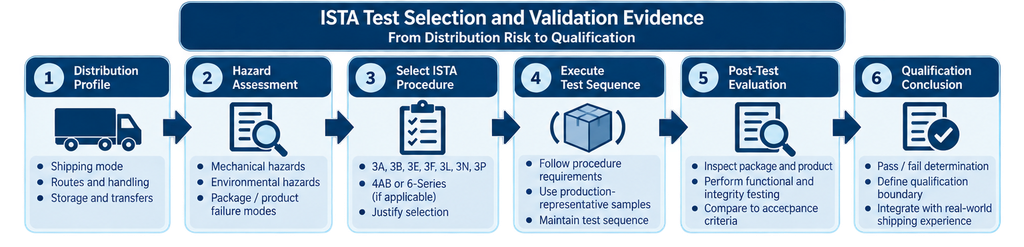
A sound ISTA qualification strategy begins with the commercial distribution pathway rather than the procedure number. The packaged-product configuration and credible transportation hazards are defined first. The applicable procedure is then selected from the distribution mode, package type, region, and qualification objective. Test samples, acceptance criteria, and post-test evaluations are established before execution, and the laboratory results are subsequently compared with actual commercial performance.
The validation path can be summarized as:
Distribution pathway → packaged-product risks → appropriate ISTA procedure → representative samples → controlled test sequence → predefined post-test evaluation → qualification conclusion → lifecycle monitoring and retesting
Used this way, ISTA procedures provide reproducible and technically relevant evidence within a packaging validation program. Used simply as a checklist or customer-requested certificate, they provide substantially less assurance about whether the commercial packaging system is actually capable of protecting the regulated product.