

Analytical Instrument User Requirements and System Boundaries
Analytical instrument user requirements define what an instrument or analytical system must do to support its intended laboratory use. They establish the performance, configuration, software, data, interface, infrastructure, environmental, security, service, and lifecycle expectations against which the proposed solution is selected and qualified.
Requirements must extend beyond the physical instrument when software, workstations, databases, network services, interfaces, or external storage contribute to the analytical result. A technically strong User Requirements Specification, or URS, therefore begins with intended use and a defined system boundary rather than a generic list of vendor features.
The required documentation depth should be proportionate to instrument complexity and GMP impact. A simple measuring instrument may be adequately defined through a concise approved specification, while a computerized analytical system normally requires a structured URS covering hardware, software, data, infrastructure, interfaces, security, and lifecycle support.
Purpose and Lifecycle Position
The analytical instrument URS provides the foundation for:
- Instrument and supplier selection
- Design assessment
- System-boundary definition
- Risk assessment
- Qualification planning
- Design Qualification
- Installation, operational, and performance testing
- Software validation
- Configuration control
- Release for routine use
- Change assessment
- Periodic review
- Requalification
- System replacement or retirement
The URS describes the required outcome. It should not prematurely dictate a supplier’s implementation unless a specific design, technology, or configuration is necessary for the intended analytical use.
The analytical instrument categories and risk classification should be established early enough to determine the appropriate depth and formality of the requirements. The approved requirements then provide a principal input to the risk-based analytical instrument qualification strategy.
Regulatory Basis
US drug CGMP regulations do not prescribe a universal URS template. They require scientifically sound laboratory controls, suitable equipment performance, controlled computerized systems, complete laboratory records, and documented calibration programs.
21 CFR 211.160, General Requirements requires scientifically sound and appropriate laboratory controls. It also requires calibration programs containing specific directions, schedules, accuracy and precision limits, and provisions for remedial action.
21 CFR 211.68, Automatic, Mechanical, and Electronic Equipment addresses routine calibration, inspection, or checking of automated equipment and controls over computer-related systems, data input and output, authorized changes, and backup data.
21 CFR 211.194, Laboratory Records requires complete laboratory data, identification of the methods used, records of calculations, test results, review, and periodic calibration of laboratory instruments.
When electronic records or electronic signatures are used to satisfy FDA requirements, applicability of 21 CFR Part 11, Electronic Records and Electronic Signatures must be assessed.
The URS translates these applicable regulatory and quality-system expectations into specific requirements for the intended analytical system. A citation to a regulation does not replace a testable requirement describing how the selected system must operate or be controlled.
Principles for Effective User Requirements
Analytical instrument requirements should be:
- Linked to a defined intended use
- Necessary for the analytical application or lifecycle control
- Clear and unambiguous
- Verifiable through review, inspection, testing, or documented evidence
- Written independently of a preferred supplier where practical
- Specific enough to support acceptance criteria
- Prioritized according to GMP and operational significance
- Traceable through design, qualification, release, and change control
- Maintained as the intended use or system changes
Requirements should describe what is needed rather than repeat marketing specifications. Statements such as “the system shall be user-friendly,” “the software shall be compliant,” or “the instrument shall meet all GMP requirements” are not objectively verifiable.
A requirement should identify the expected function, condition, range, control, or outcome. For example:
The system shall restrict creation and modification of analytical methods to authorized roles.
This can be evaluated through design review, configuration verification, and functional testing. A statement such as “the system shall have security” does not define the required behavior. An analytical instrument URS converts intended use and risk into coordinated performance, configuration, data, infrastructure, environmental, and lifecycle requirements.
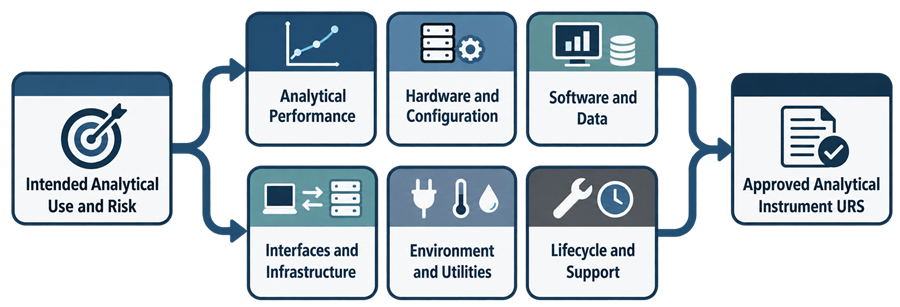
Intended Analytical Use
The intended-use statement is the central input to the URS. It should define the role of the instrument in the laboratory and the decisions supported by its data.
The intended use should address:
- Instrument type or analytical technology
- Materials and sample types
- Analytical procedures or technique families
- Quality attributes or measurements
- Required measurement ranges
- Expected sample throughput
- Use for release, stability, in-process, validation, development, or other testing
- GMP or non-GMP status
- Required operating locations
- Data and records generated
- External systems receiving or supplying data
- Applicable retention requirements
- Expected lifecycle and support model
A suitable intended-use statement might be:
The HPLC system will be used in the Quality Control laboratory for assay and impurity testing of commercial drug-product release and stability samples using approved analytical procedures. The system will acquire, process, review, and retain original electronic chromatographic data and transfer approved results to LIMS.
This statement establishes analytical purpose, sample type, regulatory use, data lifecycle, and interface expectations. It provides a stronger foundation than “HPLC used for product testing.”
The intended-use statement should also identify exclusions when they affect qualification. For example, a system may not be intended for electronic signatures, unattended overnight operation, direct LIMS transfer, or use of a specific detector type.
Samples, Standards, Methods, and Workflow
Requirements must reflect the materials and laboratory processes the instrument will support. Relevant considerations include:
- Sample matrices
- Expected concentration ranges
- Sample volumes
- Sample stability
- Reference standards
- Reagents and solutions
- Container and vial types
- Required sample preparation
- Number of samples per sequence or batch
- Approved analytical methods
- Method parameters
- Required accessories
- Cleaning between samples
- Carryover risk
- Cross-contamination risk
- Analyst interaction
- Review and approval workflow
- Handling of failed, aborted, or repeated analyses
These inputs affect instrument configuration. Sample volume may influence autosampler selection. Required sensitivity may determine detector technology. Throughput may affect capacity, automation, and data-storage requirements. Viscous, corrosive, volatile, biological, or light-sensitive samples may require specific materials, containment, environmental, or handling provisions.
The URS should define the analytical need without attempting to validate the analytical procedure. Instrument requirements establish the capabilities needed to support the procedure; analytical procedure validation separately demonstrates that the procedure is fit for its analytical purpose.
System-Boundary Definition
The system boundary identifies which components, software, infrastructure, interfaces, and supporting services are included in the analytical system and which are controlled externally. A complete boundary may include:
- Instrument base unit
- Pumps, detectors, sensors, and analytical modules
- Autosamplers and sample-handling components
- Columns, cells, probes, or measurement accessories
- Embedded controllers and firmware
- Control and acquisition software
- Processing and calculation functions
- Workstations
- Operating systems
- Local or shared databases
- User and security configuration
- Audit trails
- Network connections
- Instrument–LIMS interfaces
- Data export and import functions
- Backup and archival services
- Time-synchronization services
- Printers or report-generation components
- Remote-support connections
The boundary should identify dependencies outside the direct qualification package, including:
- Electrical power
- Uninterruptible power supply
- Instrument gases
- Vacuum
- Cooling water
- HVAC
- Temperature and humidity control
- Network services
- Identity-management services
- Enterprise backup
- LIMS
- Centralized data platforms
- Controlled reference standards
- Approved analytical procedures
- Trained users
The analytical-system boundary should distinguish qualified instrument components from external samples, methods, utilities, infrastructure, and receiving data systems.
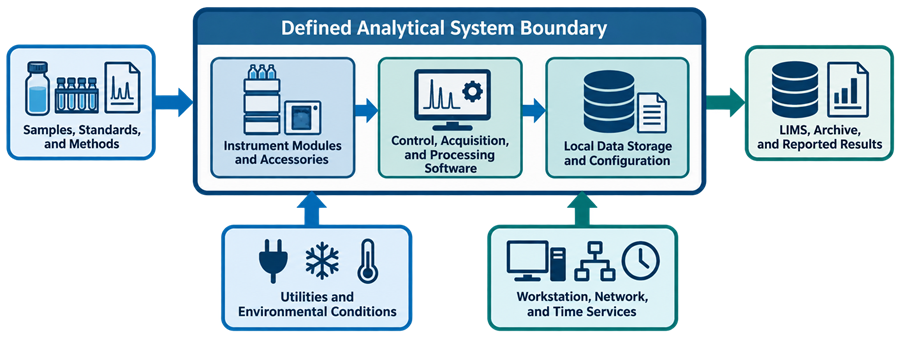
Excluding a dependency from the instrument qualification package does not eliminate the need to control it. The URS should identify the responsible system, department, or procedure and define the required interface condition.
Analytical Performance Requirements
Performance requirements define how the instrument must perform to support its intended analytical use. Depending on the technology, requirements may address:
- Measurement range
- Accuracy
- Precision
- Repeatability
- Resolution
- Sensitivity
- Detection capability
- Response linearity
- Signal-to-noise performance
- Baseline noise and drift
- Wavelength accuracy
- Flow accuracy
- Gradient composition
- Temperature accuracy and uniformity
- Rotational speed
- Injection-volume accuracy and precision
- Carryover
- Timing accuracy
- Pressure range
- Response time
- Sample capacity
- Throughput
- System availability
Required ranges should reflect actual and reasonably foreseeable use. A supplier’s maximum operating range does not automatically define the qualified range.
Acceptance criteria should be scientifically connected to the intended procedures. They may be based on:
- Analytical procedure requirements
- Compendial requirements
- Manufacturer specifications
- Reference-standard capability
- Historical platform knowledge
- Measurement uncertainty
- Site procedures
- Risk assessment
The URS should avoid copying analytical procedure validation characteristics directly as instrument specifications. Accuracy, precision, specificity, range, and detection capability may describe both instruments and procedures, but the relevant meaning and test design differ.
For example, an analytical procedure’s accuracy evaluates agreement of the complete procedure with an accepted value. Instrument qualification may separately verify detector response, injection precision, flow accuracy, or wavelength accuracy.
Hardware and Configuration Requirements
Hardware requirements define the physical components necessary to support the intended analytical use. They may address:
- Instrument model or technology
- Required modules
- Detector types
- Number and type of sample positions
- Autosampler configuration
- Temperature-controlled compartments
- Pumps and flow paths
- Sample-contact materials
- Chemical compatibility
- Pressure and temperature ratings
- Required accessories
- Replaceable components
- Cleaning access
- Containment
- Ergonomics
- Bench space
- Mobility or fixed installation
- Labels and identification
- Connections to utilities
- Expansion capability
Configuration requirements should identify:
- Installed modules
- Enabled functions
- Firmware versions
- Instrument settings
- Default parameters
- Calculation options
- Processing capabilities
- Method controls
- Report templates
- Required licenses
- User roles
- Interfaces
- Data-storage locations
Configuration requirements establish the approved baseline. Options and features that are purchased but not intended for GMP use should be identified so they can be disabled, restricted, or excluded from qualification with documented justification.
Functional and Operational Requirements
Functional requirements define what the system must do during normal and abnormal operation. Relevant functions may include:
- Instrument startup and shutdown
- Initialization and self-checks
- Sample identification
- Method selection
- Sequence creation
- Sample injection or introduction
- Measurement and data acquisition
- Real-time display
- Calculations
- Data processing
- Result evaluation
- Report generation
- Alarms and error messages
- Interrupted-run handling
- Power-failure recovery
- Communication-failure handling
- Reprocessing
- Repeat analysis
- Manual integration
- Data review
- Approval
- Export and transfer
Requirements should define expected handling of abnormal conditions, not only successful operation.
Examples include:
- The system shall prevent acquisition when required modules have not completed initialization.
- The system shall identify an interrupted sequence and preserve data acquired before interruption.
- The system shall display and record communication failures affecting data transfer.
- The system shall prevent unauthorized modification of approved processing methods.
- The system shall retain original data when results are reprocessed.
These requirements support meaningful Operational Qualification rather than confirmation only of basic menu functions.
Software and Data Requirements
Software requirements should reflect the functions used to control the instrument and create, process, review, transfer, and retain analytical records. Requirements may address:
- Software name and supported version
- Firmware
- Operating-system compatibility
- Database architecture
- Instrument control
- Data acquisition
- Method creation and approval
- Sequence creation
- Calculations
- Processing parameters
- Manual integration
- Reprocessing
- Result reporting
- Electronic signatures
- Audit trails
- Data export
- Data import
- Interface monitoring
- Backup and recovery
- Archival
- Data retrieval
- Configuration management
- System logs
- Time synchronization
The URS should identify which records constitute original data and associated metadata. It should define where those records are created, where they are retained, and how they remain complete, protected, readable, and available throughout the retention period.
Detailed software controls are addressed in Analytical Instrument Software Validation.
Electronic Records and Data Integrity
Electronic-record requirements should address the complete data lifecycle rather than only final reported results.
Requirements may include:
- Unique user identification
- Role-based access
- Administrator restrictions
- Password controls
- Account creation and deactivation
- Audit-trail generation
- Audit-trail availability and review
- Preservation of original data
- Preservation of metadata
- Record versioning
- Protection against overwriting
- Control of deletion
- Reason-for-change entry
- Date and time controls
- Review of processing changes
- Control of manual integration
- Record approval
- Electronic signatures where used
- Data retention
- Record retrieval
- Backup and recovery
- Archival
- Migration capability
FDA’s Data Integrity and Compliance With Drug CGMP guidance explains expectations for complete data, metadata, authorized access, audit trails, review, retention of original records, and investigation of data-integrity deficiencies.
A generic statement that the system “shall comply with Part 11” is not sufficient. Applicable requirements should be translated into specific technical and procedural expectations. Additional Part 11 principles are addressed in 21 CFR Part 11 Compliance and Checklist.
User Access and Security Requirements
Security requirements should define the required controls without prescribing roles copied from a supplier’s default configuration. The URS should address:
- Unique user accounts
- Prohibition of shared accounts
- Required role structure
- Separation of analyst, reviewer, approver, and administrator functions
- Privileged-account management
- Password or authentication requirements
- Account lockout
- Session timeout
- Access approval
- Periodic access review
- Account deactivation
- Remote access
- Vendor service access
- Security logging
- Electronic signatures where applicable
- Control of method and configuration changes
The requirement set should identify who is permitted to perform critical actions such as:
- Creating or modifying analytical methods
- Changing processing parameters
- Performing manual integration
- Reprocessing results
- Modifying report templates
- Deleting data
- Managing users
- Changing system time
- Changing audit-trail settings
- Restoring data
- Altering interfaces or storage configuration
Technical controls and procedural controls should be distinguished. If the system cannot enforce a required restriction, the gap should be identified during selection and evaluated before relying on a procedural workaround.
Interface Requirements
Interfaces must be defined in both directions and across the complete data path. Potential interfaces include:
- Instrument to workstation
- Instrument software to chromatography data system
- Instrument software to LIMS
- LIMS to instrument software
- Instrument system to network storage
- Instrument system to archive
- Instrument system to identity-management service
- Instrument system to time service
- Instrument system to reporting or analytics platforms
Interface requirements should define:
- Data sent and received
- Source and destination
- Sample and test identifiers
- Units
- Significant figures
- Rounding
- Result status
- Method identifiers
- Timestamps
- User attribution
- Transfer initiation
- Acknowledgment
- Error handling
- Duplicate prevention
- Reconciliation
- Retry behavior
- Audit trails
- Security
- Monitoring
- Recovery after interruption
An interface requirement stating only that “the instrument shall connect to LIMS” is inadequate. The URS must identify what will be transferred, how accuracy and completeness will be confirmed, and how failures will be detected and resolved.
Detailed interface controls are addressed in Analytical Instrument–LIMS Integration.
Infrastructure Requirements
Infrastructure requirements should define the environment needed to operate and support the analytical system. They may include:
- Workstation specifications
- Server requirements
- Operating-system compatibility
- Database platform
- Network connectivity
- Network segmentation
- Domain integration
- Identity management
- Storage capacity
- Storage growth
- Backup infrastructure
- Recovery capability
- Archive platform
- Time synchronization
- Antivirus or endpoint protection
- Patch management
- Remote-support tools
- Printer or label-printer support
- Virtualization or cloud services
The requirements should distinguish supplier responsibilities from site IT responsibilities. The instrument supplier may specify supported infrastructure, but site IT normally controls network, security, storage, backup, identity, and recovery services.
Unsupported combinations of instrument software, operating systems, database versions, and cybersecurity tools should be identified before purchase.
Utility Requirements
Utility requirements should specify the services needed for installation and operation. Depending on the instrument, these may include:
- Electrical voltage and frequency
- Grounding
- Uninterruptible power
- Emergency power
- Instrument air
- Nitrogen
- Helium
- Hydrogen
- Other analytical gases
- Gas purity
- Gas pressure and flow
- Vacuum
- Exhaust
- Cooling water
- Drainage
- Compressed air
- Network connections
Utility requirements should identify acceptable ranges, connection types, monitoring needs, and actions following interruption.
Where utility quality can affect analytical performance, qualification must verify that the available service is suitable. For example, gas purity and pressure can affect chromatography performance, while unstable electrical power can affect sensitive detection systems.
Environmental Requirements
Environmental conditions may influence instrument performance and data reliability. The URS should evaluate:
- Temperature range
- Humidity range
- Temperature rate of change
- Vibration
- Airflow
- Dust
- Electromagnetic interference
- Light exposure
- Bench stability
- Clearance
- Noise
- Corrosive vapors
- Biosafety or containment needs
- Cleanroom classification where applicable
- Controlled access
- Proximity to utilities and sample-preparation areas
Environmental limits should be based on instrument capability and intended analytical performance. A supplier’s broad operating limit may not be suitable as the site’s normal control range if measurement performance is sensitive to smaller changes.
Requirements should also identify how environmental suitability will be demonstrated and maintained.
Throughput, Availability, and Operational Capacity
Operational requirements should account for the expected laboratory workload. They may include:
- Number of samples per day or sequence
- Maximum batch or sequence size
- Analysis duration
- Unattended operation
- Autosampler capacity
- Required detector or module availability
- Data-processing time
- Review time
- Report-generation time
- System uptime
- Redundancy
- Recovery time following failure
- Spare-instrument strategy
- Consumable availability
- Future capacity
Throughput requirements should be realistic and connected to laboratory operations. Excessive capacity can add unnecessary complexity, while inadequate capacity can create pressure for uncontrolled workarounds, rushed review, or use outside the qualified configuration.
Calibration and Routine Verification Requirements
The URS should identify functions requiring calibration or routine verification based on their effect on analytical results. Requirements may address:
- Critical measurement parameters
- Required calibration ranges
- Accuracy and precision limits
- Traceability of reference standards
- Calibration interval
- Routine checks
- System suitability
- Internal diagnostic functions
- As-found and as-left data
- Out-of-tolerance handling
- Lockout or status control
- Review of previously generated data
Calibration requirements should be technically achievable and aligned with intended operating ranges. The system should not be selected with performance requirements that cannot be verified using suitable standards or methods.
Detailed controls are addressed in Calibration Control for Analytical Instruments.
Maintenance, Service, and Support Requirements
Lifecycle requirements should be defined before purchase. The laboratory should not discover after installation that critical components, software support, or service records are unavailable.
Requirements may address:
- Preventive-maintenance tasks
- Maintenance intervals
- Service-provider qualifications
- Availability of replacement parts
- Consumables
- Response time
- Remote support
- On-site support
- Diagnostic access
- Service-account control
- Service records
- Calibration after maintenance
- Post-maintenance verification
- Software support
- Firmware support
- Cybersecurity updates
- Supplier change notification
- Product discontinuation
- End-of-support notification
- Data extraction at retirement
Remote service access should be controlled, time limited, authorized, and reviewable. Supplier personnel should not receive uncontrolled persistent administrative access.
Backup, Recovery, Retention, and Archival Requirements
The URS should define how data will remain protected and available throughout the required retention period.
Requirements should address:
- Data included in backup
- Backup frequency
- Backup location
- Backup monitoring
- Protection from alteration or loss
- Restoration testing
- Recovery-time expectations
- Recovery-point expectations
- Archive format
- Metadata preservation
- Record readability
- Search and retrieval
- Migration
- Legacy-system access
- Retention period
- Controlled disposition
Backup and archival are not interchangeable. Backup supports recovery after loss or failure; archival supports long-term retention and retrieval of records in their complete context.
The URS should identify whether the supplier provides a supported method for exporting complete records and metadata. Proprietary data formats without a sustainable retrieval strategy create lifecycle and retirement risk.
Supplier Documentation and Evidence Requirements
The URS may define required supplier deliverables, including:
- Technical specifications
- System architecture
- Hardware configuration
- Software description
- Data-flow diagrams
- Installation instructions
- Environmental and utility requirements
- Calibration certificates
- IQ/OQ documentation
- Test methods
- Software-development evidence
- Release notes
- Known issues
- Security documentation
- Backup and recovery instructions
- Interface specifications
- Maintenance procedures
- Training
- Service documentation
- Change notifications
- End-of-support notifications
Supplier documents should be assessed for relevance to the purchased configuration and intended use. The URS should avoid requiring documents that the supplier cannot reasonably provide unless their absence would make the proposed system unacceptable.
Supplier evidence can support qualification, but the regulated laboratory remains responsible for confirming that the installed system meets approved requirements.
Requirement Prioritization
Requirements may be prioritized to distinguish those affecting GMP decisions, analytical performance, data integrity, safety, operations, and preferences.
A practical model may identify:
- Critical requirements — failure could affect product quality, patient safety, data integrity, or a regulated decision
- Essential requirements — necessary for intended operation, support, or lifecycle control
- Desirable requirements — beneficial but not necessary for fitness for intended use
Priority should influence supplier selection, risk assessment, verification depth, deviation handling, and release decisions.
A critical requirement cannot be waived simply because the selected supplier does not meet it. The laboratory must resolve the gap through design change, an effective compensating control, restricted intended use, or selection of another system.
Requirements Traceability and Verification
Each approved requirement should be linked to an appropriate verification method. Verification may occur through:
- Design review
- Supplier-document review
- Inspection
- Installation verification
- Configuration verification
- Calibration
- Functional testing
- Operational testing
- Performance qualification
- Procedure review
- Training verification
- Interface testing
- Backup and recovery testing
A traceability record should identify:
- Requirement identifier
- Requirement text
- Priority or criticality
- Design or supplier response
- Verification method
- Protocol or test reference
- Result
- Deviation
- Final disposition
- Approval status
Requirements traceability connects each approved need with design evidence, qualification verification, final disposition, and lifecycle change control.
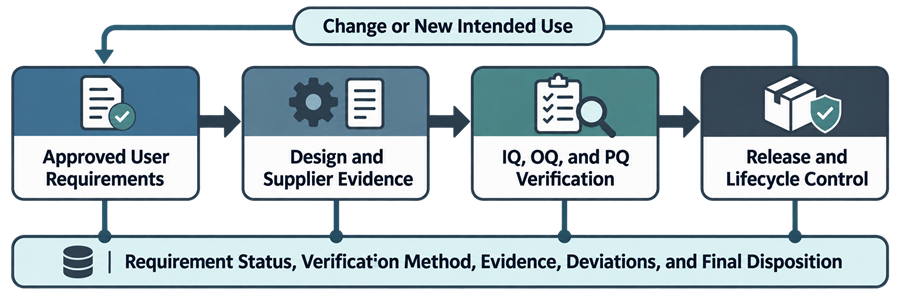
Not every requirement must be tested in OQ. Some requirements are more appropriately verified through document review, inspection, calibration, supplier evidence, or PQ. The verification method should match the nature and risk of the requirement.
Traceability must demonstrate complete coverage without creating artificial one-to-one relationships. A single test may verify several related requirements, and one critical requirement may require evidence from multiple lifecycle stages.
Requirement Changes and Lifecycle Control
The approved URS remains relevant after initial qualification. Changes should be evaluated against the requirements and intended use. Potential triggers include:
- New product or analytical procedure
- Expanded measurement range
- New detector or instrument module
- Increased throughput
- LIMS integration
- Electronic-signature implementation
- Network or database migration
- Software upgrade
- New data-retention requirement
- New security requirement
- Change in utility or environment
- Supplier support change
- Obsolescence
- New regulatory commitment
The assessment should determine:
- Which requirements are affected
- Whether new requirements are needed
- Whether the approved design remains suitable
- Whether qualification evidence remains valid
- Whether testing, procedure changes, training, or requalification are required
- Whether previously generated data could be affected
A revised URS should maintain traceability to the original approved baseline and associated change records.
URS Review and Approval
The URS should be reviewed by functions responsible for the intended use and supporting controls. Depending on system scope, reviewers may include:
- Laboratory or system owner
- Analytical subject-matter expert
- Validation
- Quality unit
- Metrology
- Maintenance
- Information technology
- Information security
- Data governance
- Engineering or facilities
- Procurement
- Environmental health and safety
Reviewers should evaluate requirements within their area of responsibility. Approval confirms that the requirements are complete enough to support supplier selection, design assessment, qualification planning, and lifecycle control.
Common Deficiencies
Common analytical instrument URS deficiencies include:
- Intended use defined too broadly
- Requirements copied from a generic equipment template
- Supplier brochure text used as requirements
- Failure to define samples, methods, ranges, or throughput
- No defined system boundary
- Software treated as an accessory
- Original electronic records and metadata not identified
- “Part 11 compliant” used as the only electronic-record requirement
- Interfaces described only as connectivity
- No error-handling or reconciliation requirements
- Missing backup, recovery, archival, and migration requirements
- No security-role or administrator requirements
- Environmental or utility requirements omitted
- Performance requirements copied from supplier maximum specifications
- Analytical procedure criteria confused with instrument requirements
- Requirements that cannot be objectively verified
- Excessive design prescription without technical need
- Supplier documentation accepted without predefined expectations
- No support, obsolescence, or retirement requirements
- No traceability from requirements to qualification evidence
- URS not reassessed after intended-use changes
These deficiencies weaken supplier selection and propagate gaps into design review, qualification, release, and routine operation.
Conclusion
Analytical instrument user requirements must define more than the physical equipment. They should describe the intended analytical use, required performance, hardware and configuration, software and data controls, interfaces, infrastructure, utilities, environment, security, calibration, service, retention, and lifecycle expectations for the complete analytical system.
A well-defined boundary prevents critical dependencies from being omitted. Clear and verifiable requirements provide the basis for supplier selection, Design Qualification, IQ, OQ, PQ, software validation, release, change assessment, periodic review, and requalification.
The objective is not to produce the longest possible URS. It is to establish a complete, proportionate, and traceable definition of what the analytical system must accomplish and how its fitness for intended use will be demonstrated and maintained.