

Design Qualification and Supplier Assessment for Analytical Instruments
Design Qualification confirms that a proposed analytical instrument, configuration, software environment, infrastructure, interfaces, and supplier support model can satisfy the approved User Requirements Specification before procurement and installation.
For a simple commercial instrument, this assessment may be concise. For a configurable or computerized analytical system, Design Qualification should examine the complete proposed solution, including measurement capability, hardware modules, software architecture, data flow, security, infrastructure, interfaces, calibration, maintenance, service access, supplier documentation, cybersecurity support, and long-term system viability.
Design Qualification is not an execution test of the installed instrument. It is a documented technical and compliance review used to determine whether the selected design is suitable, whether identified gaps are resolved, and whether procurement and installation may proceed.
Purpose and Lifecycle Position
Design Qualification connects the approved analytical instrument user requirements and system boundary with supplier selection, procurement, installation, and subsequent qualification.
Its objectives are to confirm that:
- The proposed analytical technology is appropriate
- Required measurement capability is available
- The selected hardware configuration supports intended use
- Software functions support required workflows
- Electronic records and metadata can be controlled
- Data flow and storage are defined
- Infrastructure and interfaces are compatible
- Security and cybersecurity needs can be met
- Calibration and maintenance can be supported
- Supplier evidence is adequate or can be supplemented
- Service and lifecycle support are acceptable
- Requirements are traceable to design features
- Gaps are resolved or formally accepted
- The proposed solution is suitable for procurement and installation
Analytical instrument DQ evaluates coordinated technical, data, infrastructure, supplier, service, cybersecurity, and lifecycle characteristics before procurement and installation.
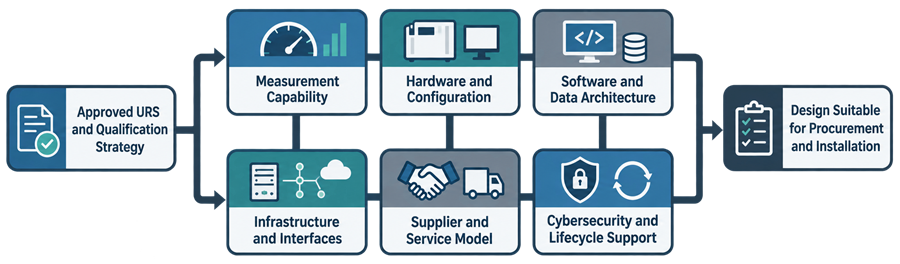
The risk-based analytical instrument qualification strategy determines the depth and formality of the DQ. The output of DQ establishes the approved design and configuration baseline later verified during Analytical Instrument Installation Qualification.
Regulatory Basis
US drug CGMP regulations do not prescribe a specific DQ document for every analytical instrument. They require suitable equipment, scientifically sound laboratory controls, reliable computerized systems, complete laboratory records, and documented calibration programs.
21 CFR 211.160, General Requirements requires scientifically sound laboratory controls and calibration programs containing specific directions, schedules, accuracy and precision limits, and provisions for remedial action.
21 CFR 211.68, Automatic, Mechanical, and Electronic Equipment requires routine calibration, inspection, or checking of automated equipment and appropriate controls over computer-related systems, data input and output, authorized changes, and backup data.
When electronic records or electronic signatures are used to meet FDA record requirements, applicability of 21 CFR Part 11, Electronic Records and Electronic Signatures must be assessed.
FDA’s Q9(R1) Quality Risk Management guidance supports science-based decisions with effort and formality proportionate to risk, uncertainty, importance, and system complexity.
Design Qualification translates these requirements and principles into an assessment of the proposed analytical solution. It does not establish compliance merely by listing regulatory citations.
DQ Applicability and Proportionality
Design suitability must be considered for every instrument used in a regulated analytical process, but it does not require the same document structure for every instrument.
Simple Apparatus
For simple apparatus, design suitability may be documented through:
- Approved specifications
- Material or dimensional requirements
- Supplier certificate review
- Suitability assessment
- Procurement approval
A separate formal DQ protocol may provide little additional value.
Measuring Instruments
For balances, pH meters, thermometers, conductivity meters, and similar measuring instruments, DQ may focus on:
- Intended measurement
- Required range
- Accuracy and precision
- Environmental sensitivity
- Calibration capability
- Display and record functions
- Accessories
- Serviceability
Configurable Instruments
Configurable instruments require broader assessment of:
- Hardware options
- Firmware
- Software functions
- Methods and calculations
- User roles
- Electronic records
- Data storage
- Interfaces
- Maintenance
- Supplier support
Computerized Analytical Systems
Computerized analytical systems normally require formal DQ covering:
- Instrument modules
- Acquisition and processing software
- Workstations and operating systems
- Databases
- Security
- Audit trails
- Interfaces
- Backup and recovery
- Archival
- Infrastructure
- Cybersecurity
- Supplier software controls
- Support and obsolescence
The assessment should be proportionate, but it must cover every component and dependency required for fitness for intended use.
DQ Inputs and Prerequisites
Design Qualification should begin only when sufficient information is available to evaluate the proposed solution. Typical inputs include:
- Approved intended-use statement
- Approved User Requirements Specification
- Instrument-category and GMP-impact assessment
- Qualification strategy
- System-boundary description
- Supplier quotation
- Technical proposal
- Hardware specifications
- Configuration or bill of materials
- Software and firmware descriptions
- System architecture
- Data-flow description
- Interface specifications
- Infrastructure requirements
- Utility and environmental requirements
- Security documentation
- Supplier qualification documents
- Calibration information
- Maintenance requirements
- Service agreement
- Product-lifecycle information
- Known limitations
- Applicable regulatory and compendial requirements
If critical information is unavailable, DQ should identify the uncertainty and determine whether additional evidence is required before approval.
Approval should not be based on an assumption that missing design information will be resolved during IQ or OQ.
DQ Roles and Responsibilities
DQ normally requires coordinated review by several functions.
Laboratory or System Owner
The owner:
- Defines intended use
- Approves analytical and operational requirements
- Confirms required modules and workflow
- Evaluates usability and throughput
- Assesses supplier support
- Accepts operational limitations
Analytical Subject-Matter Expert
The analytical expert evaluates:
- Measurement principle
- Method compatibility
- Required performance
- Sample and standard handling
- Critical instrument parameters
- Accessories
- System suitability needs
- Method-dependent risks
Validation or Qualification
Validation:
- Establishes the DQ approach
- Confirms alignment with the qualification strategy
- Maintains requirements traceability
- Evaluates supplier evidence
- Identifies qualification gaps
- Defines supplemental verification
- Documents the approval basis
Information Technology and Security
IT and security functions evaluate:
- Workstations
- Operating systems
- Databases
- Network compatibility
- Identity management
- Storage
- Backup
- Recovery
- Cybersecurity
- Remote access
- Patch support
- Infrastructure ownership
Metrology and Maintenance
Metrology and maintenance evaluate:
- Calibration capability
- Reference standards
- Maintenance tasks
- Service access
- Replaceable components
- Spare parts
- Post-maintenance testing
- Support availability
Quality Unit
The quality unit provides oversight appropriate to GMP impact and risk, including review of:
- Critical requirements
- Data-integrity controls
- Supplier evidence
- Gaps and residual risk
- Qualification approach
- Final design approval
Responsibilities should be defined in the DQ or qualification plan.
URS-to-Design Conformance
The central DQ activity is comparison of approved requirements with the proposed design. Each requirement should be assigned a disposition such as:
- Met by the proposed design
- Partially met
- Met through configuration
- Met through an external supporting system
- Met through a procedural control
- Requires supplemental qualification testing
- Not met
- Not applicable with justification
The assessment should identify the supporting evidence, such as:
- Supplier specification
- Architecture document
- Configuration description
- Demonstration
- Test result
- Certificate
- Interface specification
- Procedure
- Site infrastructure control
A supplier statement that a feature is available does not establish that it is included, licensed, configured, or suitable for the intended use.
Measurement Principle and Analytical Capability
DQ should confirm that the selected measurement technology is suitable for the intended analytical applications. The review may address:
- Measurement principle
- Selectivity
- Required analytical range
- Sensitivity
- Resolution
- Accuracy
- Precision
- Response linearity
- Detection capability
- Noise and drift
- Sample throughput
- Sample volume
- Sample matrix
- Potential interferences
- Environmental sensitivity
- Required accessories
The assessment should distinguish between:
- Instrument capability
- Supplier performance specifications
- Qualification acceptance criteria
- Analytical procedure performance
An instrument specification does not demonstrate that an analytical procedure is validated. Conversely, an approved analytical procedure cannot compensate for an instrument incapable of delivering the required performance.
The proposed measurement range should cover actual and reasonably foreseeable use. Selecting an instrument solely because its maximum specification exceeds the requirement can introduce unnecessary complexity without improving intended-use suitability.
Hardware and Configuration Review
The proposed hardware configuration should be compared with the approved URS and intended workflow. The assessment may include:
- Base instrument
- Pumps
- Detectors
- Sensors
- Autosamplers
- Sample trays
- Temperature-controlled compartments
- Columns, cells, probes, and accessories
- Sample-contact materials
- Tubing and flow paths
- Pressure and temperature ratings
- Control modules
- Local controllers
- Workstations
- Printers
- Network components
- Backup devices
- Required cables and connections
- Licenses and optional features
The DQ should confirm:
- All required modules are included
- Modules are mutually compatible
- Components support the required range and performance
- Materials are compatible with samples, reagents, and cleaning agents
- Required accessories are available
- Future expansion is technically feasible where required
- Unused functions can be disabled or controlled
- The proposed configuration can be uniquely identified and baselined
Options discussed during sales demonstrations should not be assumed to be included in the purchased configuration.
Sample, Standard, and Method Compatibility
The design review should evaluate whether the proposed system supports the actual samples, standards, and analytical procedures. Considerations may include:
- Sample matrices
- Sample concentration
- Sample volume
- Vial or container format
- Volatility
- Viscosity
- Chemical compatibility
- Biological hazard
- Light sensitivity
- Temperature sensitivity
- Sample stability
- Carryover
- Cross-contamination
- Cleaning
- Waste handling
- Reference-standard preparation
- Method duration
- Required sequence size
The proposed configuration should support the intended method without uncontrolled modifications or use outside supplier recommendations.
For example, the autosampler must accommodate the required containers and sample volumes. The detector must support the required response range. Wetted materials must tolerate intended solvents. Temperature-controlled modules must cover the required operating conditions.
Software Architecture
For software-controlled instruments, DQ should establish how the software supports intended operation and analytical records. The review should identify:
- Software product
- Version
- Firmware
- Operating system
- Database
- Instrument drivers
- Licenses
- Modules
- Configurable functions
- Custom functions
- Calculations
- Processing methods
- Reporting functions
- User-management functions
- Audit trails
- Electronic signatures
- Interfaces
- Backup functions
- Archival functions
The architecture should distinguish among:
- Instrument firmware
- Instrument-control software
- Data-acquisition software
- Processing software
- Database services
- Client workstations
- Servers
- Middleware
- LIMS
- External storage
- Archive systems
Detailed lifecycle controls are addressed in Analytical Instrument Software Validation.
Data Flow and Electronic Records
DQ should define how data move from sample acquisition to the final reviewed result. The data-flow assessment should identify:
- Data inputs
- Sample and test identifiers
- Instrument signals
- Raw data
- Original electronic records
- Metadata
- Processing methods
- Calculations
- Reprocessing
- Manual integration
- Review
- Approval
- Result transfer
- Reports
- Storage
- Backup
- Archival
- Retrieval
- Migration
The proposed qualified-system boundary should show how analytical data move from sample and method inputs through measurement, software processing, storage, review, transfer, and archival.
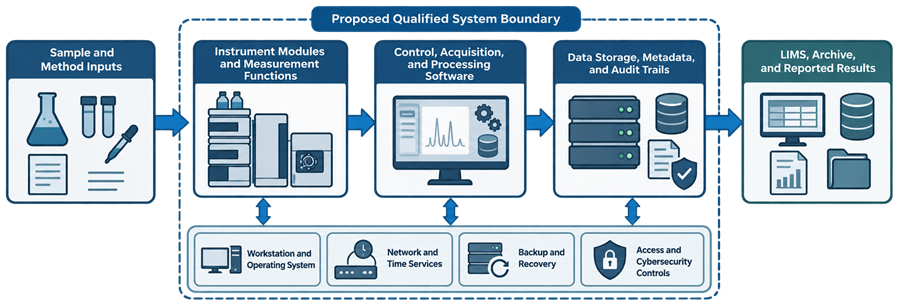
The review should determine:
- Where original records are created
- Where they are stored
- Whether records can be overwritten
- Whether deletion is possible
- How changes are recorded
- Which audit trails are available
- How data are reviewed
- How records remain readable
- How records are retained
- How records will be recovered
- How data will be extracted at retirement
FDA’s Data Integrity and Compliance With Drug CGMP guidance explains expectations for complete data, metadata, audit trails, authorized access, record review, retention of original information, and backup.
A design that produces compliant final reports but cannot preserve and review original electronic records and metadata may be unsuitable for GMP analytical use.
Access Control and Electronic Signatures
The proposed design should support required access and authorization controls.
DQ should evaluate:
- Unique user accounts
- Role-based permissions
- Analyst, reviewer, approver, and administrator roles
- Privileged-account control
- Password or authentication options
- Account lockout
- Session timeout
- Account deactivation
- Audit-trail access
- Method-management permissions
- Processing and reprocessing permissions
- Manual-integration permissions
- Report-template control
- Electronic signatures
- Record locking
- Administrative independence
Applicable requirements are further addressed in 21 CFR Part 11 Compliance and Checklist.
Supplier default roles may not support the site’s required segregation of duties. Role design and configuration capability should be evaluated before purchase rather than deferred until installation.
Infrastructure and Compatibility
The proposed instrument system must be compatible with available and planned site infrastructure.
DQ should assess:
- Workstation specifications
- Processor and memory requirements
- Operating-system support
- Database platform
- Virtualization
- Network connectivity
- Network segmentation
- Domain integration
- Identity management
- Storage capacity
- Storage growth
- Backup infrastructure
- Recovery capability
- Archive platform
- Time synchronization
- Antivirus compatibility
- Endpoint protection
- Patch management
- Remote-support tools
- Printer and label-printer compatibility
The review should identify infrastructure ownership and responsibilities among the supplier, laboratory, IT, and other support functions.
Unsupported operating systems, databases, or network configurations create immediate lifecycle and cybersecurity risk. The supplier’s support statement should cover the proposed site architecture.
Interface Design
Interfaces should be defined before procurement when they are required for intended use. Potential interfaces include:
- Instrument to workstation
- Instrument software to shared database
- Instrument software to LIMS
- LIMS to instrument software
- Instrument system to network storage
- Instrument system to archive
- Identity-management service
- Time service
- Reporting systems
- Middleware
The design review should address:
- Direction of transfer
- Data elements
- Identifiers
- Units
- Significant figures
- Rounding
- Result status
- Timestamps
- Method identifiers
- User attribution
- Transfer initiation
- Acknowledgment
- Error handling
- Retry behavior
- Duplicate prevention
- Reconciliation
- Audit trails
- Security
- Monitoring
Detailed interface controls are addressed in Analytical Instrument–LIMS Integration.
A statement that the instrument is “LIMS compatible” is insufficient. DQ should confirm the required data path, available interface technology, responsibilities, limitations, and qualification approach.
Utilities and Environmental Conditions
DQ should verify that site utilities and environmental conditions can support the proposed instrument. Utilities may include:
- Electrical power
- Voltage and frequency
- Grounding
- Uninterruptible power
- Emergency power
- Instrument air
- Nitrogen
- Helium
- Hydrogen
- Other gases
- Gas purity
- Pressure and flow
- Vacuum
- Exhaust
- Cooling water
- Drainage
- Network connections
Environmental considerations may include:
- Temperature
- Humidity
- Temperature rate of change
- Vibration
- Airflow
- Dust
- Electromagnetic interference
- Bench stability
- Light exposure
- Corrosive vapors
- Noise
- Clearance
- Controlled access
- Containment
The review should compare supplier requirements with actual site capability. If facility or infrastructure modifications are needed, they should be identified before procurement and included in project planning.
Cybersecurity Considerations
Cybersecurity should be evaluated according to the system’s architecture, connectivity, data criticality, and support model.
DQ considerations may include:
- Supported operating systems
- Patch availability
- Security-update process
- Antivirus and endpoint-protection compatibility
- Network segmentation
- Firewall requirements
- Unused ports and services
- Encryption
- Authentication
- Privileged access
- Remote access
- Vendor service accounts
- Security logging
- Vulnerability notification
- Incident support
- Backup protection
- Restoration capability
- End-of-support dates
The DQ does not need to convert every instrument into an enterprise cybersecurity project. It must identify credible security dependencies and determine whether the proposed system can operate within site controls without compromising availability, data integrity, or validated configuration.
Unsupported legacy software at initial purchase is generally a design deficiency, not a problem to defer to future lifecycle management.
Supplier Assessment
Supplier assessment should evaluate the supplier’s ability to provide, support, document, and maintain the proposed analytical system. The assessment should be proportionate to system risk and supplier dependency.
Technical Capability
Evaluate:
- Experience with the analytical technology
- Knowledge of the intended industry
- Product maturity
- Technical support
- Application support
- Service coverage
- Training capability
- Spare parts
- Consumables
- Escalation process
Quality and Documentation Controls
Evaluate:
- Document control
- Configuration management
- Product-release controls
- Test controls
- Calibration practices
- Deviation handling
- Complaint handling
- Defect correction
- Change notification
- Record retention
Software-Lifecycle Controls
For software-controlled systems, evaluate:
- Development lifecycle
- Requirements and testing
- Version control
- Release management
- Defect management
- Known-issue management
- Cybersecurity support
- Patch management
- Compatibility testing
- Upgrade support
- Obsolescence policy
Service Model
Evaluate:
- On-site service
- Remote support
- Response times
- Service-account controls
- Service records
- Calibration after service
- Post-maintenance verification
- Parts replacement
- Firmware changes
- Software support
- Escalation and complaint handling
A supplier questionnaire may support the assessment but should not be the only evidence when significant reliance will be placed on the supplier.
Supplier Documentation Assessment
The DQ should define which supplier documents are required and whether available documentation is suitable. Potential documents include:
- Product specifications
- Configuration list
- Bill of materials
- Architecture description
- Data-flow diagram
- Functional description
- Interface specification
- Software description
- Security documentation
- Calibration certificates
- Factory test records
- IQ/OQ protocols
- Executed qualification evidence
- Software-development summary
- Release notes
- Known-issue list
- Backup and recovery instructions
- Maintenance procedures
- Service manuals
- Training materials
- Change-notification commitments
- Obsolescence policy
Documents should be evaluated for:
- Relevance to the proposed configuration
- Technical completeness
- Version identification
- Internal consistency
- Traceability
- Actual results
- Deviations
- Availability for review
- Retention or continued access
A blank vendor IQ/OQ template demonstrates document availability, not successful verification.
Calibration and Metrology Design
DQ should determine whether critical measurement functions can be calibrated or verified throughout the lifecycle. The assessment should address:
- Critical parameters
- Required ranges
- Tolerances
- Reference standards
- Traceability
- Measurement uncertainty
- Calibration access
- Calibration software
- Internal versus external calibration
- Supplier service dependency
- As-found and as-left data
- Out-of-tolerance handling
- Calibration intervals
The proposed system should permit calibration over the actual intended-use range. A design should not be approved when critical parameters cannot be verified using suitable standards or methods.
Maintenance and Serviceability
Maintenance requirements should be assessed before procurement. DQ should consider:
- Preventive-maintenance tasks
- Recommended intervals
- Access for maintenance
- Replaceable parts
- Consumables
- Cleaning
- Diagnostic functions
- Service tools
- Proprietary access
- Service passwords
- Parts availability
- Local service coverage
- Post-maintenance testing
- Configuration backup
- Configuration restoration
- Service documentation
The design should allow maintenance without uncontrolled loss of configuration, records, security settings, or qualification status.
Lifecycle Support and Obsolescence
The supplier and system should be evaluated for expected operational life. Consider:
- Product maturity
- Expected commercial availability
- Software-support period
- Operating-system roadmap
- Database support
- Parts availability
- Firmware support
- Security updates
- Upgrade path
- Data migration
- Export capability
- Archive readability
- End-of-life notification
- End-of-support notification
- Replacement options
A technically capable instrument may still be an unsuitable design when its software, operating system, or service model is near obsolescence.
Factory Testing and Supplier Evidence
Factory Acceptance Testing and supplier qualification evidence may support DQ and later qualification when appropriately assessed. DQ should determine:
- What supplier testing exists
- Which requirements are covered
- Which configuration was tested
- Whether test methods are suitable
- Whether actual results are available
- Whether deviations were resolved
- Whether reference equipment was calibrated
- Whether tests remain valid after shipment and installation
- Which tests require site repetition
- Which site-specific functions remain untested
Supplier evidence should be incorporated into the qualification strategy rather than accepted automatically or ignored and unnecessarily repeated.
Risk Assessment and Critical Aspects
The DQ risk assessment should identify critical aspects of the proposed design. Critical aspects may include:
- Measurement parameters
- Sample delivery
- Detector performance
- Temperature control
- Timing
- Calculations
- Processing methods
- Security
- Audit trails
- Original data
- Backup
- Interfaces
- Configuration
- Environmental dependencies
- Utility dependencies
The assessment should determine:
- Design controls
- Verification methods
- Supplemental tests
- Operational controls
- Monitoring
- Residual risk
Risk assessment should support the design decision, not merely generate a numerical score after selection has already been made.
Gap Assessment and Resolution
Differences between the URS and proposed design should be documented and resolved before approval. Possible resolutions include:
- Design or configuration change
- Addition of a module or license
- Alternative supplier solution
- Supplemental site control
- Infrastructure modification
- Procedural control
- Restricted intended use
- Additional qualification testing
- Scientifically justified requirement revision
- Rejection of the proposed design
DQ approval requires identified gaps and residual risks to be resolved or formally accepted before procurement and installation.
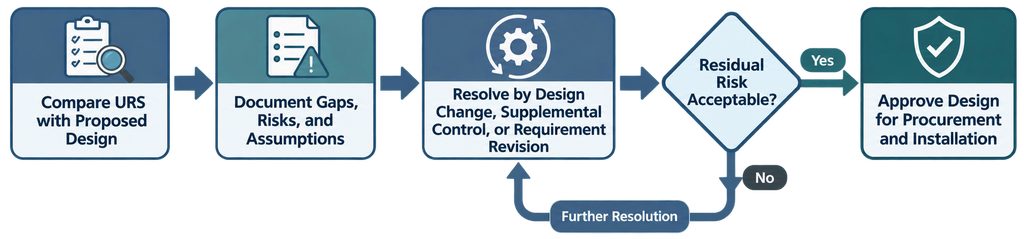
A requirement should not be revised solely to make an unsuitable supplier response appear compliant.
Critical gaps affecting measurement capability, data integrity, security, record retention, or intended use should be resolved before procurement. If a gap must remain open, its risk, interim control, owner, due date, and final disposition must be approved.
DQ Deliverables
Design Qualification may generate:
- DQ plan or protocol
- Approved URS
- System-boundary description
- Proposed configuration
- Hardware architecture
- Software architecture
- Data-flow diagram
- Interface description
- Infrastructure assessment
- Utility and environmental assessment
- Cybersecurity assessment
- Supplier assessment
- Supplier-document review
- Requirements-to-design traceability
- Risk assessment
- Gap log
- Gap resolutions
- Residual-risk assessment
- DQ report
- Design-approval record
- Inputs to procurement
- Inputs to IQ, OQ, and PQ
The documents may be consolidated where appropriate. The evidence must still support a clear conclusion.
DQ Approval Decision
DQ approval should confirm that:
- Intended use is defined
- Requirements are approved
- The system boundary is understood
- The proposed configuration is identified
- Measurement capability is suitable
- Hardware and software meet requirements
- Data and electronic-record controls are adequate
- Interfaces and infrastructure are feasible
- Utility and environmental needs can be met
- Supplier capability is acceptable
- Calibration and maintenance can be supported
- Lifecycle support is adequate
- Critical gaps are resolved
- Residual risks are acceptable
- Required supplemental qualification work is defined
Approval authorizes procurement and installation of the reviewed configuration. It does not authorize routine GMP use.
Changes to the approved design after DQ should be assessed through project change control or formal change control, depending on project phase and site procedures.
Transition to Installation Qualification
The approved DQ establishes the reference baseline for IQ. IQ should verify that:
- The delivered system matches the approved configuration
- Required modules and accessories are present
- Hardware and software versions are correct
- Utilities and environmental conditions are suitable
- Infrastructure and interfaces are installed as designed
- Documentation is available
- Calibration status is acceptable
- Security and configuration baselines are established
If the delivered system differs from the approved design, the difference must be assessed before IQ approval and progression to functional testing.
Common DQ Deficiencies
Common deficiencies include:
- DQ performed after purchase or installation
- Intended use defined too broadly
- URS copied from supplier literature
- Design review limited to hardware
- System boundary not defined
- Software architecture omitted
- Original electronic records not identified
- Data flow not documented
- Interface capability assumed
- Supplier statements accepted without evidence
- Blank IQ/OQ protocols treated as qualification evidence
- Infrastructure compatibility not assessed
- Unsupported operating system selected
- Cybersecurity and remote access omitted
- Calibration capability not confirmed
- Maintenance and serviceability ignored
- Obsolescence not considered
- Critical gaps deferred to IQ or OQ
- Requirements revised to match an unsuitable design
- No requirements-to-design traceability
- No documented approval basis
These deficiencies transfer avoidable risk into installation, qualification, routine use, and future system support.
Conclusion
Design Qualification determines whether the proposed analytical instrument and supporting system can satisfy approved requirements before procurement and installation.
A defensible DQ evaluates measurement capability, hardware configuration, sample and method compatibility, software architecture, data flow, electronic records, infrastructure, interfaces, security, cybersecurity, calibration, maintenance, supplier evidence, service, and lifecycle support.
The final decision should be based on traceable evidence, resolved gaps, and acceptable residual risk. DQ approval establishes the design baseline for procurement and IQ; it does not replace installation verification, functional testing, performance qualification, or release.