

Analytical Instrument Periodic Review and Requalification
Analytical instrument periodic review and requalification are related but distinct lifecycle controls.
A periodic review is an evidence-based assessment of whether an instrument remains suitable, controlled, supported, and compliant. It consolidates information generated during routine operation and determines whether current controls remain adequate.
Requalification is the documented verification performed after a change, failure, repair, relocation, adverse trend, or other event that may affect the instrument’s qualified state. Its scope should be based on impact and risk.
A periodic review should not automatically require repetition of Installation Qualification (IQ), Operational Qualification (OQ), or Performance Qualification (PQ). Likewise, waiting for the next periodic review is inappropriate when a significant event requires immediate assessment.
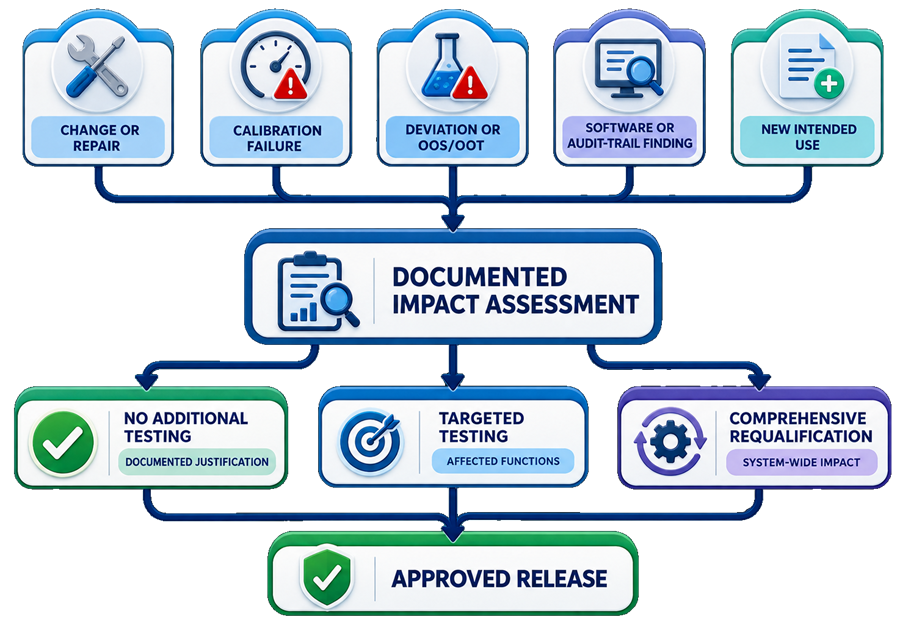
The lifecycle program should support three proportionate outcomes:
- no additional testing, supported by documented justification
- targeted testing of affected functions
- comprehensive requalification when the qualified state cannot otherwise be adequately demonstrated
Purpose
The periodic review and requalification program should demonstrate that:
- the instrument remains suitable for its approved intended use
- its configuration remains consistent with the controlled baseline
- qualification, calibration, maintenance, and verification activities remain current
- changes and repairs have been assessed and appropriately tested
- calibration failures, deviations, and analytical investigations have been evaluated collectively
- adverse performance trends are identified before they become recurring failures
- software, interfaces, access controls, audit trails, backup, and electronic records remain controlled
- supplier support and obsolescence risks are understood
- relocation and intended-use changes receive proportionate verification
- instruments that are no longer suitable are restricted, replaced, or decommissioned
- return to service is formally documented
The program should be integrated with the approved risk-based analytical instrument qualification strategy and analytical instrument risk classification.
Regulatory Basis
Under 21 CFR 211.160, laboratory controls must include calibration of instruments at suitable intervals under an established written program. Instruments that do not meet established specifications must not be used.
21 CFR 211.68 requires appropriate controls over automated equipment, including routine checks according to a written program and retention of associated records.
21 CFR 211.194 requires complete laboratory records, including records of instrument calibration and modifications to established analytical methods.
USP General Chapter <1058> provides a lifecycle framework for analytical instrument qualification. It should be cited by chapter number without linking to subscriber-controlled text.
These requirements do not establish a universal requalification interval. The laboratory should define a scientifically justified, risk-based system using the instrument’s intended use, critical functions, performance history, changes, failures, and available controls.
Periodic Review Versus Requalification
| Periodic review | Requalification |
|---|---|
| Evaluates accumulated lifecycle evidence | Verifies performance after an identified trigger |
| Occurs at a defined risk-based interval | Occurs when an event or finding justifies it |
| Reviews continued suitability and control | Tests affected or potentially affected functions |
| May identify trends or emerging risks | Generates direct verification evidence |
| May conclude that no additional testing is required | May be targeted or comprehensive |
| Does not automatically repeat IQ, OQ, or PQ | May include selected IQ, OQ, PQ, software, or interface tests |
| Produces actions and a continued-use decision | Produces a documented qualification and release decision |
Periodic review is therefore a decision-making process, not simply a recurring qualification protocol.
Requalification is a verification process. It should be performed when the potential effect of an event cannot be adequately addressed by existing evidence, routine checks, calibration, system suitability, or documented engineering evaluation.
Lifecycle Evidence for Periodic Review
A periodic review should consolidate evidence from the full instrument lifecycle.
The following illustration shows the principal evidence sources and the possible review outcomes.
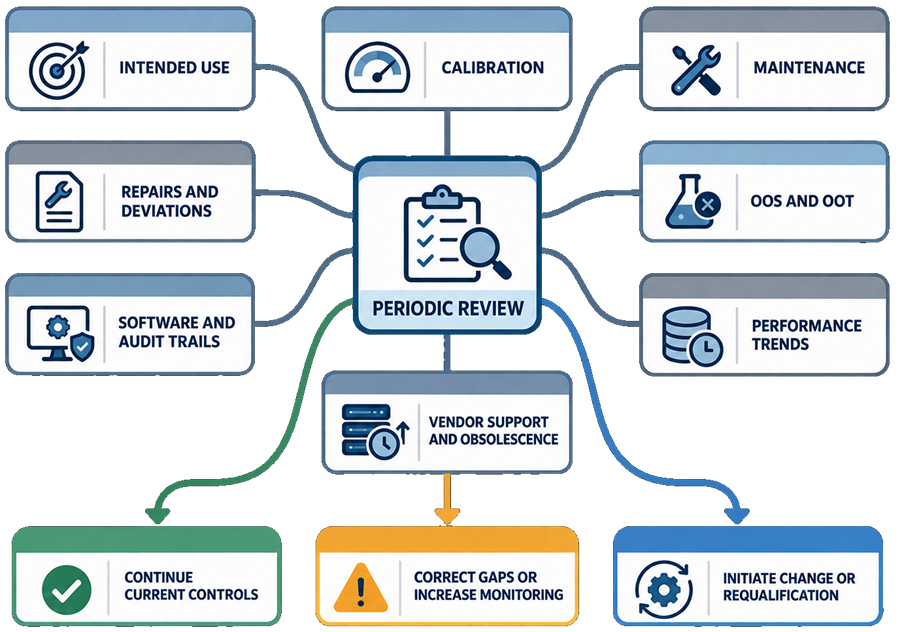
The review should identify:
- current intended use
- approved equipment and software configuration
- qualification status
- calibration status
- preventive-maintenance status
- routine performance-verification results
- system-suitability performance
- repairs and component replacements
- deviations and investigations
- out-of-specification and out-of-trend events
- recurring alarms and aborted analyses
- software and firmware changes
- audit-trail findings
- access-control issues
- backup and restoration evidence
- interface failures
- supplier notices
- cybersecurity or operating-system concerns
- spare-part availability
- support status and obsolescence
- changes planned for the next review period
The review should examine relationships among these records rather than treating each record category independently.
For example, repeated calibration adjustments, increasing system-suitability variability, several service visits, and declining detector response may collectively indicate deteriorating performance even when each individual event was closed successfully.
Periodic Review Responsibilities
The periodic-review procedure should define responsibilities for:
- initiating and scheduling reviews
- assembling lifecycle records
- performing the technical assessment
- evaluating computerized functions
- assessing quality and compliance implications
- assigning and tracking actions
- approving continued use
- restricting use where necessary
- initiating change control or requalification
- escalating obsolescence and replacement needs
The review should normally involve the instrument owner or laboratory representative. Quality, metrology, engineering, information technology, data-integrity, or validation personnel should participate when their areas are relevant.
A supplier may provide service history or technical information, but the regulated organization remains responsible for the review conclusion.
Periodic Review Frequency
No single periodic-review frequency is appropriate for every analytical instrument. The interval should consider:
- instrument category and complexity
- criticality of generated data
- intended use
- frequency of use
- reliance on software
- interface complexity
- calibration and maintenance history
- failure and repair frequency
- performance trends
- method sensitivity
- availability of routine system suitability
- supplier support
- technology age
- change frequency
- previous periodic-review findings
A simple instrument with strong daily verification may require a different review interval from a networked chromatography system with multiple users, interfaces, calculations, and electronic records.
The organization may use a standard interval with documented risk-based exceptions. The procedure should also allow an early review when significant concerns emerge.
Intended Use and Configuration Baseline
The review should confirm that the current use remains within the approved instrument capability and qualified range.
Questions should include:
- What regulated tests are currently performed?
- Have new methods, sample types, concentration ranges, or applications been introduced?
- Are operating ranges more demanding than those originally qualified?
- Are optional modules or accessories now in use?
- Has the instrument become a source of reportable results when it was previously used only for supporting measurements?
- Has manual data transcription been replaced by an interface?
- Have calculations or reporting functions changed?
- Has the number or type of users changed?
- Are there unsupported uses outside the documented baseline?
The configuration review should address applicable items such as:
- manufacturer and model
- equipment identification
- serial numbers
- installed modules
- accessories
- sensors and detectors
- firmware
- operating system
- instrument-control software
- data-system version
- configured methods and templates
- enabled functions
- licenses
- interfaces
- data-storage location
- network connection
- user roles
- backup arrangement
- time synchronization
An undocumented configuration difference does not automatically mean the instrument has failed. It does require investigation of when the change occurred, why it occurred, whether it was authorized, and whether qualification evidence remains applicable.
Qualification Status
The review should confirm that:
- the original qualification was approved
- qualification records identify the installed configuration
- deviations were resolved
- acceptance criteria were met or scientifically justified
- previous requalification actions were completed
- unresolved qualification conditions are visible
- supplier documentation was assessed for applicability
- required periodic or continued-verification activities are current
- qualification evidence remains relevant to current use
Qualification documents should not be accepted merely because they exist. The review should establish whether they cover the current configuration and intended use.
Calibration and Routine Verification
The review should evaluate the evidence generated under Calibration and Routine Performance Verification of Analytical Instruments.
Applicable information includes:
- calibration completion status
- overdue calibration events
- as-found and as-left results
- adjustment frequency
- calibration failures
- measurement uncertainty
- reference-standard traceability
- repeated results near tolerance limits
- changes in calibration interval
- routine check failures
- reference-material performance
- control-chart or trend information
A current calibration label does not by itself demonstrate stable performance.
Repeated adjustments, deteriorating as-found results, or values moving progressively toward a limit may require investigation, increased monitoring, maintenance, or requalification.
Maintenance and Repair History
The review should evaluate records produced under Preventive Maintenance and Performance Trending of Analytical Instruments and Analytical Instrument Repair, Change Control, and Return to Service.
The assessment should consider:
- whether planned maintenance was completed
- overdue maintenance
- frequently replaced consumables
- recurring breakdowns
- emergency service visits
- repeated replacement of the same component
- temporary repairs
- non-original replacement parts
- supplier recommendations
- service-access records
- post-maintenance testing
- unresolved service observations
- instrument downtime
- parts becoming unavailable
A high number of individually acceptable repairs may indicate declining reliability or obsolescence when reviewed collectively.
Deviations, OOS, and OOT Investigations
Periodic review should consider whether instrument-related signals have appeared in:
- deviations
- out-of-specification investigations
- out-of-trend investigations
- atypical-result assessments
- invalidated analytical runs
- repeated testing
- aborted sequences
- data-transfer failures
- analyst observations
- laboratory investigations
- product-impact assessments
The review should not automatically classify every OOS or OOT result as an instrument problem. It should determine whether investigations revealed, excluded, or left unresolved a possible instrument contribution.
Recurring observations across different methods or analysts may be more significant than an isolated event.
If an investigation identifies a potential instrument failure, the response should not be deferred until the scheduled periodic review. Immediate containment and impact assessment are required.
Performance Trending
Trend information can provide earlier warning than individual pass-or-fail results.
Applicable trends may include:
- calibration drift
- system-suitability precision
- retention-time stability
- detector response
- baseline noise
- carryover
- temperature stability
- wavelength accuracy
- balance sensitivity
- dissolution-apparatus mechanical measurements
- failed injections
- aborted runs
- alarm frequency
- repeat service calls
- consumable life
- communication failures
- instrument downtime
Trend assessment should use comparable data and account for differences in analytical methods, standards, columns, reagents, consumables, and environmental conditions.
An unfavorable trend does not always require comprehensive requalification. It may justify maintenance, more frequent verification, targeted testing, or investigation of another source of variability.
Software and Firmware
The review should evaluate computerized functions in coordination with analytical instrument software validation.
Applicable evidence includes:
- software and firmware versions
- patches and upgrades
- configuration changes
- changes to calculations
- changes to processing methods
- report-template changes
- user-role changes
- inactive and privileged accounts
- failed logins
- communication errors
- interface modifications
- backup failures
- restoration tests
- known supplier defects
- operating-system support
- antivirus or security compatibility
- open validation actions
- unresolved incidents
A software change does not automatically require complete instrument requalification. The assessment should determine which acquisition, control, processing, calculation, reporting, record-management, security, or interface functions could be affected.
Audit Trails and Data Integrity
The review should incorporate applicable evidence from:
- audit-trail review
- user-access review
- administrator activity
- method changes
- aborted or deleted sequences
- reintegration
- reprocessing
- result changes
- time and date changes
- failed data transfers
- incomplete records
- backup exceptions
- unexplained configuration changes
Relevant internal controls are described in:
- Audit Trails and Data Change Control
- Access Control and Electronic Signatures
- Electronic Record Lifecycle and Retention
The FDA Data Integrity and Compliance With Drug CGMP guidance should be considered when assessing the completeness, consistency, accuracy, attribution, security, and retention of electronic laboratory records.
An audit-trail finding may require procedural correction, access remediation, software testing, data review, or a broader investigation. Requalification is appropriate when the finding creates doubt about a controlled instrument function or validated computerized process.
Vendor Notices and Obsolescence
Periodic review should consider external information that may change the instrument’s risk profile.
Examples include:
- safety notices
- service bulletins
- product corrections
- firmware updates
- software defect notices
- cybersecurity advisories
- discontinued parts
- end of technical support
- end of operating-system support
- loss of compatible peripherals
- withdrawal of calibration services
- acquisition or closure of the supplier
- changes in authorized service providers
A vendor notice should be evaluated for applicability to the installed model, serial number, configuration, software version, and intended use.
Obsolescence should be managed before failure makes data inaccessible or the instrument impossible to repair. The review should identify replacement, migration, archive, and budget needs early enough to maintain continuity.
Periodic Review Outcomes
A periodic review may conclude that:
- the instrument remains suitable under current controls
- administrative records require correction
- maintenance or calibration frequency should change
- monitoring should be increased
- an adverse trend requires investigation
- a configuration baseline should be updated through change control
- access, backup, or audit-trail controls require remediation
- targeted requalification is required
- comprehensive requalification is required
- use should be restricted
- replacement planning should begin
- the instrument should be decommissioned
Each conclusion should identify:
- supporting evidence
- identified risks
- required actions
- responsible person
- completion date
- interim controls
- continued-use or restricted-use status
- approval
Event-Driven Requalification
Event-driven requalification begins with a specific trigger rather than a fixed calendar date. Triggers may include:
- repair
- component replacement
- configuration change
- calibration failure
- repeated adjustment
- deviation
- OOS or OOT investigation
- adverse performance trend
- software or firmware change
- audit-trail finding
- interface modification
- relocation
- utility change
- new intended use
- vendor notice
- prolonged shutdown
- loss of control over environmental conditions
- unexplained malfunction
- significant maintenance
- recovery from disaster or data-system failure
The event should first be contained and assessed. Testing should then be selected according to the affected functions and risk.
The following illustration shows how triggers should be translated into no additional testing, targeted testing, or comprehensive requalification.
Requalification Impact Assessment
The impact assessment should identify:
- what happened
- when it occurred
- how it was detected
- affected equipment, modules, software, and interfaces
- previous and current configuration
- potentially affected functions
- applicable intended uses
- affected qualification requirements
- possible impact on data and product
- existing evidence that remains valid
- testing required before release
- need for deviation or change control
- need for corrective or preventive action
- approval responsibilities
The assessment should be completed by personnel who understand both the technical change and the regulated analytical use.
The rationale should be specific. Statements such as “no impact,” “like-for-like,” or “vendor tested” are conclusions, not adequate supporting assessments.
No Additional Testing
No additional testing may be justified when documented evidence demonstrates that the event cannot affect a qualified function or regulated record. Examples may include:
- replacement of a nonfunctional cosmetic panel
- correction of an equipment-record typographical error
- replacement of an external accessory that has no measurement, control, data, or safety function
- administrative ownership change with no configuration or access impact
- supplier notification that does not apply to the installed model or version
- relocation of an unused detachable item that is not part of the qualified system
The assessment should still document:
- the event
- why qualified functions are unaffected
- evidence supporting the conclusion
- whether routine checks remain current
- authorization for continued use
“No testing” should not be selected merely to avoid downtime.
Targeted Testing
Targeted testing is appropriate when the affected functions can be clearly identified and unaffected qualification evidence remains valid.
Examples include:
| Event | Possible targeted verification |
|---|---|
| Temperature-sensor replacement | Temperature accuracy, stability, alarms, and applicable method performance |
| Autosampler repair | Positioning, injection precision, carryover, sequence operation, and communication |
| Detector service | Detector response, noise, drift, linearity, and representative system suitability |
| Balance relocation within a controlled laboratory | Level, environmental suitability, calibration, repeatability, eccentricity where applicable |
| Pump-seal replacement | Leak integrity, flow accuracy, pressure behavior, gradient performance where applicable |
| Software report change | Report content, calculations, data mapping, permissions, and audit trail |
| Interface modification | Field mapping, units, precision, failed transfer, duplicate prevention, and reconciliation |
| User-role change | Authorized functions, prohibited functions, audit trail, and electronic signature behavior |
| Firmware upgrade | Changed functions, communication, configuration retention, alarms, and representative operation |
Targeted testing may include selected elements of IQ, OQ, PQ, software regression testing, calibration, interface testing, or method system suitability.
The protocol should identify why omitted tests remain valid.
Comprehensive Requalification
Comprehensive requalification may be necessary when:
- the extent of impact cannot be reliably isolated
- multiple critical modules have changed
- the instrument has been substantially rebuilt
- configuration records are incomplete
- the qualified baseline has been lost
- significant unauthorized changes occurred
- software and hardware were replaced together
- a new intended use exceeds the original qualified range
- prolonged uncontrolled storage may have affected several functions
- extensive relocation changes utilities and environment
- recurring failures create doubt about overall reliability
- major data-integrity deficiencies undermine confidence in prior controls
- qualification records are missing or no longer applicable
Comprehensive requalification does not necessarily mean blindly repeating every historical test. The protocol should establish a current, risk-based qualification baseline covering the complete intended use.
Changes and Repairs
The assessment of a change or repair should consider:
- function of the affected component
- whether the replacement is truly equivalent
- specifications and tolerances
- material of construction
- firmware or embedded software
- calibration relationship
- communication with other modules
- stored configuration
- effect on data acquisition
- effect on calculations or reports
- effect on electronic records
- supplier recommendations
- installation requirements
- need for method-specific verification
A like-for-like replacement may reduce requalification scope, but it does not eliminate assessment. Installation errors, configuration loss, calibration needs, or interaction with adjacent components may still require testing.
Calibration Failures
A calibration failure should trigger:
- removal from or restriction of use
- assessment of the as-found condition
- determination of the potential period of malfunction
- evaluation of affected data and product
- investigation of the failure
- repair or adjustment where appropriate
- definition of return-to-service testing
- review of calibration frequency and trend
- documented release
Requalification scope should reflect the failed parameter and its relationship to other functions.
A temperature calibration failure may require more than recalibration if the instrument uses temperature to control sample preparation, separation, reaction, or measurement response.
Deviations and OOS/OOT Events
When an analytical investigation implicates an instrument, the assessment should determine whether:
- the problem was limited to one method or sequence
- a specific module or function failed
- the failure was intermittent
- the problem could have existed before detection
- other methods use the same function
- previous data require review
- repair or adjustment changed the qualified state
- routine system suitability would reliably detect recurrence
- additional qualification testing is required
Successful reinjection or passing system suitability after restart does not necessarily establish that the root cause has been removed.
Software and Audit-Trail Findings
Software-related requalification may include:
- installation verification
- version and configuration confirmation
- instrument communication
- acquisition start and stop
- raw-data creation
- sample association
- method versioning
- calculations
- integration
- reporting
- user roles
- audit trails
- electronic signatures
- interfaces
- backup
- restoration
- record retrieval
Testing should be based on changed and potentially affected functions.
If an audit-trail finding reveals unauthorized configuration changes, the laboratory should establish the valid baseline before deciding which tests are required.
Intended-Use Changes
A new method does not automatically require instrument requalification. The assessment should determine whether the method remains within existing qualified capabilities.
Additional verification may be required when the new use introduces:
- a wider operating range
- lower measurement levels
- higher accuracy or precision requirements
- faster acquisition
- narrower chromatographic peaks
- different detector functions
- new accessories
- new calculations
- new interfaces
- new environmental requirements
- new sample hazards
- new electronic-record requirements
Method validation or verification demonstrates method performance. Instrument requalification demonstrates that the equipment functions required by the method remain appropriately controlled. One does not automatically replace the other.
Relocation
Relocation should be evaluated according to the nature of the move.
Minor internal movement
Movement on the same bench or within the same controlled room may require:
- visual inspection
- level or alignment check
- utility reconnection
- calibration or operational check
- confirmation of network and data connections
- representative system suitability
The scope depends on instrument sensitivity and the effect of disconnection or movement.
Relocation within the same site
A move to another room may affect:
- temperature and humidity
- vibration
- airflow
- bench stability
- electrical supply
- gases
- water
- drainage
- ventilation
- network connection
- data-storage path
- safety controls
Applicable IQ elements should be repeated for the new location, followed by calibration and affected OQ or PQ tests.
Relocation to another site
Site-to-site relocation generally requires broader assessment because the instrument may be:
- dismantled
- packaged
- transported
- exposed to vibration or temperature extremes
- reassembled
- connected to different utilities
- placed on a different network
- assigned different users
- connected to different data systems or interfaces
The new installation should be documented. Requalification should verify the functions that could have been affected by transport, reassembly, environment, utilities, configuration, and integration.
Historical qualification evidence may be leveraged when it remains applicable.
Requalification Planning and Execution
The approved protocol or controlled test plan should define:
- trigger and impact assessment
- equipment identification
- current configuration
- intended use
- affected requirements and functions
- tests to be performed
- tests not repeated and their justification
- prerequisites
- reference standards and equipment
- acceptance criteria
- data-recording requirements
- deviation handling
- reviewer and approver responsibilities
- release conditions
Testing should use calibrated reference equipment and controlled procedures.
Acceptance criteria should be based on:
- approved intended use
- user requirements
- manufacturer specifications
- analytical procedures
- historical performance
- calibration tolerances
- compendial requirements where applicable
- scientific and risk-based justification
Acceptance criteria should be approved before execution unless a documented investigation justifies another controlled approach.
Deviations During Requalification
A requalification deviation should identify:
- the expected requirement
- the observed condition
- affected test and function
- immediate containment
- investigation
- root cause where applicable
- correction
- repeated or additional testing
- effect on other completed tests
- effect on prior data
- final disposition
Testing should not be repeatedly restarted until acceptable results are obtained without documenting the original failure.
Return to Service
Return to service should require evidence appropriate to the event, such as:
- completed repair or change
- confirmed configuration
- installation checks
- calibration
- targeted functional testing
- software regression testing
- interface verification
- representative PQ
- system suitability
- resolved deviations
- completed data or product impact assessment
- updated procedures and training
- updated equipment records
- approved release
The instrument’s status should remain clearly controlled until release.
Partial or restricted release may be appropriate when:
- only defined functions have been verified
- unaffected uses can be clearly separated
- access or configuration prevents unapproved use
- restrictions are documented and communicated
- remaining actions have owners and due dates
- Quality approves the arrangement where required
Relocation, Restriction, and Decommissioning
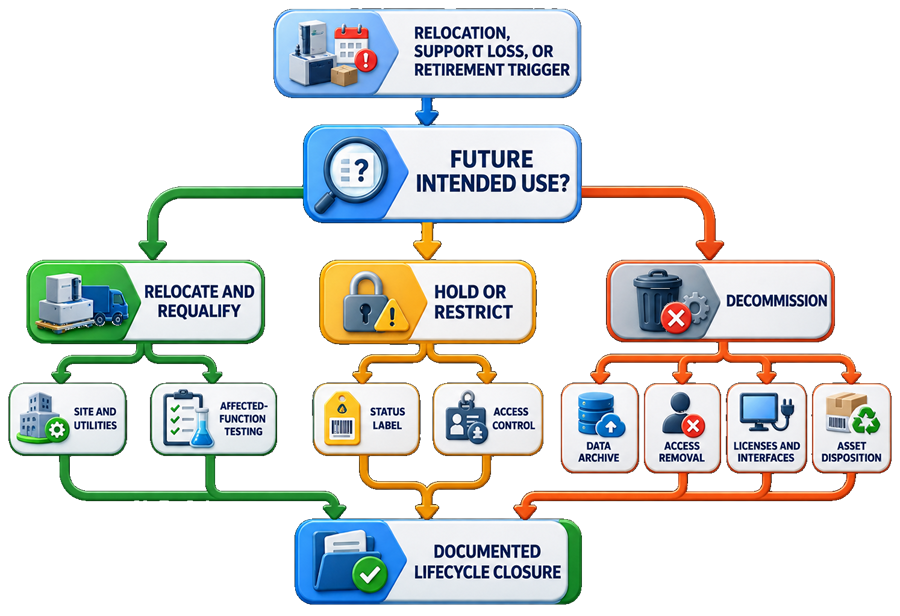
When continued operation is uncertain, the organization should determine whether the instrument will be relocated, temporarily restricted, placed on hold, replaced, or decommissioned.
The following illustration shows the distinct controls associated with these lifecycle decisions.
Decommissioning Decision
Decommissioning may be appropriate when:
- the instrument is no longer needed
- it cannot meet current requirements
- recurring failures make operation unreliable
- spare parts are unavailable
- software or the operating system is unsupported
- cybersecurity risks cannot be adequately controlled
- calibration or qualification can no longer be maintained
- migration to a replacement system is complete
- repair is technically or economically unjustified
Decommissioning is a controlled lifecycle activity, not merely physical disposal.
Decommissioning Controls
The decommissioning plan should address:
- identification of affected methods and users
- replacement or transfer of analytical work
- completion of open sequences and investigations
- final instrument status
- electronic-record inventory
- archive and retention
- record readability
- metadata and audit trails
- method and report-template retention
- backup verification
- restoration or retrieval capability
- interface shutdown
- account and remote-access removal
- license management
- removal of network credentials
- proprietary or confidential data
- calibration and maintenance records
- cleaning and decontamination
- hazardous materials
- radioactive or biological components where applicable
- reusable parts
- asset-register update
- physical disposition
- approval of lifecycle closure
Data should not be deleted merely because the original instrument is being removed. Records must remain accessible, readable, protected, and retrievable for the applicable retention period.
If data require the original software or hardware for reconstruction, the archive strategy should address how future access will be maintained.
Temporary Hold or Restricted Status
An instrument may be placed on hold when:
- an investigation remains open
- replacement parts are pending
- calibration has expired
- software support is uncertain
- a relocation decision is pending
- qualification actions are incomplete
- approved uses must be limited
Controls should prevent accidental use through:
- physical status labels
- electronic status controls
- restricted user access
- scheduling restrictions
- disconnected utilities where appropriate
- written communication
- inventory or asset-system status
- documented authorization for any limited use
Long-term storage conditions should protect the instrument and its records. Reactivation should be treated as an event requiring impact assessment.
Periodic Review Report
The final periodic-review report should include:
- equipment identification
- review period
- current location
- current intended use
- configuration summary
- qualification status
- calibration and maintenance status
- repair and failure summary
- deviation and OOS/OOT assessment
- performance trends
- software and firmware status
- access and audit-trail assessment
- backup and interface status
- supplier-support and obsolescence status
- open actions
- risk assessment
- continued-use decision
- required monitoring or requalification
- next review date or interval
- approvals
The report should be concise enough to support a decision while remaining traceable to the underlying records.
Common Deficiencies
Common deficiencies include:
- treating periodic review as automatic full requalification
- waiting for the periodic review before assessing a significant event
- using a fixed requalification interval without risk justification
- reviewing calibration, maintenance, and deviations separately without considering collective trends
- failing to confirm current intended use
- failing to compare the installed configuration with the qualified baseline
- classifying replacement as like-for-like without technical evidence
- accepting a supplier service report as sufficient return-to-service evidence
- repeating only the failed calibration without assessing data or product impact
- using passing system suitability as the sole requalification evidence
- omitting software, interfaces, access controls, and audit trails
- failing to assess vendor notices
- allowing unsupported software to remain in use without documented risk controls
- repeating the entire original qualification when only one function changed
- performing insufficient testing after extensive repair or relocation
- failing to justify tests omitted from a targeted protocol
- returning equipment to service before deviations are resolved
- leaving a restricted instrument physically or electronically available for general use
- disposing of an instrument without protecting retained electronic records
- failing to remove remote access, accounts, interfaces, and credentials during decommissioning
Conclusion
Periodic review and event-driven requalification serve different purposes.
Periodic review evaluates accumulated lifecycle evidence to determine whether the analytical instrument remains suitable, controlled, reliable, supported, and compliant. It may confirm continued use, identify corrective actions, increase monitoring, initiate change control, or trigger requalification.
Event-driven requalification responds to a specific change, failure, repair, investigation, relocation, software modification, adverse trend, or new intended use. Its scope should be proportionate to impact: no additional testing with documented justification, targeted testing of affected functions, or comprehensive requalification when the qualified state cannot otherwise be demonstrated.
A mature program also controls relocation, restriction, obsolescence, and decommissioning. These decisions protect both the physical instrument and the analytical records produced throughout its lifecycle.