

HPLC and UHPLC System Qualification and Lifecycle Control
High-performance liquid chromatography (HPLC) and ultra-high-performance liquid chromatography (UHPLC) systems generate critical analytical data used for release testing, stability studies, impurity testing, cleaning validation, process investigations, and other regulated laboratory decisions.
Qualification should demonstrate that the complete chromatographic system is suitable for its intended use. The qualified boundary commonly includes solvent delivery, mixing and degassing, high-pressure pumping, sample introduction, column temperature control, detection, data acquisition, chromatography software, electronic-record storage, and applicable interfaces.
HPLC and UHPLC use the same basic analytical architecture and qualification lifecycle. UHPLC systems, however, operate at higher pressures and with lower system volumes, smaller-particle columns, narrower tubing, and faster acquisition requirements. They are therefore more sensitive to leaks, poor connections, extra-column dispersion, dwell volume, sampling rate, and small deviations in flow, injection, and gradient formation.
Qualification should address these differences without creating separate and largely duplicative HPLC and UHPLC programs.
Purpose and Qualification Objectives
HPLC/UHPLC qualification should demonstrate, as applicable, that:
- the installed configuration matches the approved system design
- solvent-delivery functions operate accurately and consistently
- gradient composition and timing are controlled
- the pressure system is leak-free and stable within its intended range
- injection volume is sufficiently accurate and precise
- sample carryover is controlled
- column temperature is maintained within defined limits
- detector wavelength and response are suitable for intended methods
- detector noise and drift remain acceptable
- chromatographic signals are acquired without loss or distortion
- software performs approved acquisition, processing, calculation, review, and reporting functions
- electronic records and metadata are complete and protected
- representative analytical methods meet applicable performance and system-suitability criteria
- routine checks, calibration, maintenance, and trend review maintain continued fitness for use
- changes, repairs, and failures receive an appropriate requalification assessment
The scope and depth should follow the approved risk-based analytical instrument qualification strategy and the instrument’s risk classification.
HPLC and UHPLC System Architecture
A typical liquid chromatography system includes:
- solvent reservoirs
- solvent filters and inlet tubing
- degasser
- proportioning valve or solvent-selection valve
- mixer
- high-pressure pump
- pressure sensor
- leak sensors
- autosampler
- sample tray or sample cooler
- injection valve and sample loop
- needle and wash system
- column compartment or oven
- chromatographic column
- detector
- instrument controller
- acquisition workstation
- chromatography data system
- database or electronic-record repository
- network and interfaces
- backup and archival services
The following illustration shows the primary HPLC/UHPLC liquid-flow path and the transition from detector output to the chromatography data system.

The system boundary should identify which components are included in the instrument qualification and which are controlled through separate infrastructure, software-validation, calibration, or laboratory procedures.
A centralized chromatography data system may support several instruments. In that case, shared servers, databases, identity-management services, and backup infrastructure may be qualified separately, while each individual HPLC/UHPLC qualification verifies the applicable instrument connection, configuration, acquisition channels, methods, and data flow.
HPLC Versus UHPLC Qualification Considerations
HPLC and UHPLC share the same core qualification parameters, but the significance and tolerances of those parameters may differ. UHPLC-specific considerations include:
- higher operating pressure
- smaller internal tubing diameter
- lower dwell and delay volumes
- greater sensitivity to poorly seated fittings
- increased risk of extra-column dispersion
- greater effect of injection-path volume
- smaller injection volumes
- faster and narrower chromatographic peaks
- higher required detector acquisition rates
- greater sensitivity to system volume and mixing behavior
- increased effect of tubing replacement or configuration change
- stricter control of column hardware and connection geometry
A conventional HPLC test method may not adequately challenge a UHPLC system. For example, a long isocratic run with broad peaks may not reveal sampling-rate limitations, excessive extra-column dispersion, or gradient-delay effects relevant to fast UHPLC separations.
Qualification should reflect the actual method envelope rather than the maximum theoretical capability stated in vendor literature.
Intended Use and User Requirements
The analytical instrument user requirements should define how the HPLC/UHPLC system will be used.
Applicable requirements include:
- assay, impurity, dissolution, cleaning, stability, or other intended tests
- isocratic or gradient operation
- required flow-rate range
- required pressure range
- solvent compatibility
- required injection-volume range
- required sample capacity
- sample cooling or temperature control
- required column-temperature range
- detector type
- wavelength range
- sensitivity
- expected peak width
- required data-acquisition rate
- sequence length
- throughput
- calculation and processing functions
- report requirements
- electronic-record requirements
- interfaces
- backup and retention
- user roles and security
- maintenance and service expectations
Requirements should not merely reproduce the manufacturer’s complete specification sheet. They should identify the capabilities required by the laboratory’s intended methods and data workflow.
Design Qualification and Supplier Assessment
Design Qualification and supplier assessment should verify that the selected system can meet the approved requirements before procurement and installation.
The review should address:
- pump design and pressure capability
- isocratic, binary, quaternary, or other gradient configuration
- degassing and mixing technology
- dwell volume
- autosampler design
- injection-volume range
- needle-wash capabilities
- sample cooling
- column-compartment range and stability
- detector type and optical range
- detector acquisition rate
- compatibility with expected peak widths
- solvent and sample compatibility
- software functions
- electronic-record controls
- integration with existing laboratory infrastructure
- service and spare-parts support
- supplier qualification documentation
- software and firmware lifecycle support
For UHPLC systems, the design review should specifically evaluate pressure capability, connection technology, internal volume, dispersion, detector flow-cell volume, and acquisition performance.
Supplier documentation may support qualification, but its applicability to the purchased configuration and intended use should be assessed before it is included in the approved strategy.
Installation Qualification
Analytical Instrument Installation Qualification should establish the installed HPLC/UHPLC configuration and supporting environment.
Applicable IQ checks include:
- manufacturer and model
- serial numbers
- equipment identification
- installed pump type
- mixer configuration
- degasser
- autosampler model
- injection hardware
- sample cooler
- column compartment
- detectors
- flow-cell type
- computer and workstation
- software version
- firmware versions
- drivers and communication modules
- licenses and enabled features
- network configuration
- data-storage location
- interfaces
- power requirements
- environmental conditions
- manuals and certificates
- calibration status
- supplier installation records
The installed flow path should be documented sufficiently to establish the baseline. For UHPLC systems, critical tubing dimensions, fitting types, and major connection arrangements may require configuration control because apparently minor changes can affect pressure, dwell volume, or chromatographic dispersion.
Initial security configuration, system time, data locations, user roles, and backup connections should be established before OQ challenge testing.
Operational Qualification Strategy
Operational Qualification and functional testing should challenge critical HPLC/UHPLC functions throughout the ranges required by intended use.
The OQ scope commonly includes:
- pump flow
- gradient composition
- pressure and leak response
- autosampler injection performance
- carryover
- column-compartment temperature
- detector wavelength
- detector response
- detector noise and drift
- module communication
- data acquisition
- chromatography software
- alarms and error handling
- electronic-record controls
- interfaces
- backup and restoration functions
The following illustration maps the main HPLC/UHPLC modules to their principal qualification controls.
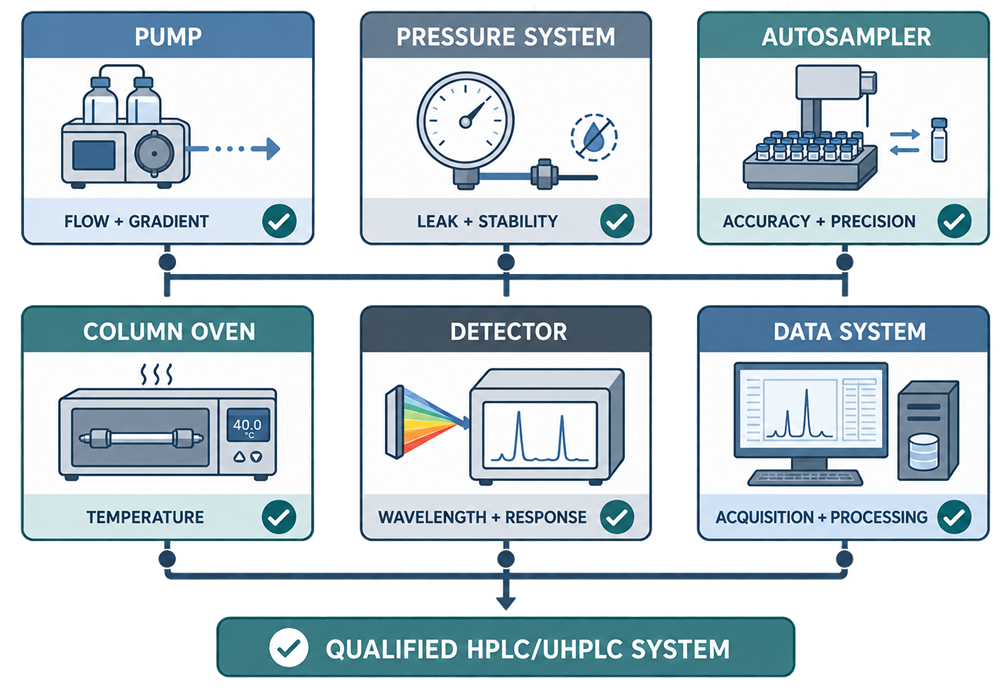
Acceptance criteria should be predefined and based on intended use, approved analytical procedures, manufacturer specifications, development knowledge, compendial requirements where applicable, and scientific justification.
Generic vendor limits should not be accepted automatically when they do not support the laboratory’s method requirements.
Pump Flow Accuracy and Precision
Pump performance directly affects retention time, resolution, response, and method reproducibility. Flow testing should address the operating range used by approved or representative methods. Applicable verification may include:
- flow accuracy
- flow precision
- stability over time
- performance at low, nominal, and high intended flow
- operation under representative backpressure
- pump-channel performance
- pressure response
- leak detection
- response to solvent depletion or flow interruption
Flow may be verified gravimetrically, volumetrically, or using a calibrated flow-measurement device. The method should account for:
- solvent density
- evaporation
- measurement duration
- collection technique
- temperature where relevant
- reference-device calibration
- backpressure conditions
A pump may deliver an acceptable average flow while exhibiting excessive pulsation or instability. Test design should therefore consider both accuracy and repeatability or stability.
For UHPLC systems, testing under representative backpressure is important because low-pressure or open-flow testing may not adequately challenge seals, check valves, connections, and control behavior under actual operating conditions.
Gradient Composition and Timing
Gradient performance depends on proportioning accuracy, solvent compressibility, degassing, mixing, pump synchronization, dwell volume, and system configuration. Gradient verification may evaluate:
- composition accuracy
- proportioning linearity
- step response
- gradient timing
- channel selection
- mixing performance
- dwell or delay volume
- repeatability
- baseline response
- return to initial conditions
A common test uses solvents or additives with measurably different detector responses to assess programmed composition changes. The selected materials should be compatible with the system and detector and should provide a stable, interpretable response.
Gradient acceptance criteria should reflect the methods being supported. A laboratory using shallow impurity gradients may require different evidence from one using only broad gradient changes.
The test should distinguish among:
- programmed gradient
- composition delivered by the pump
- time required for the gradient to reach the column
- time required for the gradient to reach the detector
Dwell volume is not necessarily a failure condition. It is a system characteristic that should be understood and controlled, particularly when transferring methods between systems with different gradient-delay volumes.
Pressure Performance and Leak Control
Pressure is a critical operational indicator for both HPLC and UHPLC systems. Qualification should address, as applicable:
- pressure-sensor operation
- pressure stability
- upper-pressure limit
- high-pressure alarm
- low-pressure response
- leak detection
- pump shutdown or safe response
- pressure-release behavior
- communication of pressure status to software
- recording of pressure data
- recovery after correction
Pressure accuracy may require calibration or comparison with a suitable reference where pressure values directly support method control or diagnostics.
Leak testing should include visual inspection and functional challenge of installed leak sensors where practical. A simple absence of visible leakage during one low-pressure run does not fully demonstrate pressure-system integrity.
UHPLC systems require particular attention to:
- fitting installation
- tubing compatibility
- connection depth
- pressure rating
- ferrule condition
- column connections
- detector flow-cell limits
- small leaks that may evaporate before becoming visible
High-pressure challenges should remain within approved equipment ratings and safe operating procedures.
Autosampler Performance
The autosampler affects sample identity, injection volume, precision, carryover, sequence integrity, and throughput. Qualification may address:
- vial and well-plate position
- tray recognition
- sample identification
- injection sequence
- injection-volume accuracy
- injection precision
- linearity across the intended injection range
- partial-loop or full-loop operation
- needle depth
- sample aspiration
- sample cooling
- mixing or dilution functions
- wash cycles
- communication with the data system
- response to missing vials
- response to insufficient sample
- interrupted injection recovery
Not every autosampler function requires testing. The scope should match the configured hardware and intended workflows.
Injection Accuracy
Injection accuracy concerns agreement between the intended and delivered injection volume.
Direct measurement may be difficult because the delivered volume is small and passes into a closed flow path. Assessment may use:
- response comparison with independently prepared solutions
- gravimetric or volumetric methods where feasible
- manufacturer-qualified metering tests
- another scientifically justified technique
The test should distinguish injection-volume performance from detector response and solution-preparation variability.
Injection Precision
Injection precision evaluates consistency among repeated injections. It may be expressed as:
- peak-area relative standard deviation
- peak-height relative standard deviation
- another appropriate response measure
Repeated injections from a single homogeneous vial principally evaluate injection and measurement repeatability. They do not demonstrate independent sample-preparation precision.
For systems supporting very small UHPLC injection volumes, the qualification range should include the lower volumes actually used by critical methods.
Injection Carryover
Carryover can generate false peaks, biased impurity results, inaccurate assay results, or contamination of subsequent samples. Carryover testing should consider:
- high-concentration sample
- blank following the high sample
- needle exterior
- needle interior
- injection valve
- sample loop
- seat
- connecting tubing
- wash solvent
- wash volume
- wash sequence
- sample matrix
- analyte retention
A carryover test should reflect the concentration range and sensitivity of intended methods. A test using a moderate standard may not adequately challenge a system used for trace-level impurity testing after high-concentration samples.
Acceptance criteria may be based on:
- percentage of the preceding response
- percentage of a specification or reporting limit
- signal relative to quantitation level
- absence of an interfering peak
- another method-relevant limit
Carryover failure should trigger evaluation of wash configuration, contamination, worn components, sample properties, and sequence design.
Sample Cooling and Temperature Control
Where sample temperature affects stability, evaporation, viscosity, or result integrity, the autosampler cooling system should be qualified across the intended range. Applicable tests include:
- temperature accuracy
- temperature stability
- spatial distribution within the sample tray
- recovery after door opening
- alarm or error response
- displayed versus measured temperature
Not every autosampler requires temperature mapping. The number and location of measurements should reflect tray size, system design, intended storage duration, and risk to sample integrity.
The sample-cooling setpoint should not be assumed to represent the actual sample temperature without appropriate evidence.
Column-Compartment Temperature
Column temperature can affect retention time, selectivity, resolution, viscosity, pressure, and peak shape. Qualification may address:
- temperature accuracy
- temperature stability
- operating range
- heating and cooling response
- displayed versus measured temperature
- spatial differences where multiple columns may be installed
- preheating functions
- high- and low-temperature alarms
- recovery after opening
Temperature should be measured using a calibrated reference positioned to represent the controlled column environment.
For systems using active solvent preheating, the qualification strategy should determine whether column-compartment air temperature alone provides sufficient evidence.
Acceptance criteria should support the temperature sensitivity of intended methods rather than relying only on the broad manufacturer specification.
Detector Qualification
Detector qualification should be specific to the installed detector type and intended analytical use. Potential detectors include:
- ultraviolet
- variable-wavelength
- photodiode-array
- fluorescence
- refractive-index
- electrochemical
- evaporative light-scattering
- charged aerosol
- mass-selective detection
Tests appropriate for one detector technology should not be applied automatically to another.
Wavelength Accuracy
For UV, variable-wavelength, and photodiode-array detectors, wavelength accuracy may be verified using:
- certified wavelength standards
- approved reference materials
- built-in reference features supported by suitable supplier evidence
- another traceable approach
Testing should cover wavelengths representative of intended methods. A single verification point may not support a broad intended wavelength range.
Detector Response
Response testing may evaluate:
- photometric accuracy
- response accuracy
- response linearity
- sensitivity
- repeatability
- detector-channel comparability
- reference response
Acceptance criteria should be based on intended analytical use and the properties of the selected reference material.
Detector response testing is not the same as full analytical procedure linearity. The qualification test focuses on the detector or complete instrument response under controlled conditions.
Noise and Drift
Noise and drift affect sensitivity, integration, quantitation, baseline interpretation, and the detection of small peaks. Evaluation should define:
- solvent or mobile phase
- flow condition
- temperature
- detector settings
- equilibration time
- acquisition interval
- data rate
- filtering
- wavelength
- measurement period
- calculation method
Noise is short-term signal variation. Drift is progressive baseline change over time. They should not be treated as interchangeable.
The test configuration should be controlled because bubbles, solvent quality, temperature change, detector warm-up, contamination, and lamp condition can materially affect results.
Acquisition Rate and Peak Fidelity
Fast UHPLC peaks require an acquisition rate capable of collecting sufficient data points across each peak. Qualification or intended-use verification should evaluate:
- detector sampling rate
- data-system acquisition setting
- filtering
- response time
- expected peak width
- preservation of peak area
- preservation of peak height
- integration performance
- data-file generation
An inadequate acquisition rate can distort narrow peaks even when the detector otherwise meets wavelength and response specifications.
Chromatography Data Acquisition
The acquisition path should preserve detector output as complete, accurate, and attributable electronic data. Testing may address:
- instrument connection
- channel assignment
- detector identification
- signal acquisition
- acquisition start and stop
- sequence association
- sample identification
- method association
- time synchronization
- raw-data creation
- metadata
- interrupted acquisition
- communication failure
- unavailable data-storage location
- recovery behavior
- record retrieval
For networked systems, loss of communication should produce a defined and detectable response. The system should not silently lose chromatographic data or associate data with the wrong sample.
Data acquisition should be tested using the actual instrument, detector, workstation, server, and data path included in the approved system boundary.
Chromatography Software Qualification
Chromatography software commonly controls:
- instrument configuration
- methods
- sequences
- data acquisition
- integration
- reprocessing
- calculations
- system suitability
- result review
- approval
- reporting
- export
- audit trails
- electronic signatures
- data retention
Instrument qualification should be coordinated with analytical instrument software validation to avoid both gaps and unnecessary duplication.
Site-specific testing should address applicable functions such as:
- method creation and approval
- method version control
- sequence creation
- sample identification
- acquisition
- processing methods
- integration controls
- reintegration
- manual peak changes
- calculations
- system-suitability calculations
- report templates
- result approval
- data export
- user roles
- audit-trail review
- electronic signatures
- backup and restoration
- interfaces
Supplier software documentation may support standard functionality. Site-configured methods, roles, workflows, reports, calculations, interfaces, and data-management arrangements normally require site-specific verification.
Chromatographic Data Integrity
Chromatography creates dynamic electronic records that may include:
- original signal
- acquisition method
- sequence
- sample information
- integration events
- processing method
- manual integration
- reintegration
- calculations
- results
- audit trails
- review and approval records
- metadata
Qualification should demonstrate that these records remain linked and available for reconstruction of the analytical activity.
Controls should address:
- unique user accounts
- role-based permissions
- administrator access
- method changes
- integration changes
- reprocessing
- record invalidation
- deletion
- audit trails
- electronic signatures
- system time
- data storage
- backup
- recovery
- retention
- review of complete data
The FDA Data Integrity and Compliance With Drug CGMP guidance specifically discusses HPLC audit-trail information, integration parameters, reprocessing, and retention of complete chromatography data.
Detailed controls are addressed further in:
- Audit Trails and Data Change Control
- Access Control and Electronic Signatures
- Electronic Record Lifecycle and Retention
Applicable regulatory requirements include 21 CFR 211.68 and 21 CFR 211.194.
Interface Qualification
HPLC/UHPLC systems may transfer results to LIMS, stability systems, reporting platforms, or other applications. Interface testing should address:
- source and destination
- sample identifier
- test identifier
- component name
- result
- units
- decimal precision
- specification status
- analyst or reviewer information
- date and time
- complete transfer
- rejected records
- duplicate prevention
- interrupted transfer
- error notification
- reconciliation
- unauthorized modification
A single successful transfer is insufficient when the interface includes multiple record types, components, units, or error conditions.
Additional considerations are covered in Analytical Instrument–LIMS Integration.
Performance Qualification and Intended-Use Verification
Analytical Instrument Performance Qualification and Continued Verification should demonstrate that the qualified HPLC/UHPLC system supports representative intended-use methods under routine conditions.
Applicable PQ evidence may include:
- representative isocratic or gradient method
- system-suitability performance
- injection precision
- retention-time consistency
- detector response
- resolution
- sensitivity
- carryover
- sequence performance
- data processing
- calculations
- report generation
- review and approval
- representative data transfer
The method selection should challenge the modules and functions important to the approved intended use.
PQ should not duplicate analytical procedure validation. Existing method-validation data may support qualification when the tested system and configuration are identified, the evidence remains applicable, and any gaps are addressed.
FDA’s Q2(R2) Validation of Analytical Procedures and Q14 Analytical Procedure Development provide relevant principles for analytical procedure performance and lifecycle understanding.
System Suitability
System suitability provides time-of-use evidence that the complete chromatographic system and analytical procedure are capable of acceptable performance.
Parameters may include:
- injection repeatability
- retention time
- resolution
- tailing or asymmetry
- theoretical plates
- detector response
- signal-to-noise ratio
- sensitivity
- blank response
- carryover
- reference-standard response
System suitability does not replace qualification, calibration, or method validation.
Individual system-suitability results support the current analytical sequence. Aggregated results also support continued performance verification by revealing changes in pressure, retention, precision, response, resolution, noise, or other characteristics.
Calibration Versus Qualification
Calibration control for analytical instruments and HPLC/UHPLC qualification support different conclusions.
Calibration may address:
- flow
- pressure
- temperature
- wavelength
- detector response
- injection volume where a suitable method exists
- reference devices used during qualification
Qualification evaluates the integrated functions, software, data path, alarms, interfaces, and intended-use performance of the complete system.
A calibrated pump does not demonstrate correct gradient formation. A wavelength-calibrated detector does not demonstrate acceptable noise, acquisition, integration, or system suitability. Conversely, successful system suitability does not eliminate the need for calibration of critical measurement functions.
Qualification Intervals
No single qualification interval is appropriate for every HPLC/UHPLC system. Intervals should be based on:
- intended use
- data criticality
- system complexity
- frequency of use
- method sensitivity
- system-suitability capability
- routine-check program
- calibration history
- failure history
- maintenance history
- manufacturer recommendations
- environmental conditions
- prior qualification performance
- change frequency
- laboratory procedures
Some qualification or verification activities may be performed on a fixed schedule. Others should be event-driven or supported through routine checks and performance trends.
The program should define:
- tests performed at each interval
- acceptance criteria
- responsible personnel
- approved procedures
- reference standards
- review and approval
- failure response
- relationship to calibration
- conditions requiring additional requalification
Calendar-based execution should not replace evaluation of actual performance evidence.
Continued Performance Verification
Continued verification should evaluate evidence that the HPLC/UHPLC system remains fit for use after release.
Inputs may include:
- system-suitability trends
- pressure trends
- retention-time trends
- injection-precision results
- detector-response trends
- baseline noise
- drift
- carryover
- calibration results
- calibration adjustments
- leak events
- failed injections
- aborted sequences
- communication failures
- service calls
- replaced parts
- repeat repairs
- software changes
- audit-trail observations
- backup failures
- instrument downtime
A result may remain within an individual acceptance limit while contributing to an adverse trend. Review should therefore consider drift, increasing variability, recurring failures, and repeated maintenance.
Preventive Maintenance
Preventive maintenance should address components subject to wear, contamination, blockage, or performance deterioration. Applicable activities may include:
- pump seals
- pistons
- check valves
- solvent filters
- degasser channels
- mixer
- purge valve
- pressure sensor
- injection needle
- needle seat
- rotor seal
- sample loop
- wash lines
- column connections
- oven fan or sensor
- detector lamp
- flow cell
- leak sensors
- tubing and fittings
- workstation and data storage
Maintenance frequency should consider actual use, solvent properties, pressure, sample matrix, supplier recommendations, failure history, and trend data.
Post-maintenance testing should be selected according to the affected function. Replacing a lamp may require detector checks. Replacing pump seals may require leak, pressure, and flow verification. Replacing an injection valve may require injection precision and carryover testing.
Common HPLC/UHPLC Failure Modes
Solvent-delivery failures
- blocked inlet filter
- air in the flow path
- degasser failure
- worn pump seal
- contaminated check valve
- pump pulsation
- incorrect solvent channel
- poor mixing
- inaccurate gradient composition
- leakage
- pressure instability
Autosampler failures
- worn needle or seat
- damaged rotor seal
- blocked wash line
- incorrect vial position
- insufficient sample
- injection-volume error
- poor injection precision
- carryover
- sample-temperature failure
- communication interruption
Column-compartment failures
- temperature bias
- temperature instability
- poor air circulation
- sensor failure
- door or cover problem
- inadequate solvent preheating
Detector failures
- aging lamp
- contaminated flow cell
- bubbles
- wavelength error
- response loss
- excessive noise
- excessive drift
- inadequate data rate
- saturation
- communication failure
Data-system failures
- interrupted acquisition
- incorrect instrument configuration
- unauthorized method change
- processing-method error
- uncontrolled integration
- failed interface
- unavailable storage
- incomplete backup
- time mismatch
- audit-trail or access-control deficiency
Recurring minor failures should be evaluated collectively. Repeated seal replacement, leaks, unstable pressure, injection imprecision, detector noise, or communication failures may indicate declining control even when each event is individually corrected.
Change and Requalification
Maintenance, failures, repairs, and changes should receive a documented impact assessment before return to routine use.
Potential requalification triggers include:
- pump replacement
- major pump repair
- mixer or proportioning-valve replacement
- pressure-sensor replacement
- autosampler or injection-valve replacement
- sample-loop change
- major tubing reconfiguration
- column-compartment sensor replacement
- detector replacement
- flow-cell change
- detector-lamp replacement where performance may be affected
- workstation or server replacement
- software or firmware upgrade
- database change
- interface change
- system relocation
- unresolved adverse trend
- repeated system-suitability failure
- expansion to more demanding intended use
The following illustration shows how maintenance, failure, or change should be translated into proportionate verification before return to use.
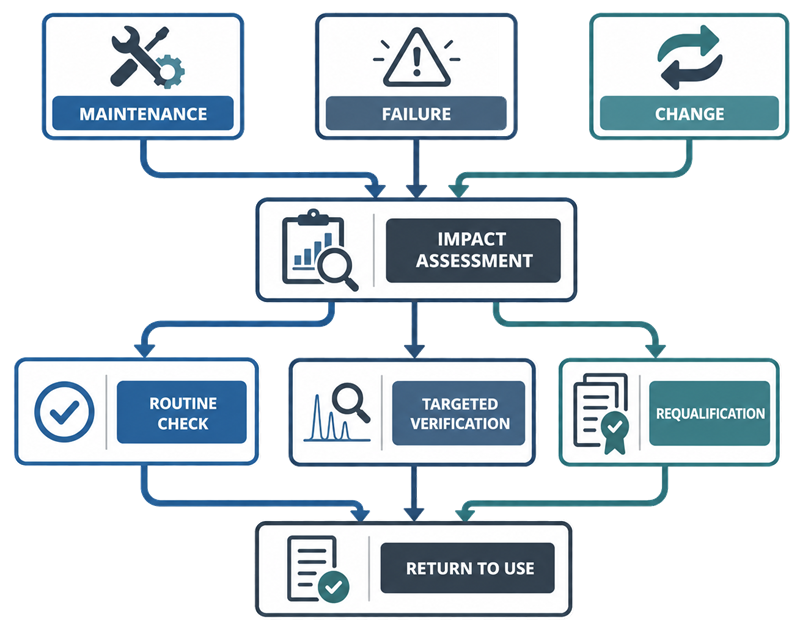
The response may include:
- routine operational check
- calibration
- targeted functional verification
- targeted PQ
- software regression testing
- interface testing
- partial requalification
- broader requalification
The assessment should identify the affected function, potential impact, previous data potentially affected, tests required, acceptance criteria, and release authority.
The analytical instrument requalification framework should be used to determine scope rather than automatically repeating the entire original qualification.
Return to Service
Return-to-service evidence should be proportionate to the work performed and may include:
- maintenance completion
- correct component identification
- calibration
- leak test
- pressure test
- flow verification
- gradient verification
- injection precision
- carryover
- temperature verification
- detector performance
- communication check
- software regression test
- representative system suitability
- review of deviations
- approved release
The instrument should not be released solely because the supplier service record states that the repair was completed. The laboratory should confirm that affected GMP functions and data controls remain acceptable.
Common Qualification Deficiencies
Common deficiencies include:
- qualifying only the physical instrument and excluding software and data storage
- testing vendor specifications without considering actual intended use
- omitting representative backpressure from pump testing
- checking average flow without assessing stability
- failing to evaluate gradient composition and dwell volume
- treating injection precision as injection accuracy
- using an inadequate carryover challenge
- omitting sample-temperature verification
- testing detector wavelength without response, noise, or drift
- ignoring detector acquisition rate for fast UHPLC peaks
- failing to control tubing and fittings in UHPLC systems
- relying on one successful chromatogram as PQ
- treating system suitability as a replacement for qualification
- accepting supplier OQ documentation without applicability assessment
- repeating full qualification after minor maintenance without impact assessment
- returning the system to use without targeted post-maintenance testing
- reviewing repeated failures only as isolated events
- failing to retain original chromatography data, metadata, and processing history
Conclusion
HPLC and UHPLC qualification should demonstrate control of the complete chromatographic system, from solvent reservoirs and high-pressure delivery through injection, separation, detection, data acquisition, processing, review, and electronic-record retention.
The qualification strategy should focus on the functions and operating ranges required by intended analytical use. It should account for UHPLC-specific pressure, volume, connection, dispersion, and acquisition risks without creating a separate duplicative lifecycle.
Continued fitness for use depends on more than the initial qualification. Calibration, system suitability, routine checks, maintenance, failure investigation, performance trending, controlled change, and proportionate requalification collectively maintain the qualified state.