

Analytical Laboratory Audit Trails, User Access, and Data Review
Analytical laboratory systems generate more than final test results. They also create raw data, metadata, instrument methods, processing methods, sample sequences, calculations, audit trails, electronic signatures, configuration records, and security events. Together, these records provide the context needed to reconstruct how an analysis was performed, processed, reviewed, approved, and reported.
Effective control therefore requires more than enabling an audit-trail function. The laboratory must define which actions are recorded, protect records from unauthorized change, assign access according to job responsibilities, review relevant audit-trail entries with the associated analytical data, document the review, and investigate unexplained or potentially consequential activity.
These controls should be established within the broader analytical instrument software validation lifecycle. Their design and depth should reflect intended use, data criticality, system capability, applicable record requirements, and the risks associated with inappropriate access or manipulation of analytical data.
Regulatory and Data-Integrity Context
For pharmaceutical laboratory systems, data controls arise from the applicable current good manufacturing practice requirements and, where electronic records are used to satisfy regulated record requirements, 21 CFR Part 11.
Relevant requirements include:
- 21 CFR 211.68, addressing automatic, mechanical, and electronic equipment, authorized changes, checks, and protection of backup data
- 21 CFR 211.180, addressing record retention and availability
- 21 CFR 211.194, addressing complete laboratory records
- 21 CFR Part 11, addressing electronic records and electronic signatures
- FDA’s Data Integrity and Compliance With Drug CGMP guidance
- FDA’s Part 11—Scope and Application guidance
FDA has explained that a printed chromatogram generally does not constitute a complete copy of the electronic raw data because it may omit the injection sequence, instrument method, integration method, audit trail, and other metadata needed to evaluate the validity of the result. The regulated record boundary must therefore be based on the complete electronic record, not merely the values or reports selected for printing.
The practical objective is to maintain data that are attributable, legible, contemporaneous, original or a true copy, accurate, complete, consistent, enduring, and available throughout the required retention period.
Audit Trails and Other Electronic History Records
An audit trail is a secure, computer-generated, time-stamped record that allows reconstruction of events related to the creation, modification, or deletion of an electronic record. It should identify, as applicable:
- the user who performed the action;
- the date and time of the action;
- the affected record, object, or configuration;
- the previous and revised values;
- the type of action performed;
- the reason for change, when required;
- the electronic signature or approval associated with the action; and
- sufficient context to understand the effect of the event.
Not every event log is an audit trail. Systems may maintain several types of history records, each serving a different purpose.
| Record type | Typical content | Principal review purpose |
|---|---|---|
| Data audit trail | Creation, modification, deletion, recalculation, reprocessing, or approval of regulated data | Determine whether data were generated and processed appropriately |
| Method audit trail | Changes to acquisition, processing, calculation, or reporting methods | Confirm that approved methods and parameters were used |
| Sequence or batch history | Sample order, vial position, injections, additions, removals, and sequence edits | Identify omitted, substituted, repeated, or unauthorized analyses |
| Security audit trail | Logins, failed access attempts, password events, role assignments, and account changes | Detect inappropriate access or security-administration activity |
| Configuration audit trail | Changes to system settings, interfaces, calculations, time settings, and audit-trail configuration | Evaluate effects on validated state and electronic records |
| Instrument event log | Startup, shutdown, faults, communication failures, and hardware events | Correlate technical events with analytical results |
| Operating-system or database log | System-level access, service activity, database events, and infrastructure errors | Support technical investigation and privileged-access monitoring |
The laboratory should identify which records are required to reconstruct each regulated analytical activity. A system-level event log cannot compensate for a missing data audit trail, and a result-level audit trail may not capture changes made to methods, sequences, security roles, or system configuration.
Audit-Trail Enablement and Configuration
Audit trails used to protect regulated records should be enabled before the system is released for GMP use. Configuration should be verified during system qualification and maintained under change control.
The assessment should determine whether the system:
- records creation, modification, and deletion of regulated data;
- captures the identity of the person performing each action;
- applies a reliable date-and-time stamp;
- preserves the original value and the changed value;
- requires a reason for significant changes;
- prevents ordinary users from disabling or modifying the audit trail;
- records changes to methods, sequences, calculations, and report templates;
- records changes to security roles and user accounts;
- retains audit-trail records for at least as long as the associated regulated records;
- links audit-trail entries to the corresponding data;
- permits retrieval in a readable form;
- supports filtering or reporting without concealing relevant entries; and
- protects audit trails during backup, restoration, archival, migration, and system retirement.
Where audit-trail functionality is limited, the deficiency should be assessed against intended use and data risk. Procedural controls may reduce certain risks, but they should not be treated automatically as equivalent to a secure computer-generated audit trail. Unresolved limitations may require restricted use, technical remediation, additional independent review, replacement planning, or retirement of the system.
The audit trail should not be disabled merely because its entries are difficult to review. Excessive or poorly structured audit-trail output is a system-design and review-process problem, not a justification for removing record history.
Defining the Regulated Record Set
Audit-trail review begins with a clear definition of the electronic records that support the reported result. Depending on the technology, the record set may include:
- original detector or instrument response;
- sample and standard identifiers;
- weights, dilutions, potency factors, and preparation data;
- acquisition methods;
- processing and integration methods;
- sequence or run tables;
- injection records;
- calculations and formula versions;
- calibration and system-suitability results;
- chromatograms, spectra, images, or other graphical outputs;
- reprocessed or recalculated results;
- aborted, interrupted, incomplete, or failed runs;
- invalidated and superseded records;
- audit trails and event histories;
- comments, annotations, and reasons for change;
- electronic signatures and approval history;
- interface transactions; and
- final reports and transferred results.
The review procedure should not define the record set only as the data displayed on the final report. Reviewers need access to the information required to determine whether the report accurately represents the complete analytical activity.
Risk-Based Audit-Trail Review
Audit-trail review should be integrated with review of the associated electronic records. Reviewing an exported audit-trail report without examining the affected data may identify that a change occurred but not whether the change was scientifically justified or altered the reported result.
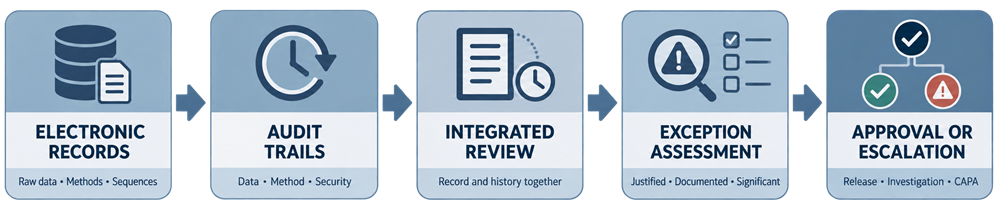
The review scope should consider:
- the criticality of the test and reported result;
- the capability and complexity of the system;
- the ability of users to modify data or processing parameters;
- the degree of automation;
- known system limitations;
- the effectiveness of preventive controls;
- the types and frequency of data changes;
- the potential effect on product quality or disposition; and
- previous deviations, investigations, or adverse trends.
Routine Record-Level Review
For records supporting batch release, stability decisions, validation conclusions, or other GMP decisions, relevant audit trails should normally be reviewed with the data before the record is approved or used for the decision.
The reviewer should examine events capable of affecting data validity, including:
- deletion or attempted deletion of data;
- aborted, interrupted, incomplete, or failed runs;
- repeated injections or analyses;
- samples added to or removed from a sequence;
- changes to vial position or sample identity;
- modification of acquisition or processing methods;
- reintegration or manual integration;
- reprocessing or recalculation;
- changes to sample weights, dilution factors, potency values, or calculations;
- invalidation or replacement of results;
- use of unapproved methods;
- changes made after initial review;
- activity performed by privileged users; and
- unusual date, time, or attribution events.
The reviewer should determine whether each significant action was authorized, scientifically justified, contemporaneously documented, consistent with procedure, and properly reflected in the reported result.
Periodic or System-Level Review
Some activities are better evaluated across multiple records or over a defined period. Periodic review can identify patterns that may not be evident during review of one analysis.
Examples include:
- repeated aborted runs by user, instrument, method, or product;
- recurring reintegration or reprocessing;
- frequent manual changes to calculations or sample information;
- testing performed outside expected hours;
- repeated failed login attempts;
- use of emergency or administrative accounts;
- unexplained creation and deletion of sequences;
- audit-trail configuration changes;
- recurring interface failures;
- users retaining access after transfers or terminations;
- accumulation of excessive privileges; and
- changes made after approval or release.
Periodic review does not replace record-level review when an audit-trail event could affect an individual result or batch decision. The two activities address different risks and should be defined separately.
Establishing Review Frequency
Where an applicable CGMP requirement establishes the timing of record review, the related audit trail should be reviewed at the same point in the process. For example, audit-trail information that may affect a release decision should be evaluated before the decision is approved.
Where review frequency is not specified by regulation, the laboratory should establish it through documented risk assessment. Factors may include:
- data criticality;
- frequency of system use;
- ability to modify or delete data;
- effectiveness of technical restrictions;
- volume and type of audit-trail entries;
- history of discrepancies;
- system maturity;
- use of manual processing;
- level of administrative access; and
- effect of delayed detection.
The result may be a combination of event-driven, per-run, per-sequence, per-batch, monthly, quarterly, or other defined review intervals. A generic annual review is usually insufficient for events that could affect data used much earlier for product disposition.
Reviewer Responsibilities and Independence
Audit-trail review should be performed by personnel who understand the analytical method, system workflow, applicable procedures, and significance of the recorded events. The reviewer must be able to distinguish an expected operational event from an unexplained or potentially consequential data change.
Responsibilities should be separated where practical:
- analysts generate and process data within their authorized role;
- designated laboratory reviewers evaluate the complete analytical record;
- Quality provides independent oversight according to the site quality system;
- system administrators maintain technical configuration and accounts;
- data owners approve access and review significant system changes; and
- information technology personnel manage infrastructure without deciding the scientific acceptability of analytical data.
An individual should not be the sole reviewer of changes that the same individual performed. When self-review cannot be completely prevented because of system or staffing limitations, a documented independent review should be added for the affected activity.
The reviewer should have sufficient system access to inspect the original electronic data and relevant audit trails. A reviewer restricted to static PDF reports cannot adequately evaluate changes recorded only in the live system.
Administrative Independence and Privileged Access
Administrative permissions can permit users to create accounts, modify roles, change system time, alter configuration, move or delete files, restore data, or disable controls. These permissions should be restricted to the minimum number of qualified personnel needed to support the system.
Where technically and operationally feasible, laboratory personnel responsible for generating or approving data should not administer their own access or control the system’s audit-trail configuration. Administrative functions should be assigned to an independent group, such as information technology, system support, or another designated function without responsibility for the analytical result.
Independence does not mean that administrators operate without quality oversight. Privileged activity should remain attributable, controlled, and reviewable.
Controls should include:
- named administrative accounts;
- separation of routine and administrative identities;
- documented authorization for privileged access;
- restricted use of default, vendor, service, and emergency accounts;
- enhanced logging of administrative actions;
- periodic review of privileged-account activity;
- prompt removal of unnecessary permissions;
- control of remote vendor access;
- password-vault or equivalent controls where appropriate; and
- investigation of unexplained administrative activity.
Administrators should use their standard account for ordinary tasks and invoke a separate privileged account only when administrative permissions are required. This separation makes elevated activity easier to identify and review.
Individual Accounts and Shared-Account Prohibition
Each user should have a unique identity. Shared accounts compromise attribution because the system cannot reliably identify who performed an action.
Generic analyst accounts, shared passwords, group logins, and common administrator credentials should not be used for regulated activity. Exceptions should be limited to technically necessary service identities that do not permit interactive analytical work and are controlled through documented technical measures.
Account controls should address:
- unique user identification;
- identity verification before account issuance;
- password or authentication requirements;
- prohibition of credential sharing;
- account lockout or equivalent controls;
- timely disabling of inactive or terminated accounts;
- retention of user identity history;
- prevention of reassignment of a former user’s identity;
- control of temporary and contractor accounts;
- service-account ownership and permitted functions; and
- emergency-access authorization and retrospective review.
A user’s account should normally be disabled rather than deleted so that historical records remain attributable to the original identity.
Security Roles and Least-Privilege Access
Security roles should be based on defined job responsibilities and should grant only the permissions necessary to perform assigned tasks. Role design should be established before individual accounts are issued.
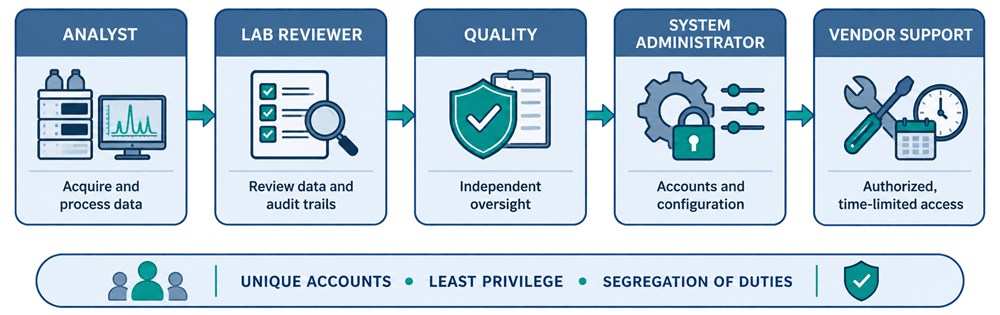
Typical role categories may include:
| Role | Typical permitted activities | Typical restrictions |
|---|---|---|
| Analyst | Acquire data, enter authorized metadata, apply approved methods | Cannot approve own data, alter security, disable audit trails, or delete regulated records |
| Senior analyst or method specialist | Approved method-management or advanced processing functions | Changes remain controlled and independently reviewed |
| Laboratory reviewer | Review electronic records, audit trails, calculations, and reports | Cannot modify the data under review |
| Quality reviewer | Perform independent review or approval and access relevant histories | No routine data generation |
| System administrator | Manage accounts, roles, configuration, and technical support | No authority to approve analytical acceptability |
| Service or vendor support | Perform specifically authorized maintenance | Time-limited access, monitored activity, no uncontrolled data changes |
| Read-only auditor | View records, audit trails, and reports | No creation, modification, or deletion privileges |
Role configuration should be tested during qualification. Testing should demonstrate both that authorized functions are available and that prohibited actions are blocked. Permission testing limited to successful access does not establish effective segregation of duties.
Deleted, Aborted, and Incomplete Runs
Deleted, aborted, interrupted, incomplete, or failed runs remain part of the analytical history when they relate to GMP testing. Their existence may be scientifically legitimate, but they should not disappear from review merely because they did not produce a reportable result.
The system and procedure should ensure that:
- the event remains visible in the electronic record or audit trail;
- the associated samples and sequence are identifiable;
- the reason for the event is recorded contemporaneously;
- generated data are retained where required;
- repeat analysis follows an approved procedure;
- the original activity remains linked to the repeat or replacement activity; and
- unexplained patterns are escalated.
Examples of acceptable reasons may include a documented instrument fault, verified vial breakage, communication failure, or an approved system-suitability response. “Analyst error” without a specific, scientifically supported explanation is not adequate justification.
Abort functions should not provide a mechanism for screening results before the data become part of the official record.
Sequence Creation and Modification
Chromatographic and other sequence-based systems require particular attention because changes to sample order, injection type, vial position, or replicate structure can alter the analytical narrative.
Review should address:
- when the sequence was created;
- who created and modified it;
- whether samples, standards, blanks, and controls match the approved testing plan;
- whether injections were added, removed, substituted, or reordered;
- whether vial positions or sample identifiers were changed;
- whether additional injections were authorized;
- whether the acquisition method changed during the sequence;
- whether the sequence was partially executed, stopped, or restarted; and
- whether all acquired injections were included in the final assessment.
Laboratory procedures should define which sequence changes are permitted before acquisition, which require documented authorization, and which constitute a deviation or investigation.
Reprocessing, Reintegration, and Recalculation
Reprocessing is not inherently improper. Analytical systems may require legitimate reprocessing when an approved processing method is corrected or when scientifically justified integration parameters are applied. The control failure occurs when reprocessing is undocumented, selectively performed to obtain a preferred result, or used without preserving the original data and processing history.
Controls should require:
- retention of the original raw data and original processed result;
- use of approved processing methods where applicable;
- identification of the user performing the reprocessing;
- a contemporaneous reason for the action;
- preservation of each relevant version;
- comparison of original and revised results;
- independent review of the justification;
- assessment of effects on system suitability and other samples;
- linkage to a deviation or investigation when required; and
- inclusion of the appropriate result in the final report.
Repeated processing attempts should be visible to the reviewer. The system should not permit users to overwrite an earlier result without retaining its history.
Manual Integration
Manual integration may be scientifically justified for some chromatographic data, but it presents increased data-integrity risk because the result depends on user judgment.
Procedures should define:
- when manual integration is permitted;
- objective integration rules;
- who may perform it;
- required justification;
- required comparison with the original automated integration;
- approval requirements;
- audit-trail review expectations; and
- circumstances requiring investigation.
Manual integration should not be used simply because the automated result does not meet specification, system suitability, or an expected value. Frequent manual integration may indicate an unsuitable processing method, poor chromatography, inadequate method controls, instrument problems, or inappropriate analyst practices.
Review Evidence
Completion of review should produce attributable and retrievable evidence. A checkbox stating “audit trail reviewed” is insufficient unless the procedure clearly defines what was reviewed and the system or record establishes the applicable scope.
Review evidence should identify, as appropriate:
- system and record reviewed;
- analytical run, sequence, batch, or reporting period;
- audit-trail types included;
- filters or date ranges used;
- significant entries evaluated;
- supporting records examined;
- identified discrepancies;
- conclusions and required actions;
- reviewer identity;
- review date and time; and
- electronic signature or documented approval.
Where an audit-trail report is generated, the report should remain traceable to the live electronic records and should not replace retention of the underlying audit trail. Filters used to create the report should be controlled so that significant entries are not inadvertently excluded.
Review evidence should allow another qualified person to understand what was reviewed, which exceptions were identified, and why the data were considered acceptable.
Exception Handling and Escalation
Procedures should define when an audit-trail observation can be resolved during routine review and when it requires formal escalation.
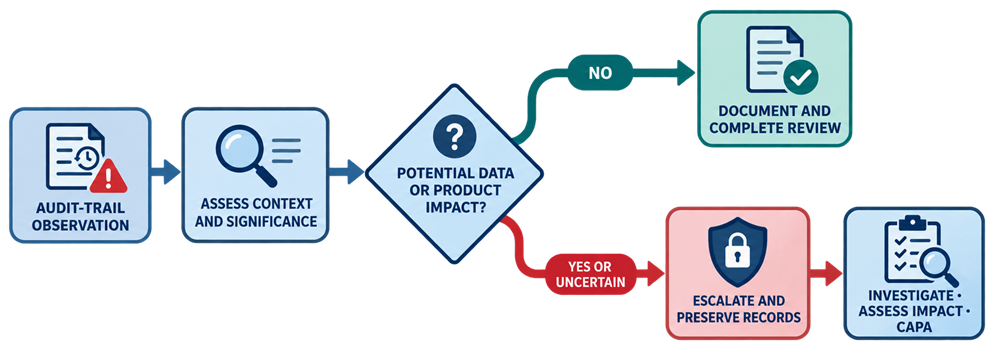
Potential escalation triggers include:
- unexplained deletion or attempted deletion;
- missing raw data or metadata;
- undocumented aborted or repeated analyses;
- unauthorized sequence changes;
- unapproved processing or integration methods;
- changes made after review or approval;
- activity under another person’s account;
- use of shared or generic credentials;
- unexplained privileged-user activity;
- disabled audit trails or missing audit-trail periods;
- changes to system date or time;
- discrepancies between electronic data and reported results;
- recurring manual integration or reprocessing;
- retrospective entry of reasons for change;
- evidence of testing into compliance; and
- patterns suggesting intentional data manipulation.
Escalation should preserve the affected records, restrict further modification where necessary, notify designated laboratory and Quality personnel, evaluate product and batch impact, determine the investigation scope, and address systemic causes.
The investigation should consider whether the observation affects only one result or indicates a broader weakness involving other users, methods, products, instruments, or reporting periods.
Periodic User-Access Review
User access should be reviewed periodically and after relevant personnel or organizational changes. The purpose is to confirm that every active account remains necessary, belongs to a current authorized user, and retains only appropriate permissions.
The review should include:
- active, inactive, disabled, temporary, and locked accounts;
- user employment or contractor status;
- current job responsibilities;
- assigned roles and effective permissions;
- privileged and administrative accounts;
- default and vendor accounts;
- service and interface accounts;
- emergency accounts;
- remote-access permissions;
- accounts without recent use;
- segregation-of-duties conflicts; and
- unresolved access exceptions.
The review should compare the system’s actual account listing with authoritative personnel and authorization records. Reviewing only a previously approved access form will not identify later configuration changes or unauthorized privilege accumulation.
Required corrections should be tracked to completion. High-risk access, such as unnecessary administrative privilege or an active account belonging to a departed employee, should be addressed promptly rather than deferred until the review report is closed.
Access Changes Through the Personnel Lifecycle
Access management should cover the full personnel lifecycle:
- Joiner: identity verified, training completed, role approved, and unique account issued.
- Mover: access reassessed when responsibilities, department, project, or site changes.
- Temporary assignment: additional permissions authorized for a defined purpose and expiration date.
- Leave or suspension: access restricted according to established security and human-resources procedures.
- Leaver: interactive access disabled promptly while historical attribution is preserved.
- Reinstatement: access reauthorized rather than automatically restored.
- Periodic review: actual permissions reconciled with current responsibilities.
Automated identity-management tools can improve timeliness, but interfaces and role mappings must themselves be controlled and verified.
Configuration, Change Control, and Periodic Review
Changes to audit-trail settings, role permissions, authentication controls, report filters, database configuration, or review workflows may affect the validated state and should be managed through change control.
The impact assessment should consider:
- whether previously recorded data remain available;
- whether the change alters audit-trail content;
- whether new permissions create segregation conflicts;
- whether reviewers can still retrieve complete histories;
- whether reports or filters exclude relevant events;
- whether procedures and training require revision;
- whether qualification testing is required; and
- whether retrospective review is necessary.
Periodic system review should evaluate the continuing effectiveness of audit-trail and access controls using information such as deviations, investigations, access reviews, audit-trail review trends, security incidents, system changes, vendor updates, backup and restoration results, and known system limitations.
The review should lead to a documented decision on continued use, corrective action, targeted requalification, broader remediation, or system replacement.
Common Control Weaknesses
Frequently observed weaknesses include:
- enabling audit trails without defining how they will be reviewed;
- reviewing only the final result or printed report;
- treating all audit-trail entries as equally significant;
- allowing analysts to administer their own accounts;
- using shared or generic accounts;
- granting administrator access for convenience;
- failing to review deleted, aborted, or incomplete runs;
- accepting repeated reprocessing without investigating the pattern;
- permitting manual integration without objective criteria;
- documenting review only with an unexplained checkbox;
- reviewing user access against obsolete authorization lists;
- deleting inactive accounts and losing historical identity context;
- failing to control vendor or remote-support access;
- relying on annual review for events affecting current batch release; and
- assuming that procedural controls fully compensate for missing technical capability.
These conditions do not automatically establish that data are invalid. They indicate weaknesses that require risk assessment, investigation where appropriate, and proportionate corrective action.
Lifecycle Control Strategy
A sustainable control strategy connects system design, qualification, laboratory procedures, and routine oversight.
The lifecycle should include:
- defining the regulated electronic record set;
- identifying required audit trails and event histories;
- configuring audit-trail and security functions;
- establishing roles and segregation of duties;
- testing permissions and prohibited actions;
- defining review scope, frequency, and evidence;
- training analysts, reviewers, administrators, and Quality personnel;
- controlling exceptions, reprocessing, and manual integration;
- reviewing access and privileged activity;
- trending significant events;
- managing configuration and software changes;
- periodically evaluating control effectiveness; and
- maintaining complete records through archival, migration, and retirement.
Audit trails are effective only when the recorded activity is protected, interpretable, reviewed in context, and acted upon. User-access controls are effective only when actual permissions remain aligned with current responsibilities. Data review is effective only when it considers the complete electronic record rather than a selected final output.
Together, these controls support reliable analytical decisions and provide defensible evidence that laboratory data remain complete, attributable, and scientifically sound throughout their lifecycle.