

Packaging System Requirements, Design, and Risk Assessment
Packaging is part of the product protection strategy, not simply a container selected after product development is complete. A packaging system must maintain the required product characteristics from packaging through storage, distribution, handling, and use while remaining compatible with the product and with the processes used to manufacture, sterilize, assemble, label, and distribute it.
Effective packaging design therefore begins with defined requirements. Product characteristics, intended use, shelf life, storage conditions, distribution hazards, sterility or barrier requirements, manufacturing processes, and regulatory expectations are translated into measurable packaging requirements. Risk assessment is then used to identify the failures that could compromise product quality or device performance and to determine which design characteristics require particular control and downstream verification.
For pharmaceutical and biological products, 21 CFR §211.94 requires drug-product containers and closures to be nonreactive, nonadditive, and nonabsorptive to the extent necessary to protect product safety, identity, strength, quality, and purity. Container-closure systems must also provide adequate protection against foreseeable external factors during storage and use. FDA’s guidance on Container Closure Systems for Packaging Human Drugs and Biologics further establishes the container-closure system as the combination of packaging components that together contain and protect the dosage form.
For medical devices, the FDA Quality Management System Regulation (QMSR) became effective February 2, 2026 and incorporates ISO 13485:2016 into the U.S. device quality-system framework. For terminally sterilized medical devices, FDA currently recognizes ISO 11607-1:2019 including Amendment 1:2023 for materials, sterile barrier systems, and packaging systems, together with ISO 11607-2 for validation of forming, sealing, and assembly processes.
Key Principles
- Packaging requirements should be derived from product, process, storage, distribution, and intended-use requirements before the final packaging configuration is selected.
- The complete packaging system should be considered, including components that provide containment, barrier protection, physical protection, labeling, handling, or distribution protection.
- Packaging materials and components must be compatible with the product and suitable for the intended environmental and processing conditions.
- Product stability, sterility, physical integrity, and functional performance should be treated as packaging design inputs when packaging can influence those attributes.
- Risk assessment should identify credible packaging failure modes and connect them to design controls, specifications, qualification studies, and lifecycle monitoring.
- Distribution hazards should be considered during design even though laboratory transport simulation and actual shipping qualification occur later.
- Worst-case configurations should be scientifically justified based on the characteristics that challenge package performance rather than selected solely by nominal package size.
- Packaging design, packaging-process capability, stability, integrity, distribution performance, and shipping validation should form a connected lifecycle rather than independent studies.
Packaging Design Begins With Requirements
The first engineering task is to determine what the packaging system must accomplish. Selecting a bottle, vial, pouch, blister, tray, carton, or shipping case before defining these requirements reverses the proper design sequence.
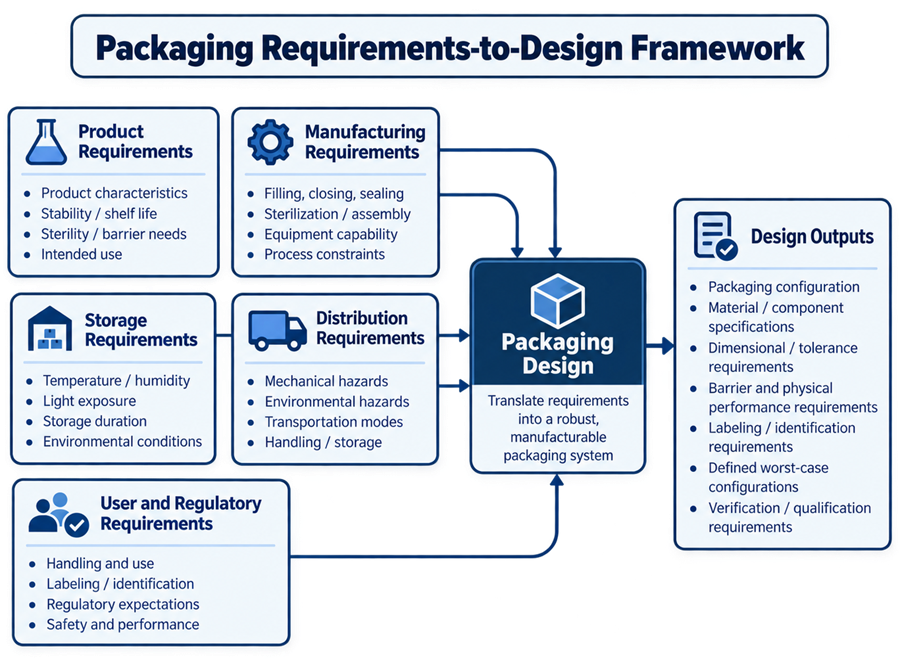
Packaging requirements should originate from several sources simultaneously. Product development defines chemical, physical, microbiological, and stability sensitivities. Manufacturing defines filling, closing, sealing, sterilization, assembly, and labeling constraints. Distribution defines mechanical and environmental exposures. Intended use introduces handling, opening, dispensing, administration, and user-interface requirements. Regulatory requirements establish additional controls for materials, product protection, sterility, identification, and documentation.
These requirements should be captured in a controlled packaging requirements document, design-input specification, or equivalent engineering record. The terminology is less important than establishing clear, testable requirements and traceability between the identified need, the selected packaging feature, and the evidence ultimately used to demonstrate suitability.
Defining the Packaging System Boundary
The design assessment should consider the complete packaging configuration rather than only the component in direct contact with the product. The relationship between primary, secondary, tertiary, and sterile-barrier packaging is discussed in more detail in Packaging System Types: Primary, Secondary, Tertiary, and Sterile Barrier Packaging.
For a pharmaceutical product, the primary container-closure system may include a vial, stopper, and seal; a bottle and cap; a blister cavity and lidding material; or a prefilled syringe with its associated closure components. Secondary components may provide light protection, physical restraint, labeling space, tamper evidence, or additional environmental protection. Tertiary packaging may protect multiple units during handling and distribution.
For a sterile medical device, the sterile barrier system may consist of a pouch, tray and lid, or another validated configuration that permits sterilization while maintaining an appropriate microbial barrier until use. Protective packaging outside the sterile barrier may be required to prevent puncture, crushing, abrasion, seal stress, or other damage during distribution.
The package boundary should therefore be based on function. A component that does not contact the product directly can still be critical when its failure can compromise stability, sterility, labeling, physical integrity, or delivery to the user.
Product Characteristics as Design Inputs
Product characteristics determine the protection that packaging must provide. These characteristics should be identified early because they influence material selection, barrier properties, closure design, headspace, package dimensions, protective features, and environmental requirements.
For pharmaceuticals and biologics, relevant characteristics may include sensitivity to moisture, oxygen, light, temperature, adsorption, leaching, solvent loss, microbial contamination, or changes in concentration. Liquid, solid, lyophilized, semisolid, and biological products can impose substantially different requirements on the same nominal package type.
Sterile products require particular attention to the interfaces responsible for maintaining the sterile state. The package design must remain capable of maintaining the required barrier over the intended shelf life and through reasonably anticipated manufacturing, storage, and distribution stresses. Detailed integrity-test strategy belongs in Package Seal Strength, Integrity, and Sterile Barrier Testing rather than being established by package appearance alone.
Medical-device packaging must also consider physical characteristics of the device itself. Sharp edges, concentrated loads, heavy components, flexible tubing, articulated assemblies, and components capable of movement inside the package can damage a sterile barrier even when the packaging material is otherwise suitable. Packaging should restrain and protect the device without introducing stresses that affect device performance or presentation.
Material and Component Selection
Packaging materials should be selected against defined functional requirements rather than solely on historical use or supplier availability. Depending on the application, important properties can include moisture and gas permeability, light transmission, chemical resistance, mechanical strength, puncture resistance, flexibility, sealability, dimensional stability, cleanliness, particulate generation, sterilization compatibility, and performance over the labeled shelf life.
For drug products, compatibility between the formulation and packaging components is fundamental. FDA’s current regulation requires containers and closures not to be reactive, additive, or absorptive in a manner that adversely alters required product characteristics. Material selection may therefore require evaluation of extractables and leachables, sorption, permeation, moisture loss or uptake, oxygen transmission, and other product-specific interactions.
Material properties also must be assessed after relevant processing. Heat sealing, sterilization, freezing, refrigerated storage, elevated temperature, irradiation, moisture exposure, or repeated handling can alter material characteristics. A design based only on incoming-material properties may therefore fail to represent the condition of the package throughout its actual lifecycle.
Supplier information can support the design decision, but supplier data should not substitute for product- and process-specific assessment when the material property is critical to package performance.
Connecting Packaging Design to Product Stability
Packaging and stability development should not be treated as independent programs. The proposed market package establishes the microenvironment in which a pharmaceutical or biological product must remain acceptable throughout its labeled shelf life.
ICH Q1A(R2) establishes the general stability framework currently implemented by FDA, including evaluation of drug products in the proposed container-closure system. Moisture transmission, solvent loss, oxygen ingress, light exposure, adsorption, and interaction with packaging materials can therefore become packaging design variables rather than merely stability-test observations.
The design stage should identify which package characteristics can influence stability and establish appropriate specifications or controls. The actual evidence supporting shelf life and package aging is addressed separately in Packaging Aging, Shelf-Life, and Stability Integration.
For sterile products, container-closure integrity can also form part of the stability strategy. FDA recognizes container and closure system integrity testing as a scientifically useful approach for assessing maintenance of integrity during the stability period when appropriately justified.
Manufacturing and Packaging-Process Requirements
A package design is not adequate merely because an individual laboratory sample performs well. It must also be capable of being manufactured and assembled consistently under routine operating conditions.
Design considerations therefore include equipment capability, tolerances, component presentation, filling and closure operations, seal geometry, sealing surfaces, assembly sequence, sterilization, inspection capability, coding and labeling, line speeds, and the normal sources of process variation. Package dimensions and tolerances should be compatible with both the product and the packaging equipment.
For heat-sealed packages, for example, the material combination may theoretically create an effective seal while still having an operating window too narrow for reliable commercial processing. Closure systems can similarly be sensitive to dimensional variation, torque, stopper placement, crimping, or other process parameters. These relationships should be understood during design so that the eventual manufacturing process has an adequate operating range.
Formal qualification and validation of package forming, sealing, and assembly processes will be addressed in Packaging Process Validation: Forming, Sealing, and Assembly. FDA recognizes ISO 11607-2 for this purpose for terminally sterilized medical devices.
Storage and Distribution as Design Inputs
A packaging system must be designed for the conditions it can reasonably encounter after manufacture. Storage and transportation hazards should therefore be characterized during design even though formal distribution simulation and shipping validation are separate downstream activities.
Potential mechanical hazards include drop, shock, vibration, compression, abrasion, puncture, impact, stacking, and load shifting. Environmental hazards can include high or low temperature, thermal cycling, humidity, pressure or altitude changes, light exposure, and extended transportation duration.
The significance of each hazard depends on the product-package combination. A glass vial may be particularly sensitive to impact and contact between adjacent units. A pouch containing a device with a sharp feature may be sensitive to abrasion or puncture. A bottle containing a moisture-sensitive dosage form may depend primarily on moisture-barrier performance and closure effectiveness. A refrigerated biological product may require a packaging system capable of maintaining a controlled thermal environment despite variable ambient conditions.
The design objective is not to reproduce every possible transportation event. It is to identify credible hazards and ensure that the proposed packaging system has features capable of controlling them. Formal laboratory challenge is subsequently established through Distribution Simulation Strategy and Transport Testing, while the overall distribution strategy is addressed in Shipping Validation Strategy and Distribution Risk Assessment.
Temperature-sensitive products require additional consideration of thermal protection, payload characteristics, refrigerants, insulation, pack-out, and shipment duration. These subjects are developed separately in Temperature-Controlled Packaging System Qualification.
Packaging Risk Assessment
Risk assessment provides the connection between packaging requirements and the evidence required to demonstrate that the selected design is suitable. It should be used to identify credible failure modes, determine their potential effect on product quality or device safety and performance, and establish appropriate preventive and verification controls.
ICH Q9(R1) provides the current FDA framework for pharmaceutical quality risk management and emphasizes that the level of effort, formality, and documentation should be commensurate with risk. For medical devices, ISO 14971:2019, currently recognized by FDA, establishes a lifecycle process for identifying hazards, estimating and evaluating associated risks, implementing controls, and monitoring their effectiveness.
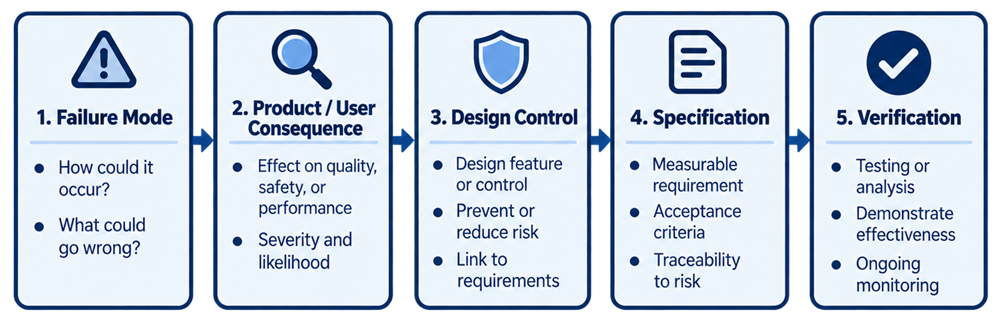
Packaging risk assessment can use FMEA or another suitable method, but the value of the assessment depends more on technical reasoning than on the numerical scoring format. The assessment should identify how a packaging failure could occur, what product or user consequence could result, what design feature prevents or reduces the failure, and what evidence will verify the control.
Typical packaging failure scenarios include:
| Potential failure | Possible consequence | Examples of design response |
|---|---|---|
| Loss of barrier or seal | Contamination, loss of sterility, moisture or oxygen ingress | Material/barrier specification, seal design, protective packaging |
| Container breakage | Product loss, contamination, user hazard | Material selection, cushioning, separation, protective geometry |
| Puncture or abrasion | Sterile-barrier failure or product exposure | Device restraint, protective features, higher-resistance material |
| Closure movement or leakage | Loss of containment or integrity | Closure geometry, engagement controls, dimensional tolerances |
| Moisture or oxygen transmission | Product degradation | Barrier material, desiccant, closure design, overwrap |
| Light exposure | Photodegradation | Opaque or UV-protective material, secondary packaging |
| Product/package interaction | Leachables, adsorption, potency or purity effects | Material compatibility assessment and stability studies |
| Temperature exposure | Product degradation or loss of performance | Thermal packaging requirements and controlled distribution |
| Compression or impact | Package deformation or product damage | Structural design, cushioning, tertiary-packaging configuration |
| Incorrect identification or damaged label | Misidentification or improper use | Label controls, placement, material durability, protective design |
The risk assessment should remain traceable to downstream testing. A high-risk failure mode that depends on seal integrity should generate defined seal or integrity requirements. A risk controlled by cushioning should be challenged during distribution testing. A moisture-protection requirement should be supported by appropriate material characteristics and stability evidence. Risk assessment should therefore determine what must be demonstrated rather than simply producing a risk score.
Worst-Case Packaging Configuration
Packaging systems are often marketed in multiple sizes, fill volumes, device configurations, materials, or pack quantities. Testing every combination may not be scientifically necessary, but representative or worst-case configurations must be selected on the basis of the failure mechanism being evaluated.
There is rarely one universal worst case. The configuration most challenging for drop resistance may differ from the configuration most challenging for seal integrity, thermal performance, compression resistance, or moisture protection.
Factors that can influence worst-case selection include package dimensions, headspace, fill volume, product mass, center of gravity, surface-area-to-volume ratio, seal length, material thickness, closure geometry, number of units per case, cushioning, payload thermal mass, and the ability of the product or device to move within the package.
The design-stage risk assessment should identify these variables. Formal selection and justification of qualification configurations are addressed in Packaging Qualification Strategy and Worst-Case Configuration.
Labeling, Identification, and Use Requirements
The packaging system must also support correct identification, handling, storage, and use. Label area, adhesion, durability, print legibility, barcode or machine-readable information, tamper-evident features, orientation markings, storage statements, and instructions can impose physical design requirements on the package.
These requirements should be evaluated under actual packaging and distribution conditions. A label that is legible when initially applied may not remain suitable after refrigerated storage, condensation, abrasion, freezing, heat exposure, or contact with secondary packaging.
For medical devices, packaging design should also consider how the package is opened and how the device is presented to the user. A sterile barrier that maintains integrity but cannot be opened without contaminating the device, damaging it, or creating unreasonable handling difficulty may not adequately support intended use.
Design Outputs and Packaging Specifications
The packaging-development stage should conclude with defined design outputs rather than a general statement that the package appears suitable. Depending on the product, these outputs can include:
- approved packaging configuration and component hierarchy;
- material and component specifications;
- dimensional and tolerance requirements;
- barrier and physical-performance requirements;
- closure or seal requirements;
- sterilization compatibility requirements;
- environmental and storage limits;
- critical packaging-process requirements;
- labeling and identification requirements;
- defined worst-case configurations;
- stability-related packaging requirements;
- distribution protection requirements;
- inspection and acceptance requirements; and
- identified qualification and verification studies.
The design documentation should establish traceability from the original requirement through the selected design feature to the planned verification method.
From Packaging Design to Qualification
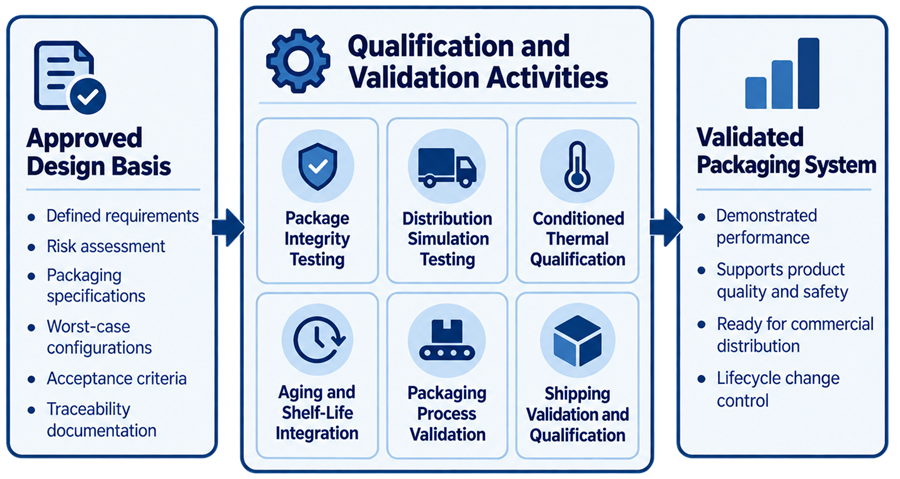
Packaging design and packaging qualification are related but distinct activities. Design establishes what the system must accomplish and selects a configuration intended to meet those requirements. Qualification generates objective evidence that the defined system performs as intended under specified challenges.
The approved design basis should therefore become the input to Packaging Qualification Strategy and Worst-Case Configuration. Specific performance requirements can then be verified through package integrity testing, distribution simulation, aging studies, packaging-process validation, thermal qualification, or real-world shipping studies as applicable.
This separation prevents a common validation weakness: performing standard package tests without first establishing why those tests, severities, configurations, and acceptance criteria are relevant to the particular product. A successful test has limited value if the tested condition is not traceable to a defined product or packaging requirement.
Lifecycle Considerations
Packaging requirements do not end when the initial design is qualified. Material substitutions, supplier changes, component dimensional changes, revised sterilization processes, packaging-equipment changes, altered pack quantities, new shipping routes, revised storage conditions, or changes to the product itself can affect previously established packaging controls.
For pharmaceutical and biological products, FDA has specifically addressed risk-based evaluation of certain postapproval container-closure changes, demonstrating the importance of assessing packaging changes against their potential product-quality impact.
Packaging design documentation and its associated risk assessment should therefore be maintained as lifecycle records. Changes should be evaluated against the original design requirements and qualification evidence to determine whether additional testing, stability assessment, process validation, or requalification is necessary.
Validation Perspective
From a validation-engineering perspective, the most important output of packaging design is not the package drawing or bill of materials. It is a technically justified design basis connecting product requirements and risks to measurable packaging characteristics and subsequent verification.
A robust packaging strategy should be able to answer four questions:
- What must the packaging system protect or control?
- What credible failures could prevent it from doing so?
- What design features and specifications control those risks?
- What qualification or lifecycle evidence demonstrates that those controls remain effective?
When these relationships are defined before qualification begins, packaging testing becomes a focused verification program rather than a collection of standard tests. That foundation supports scientifically justified package qualification, distribution simulation, shipping validation, and lifecycle change control.