

Packaging Process Validation: Forming, Sealing, and Assembly
Packaging process validation provides documented evidence that the processes used to form, seal, close, and assemble a packaging system can consistently produce packages meeting predetermined requirements under routine manufacturing conditions. The focus is not simply whether a finished package passes an integrity test. Validation must demonstrate that the manufacturing process itself is capable, controlled, reproducible, and sufficiently robust to produce acceptable packaging throughout the defined operating range.
For terminally sterilized medical devices, ISO 11607-2:2019, including Amendment 1:2023, specifically establishes validation requirements for forming, sealing, and assembly processes used to manufacture preformed sterile barrier systems, sterile barrier systems, and packaging systems. ISO confirmed the 2019 edition as current in 2024, and FDA recognizes ISO 11607-2 including the 2023 risk-management amendment.
For pharmaceutical and biotechnology products, ISO 11607-2 should not automatically be applied as a regulatory requirement. Packaging processes instead operate within applicable CGMP requirements for production and process control and for drug-product containers and closures. 21 CFR §211.100 requires written production and process-control procedures designed to assure product quality, while §211.94 requires suitable container-closure systems and written procedures for applicable cleaning, sterilization, and processing of container and closure components.
The validation-engineering principles are nevertheless similar: define the process, understand critical variables, qualify the equipment, determine an acceptable operating window, demonstrate reproducible performance, establish routine controls, and reassess the validated state when relevant changes occur.
Key Principles
- Packaging process validation demonstrates process reproducibility, while package qualification demonstrates that the resulting packaging system performs its intended protective function.
- Validation should begin with defined package requirements, material specifications, equipment capability, and identified process risks.
- Forming, sealing, closing, and assembly operations should have measurable process parameters and package attributes linked to package performance.
- Installation Qualification, Operational Qualification, and Performance Qualification should be coordinated with process development rather than treated as isolated documentation exercises.
- OQ should challenge justified operating limits and establish the process window; PQ should demonstrate reproducible performance under routine production conditions.
- Validation samples should represent production materials, equipment, tooling, operators, configurations, and relevant process variability.
- Finished-package inspection and integrity testing provide evidence of process output but should not substitute for adequate control of the packaging process.
- Routine monitoring should confirm that critical process variables remain within the validated range.
- Packaging equipment, material, tooling, supplier, configuration, and process changes should be evaluated against the validated state and may require focused or full revalidation.
Packaging Process Validation Versus Package Qualification
Packaging process validation and packaging qualification are closely connected but answer different questions.
Package qualification asks: Can the defined package protect the product or device under the required conditions?
Packaging process validation asks: Can the manufacturing process consistently produce that defined package within approved requirements?
For example, a pouch may successfully withstand sterilization, aging, and distribution testing. That demonstrates packaging-system performance. It does not by itself demonstrate that a heat-sealing process operating every day across different operators, lots of material, line speeds, and equipment conditions will reliably create equivalent seals.
Conversely, a highly repeatable sealing process cannot compensate for an inadequate package design. A process can consistently manufacture a package that is fundamentally too weak, too permeable, or unsuitable for the intended distribution environment.
The design and package-performance requirements established in Packaging System Requirements, Design, and Risk Assessment and Packaging Qualification Strategy and Worst-Case Configuration should therefore become inputs to packaging process validation.
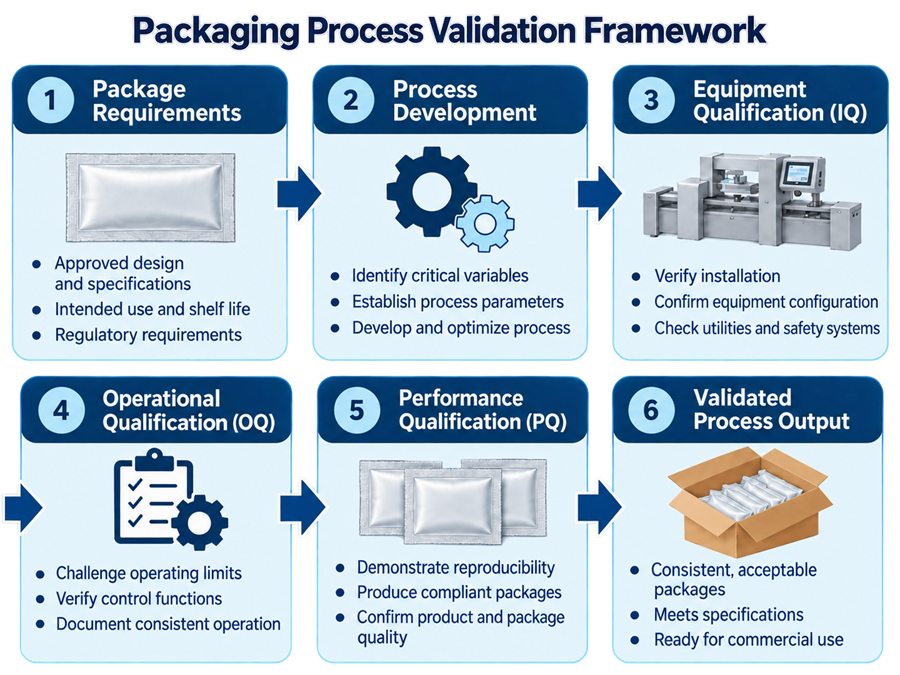
Processes Within the Validation Boundary
ISO 11607-2 applies to development and validation of packaging processes for terminally sterilized medical devices, including forming, sealing, and assembly. Its scope includes processes used for preformed sterile barrier systems, sterile barrier systems, and complete packaging systems.
Depending on the product and packaging technology, the validation boundary may include:
| Packaging operation | Examples |
|---|---|
| Forming | Thermoformed trays, form-fill-seal webs, blister cavities |
| Sealing | Pouch sealing, tray-lid sealing, blister lidding, induction sealing |
| Closing | Bottle capping, stopper placement, crimping, reusable container closure |
| Assembly | Device placement, tray assembly, kit assembly, protective-component installation |
| Wrapping | Sterilization wraps, folded systems, tape application |
| Integrated automated packaging | Form-fill-seal, automated loading, sealing, inspection, coding |
The process boundary should identify which equipment, tooling, utilities, software, sensors, materials, and manual operations can affect the resulting package.
For pharmaceutical packaging, the same boundary concept is useful even though the applicable regulatory basis differs. Bottle filling and capping, vial stoppering and crimping, blister forming and lidding, induction sealing, sachet sealing, and other packaging processes may require qualification and validation appropriate to their impact on product protection and container-closure performance.
Start With an Approved Process Specification
Validation should not begin with IQ or a prewritten OQ protocol. The process first needs a defined technical basis.
The process specification should identify the required package output, applicable materials and configurations, equipment and tooling, relevant process variables, in-process controls, acceptance criteria, and the parameters or product attributes that must be monitored to maintain control.
For a heat-sealing process, for example, relevant parameters may include sealing temperature, dwell time, pressure or force, line speed, jaw alignment, cooling conditions, and material presentation. The package attributes affected by those parameters may include seal width, seal strength, visual appearance, channel formation, peel characteristics, and sterile-barrier integrity.
For a capping or closure process, relevant variables may include torque, closure engagement, stopper position, crimp dimensions, closure force, component tolerances, line speed, and equipment alignment.
A useful validation strategy distinguishes between:
- Process parameters — variables controlled by the equipment or operator.
- Package attributes — measurable characteristics of the resulting package.
- Performance requirements — the functions that those package attributes ultimately support.
The linkage between these three levels should be established before qualification testing is designed.
Risk Assessment and Critical Process Variables
Not every machine setting requires the same degree of validation attention. Risk assessment should identify which variables can materially affect packaging-system performance.
The 2023 amendment to ISO 11607-2 specifically addresses application of risk management to packaging-process validation. FDA’s current recognition includes that amendment.
A practical risk relationship is: Process variable → package attribute → potential failure → product/device consequence
For example:
| Process variable | Package attribute affected | Potential failure |
|---|---|---|
| Seal temperature | Seal formation and strength | Weak seal, material distortion |
| Seal pressure | Seal uniformity | Incomplete seal or excessive thinning |
| Dwell time | Seal development | Underseal or overheating |
| Jaw alignment | Seal geometry | Nonuniform seal or channel |
| Closure torque | Closure engagement | Leakage or loosening |
| Forming temperature | Tray/web geometry | Thin areas, deformation |
| Vacuum or forming pressure | Wall thickness and cavity shape | Weak or malformed package |
| Device placement | Seal-area clearance | Product trapped in seal |
| Line speed | Effective process exposure | Incomplete forming or sealing |
The purpose is not simply to label parameters “critical” or “noncritical.” The analysis should determine which variables require defined operating limits, alarms, monitoring, interlocks, or verification during validation and routine operation.
Process Development Before Qualification
Process development should establish how the packaging process behaves before formal OQ begins.
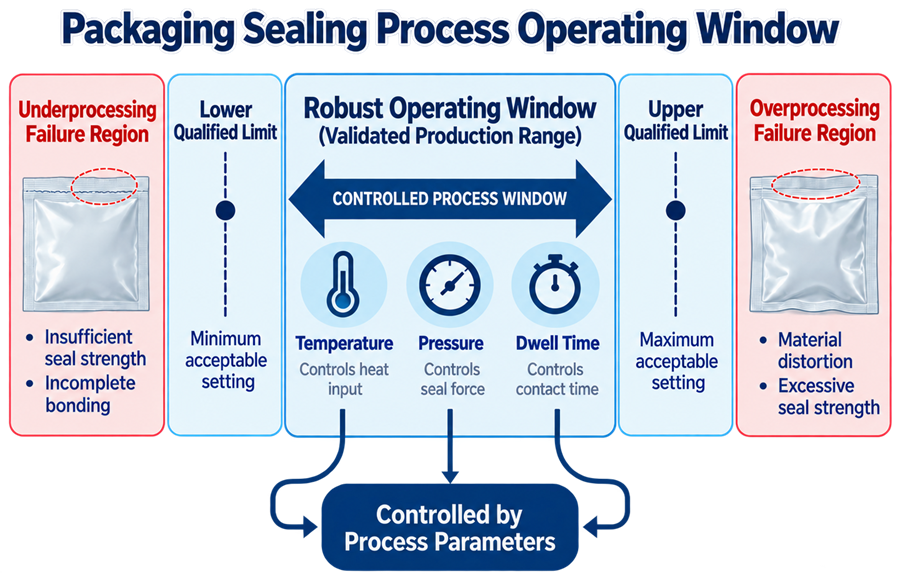
For heat sealing, development typically examines the relationship among temperature, time, and pressure. The objective is to identify a region where seals meet requirements without approaching failure conditions such as incomplete bonding, channel formation, material distortion, delamination, or excessive peel force.
For forming processes, development may evaluate material heating, forming pressure or vacuum, tool temperature, draw depth, cooling, wall-thickness distribution, and dimensional reproducibility.
For assembly processes, development can evaluate component orientation, fit, placement tolerances, presence/absence detection, assembly force, sequence, and operator interaction.
Development data should help define the ranges formally challenged during OQ. OQ should verify and justify a developed process window; it should not be the first time the process is experimentally explored.
Equipment Qualification
Packaging process validation depends on qualified equipment.
The equipment should be demonstrated capable of installing, controlling, monitoring, and recording the variables necessary for the process. Depending on the equipment, this can involve heaters, temperature controllers, pressure regulators, force systems, timers, servo drives, conveyors, vacuum systems, sensors, vision systems, data acquisition, PLC logic, recipes, alarms, and reject mechanisms.
Installation Qualification should verify that the system is installed according to approved requirements and engineering documentation. Relevant elements can include equipment identification, utilities, materials of construction, instrumentation, software or firmware versions, calibration status, safety features, drawings, manuals, and critical spare or replaceable tooling.
Equipment qualification does not by itself validate the packaging process. A heat sealer can be fully qualified as equipment yet still lack evidence that a specific material combination and operating range consistently produces acceptable sterile-barrier seals.
Installation Qualification
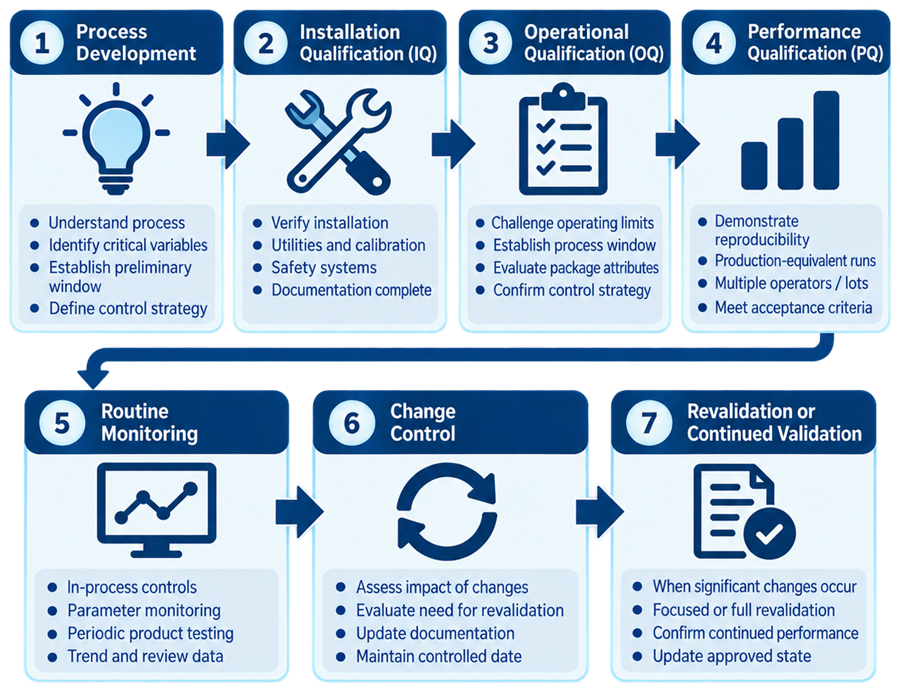
ISO 11607-2 requires packaging process validation to include IQ, OQ, and PQ in that sequence.
IQ should establish that equipment and supporting systems are installed correctly and are suitable to proceed to process qualification.
Typical IQ content includes equipment identification and configuration, utilities, instrumentation, calibration, software and recipe controls, safety systems, operating documentation, preventive-maintenance requirements, and applicable environmental requirements.
For packaging equipment, particular attention should be given to tooling and product-contact or package-contact surfaces. Seal jaws, forming tools, anvils, fixtures, guides, and change parts can directly influence process output and should be clearly identified and controlled.
Operational Qualification
OQ is where the packaging process operating window is formally challenged.
The objective is not simply to demonstrate that the machine runs at nominal settings. OQ should determine whether acceptable packaging is produced across the justified upper and lower limits of the parameters that influence package quality.
For a heat-sealing process, an OQ design may evaluate combinations of low and high seal temperature, pressure, and dwell time. For thermoforming, it may challenge forming temperature, vacuum, timing, and material conditions. For closure processes, it may challenge torque or force limits, component tolerances, and equipment speed.
The exact experimental design should reflect process complexity and interactions. Testing one parameter at a time can be sufficient for simple processes, but interacting parameters may require a more structured multivariable design.
Establishing the Process Window
The validated process window should be wide enough to accommodate routine process variation while remaining safely inside conditions that can produce unacceptable packages. For a sealing process, the lower end of the window may be limited by inadequate bond formation, while the upper end may be constrained by material distortion, excessive seal strength, delamination, brittleness, or loss of peelability.
A process operated directly at the edge of acceptable performance may technically pass OQ yet remain difficult to control in routine manufacturing. The preferred operating setpoint should therefore be located within a robust region of the validated range rather than automatically at the minimum passing condition.
The relationship can be conceptualized as: Failure region → lower qualified limit → robust operating region → upper qualified limit → failure region
Routine operating specifications may be narrower than the OQ challenge range. That provides operating margin while retaining evidence that excursions toward the controlled limits remain within a qualified envelope.
Operational Qualification Tests
OQ testing should evaluate package characteristics sensitive to the challenged variables.
For heat-sealed sterile-barrier systems, this may combine visual seal assessment, seal strength, and an appropriate integrity test. The specific methods are discussed in Package Seal Strength, Integrity, and Sterile Barrier Testing.
The important point is that different tests measure different characteristics. Seal-strength data alone should not be interpreted as proof of package integrity, and visual acceptance alone does not demonstrate adequate mechanical performance.
Where destructive testing is required, the sampling plan should ensure that sufficient units are available to evaluate the challenged conditions without using the same sample for incompatible tests.
Performance Qualification
PQ demonstrates that the established process can consistently produce acceptable packages under routine production conditions.
PQ should use production-equivalent equipment, materials, tooling, methods, personnel, and environmental conditions. Where applicable, actual product or justified product simulants should be packaged.
The purpose is to evaluate normal manufacturing reproducibility, not repeat OQ limit challenges.
PQ should consider routine sources of variation such as material lots, operators or shifts, equipment setup, normal line speeds, product configurations, tooling changes, and process start-up conditions where these can influence output.
For processes covering multiple package sizes or configurations, Packaging Qualification Strategy and Worst-Case Configuration provides the basis for bracketing or worst-case selection. The validation report should state which configurations were tested and why they support the remaining family.
Number of PQ Runs
A predetermined number such as “three runs” should not be treated as a universal regulatory requirement.
The number of PQ runs should be sufficient to demonstrate reproducible process performance and should reflect process risk, variability, equipment complexity, materials, historical knowledge, sampling strategy, and the strength of the development and OQ data.
Three successful runs may be appropriate for some packaging processes, but the technical justification should explain why they adequately demonstrate reproducibility. A high-risk process with significant material or operating variability may require additional evidence.
Conversely, adding runs without a defined statistical or technical purpose does not necessarily improve the validation.
Sampling Strategy
Packaging-process sampling should reflect both process variability and the failure mechanisms being controlled. Sampling may need to cover different positions within a seal or web, beginning/middle/end of a run, different cavities or lanes, different tooling positions, startup and steady-state operation, material lots, or product configurations.
For multi-lane or multi-cavity systems, treating a single location as representative of the entire machine can overlook significant spatial variation. The sampling plan should identify why the selected locations and quantities are capable of detecting relevant process variation.
Acceptance criteria should be established before execution and linked to approved package specifications.
Packaging Materials and Component Variability
Packaging materials can strongly influence process performance. Relevant variation can include material thickness, coating weight, adhesive characteristics, porosity, surface treatment, stiffness, forming behavior, dimensional tolerance, and supplier manufacturing variation.
A process validated using a single unusually favorable material lot may not demonstrate robust commercial performance.
Where supplier tolerances are broad enough to affect the process, validation should consider representative or challenging material conditions. Supplier controls and incoming specifications should also ensure that routinely released material remains within the range represented by validation.
Material changes should not be treated as administrative substitutions when they influence forming or sealing behavior.
Sterilization Effects
For terminally sterilized devices, the packaging process is validated before the package experiences sterilization, but package-performance evidence must account for sterilization effects. Ethylene oxide, radiation, steam, or other sterilization processes can influence film properties, adhesives, seal strength, dimensional stability, brittleness, and package opening characteristics.
The process-validation program should therefore connect the manufacturing process with post-sterilization package evidence.
This does not mean that every OQ sample must necessarily be sterilized. The overall validation strategy should determine where post-sterilization testing is required to demonstrate that packages manufactured throughout the approved process range continue to meet final requirements.
Automated Inspection and Reject Systems
Modern packaging lines frequently use automated controls to detect missing components, improper loading, seal defects, coding errors, or other conditions.
When these systems are relied upon as process controls, they should be included within the qualification and validation strategy.
The validation should establish that the inspection system can detect defined reject conditions, correctly segregate nonconforming units, and prevent rejected packages from re-entering the acceptable product stream. A reject mechanism that activates correctly during OQ but can be bypassed, overloaded, or defeated under actual production conditions is not an adequate control.
Critical alarms, interlocks, recipe controls, and automated inspections should therefore be challenged under realistic operating conditions.
Manual Assembly Operations
Not all packaging processes are automated. Manual assembly can be critical when operators position products, fold sterile wraps, assemble kits, load trays, apply closures, or perform other steps affecting package integrity.
Manual operations should have clear standardized methods, appropriate fixtures where necessary, defined acceptance criteria, and training requirements.
Validation should consider operator-to-operator variation where manual technique can influence the package.
The purpose is not to validate individual employees permanently. It is to demonstrate that the defined procedure, training, tooling, and controls enable qualified personnel to execute the process reproducibly.
In-Process Controls
Once the process is validated, routine controls should maintain operation within the qualified state. Depending on the process, these controls can include continuous parameter monitoring, periodic seal-strength testing, visual inspection, dimensional checks, closure torque, automated alarm monitoring, material verification, or scheduled integrity testing.
Process controls should be chosen according to the validated relationship between process variables and package attributes.
If OQ established that seal temperature is critical to acceptable output, routine control should ensure that temperature remains within the validated range. If jaw alignment can create channels that are not directly reflected by temperature, preventive maintenance and periodic inspection may also be required. Routine control should therefore derive from the process understanding generated during validation.
Process Capability and Statistical Evaluation
Where sufficient quantitative data are available, statistical analysis can support evaluation of process consistency and operating margin. Seal-strength measurements, dimensions, closure torque, or other continuous outputs can be trended to determine whether the process is centered appropriately and whether variability is compatible with established specifications.
Capability indices can be useful when their assumptions are satisfied, but a single capability number should not substitute for technical evaluation of the process. A process can show favorable average capability while still producing localized defects, intermittent channels, startup failures, or configuration-specific problems not reflected in the measured variable.
Statistical evaluation should therefore complement inspection, integrity testing, and process knowledge.
Deviations and Failed Validation Conditions
A failed validation result should be investigated before retesting. Potential causes can include process settings, equipment malfunction, sensor calibration, tooling damage, material variation, incorrect setup, operator execution, inadequate process development, or an inappropriate acceptance criterion.
The investigation should determine whether the failure challenges the proposed process window or validation strategy. Simply narrowing the tested range after a failure can create an artificially acceptable validation unless the revised operating limits are scientifically justified and adequately controlled.
Likewise, repeating a failed condition until acceptable samples are produced does not demonstrate reproducibility.
Validation Documentation
The validation package should provide a coherent technical history from process definition through approval for routine use.
A typical documentation structure can include:
| Document | Purpose |
|---|---|
| Packaging requirements/specification | Defines required output |
| Process risk assessment | Identifies failure mechanisms and controls |
| Process development report | Establishes preliminary parameter relationships |
| Equipment IQ | Confirms installation and supporting systems |
| Process OQ | Establishes and challenges operating limits |
| Process PQ | Demonstrates routine reproducibility |
| Validation report | Integrates results and defines validated state |
| Routine control plan | Defines monitoring and ongoing acceptance |
| Change-control requirements | Protects validated state |
The validation report should clearly identify the validated equipment, tooling, materials, package configurations, process ranges, routine setpoints, acceptance criteria, limitations, and revalidation triggers.
Pharmaceutical Packaging Processes
For pharmaceutical products, the validation approach should reflect product risk and the function performed by the packaging process.
FDA’s CGMP requirements do not establish ISO 11607-style IQ/OQ/PQ requirements for pharmaceutical package sealing as a universal rule. However, 21 CFR §211.100 requires written and controlled production procedures, and §211.94 establishes requirements for drug-product containers and closures, including adequate product protection and written methods for applicable processing.
Where a pharmaceutical packaging process directly affects container-closure integrity or product protection, validation should therefore establish appropriate evidence of reproducibility.
Examples include vial stoppering and crimping, prefilled-syringe assembly, blister lidding, bottle capping, induction sealing, pouch sealing, and other operations whose variation can affect containment, moisture protection, sterility, or stability.
For sterile pharmaceutical systems, detailed integrity strategy should remain coordinated with Container Closure Integrity Testing (CCIT) rather than applying medical-device SBS terminology indiscriminately.
Medical-Device Packaging Under QMSR
FDA’s Quality Management System Regulation became effective February 2, 2026 and incorporates ISO 13485:2016 into the U.S. medical-device quality-system framework.
ISO 11607-2 remains the more specific recognized consensus standard for validation of packaging forming, sealing, and assembly processes for terminally sterilized medical devices. FDA’s database lists ISO 11607-2:2019 including Amendment 1:2023 with complete recognition.
This makes packaging-process validation a direct connection between the manufacturer’s quality system, sterile-barrier design, manufacturing-process control, and evidence that the packaged device can maintain its required condition through sterilization, shelf life, and distribution.
Change Control and Revalidation
The validated state should be reassessed when a change can affect package formation, sealing, closing, or assembly. Examples include new packaging materials, supplier changes, equipment replacement, sealing-jaw replacement, tooling modification, software or recipe changes, altered line speed, package-size changes, revised sterilization processes, new product configurations, or modified acceptance criteria.
The assessment should determine whether the change remains within the previously validated envelope.
Not every change requires complete repetition of IQ/OQ/PQ. A tooling replacement with identical verified characteristics may require only focused qualification. A new material with different sealing behavior may require development and OQ work. A new machine or sealing technology may require full validation.
The level of revalidation should reflect the technical impact of the change rather than a fixed procedural category.
Periodic Review of Packaging Processes
Even without a formal change, long-term manufacturing data should be reviewed for evidence that the validated assumptions remain applicable. Relevant information can include parameter trends, seal-strength results, integrity failures, reject rates, maintenance history, material changes, deviations, complaints, distribution damage, and corrective actions.
An increase in rejects or integrity defects can indicate equipment wear, tooling deterioration, material drift, or a process operating too close to a qualification limit.
Periodic review should therefore evaluate both compliance with established parameters and evidence that the process remains capable of producing the intended package.
Validation Perspective
Packaging process validation should establish a defensible chain of evidence: Approved package requirements → process understanding → equipment qualification → operating-window challenge → reproducible production → routine process control → lifecycle maintenance
The central validation question is not whether acceptable packages can be produced occasionally. It is whether the defined forming, sealing, closing, or assembly process can consistently produce acceptable packaging under the range of conditions expected in routine manufacturing.
That distinction separates process validation from finished-package testing and makes packaging-process control an integral part of the product-protection lifecycle rather than a one-time qualification exercise.