

Packaging Aging, Shelf-Life, and Stability Integration
Packaging must remain suitable for the entire period during which the product is expected to retain its approved quality, sterility, functionality, and usability. Establishing initial package performance is therefore not sufficient. Materials, seals, closures, adhesives, barriers, labels, and protective components can change with time, while the product itself can interact with the packaging system throughout storage.
Packaging aging should consequently be integrated with the overall shelf-life and stability strategy rather than treated as an isolated laboratory exercise. The approach differs significantly between terminally sterilized medical devices and pharmaceutical products. Medical-device packaging frequently uses accelerated aging of the sterile barrier system to support an initial expiration-date claim while real-time aging continues. Pharmaceutical shelf life, by contrast, is established principally through product stability studies conducted in the marketed container-closure system.
For terminally sterilized medical devices, ISO 11607-1:2019 requires packaging systems to maintain sterility through the specified processing, storage, handling, and distribution period until use or expiration. ISO confirmed the 2019 edition as current in 2024, and Amendment 1:2023 incorporates application of risk management. ASTM F1980-21 provides the principal recognized approach for accelerated aging of sterile barrier systems and medical devices. FDA currently recognizes ASTM F1980-21 as a consensus standard for medical-device sterility applications.
For pharmaceutical and biological products, 21 CFR §211.166 requires stability testing in the same container-closure system in which the drug product is marketed, and 21 CFR §211.94 requires that the container-closure system provide adequate protection against foreseeable external factors that could cause deterioration or contamination. FDA’s ICH Q1A(R2) guidance provides the general framework for establishing drug-product stability and expiration dating.
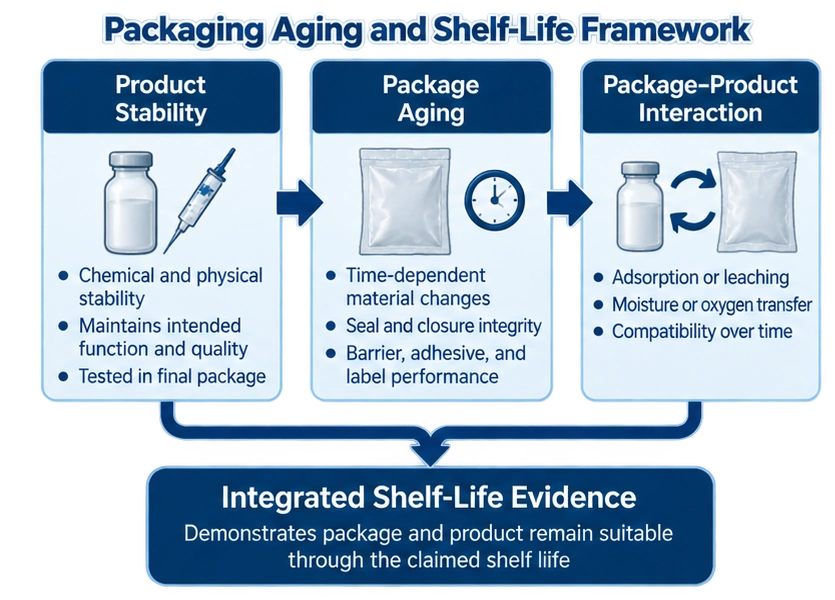
Packaging Aging, Shelf Life, and Product Stability Are Related but Different
These terms should not be used interchangeably.
- Packaging aging concerns time-dependent changes in package materials, seals, closures, adhesives, coatings, and other packaging characteristics.
- Shelf life is the period during which the packaged product is supported as meeting its defined requirements under labeled storage conditions.
- Product stability concerns the ability of the drug, biologic, device, or combination product to continue meeting defined chemical, physical, microbiological, functional, and other quality requirements over time.
A packaging system can remain physically intact while the product becomes unstable because of moisture, oxygen, light, adsorption, leaching, or another package-product interaction. Conversely, the product formulation may remain chemically acceptable while the packaging system loses integrity, seal strength, sterile-barrier capability, label adhesion, or mechanical protection.
The aging strategy must therefore identify which time-dependent characteristics belong to the product, which belong to the package, and which result from the interaction between them.
Start With the Packaging Design Basis
The aging program should be traceable to the packaging requirements established during Packaging System Requirements, Design, and Risk Assessment. If moisture protection is critical, the aging strategy should evaluate whether barrier performance and closure effectiveness remain suitable over time. If maintenance of sterility is critical, the strategy should address the seals, closures, and materials responsible for maintaining the required barrier.
The relevant packaging boundary is defined further in Packaging System Types and Sterile Barrier Systems. Aging may need to consider primary packaging, sterile barrier materials, functional secondary packaging, labels, protective packaging, or other components when their deterioration could affect product quality or successful use.
The qualification plan should document the configuration actually aged, including materials, suppliers, manufacturing process, sterilization exposure where applicable, package dimensions, product or representative load, and any protective packaging relevant to the aging claim.
Time-Related Versus Event-Related Package Failure
One of the most important distinctions in packaging aging is between time-related deterioration and event-related damage.
ASTM F1980 explicitly states that accelerated and real-time aging address the time-related aspects of potential sterile-barrier integrity loss. Mechanical hazards arising from shipping, handling, and distribution are separate package-performance challenges.
Time-related changes can include loss of seal strength, adhesive degradation, embrittlement, polymer changes, dimensional instability, barrier-property changes, or deterioration of opening characteristics.
Event-related failures can include puncture, abrasion, impact damage, compression, crushing, flex cracking, or seal stress produced by transportation and handling.
Accelerated aging therefore does not replace Distribution Simulation Strategy and Transport Testing. A package may survive aging but fail during vibration or drop testing. Conversely, a newly manufactured package may pass distribution simulation but become more brittle or mechanically vulnerable after aging.
The qualification strategy should determine how aging and distribution studies complement each other.
Medical-Device Packaging Shelf Life
For terminally sterilized medical devices, the shelf-life claim usually needs evidence that both the device and its sterile barrier system remain suitable through the claimed expiration period.
ISO 11607-1 applies to packaging materials, preformed sterile barrier systems, sterile barrier systems, and packaging systems intended to maintain sterility until the point of use. The packaging system must continue to provide the required protection through processing, storage, handling, and distribution.
The shelf-life program may therefore evaluate package characteristics such as seal integrity, material integrity, seal strength, peel characteristics, microbial-barrier function where applicable, dimensional stability, label condition, and physical protection. The device itself may require separate functional, material, electrical, chemical, or biological aging evaluations.
Packaging aging should not be interpreted as automatically establishing the complete device shelf life. It supports the part of the expiration-date justification related to packaging and, depending on the study, potentially certain device-material characteristics.
Accelerated Aging Under ASTM F1980
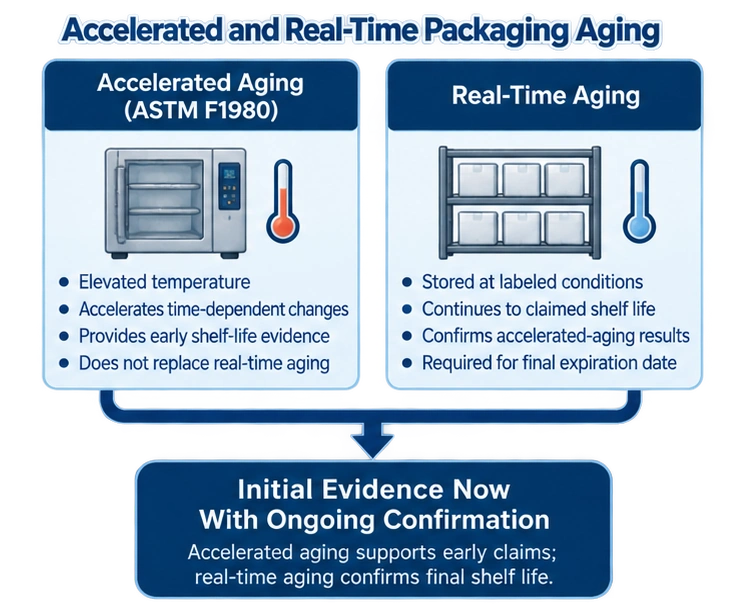
ASTM F1980-21 provides a framework for using elevated temperature to accelerate time-dependent material aging so that preliminary shelf-life evidence can be generated before the corresponding real-time period has elapsed. FDA currently recognizes this edition.
The approach is based on the principle that many chemical and physical degradation processes proceed more rapidly at elevated temperature. A Q10-based accelerated aging factor is commonly used to relate the selected accelerated-aging temperature to the normal storage temperature.
The purpose is not to expose packages to the highest temperature they can physically survive. The accelerated-aging temperature should remain compatible with the materials and should not introduce degradation mechanisms that would not occur during normal storage.
A useful validation question is therefore not simply, “How quickly can we complete the aging study?” It is, “What accelerated condition provides a scientifically reasonable model of time-related aging without fundamentally changing the materials or failure mechanism?”
Selection of Accelerated Aging Temperature
The accelerated-aging temperature should be justified based on package materials, device materials where applicable, normal storage conditions, known transitions or limitations, and available material data.
Higher temperature increases acceleration but also increases the possibility of creating nonrepresentative behavior. Polymers can soften, adhesives can flow, coatings can change, seals can relax, and device materials can behave differently above certain temperatures.
A conservative accelerated-aging program generally favors a temperature that provides useful acceleration while remaining safely below known material-transition or deformation conditions.
Humidity should also be considered where moisture can materially affect the packaging system. ASTM F1980 is principally a temperature-based accelerated-aging guide, and additional humidity exposure may need separate technical justification depending on material characteristics and product requirements.
The protocol should document the selected accelerated condition, assumed aging factor, intended equivalent aging period, material basis, and any limitations of the model.
Accelerated Aging Does Not Eliminate Real-Time Aging
ASTM F1980 makes this point clearly: real-time aging must be conducted to the claimed shelf life, and accelerated-aging conclusions remain tentative until real-time results confirm them.
Accelerated aging is therefore best understood as early evidence supporting an initial expiration-date claim, not as permanent replacement for real-time data.
A typical program proceeds with accelerated aging and real-time aging in parallel. Accelerated-aged samples reach the equivalent target interval first and can support initial qualification or market introduction when otherwise justified. Real-time samples remain under the specified storage conditions and are tested at defined intervals through the claimed shelf life.
If real-time results subsequently fail to confirm the accelerated-aging conclusions, the discrepancy must be investigated and the shelf-life claim reassessed.
Aging Study Configuration
Samples should represent the commercial package configuration as closely as practical. Packaging materials, forming or sealing processes, sterilization, assembly, and product loading can influence aging behavior.
For terminally sterilized medical devices, packages should generally reflect the relevant sterilization exposure because sterilization can alter polymers, adhesives, coatings, seal strength, and mechanical properties. When multiple sterilization cycles are allowed, the qualification strategy should determine whether the maximum permitted exposure represents the appropriate aging challenge.
The aged configuration should also represent relevant worst-case conditions established through Packaging Qualification Strategy and Worst-Case Configuration. The worst case for aging may differ from the worst case for distribution, thermal qualification, or compression.
Potential aging worst-case factors include material thickness, seal geometry, seal length, package dimensions, product-package contact, sterilization dose or exposure, device weight, and characteristics that increase stress on the package over time.
Baseline Testing
Baseline testing establishes the package condition before aging and provides the reference against which time-related changes can be evaluated.
The baseline evaluation should use the same or technically comparable methods planned for aged samples. Depending on the packaging system, this may include visual inspection, seal-strength testing, integrity testing, dimensional measurements, opening-force assessment, barrier testing, or product/device functional evaluation.
The test methods discussed in Package Seal Strength, Integrity, and Sterile Barrier Testing should be selected according to the specific failure mechanism being evaluated.
Aging studies are much more informative when they measure change against a defined baseline rather than simply applying a pass/fail test after the final interval.
Aging Intervals and Sample Allocation
The study should include sufficient samples and intervals to support the intended conclusion while accounting for destructive testing.
Not every packaging program needs the same interval schedule. Selection should reflect the claimed shelf life, available knowledge, material risk, test method, product criticality, and whether accelerated and real-time programs are being run in parallel.
Intermediate intervals can be valuable because they reveal the direction and rate of change. A package that passes at the final interval but shows progressive decline in seal strength may warrant different lifecycle consideration from one that remains essentially unchanged.
Where tests are destructive, samples should be allocated prospectively so that the required evaluations can be completed at each interval without compromising the integrity of later study units.
Aging Acceptance Criteria
Acceptance criteria should be derived from the functional requirements of the packaging system rather than from aging duration alone.
For example, acceptance may require that the package remain free of defined defects, seal strength remain above an established minimum, integrity testing remain acceptable, opening characteristics remain suitable, and the product or device continue to meet applicable requirements.
A statistically detectable change is not automatically a packaging failure. Some material properties may change over time while remaining well within acceptable performance limits. Conversely, a small change can be significant if the process is already operating near the functional limit.
The critical question is whether the aged packaging system continues to perform its required functions through the claimed shelf life.
Packaging Aging and Distribution Testing Sequence
Aging and distribution testing should be sequenced according to the qualification question.
For example, testing an aged package through distribution simulation asks whether a package near the end of its shelf life can withstand expected shipping hazards. Testing a freshly manufactured package through distribution simulation and then aging it asks whether distribution damage influences subsequent long-term package performance.
A commonly useful sequence for medical-device packaging is: Manufacture and seal → sterilize → age → environmental conditioning → distribution simulation → package integrity and device evaluation
This can provide a conservative assessment of a package after time-related material changes have occurred and before it is exposed to distribution hazards.
However, the sequence should not be adopted automatically. The technical rationale should reflect the actual lifecycle and identified failure mechanisms.
Pharmaceutical Packaging and Stability
For drug products, packaging aging should not be separated conceptually from the formal stability program.
21 CFR §211.166 requires the drug product to be tested in the same container-closure system in which it is marketed. The resulting stability data establish appropriate storage conditions and expiration dating.
ICH Q1A(R2) similarly treats the container-closure system as part of the drug-product stability configuration.
The package can influence pharmaceutical stability through moisture transmission, oxygen ingress, solvent loss, light transmission, adsorption, absorption, extractables or leachables, closure performance, and other interactions. Consequently, pharmaceutical package suitability through shelf life is generally demonstrated through the product stability program in the marketed container-closure system, supplemented by specific packaging tests where appropriate.
ASTM F1980 should not be used as a generic substitute for pharmaceutical drug-product stability studies. Its principal scope is accelerated aging of medical-device sterile barrier systems and medical devices.
Monitoring the Pharmaceutical Container-Closure System During Stability
FDA’s final guidance on container-closure systems for human drugs and biologics states that the packaging system used in each stability study should be identified and monitored for signs of instability. Where appropriate, packaging-system evaluation should be included in the stability protocol.
Relevant observations can include closure changes, leakage, container deformation, discoloration, delamination, loss of label adhesion, corrosion, moisture effects, or other evidence that package performance is changing.
For sterile products, container-closure integrity may also be incorporated into the stability program. FDA’s final guidance permits appropriately validated integrity methods to be used instead of sterility testing for confirming maintenance of container-closure integrity as part of the stability protocol.
Detailed pharmaceutical integrity testing belongs in Container Closure Integrity Testing (CCIT).
Package-Product Interaction Through Shelf Life
Some packaging failures are not caused by deterioration of the package itself but by continuous interaction between package and product.
Relevant mechanisms include adsorption of drug onto polymer or elastomer surfaces, absorption into packaging materials, migration of packaging constituents into the product, moisture exchange, oxygen transmission, solvent loss, pH-related material interaction, and corrosion.
These interactions may depend strongly on time and temperature and therefore become visible principally through stability data.
The packaging-development program should identify these risks early, while the stability program confirms whether the proposed container-closure system remains appropriate through the claimed shelf life.
This connection is particularly important for biologics and combination products, where interaction with syringes, cartridges, elastomeric closures, silicone systems, delivery-device materials, or other packaging components can affect both product quality and functional performance.
Functional Secondary Packaging and Shelf Life
Secondary packaging should be included in aging or stability considerations when it performs a function necessary to maintain product quality.
An opaque carton required for light protection, a moisture-protective overpouch, an oxygen-barrier overwrap, or protective packaging necessary to prevent sterile-barrier damage can become part of the shelf-life strategy.
Removing such components from an aging study can create a test configuration that does not represent the marketed system. Conversely, aging decorative or purely logistical components may add little value unless their deterioration can affect identification, handling, or use.
The boundary should therefore follow function rather than package level.
Labels, Adhesives, and Identification
Shelf-life evaluation should also consider labeling when label performance can affect product identification or use.
Label stock, inks, adhesives, printing, barcodes, and other identification features may be exposed to cold storage, freezing, humidity, condensation, elevated temperature, abrasion, or repeated handling.
A package can remain physically intact while the label becomes detached, illegible, or unreadable by automated systems. Where these conditions are credible, label durability should be included in the packaging aging or stability strategy.
The acceptance criterion should reflect the required function, such as continued attachment, legibility, machine readability, or preservation of critical information.
Real-Time Aging Study Control
Real-time aging samples should be maintained under documented storage conditions representative of the labeled or intended environment.
The study should control sample identity, storage location, environmental conditions, retrieval schedule, test allocation, and deviations. Temperature excursions or other environmental events affecting stored samples should be assessed because they can alter interpretation of long-term data.
The sample configuration should remain traceable to the package materials, manufacturing lot, sealing or closure process, sterilization status, and other relevant characteristics.
Long-duration aging studies can extend over several years, making configuration control and documentation particularly important. Without adequate traceability, later results may be difficult to relate confidently to the current commercial packaging system.
Integration With Packaging Process Validation
Aging studies demonstrate little about commercial suitability if the aged samples were produced by a process that does not represent routine manufacturing.
The forming, sealing, and assembly conditions used to create aging samples should therefore be linked to Packaging Process Validation: Forming, Sealing, and Assembly.
Where appropriate, samples representing the qualified operating range may be used to determine whether packages manufactured under challenging but acceptable process conditions remain suitable after aging.
This can be especially important when seal performance is sensitive to process conditions. A package produced at an optimal nominal setting may age differently from one produced near the lower qualified sealing limit.
Shelf-Life Evidence Integration
The final shelf-life conclusion should integrate multiple evidence streams rather than rely on a single aging report.
For a terminally sterilized medical device, the evidence can include initial package qualification, packaging-process validation, sterilization compatibility, accelerated aging, ongoing real-time aging, package integrity testing, distribution simulation, and device functional testing.
For a pharmaceutical product, the evidence typically integrates stability data generated in the marketed container-closure system, container-closure suitability, package-product compatibility, applicable integrity data, and supporting packaging observations or testing.
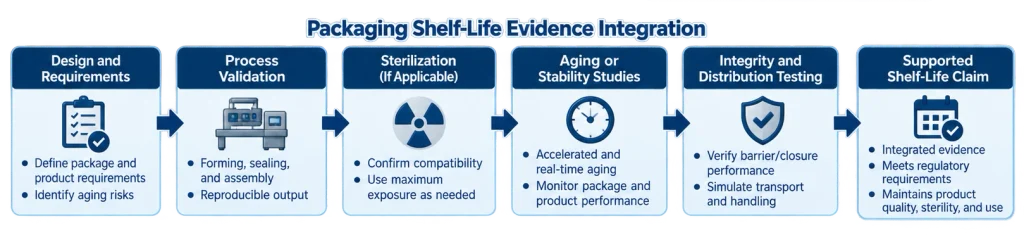
[ILLUSTRATION 3 — Packaging Shelf-Life Evidence Integration]
ALT: Packaging shelf-life evidence integration diagram showing packaging process validation, aging, stability, integrity testing, distribution testing, and real-time confirmation supporting the final expiration-date claim.
Caption: A defensible shelf-life claim integrates package manufacture, aging or stability data, integrity evidence, distribution performance, and real-time confirmation rather than relying on one accelerated study.
Changes Affecting Shelf-Life Evidence
Packaging changes should be assessed for their potential impact on existing aging and stability conclusions. Relevant changes can include material substitutions, new suppliers, changed adhesives or coatings, package dimensions, seal geometry, closure components, forming or sealing parameters, sterilization exposure, protective packaging, or labeled shelf life.
The assessment should determine whether existing data continue to represent the revised package.
A change does not necessarily require repetition of the complete aging program, but the rationale should be technical. For example, a minor dimensional change may remain within an existing bracket, while a change in polymer formulation or adhesive chemistry can directly challenge the aging mechanism and require additional evidence.
For pharmaceutical vial and stopper systems, FDA’s 2024 final guidance provides a risk-based framework for certain postapproval container-closure changes.
Aging Failures and Adverse Trends
A failed aging result should be investigated against the entire packaging system rather than attributed automatically to “material aging.”
The investigation may need to consider packaging material, sealing process, sterilization, product-package interaction, storage condition, test method, distribution damage, or an incorrect initial assumption about the package operating margin.
Trend data are particularly valuable. Progressive reduction in seal strength, increasing brittleness, worsening peel characteristics, or increased integrity failures can reveal a developing mechanism before the formal acceptance limit is crossed.
Such trends may support changes to materials, process controls, shelf-life claims, test intervals, or lifecycle monitoring.
Relationship to the 2026 FDA Draft Container-Closure Guidance
FDA issued a new draft guidance, Container Closure Systems for Human Drugs and Biological Products, in August 2026. It proposes an updated risk-based framework for evaluating container-closure systems, including quality assessment and control of packaging materials and components. FDA clearly identifies the document as Draft — Not for Implementation.
It is relevant as an indication of FDA’s evolving thinking, but this article should not treat its recommendations as current binding or final expectations. The implemented regulatory basis remains 21 CFR Part 211 and applicable final FDA and ICH guidance.
Validation Perspective
Packaging shelf-life work should establish more than the fact that a package survived a predetermined number of weeks in an aging chamber. The objective is to demonstrate that the packaging system remains suitable for its required function throughout the period for which the product is intended to remain available for use.
For medical devices, accelerated aging can provide early evidence, but real-time confirmation remains necessary. For pharmaceuticals, the marketed container-closure system is an integral part of the formal product stability program. In both cases, aging must remain connected to package design, manufacturing process, integrity, distribution performance, and lifecycle change control.
The resulting evidence should establish a clear chain: Qualified packaging system → representative manufacturing process → aging or stability exposure → package and product evaluation → real-time confirmation → supported shelf-life claim
That chain provides a stronger validation basis than treating aging, stability, package integrity, and expiration dating as separate activities.