
Cleaning Validation Sampling Strategy and Worst-Case Locations
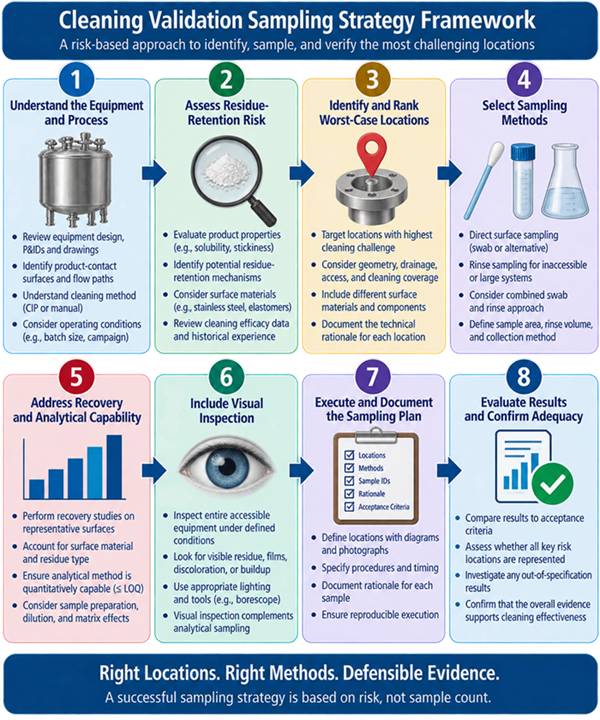
Cleaning-validation sampling should provide evidence from the locations most likely to reveal inadequate cleaning. The objective is not to collect the largest possible number of samples or to distribute samples evenly across equipment. A defensible strategy identifies where residue is most likely to remain, determines how those locations can be sampled reliably, and combines direct surface sampling, rinse sampling, visual inspection, and other appropriate evidence to support the cleaning-validation conclusion.
Sampling strategy begins with understanding the equipment, product residue, cleaning mechanism, and potential carryover pathway. Equipment geometry can create areas with poor cleaning solution coverage, limited mechanical action, difficult drainage, or restricted manual access. Product characteristics can create residues that adhere, dry, crystallize, accumulate, or become trapped at interfaces. Sampling locations should be selected where these factors interact to create credible cleaning challenges.
FDA distinguishes direct surface sampling from rinse sampling and identifies direct measurement of equipment surfaces as the more desirable approach where it is reasonably feasible because difficult-to-clean accessible areas can be evaluated directly. FDA also recognizes that rinse sampling can cover larger surface areas and inaccessible systems that cannot readily be disassembled. Current FDA CGMP Q&A states that rinse sampling alone is generally insufficient for cleaning validation when direct residue measurement is feasible and that firms may appropriately combine swab and rinse methods.
Regulatory and Scientific Basis
21 CFR 211.67 — Equipment Cleaning and Maintenance establishes the fundamental requirement that equipment be cleaned and maintained at suitable intervals to prevent contamination capable of affecting drug-product quality. The regulation does not prescribe a specific number of cleaning-validation samples or a universal sampling pattern; the sampling strategy should therefore be scientifically justified for the equipment and process.
The FDA Guide to Inspections: Validation of Cleaning Processes expects validation protocols to define the sampling procedures and analytical methods used to demonstrate acceptable residue removal. FDA identifies two general sampling approaches: direct surface sampling and rinse sampling. Direct sampling allows difficult-to-clean accessible areas to be evaluated and permits residue to be expressed relative to a known surface area. Rinse sampling can cover larger or inaccessible areas but may fail to recover insoluble or physically occluded residues.
FDA’s current CGMP Questions and Answers — Equipment is particularly clear that rinse testing alone is not generally adequate where direct measurement of the equipment surface is feasible. FDA recognizes combined swab and rinse sampling when the rinse solvent has been shown to dissolve the residues of concern and is suitable for the surfaces sampled.
ICH Q7 similarly states that cleaning-validation sampling may include swabbing, rinsing, or alternative methods as appropriate and that the methods should quantitatively measure residues remaining after cleaning. It specifically recognizes that swabbing may be impractical for inaccessible surfaces such as the interior of hoses, transfer piping, reactor vessels with small openings, and intricate equipment.
Sampling Strategy Begins with the Validation Objective
The sampling plan should be designed around the cleaning-validation objective rather than around laboratory convenience. The fundamental question is whether the approved cleaning process can reproducibly remove relevant residues from the defined equipment train to the established acceptance criteria.
The sampling strategy should therefore identify:
- which residue or residues are being evaluated;
- which equipment and product-contact surfaces are within scope;
- which locations present the greatest cleaning challenge;
- which locations present the greatest carryover risk;
- which surfaces can be sampled directly;
- which surfaces require indirect sampling;
- which analytical methods apply;
- how sampling recovery will be addressed;
- how visual inspection complements analytical sampling.
The broader Cleaning Validation Program Strategy, Scope, and Lifecycle should establish the cleaning-validation scope, while Worst-Case Product, Equipment, and Cleaning Condition Selection identifies representative product and process challenges. Sampling strategy converts those program decisions into specific evidence locations.
Map the Equipment Before Selecting Samples
A robust sampling plan should begin with an equipment map showing the complete product-contact pathway. The map can be based on engineering drawings, P&IDs, equipment drawings, photographs, 3D models, walkdowns, or a combination of these sources.
For an integrated equipment train, the map may include:
- vessel walls and heads;
- agitators and shafts;
- baffles;
- dip tubes and probes;
- spray devices;
- inlet and outlet nozzles;
- valves;
- gaskets and seals;
- pumps;
- filters and housings;
- transfer piping;
- flexible hoses;
- manifolds;
- product chutes;
- filling pathways;
- removable components.
The purpose is not merely to calculate surface area. The map should identify how product reaches each surface, how cleaning reaches it, whether the surface drains, whether it can be visually inspected, and whether it can be sampled directly.
For automated systems, the cleaning route should be compared with the product route. A product-contact surface that is not adequately represented in the cleaning circuit is a design or cleaning-process issue, not simply a sampling problem.
Identify Residue-Retention Mechanisms
Worst-case locations should be selected because there is a reason residue could persist there. Typical mechanisms include incomplete cleaning-solution coverage, weak mechanical action, poor drainage, physical entrapment, rough or damaged surfaces, product accumulation, low-flow conditions, inaccessible geometry, or residue aging.
Important examples include:
- gasket interfaces;
- valve bodies;
- pump seals;
- agitator hubs;
- underside surfaces;
- spray shadows;
- weld transitions;
- dead-ended or poorly swept areas;
- narrow passages;
- low points;
- flexible hose interiors;
- filter housings;
- screens;
- product outlets;
- filling nozzles;
- equipment corners;
- locations requiring manual cleaning.
The rationale should identify the actual mechanism. A statement such as “Location S-07 selected as worst case” is weak unless it explains whether the location is difficult to access, receives limited cleaning action, retains liquid, accumulates product, contains a challenging material, or presents another specific risk.
Hard-to-Clean Locations
A hard-to-clean location is a surface where the cleaning process has less capability to remove residue than on more favorable surfaces.
For manual cleaning, this may involve limited operator access, poor visibility, difficult brush orientation, complex disassembly, or surfaces that require special tools.
For CIP systems, difficult locations can arise from spray shadows, low turbulence, insufficient flow, complex valve arrangements, internal components, long transfer lines, poor drainability, or zones that receive lower temperature or chemical exposure.
Cleaning Procedure Development and Efficacy Studies should establish how the cleaning process removes representative soil and which conditions challenge cleaning effectiveness. Those development findings should directly inform the sampling-location assessment.
A sampling plan that ignores known difficult-to-clean locations and concentrates on flat, accessible stainless-steel surfaces produces weak evidence even if the total number of samples is large.
Worst-Case Location Does Not Mean One Location
There may be several different types of worst-case locations within one equipment train.
One location may be worst for cleaning access. Another may retain residue because of poor drainage. Another may contain an elastomeric gasket with different surface interaction. Another may experience significant product accumulation during manufacturing.
The strategy should therefore identify representative worst cases across the relevant failure mechanisms rather than force all sampling risk into one nominal “worst location.”
A practical classification may include:
- Geometry challenge — valves, crevices, internal assemblies.
- Cleaning-mechanism challenge — spray shadows, low-flow areas.
- Residue-loading challenge — outlets, low points, product accumulation areas.
- Material challenge — elastomers, polymers, rough surfaces.
- Manual-access challenge — surfaces difficult for operators to reach or inspect.
- Sampling challenge — locations that are difficult to swab reproducibly.
This structure produces a more defensible sampling rationale than simply ranking locations numerically without explaining why the highest score matters.
Equipment Surface Materials
Sampling-location selection should also consider differences in product-contact materials. Residue interaction and recovery can differ among polished stainless steel, glass, polymers, elastomers, coated surfaces, flexible hoses, gaskets, and other materials.
If an equipment train contains several materially different surfaces, the sampling plan should determine whether all are represented adequately. A stainless-steel vessel wall may not represent the residue behavior or recovery characteristics of an elastomer gasket or polymer hose.
Swab and Rinse Recovery Studies for Cleaning Validation should establish whether recovery differs sufficiently among materials to require separate recovery factors or representative grouping.
Direct Surface Sampling
Direct surface sampling provides localized evidence from a defined area of the equipment. Swabbing is the most common form, although other direct extraction approaches may be appropriate for particular surfaces or equipment.
FDA identifies direct surface sampling as particularly useful because it allows reasonably accessible hard-to-clean areas to be evaluated directly and can physically recover dried or insoluble residues.
Direct sampling also allows results to be associated with a known area: µg recovered from sample ÷ sampled cm² , which can be compared with a surface acceptance criterion such as µg/cm².
Direct sampling is especially appropriate for locations where residue is expected to be localized rather than uniformly distributed.
Limitations of Direct Sampling
Swab sampling is not universally practical. Physical access may prevent reproducible sampling of long piping, narrow tubing, small vessel openings, closed transfer systems, intricate internal components, or surfaces associated with highly hazardous materials.
ICH Q7 explicitly recognizes these limitations and allows rinsing or alternative methods when direct swabbing is impractical because of equipment design or process restrictions.
Even where access exists, a surface may be geometrically unsuitable for a defined swab area. Sampling a valve cavity or irregular gasket may not support the same area-based calculation used for a flat vessel wall. The sampling rationale should explain how such locations are evaluated and how results are interpreted.
Rinse Sampling
Rinse sampling provides indirect evidence by contacting a broader equipment surface with a defined volume of liquid and analyzing the collected rinse for residue.
Advantages include the ability to represent:
- closed systems;
- piping;
- hoses;
- inaccessible internal surfaces;
- large surface areas;
- systems that cannot be routinely disassembled.
However, rinse results depend on whether the selected liquid contacts the relevant surfaces and can remove or dissolve the residue being measured. FDA specifically warns that rinse sampling can miss insoluble or physically occluded residues.
A visually clear rinse therefore does not prove that the internal equipment surface is clean.
Rinse Sampling Should Represent the Residue
When rinse sampling is used for quantitative residue evaluation, the rinse should be tested for the residue or contaminant of concern. Merely demonstrating that the final rinse meets purified-water or WFI chemical specifications does not demonstrate product-residue removal.
FDA’s cleaning-validation guide specifically distinguishes measurement of the residue in rinse water from generic water-quality testing.
The rinse procedure should define:
- rinse liquid;
- volume;
- temperature where relevant;
- contact time;
- flow or circulation conditions;
- collection point;
- recovery basis;
- analytical procedure.
Rinse Sampling for Cleaning Validation should address these method-specific issues in detail.
Combining Swab and Rinse Sampling
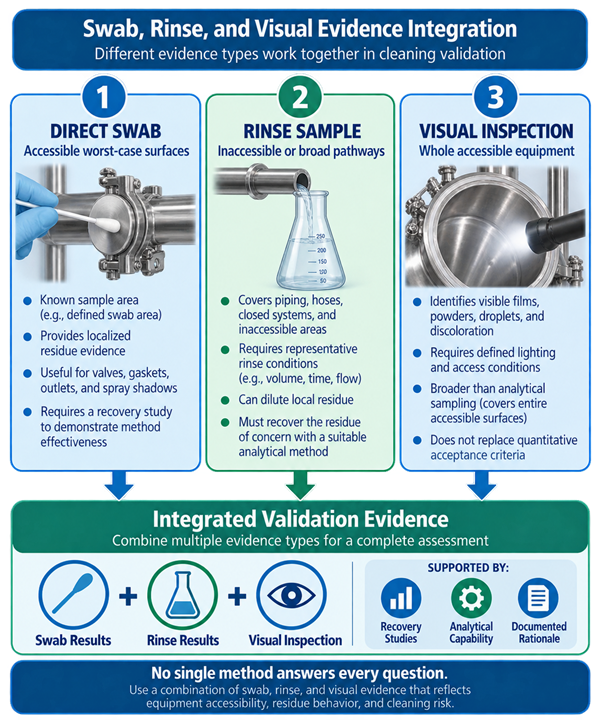
For many equipment trains, the strongest approach combines swab and rinse sampling.
Swabs can challenge accessible worst-case surfaces such as valve areas, gaskets, vessel walls, outlets, agitator interfaces, and other locations where residue may remain locally.
Rinse sampling can supplement these data by representing inaccessible piping, internal transfer pathways, hoses, or other broad surfaces that cannot be directly sampled.
FDA explicitly recognizes combined swab and rinse sampling as acceptable when the rinse method is suitable for the residue and surfaces involved.
The two methods should be treated as complementary rather than interchangeable. A passing rinse result should not be used automatically to override a failing worst-case swab result.
Visual Inspection Is Part of the Sampling Strategy
Visual inspection should not be treated as an informal activity performed after analytical sampling. It provides information that limited analytical samples cannot provide because only a small proportion of an equipment train is normally swabbed.
The entire accessible equipment should be inspected under defined conditions where practical. Particular attention should be given to the same locations identified through the worst-case assessment.
Visual inspection may reveal:
- visible films;
- powders;
- dried droplets;
- discoloration;
- residue accumulation;
- fibers;
- cleaning-agent deposits;
- retained water;
- other unacceptable conditions.
A surface should not be accepted merely because its analytical sample passes if visible residue remains.
Visual inspection also helps determine whether the selected analytical locations remain representative. If routine inspection repeatedly identifies residue at a location that was not included in the original sampling plan, the sampling strategy should be reassessed.
Accessible and Inaccessible Surfaces
The equipment map should distinguish surfaces that are:
- Directly accessible for sampling and inspection
- Accessible only after permitted disassembly
- Visible but not directly sampleable
- Accessible by rinse only
- Not practically accessible during routine operation
This classification helps prevent the common mistake of treating “not swabbable” as equivalent to “not requiring evidence.”
For inaccessible areas, evidence may need to come from a combination of rinse sampling, equipment design qualification, spray-coverage studies, cleaning-process parameters, representative coupon studies, borescope inspection, or other justified methods.
The sampling strategy should state how each important product-contact area is represented.
Sampling After Disassembly
Some components may require disassembly to permit adequate cleaning and sampling. In those cases, the validated cleaning procedure should define the disassembly state, and the sampling plan should reflect the same configuration.
Disassembly solely for validation sampling can create misleading evidence if routine cleaning occurs while the component remains assembled and the disassembly changes the cleaning challenge.
Conversely, if the approved cleaning process requires disassembly, validation should confirm that those instructions are followed and that the newly accessible surfaces are appropriately evaluated.
How Many Samples Are Required?
There is no universal regulatory number of swabs or rinse samples required for cleaning validation. The appropriate quantity depends on equipment complexity, product-contact surface area, cleaning mechanism, number of distinct worst-case locations, equipment grouping, sampling method, residue distribution, and available process knowledge.
The goal should not be to maximize sample count. It should be to ensure adequate representation of the important cleaning risks.
A simple vessel may require fewer locations than an integrated train containing a vessel, pump, transfer line, filter housing, hoses, and filling equipment. A complex manually cleaned assembly may require more location-specific evidence than an automated system with well-characterized CIP coverage and process monitoring.
A sampling plan is stronger when each sample has a defined purpose than when dozens of locations are selected through arbitrary spacing.
Sample Quantity Should Reflect Location Diversity
Sample count should consider whether the equipment contains different types of locations rather than only how much total surface area exists.
For example, a sampling strategy might intentionally represent:
- one accessible flat surface;
- one gasket interface;
- one product outlet;
- one valve;
- one difficult manual-access area;
- one low point;
- one alternate surface material;
- one rinse representing inaccessible piping.
The exact combination depends on the system. The principle is to represent the dominant cleaning and carryover mechanisms.
Equipment Mapping and the Sampling Matrix
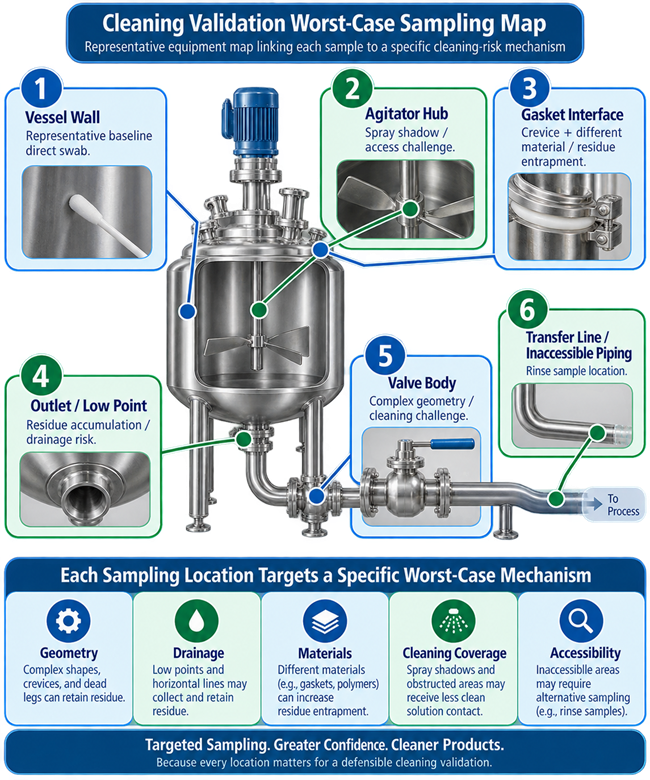
A controlled sampling matrix can link each sample location to its technical rationale.
A useful structure is:
| Location | Equipment | Surface/material | Cleaning challenge | Accessibility | Sampling method | Rationale |
|---|---|---|---|---|---|---|
| S-01 | Vessel | 316L SS | General representative surface | Direct | Swab | Baseline vessel surface |
| S-02 | Vessel outlet | 316L SS | Low point / residue accumulation | Direct | Swab | High residue-retention potential |
| S-03 | Valve | SS/elastomer | Crevice / difficult cleaning | Direct after access | Swab | Geometry worst case |
| S-04 | Agitator hub | 316L SS | Spray shadow | Direct | Swab | Reduced cleaning exposure |
| S-05 | Gasket | Elastomer | Different material / interface | Direct | Swab | Material and crevice challenge |
| R-01 | Transfer piping | 316L SS | Inaccessible internal surface | Indirect | Rinse | Cannot be reproducibly swabbed |
The final protocol should use actual equipment identifiers and sampling-location drawings or photographs where appropriate.
Location Identification Should Be Reproducible
Sample locations should be identified in a manner that allows different operators or validation teams to sample the same area consistently.
Useful controls include:
- equipment diagrams;
- numbered location maps;
- photographs;
- dimensional references;
- physical landmarks;
- templates for defined swab areas;
- sampling-location tables.
Instructions such as “swab vessel wall” are often too vague for reproducible execution. A large vessel may contain multiple wall areas exposed to different product loading or cleaning conditions.
The location should be defined sufficiently to ensure that validation results from different runs represent the same cleaning challenge.
Swab Area Should Be Defined
Where results are compared with an area-based acceptance criterion, the sampled area should be defined.
Common geometries may use a template such as 25 cm² or 100 cm², but the appropriate area depends on equipment design and the sampling procedure. There is no universal regulatory swab-area requirement.
Irregular locations may require a different approach because a precise square area cannot be established. The procedure should define how the result is reported and how the acceptance criterion is applied.
Cleaning Validation Acceptance Criteria and Residue Limits should maintain the mathematical connection among surface limit, sampled area, extraction volume, recovery, and analytical criterion.
Sampling Recovery Is Part of the Strategy
A sampling location has little value if the sampling method cannot adequately recover the residue from that surface.
FDA emphasizes that the sampling method should be challenged together with the analytical method so that the manufacturer understands the degree to which residue can be recovered from the equipment surface.
Recovery can vary with:
- surface material;
- surface finish;
- residue;
- swab material;
- solvent;
- swabbing technique;
- extraction method.
Sampling strategy and recovery strategy should therefore be developed together rather than independently.
Analytical Capability Can Affect Sampling Design
The concentration presented to the laboratory depends on the surface limit, sampled area, extraction volume, recovery, rinse volume, and dilution.
If the resulting concentration is near or below the analytical LOQ, the sampling design may need to be improved through a larger sampled area, smaller extraction volume, different analytical method, or another scientifically justified adjustment.
Analytical Sensitivity and Quantitation Limits in Cleaning Validation should evaluate this relationship.
The correct approach is to design a sampling and analytical system capable of demonstrating the established cleaning limit—not to select easy sampling locations simply because they produce higher analyte concentrations.
Sampling Timing
Sampling should occur at a defined point in the cleaning-validation sequence.
The protocol should state whether sampling occurs:
- immediately after cleaning;
- after drying;
- after visual inspection;
- after a defined clean-hold period;
- before sanitization or sterilization;
- after another specified process step.
The selected timing should correspond to the validation objective.
For example, sampling before a sanitization step may be appropriate when the objective is to evaluate chemical residue removal by cleaning. Sampling after a clean hold may be appropriate when assessing whether equipment remains suitable throughout the storage interval.
Dirty Hold Time and Clean Hold Time Studies should separately establish how hold periods affect cleaning and storage claims.
Product-Specific Versus Group Sampling Plans
Equipment groups can share a sampling strategy where the cleaning process, geometry, surface materials, and residue-retention mechanisms are sufficiently comparable. However, grouping should not obscure unique worst-case locations.
A representative product may create a different residue pattern than other products. A high-viscosity formulation may accumulate at an outlet, while a low-viscosity liquid may preferentially remain in transfer piping.
The sampling plan should therefore consider both equipment-related and product-related worst cases.
The same principle applies when one equipment train supports several product groups. The baseline map may remain constant, but additional sample locations can be required for specific residue or processing conditions.
Routine Verification Sampling May Differ from Validation Sampling
Formal cleaning validation generally uses a more extensive sampling strategy to establish cleaning capability. Routine post-validation verification may use a reduced or risk-based sampling program when supported by validation evidence and ongoing process performance.
FDA’s CGMP Q&A recognizes a risk-based residue-monitoring program after validation to demonstrate continued cleaning performance.
The routine program should not be reduced arbitrarily. Location selection and frequency should reflect the validation results, process capability, equipment risk, cleaning variability, historical failures, and ongoing trends.
A worst-case location that was critical to demonstrating validation should not disappear from routine monitoring without a documented rationale.
Sampling During Revalidation
Revalidation should reconsider the sampling strategy rather than simply reuse an old protocol automatically.
Changes that can affect sampling relevance include:
- new product;
- changed formulation;
- new equipment component;
- modified valve or gasket;
- new hose material;
- changed CIP route;
- different cleaning chemistry;
- revised dirty hold;
- increased campaign length;
- changed analytical method;
- recurring residue at a new location.
The assessment should determine whether existing worst-case locations still represent the cleaning challenge.
Documenting the Sampling Rationale
The sampling protocol should document why locations were selected and how each important equipment area is represented.
The rationale should reference:
- equipment mapping;
- cleaning mechanism;
- product flow;
- residue behavior;
- equipment geometry;
- surface materials;
- drainage;
- manual access;
- cleaning-development studies;
- prior cleaning data;
- recovery studies;
- visual-inspection history;
- sampling accessibility.
A concise rationale such as “selected because this valve body is a low-flow geometry containing an elastomer interface and has limited direct cleaning action” is stronger than simply stating “worst case.”
Sampling Deviations
A missed sample, wrong location, incorrect sampled area, compromised swab, incorrect rinse volume, delayed sample handling, or sampling before the required equipment condition can affect the representativeness of the validation run.
The impact assessment should determine whether the remaining evidence is sufficient to support the validation objective or whether additional study is required.
Replacing a missed worst-case sample with a convenient nearby location after execution should not be treated as equivalent without scientific justification.
Similarly, resampling after an initial unacceptable result should not erase the original finding. The event should be investigated through Cleaning Validation Deviations, Failures, and Investigations.
Lifecycle Review of Sampling Locations
Sampling locations should remain under lifecycle control. Routine cleaning experience may identify locations that were not recognized as difficult during initial validation.
Triggers for reassessment include:
- recurring visible residue;
- repeated high swab results;
- cleaning failures;
- equipment modification;
- new product-contact materials;
- new product or formulation;
- changed cleaning method;
- new environmental or microbiological concerns;
- maintenance revealing hidden residue.
Ongoing Cleaning Verification and Performance Trending should use routine data to determine whether established worst-case locations continue to represent actual performance.
The purpose of lifecycle review is not to preserve the original sampling map indefinitely. It is to keep the map aligned with current knowledge of the equipment and cleaning process.
Common Sampling Strategy Deficiencies
A common weakness is using a standard sampling pattern for every equipment item without evaluating product flow, geometry, cleaning mechanism, or residue retention.
Other deficiencies include selecting only flat stainless-steel surfaces; omitting valves, gaskets, low points, and transfer interfaces; using rinse samples alone where direct sampling is feasible; treating a clear rinse as evidence that the equipment surface is clean; and failing to demonstrate that the rinse solvent can recover the residue being measured.
Additional weaknesses include choosing sample quantity arbitrarily, failing to define swab locations reproducibly, ignoring materially different surface materials, using sampling methods without recovery data, and excluding inaccessible surfaces without explaining how they are otherwise represented.
A high number of samples does not compensate for poor location selection.
Key Principles
- Cleaning-validation sampling should be risk based and equipment specific. The objective is to obtain evidence from locations most likely to reveal inadequate cleaning rather than distribute samples evenly or maximize sample count.
- Equipment should be mapped before final sampling locations are selected. Product flow, cleaning mechanism, geometry, surface materials, drainage, manual access, residue loading, and historical experience should determine the location rationale.
- Direct surface sampling is generally preferred for reasonably accessible worst-case areas because it measures residue directly from the equipment surface. Rinse sampling is valuable for inaccessible surfaces and larger systems but should not automatically replace direct sampling where swabbing is feasible. FDA explicitly recognizes combined swab and rinse strategies.
- Swab and rinse sampling provide different forms of evidence and should be treated as complementary. Visual inspection adds broader assessment of equipment condition and should remain part of the overall cleaning-validation evidence.
- There is no universal regulatory number of cleaning-validation samples. Sample quantity should reflect the diversity and significance of the identified cleaning risks.
- Sampling recovery and analytical capability are integral to the sampling strategy. A negative analytical result has limited meaning if the method cannot adequately recover and quantify the residue from the selected surface.
- Worst-case sampling locations should be documented with their technical rationale and should remain under lifecycle control as products, equipment, cleaning procedures, and operating experience change.