
Dirty Hold Time and Clean Hold Time Studies
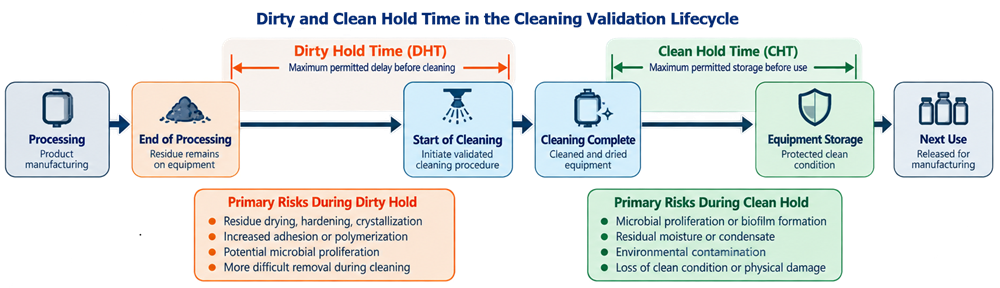
Cleaning validation should define how long equipment may remain in a particular condition before that condition begins to challenge the assumptions supporting the validated cleaning process. Two time intervals are particularly important: dirty hold time, the permitted delay between completion of processing and initiation of the defined cleaning process, and clean hold time, the permitted interval between completion of cleaning and subsequent equipment use.
These intervals address different risks. Dirty hold time primarily evaluates whether aging of process residue makes the equipment more difficult to clean. Clean hold time evaluates whether cleaned equipment can remain stored without unacceptable recontamination, microbial proliferation, moisture retention, environmental exposure, or loss of its defined clean status.
Neither interval should be selected only for manufacturing convenience. The established limits should reflect equipment design, residue characteristics, cleaning process, storage conditions, microbial risk, and the evidence available to demonstrate that equipment remains suitable for its next intended use.
FDA’s cleaning-validation inspection guide specifically identifies control of the time between completion of processing and cleaning as an important part of the cleaning procedure because dried residues can reduce cleaning effectiveness. FDA also states that routine cleaning and storage should not permit microbial proliferation and that cleaned equipment should be dried before storage rather than left with stagnant water.
Dirty Hold Time and Clean Hold Time Are Different Controls
Dirty hold time (DHT) begins at a predefined point after processing and ends when the validated cleaning process begins. Its purpose is to establish the maximum delay for which the cleaning procedure has demonstrated adequate capability.
Clean hold time (CHT) begins after completion of the defined cleaning process and associated release steps and ends when the equipment is placed into its next manufacturing use, or at another predefined endpoint established by procedure.
The distinction is important because the failure mechanisms are different. During dirty hold, residue can dry, harden, crystallize, polymerize, oxidize, degrade, or adhere more strongly to the equipment surface. During clean hold, the concern shifts to equipment storage: residual moisture, environmental exposure, microbial growth, ingress through open connections, improper assembly, or deterioration of the protected clean condition.
ICH Q7 specifically calls for establishing the maximum interval between completion of processing and equipment cleaning when appropriate. FDA’s ICH Q7 Questions and Answers further clarifies that this maximum established dirty hold time represents the interval for which evidence demonstrates that the equipment can still be reliably cleaned.
Define the Start and End Points Before the Study
A hold-time limit has little value unless its start and end points are defined consistently. Terms such as “end of batch,” “start of cleaning,” and “equipment clean” can represent different operational events depending on the manufacturing process.
For dirty hold, the start may be completion of product discharge, completion of the manufacturing step, removal of the final batch from the equipment, or another clearly defined event. The endpoint may be initiation of the first validated cleaning phase, introduction of the cleaning solution, or start of a defined pre-rinse.
This distinction becomes important when equipment is flushed, kept wet, partially disassembled, manually pre-cleaned, or otherwise treated before formal cleaning. Such activities can substantially change the residue condition. A study intended to represent dry, untreated equipment should not be compared directly with routine operation in which the equipment receives an immediate water flush.
For clean hold, the start should normally follow completion of the validated cleaning procedure and any required drying, inspection, assembly, or release activities. The endpoint should represent the point at which the equipment is placed into the next manufacturing use or another site-defined condition requiring reassessment.
The procedural definitions should match the timestamps actually recorded during routine manufacturing.
Why Dirty Hold Time Can Change Cleanability
The chemical and physical condition of residue can change substantially while equipment waits for cleaning. Water or solvent can evaporate, leaving concentrated solids that adhere more strongly to stainless steel, polymers, elastomers, or other surfaces. Proteins can denature, formulations containing binders can form films, suspensions can dry into compact deposits, and salts or APIs can crystallize.
Temperature can accelerate some of these changes. Residue remaining on warm equipment after processing may dry faster than the same residue under laboratory conditions. Formulations containing oils, polymers, high solids, coatings, or sticky excipients may also become more difficult to remove as the residue ages.
Microbiological conditions can change during dirty hold as well. Moist product residue, water-containing formulations, nutrients, and warm surfaces can support microbial proliferation where environmental and product conditions permit it.
The dirty-hold challenge should therefore be based on the actual process residue rather than an assumption that elapsed time alone is the relevant variable.
Dirty Hold Time and Worst-Case Selection
The longest permitted delay should normally be represented in cleaning validation or supported through a scientifically justified study. The selected challenge should also consider whether the product used for the study represents an appropriate residue-aging worst case.
Worst-Case Product, Equipment, and Cleaning Condition Selection should identify products whose residue becomes especially difficult to remove after drying or aging. The product representing the most restrictive toxicological limit is not necessarily the product that represents the most difficult dirty-hold condition.
Equipment geometry also matters. Residue on an open vessel wall may dry differently from residue retained under an impeller, inside a valve, behind a gasket, within a transfer hose, or at a low point where liquid remains. Where one location creates a substantially greater aging challenge, the sampling strategy should account for that location.
Maximum campaign length can interact with dirty hold. Residue accumulated over several batches and then held before cleaning may be more difficult to remove than residue from a single batch. Where campaign production is permitted, the study design should determine whether maximum campaign conditions and maximum dirty hold need to be represented together.
FDA states that cleaning validation should reflect routine manufacturing conditions and specifically notes that equipment stored uncleaned longer than the validated interval should be sampled to demonstrate that the cleaning procedure remains effective.
Establishing the Initial Dirty Hold Time
A practical initial dirty-hold limit should be based on manufacturing needs, cleaning-development knowledge, residue behavior, scheduling variability, and operational risk.
For example, if routine manufacturing normally begins cleaning within eight hours but occasional operations require up to sixteen hours, the validation strategy should determine whether sixteen hours should be directly represented or whether another justified boundary is appropriate.
The study should avoid artificially favorable conditions. Equipment should not be pre-cleaned, unnecessarily rinsed, or otherwise treated in a way that reduces the challenge unless those activities are part of the approved routine procedure. FDA specifically cautions that validation should represent the cleaning procedure as actually used rather than making the equipment easier to clean before the validated process begins.
Where the product residue is known to become progressively harder to clean, development studies can be used to compare cleaning effectiveness after different hold durations before selecting the final validation challenge.
Clean Hold Time Has a Different Regulatory Basis
Clean hold time should not be presented as though FDA or ICH imposes one universal mandatory clean-hold study for all equipment. FDA’s ICH Q7 Questions and Answers explicitly states that ICH Q7 does not specify a requirement to establish a time limit between equipment cleaning and its next use. It does, however, require procedures for protecting cleaned equipment from contamination before use and inspection for cleanliness immediately before use when practicable.
Once a site claims that cleaned equipment may be stored for a defined period without recleaning, that claim should have an appropriate scientific basis. The evidence may range from process knowledge and controlled storage conditions to formal chemical and microbiological hold-time studies, depending on risk.
The degree of study should therefore reflect the equipment, environment, storage configuration, residual moisture potential, product type, subsequent use, and microbial-control strategy.
Clean Equipment Storage Conditions
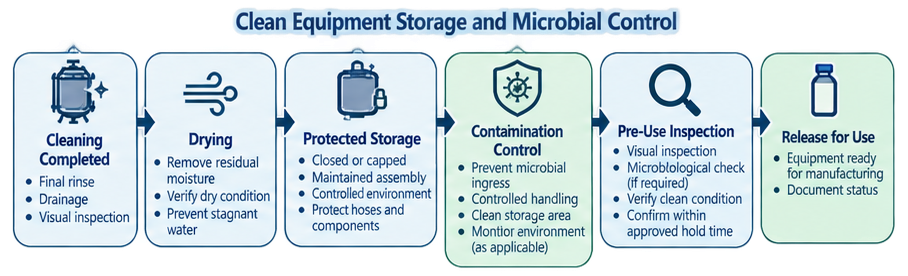
Clean hold time cannot be evaluated independently from how the equipment is stored. A stainless-steel vessel that is completely drained, dried, closed, and protected from environmental ingress represents a different risk from equipment stored wet, partially assembled, open to the room, or connected to uncontrolled piping.
Relevant storage controls include equipment drying, closed or capped product-contact openings, controlled assembly status, protection of hoses and removable components, prevention of condensate formation, drainage, environmental exposure, handling, and equipment-status identification.
FDA’s cleaning-validation guide specifically states that routine cleaning and storage should not permit microbial proliferation and that equipment should be dried before storage. It cautions against stagnant water remaining after cleaning.
For CIP equipment, Pharmaceutical Tank Cleaning and CIP Integration should define drainage, drying, final cycle status, equipment closure, and the point at which clean hold begins.
Microbiological Risk During Clean Hold
Microbial risk is often a major driver of clean hold time, particularly for equipment used with aqueous products, biotechnology materials, nonsterile products capable of supporting microbial growth, or systems in which residual moisture can remain after cleaning.
A clean surface does not need to be sterile unless the intended process requires sterility, but storage should not allow objectionable microbial proliferation or deterioration of the condition established by cleaning and sanitization.
Risk factors include residual water, warm equipment, difficult-to-drain geometry, nutrient residue, open connections, uncontrolled air ingress, contaminated covers, repeated handling, and storage in environments capable of introducing microorganisms.
Where microbiological risk is significant, the clean-hold study can include surface or rinse bioburden measurements, visual inspection, and other applicable tests. The sampling approach should represent locations where moisture or contamination is most likely to persist rather than relying solely on easily accessible surfaces.
For sterile or aseptic equipment, the clean-hold claim should also be distinguished from a sterile hold time claim. Cleaning, sanitization, sterilization, and maintenance of sterility are separate controls and should not be combined into one undefined interval.
Study Design
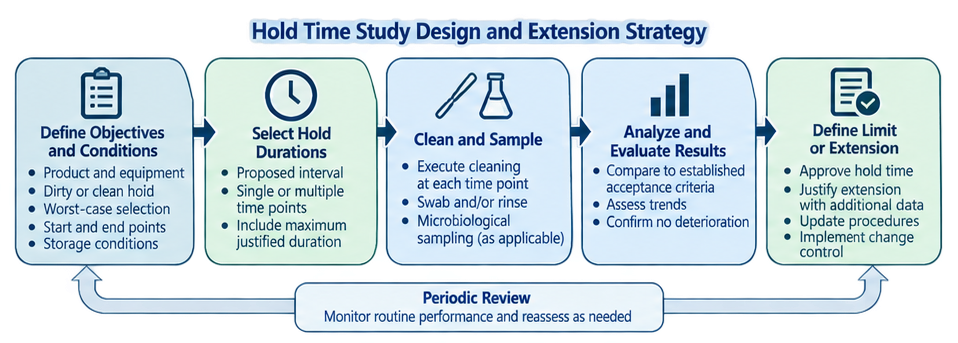
Dirty and clean hold studies should be protocol-driven where formal validation evidence is required. The protocol should define the study objective, equipment, product or soil, hold-time definition, start and end points, storage conditions, challenge duration, cleaning procedure, sampling locations, sampling method, analytical procedure, microbiological testing where applicable, acceptance criteria, deviations, and final reporting requirements.
The number of study points should reflect the intended objective. A study intended only to confirm one proposed maximum may require direct evaluation at that maximum. A development or extension study may use multiple time points to determine whether performance changes progressively with increasing duration.
For dirty hold, the study should represent a realistic residue condition and the approved cleaning process. For clean hold, the study should represent the actual equipment storage configuration, including drying, closure, protection, and environmental conditions.
The study should avoid uncontrolled variation between time points. Differences in product load, cleaning chemistry, sampling method, equipment configuration, or storage condition can make elapsed time impossible to interpret as the controlling variable.
Sampling Strategy
Sampling should target locations most likely to reveal deterioration in cleaning effectiveness or clean equipment status.
For dirty hold, worst-case locations may include areas where residue is difficult to remove, dries rapidly, accumulates, or is exposed poorly to the cleaning process. Cleaning Validation Sampling Strategy and Worst-Case Locations should provide the basis for selecting these areas.
Direct surface swabbing can provide localized evidence from accessible surfaces, while rinse sampling can provide broader information from closed or inaccessible systems. Swab Sampling for Cleaning Validation and Rinse Sampling for Cleaning Validation should define the limitations of each approach.
Sampling recovery should already be established through Swab and Rinse Recovery Studies for Cleaning Validation. A hold-time study should not introduce an unqualified sampling method that cannot reliably recover the residue being assessed.
For clean hold, additional sampling may be directed toward low points, areas susceptible to retained moisture, equipment openings, removable components, transfer paths, or other locations where storage can introduce contamination.
Chemical Acceptance Criteria
Dirty-hold acceptance criteria should generally remain consistent with the approved cleaning-validation acceptance criteria. The purpose of the study is to demonstrate that the established cleaning process still achieves the required cleanliness after the proposed delay, not to create a less restrictive limit for aged residue.
Cleaning Validation Acceptance Criteria and Surface, Swab, and Rinse Limits should define the applicable residue criteria. Where product residue, cleaning-agent residue, TOC, conductivity, or another measurement is used, the same validated analytical basis should be retained unless the study protocol provides a scientifically justified alternative.
The analytical procedure should have adequate capability at the applicable limit. Analytical Sensitivity and Quantitation Limits in Cleaning Validation and Analytical Method Validation for Cleaning Residue Testing should provide the supporting method evidence.
Visual inspection should also be included where practical. Analytical samples represent selected locations and cannot demonstrate the condition of every product-contact surface.
Microbiological Acceptance Criteria
Microbiological criteria should be defined where microbial growth represents a credible hold-time risk. The criteria should reflect the equipment use, manufacturing process, product type, downstream controls, site microbiological strategy, and applicable product requirements.
The purpose is not necessarily to prove that the equipment remains sterile. For nonsterile processing, the study may instead demonstrate that storage does not permit unacceptable microbial proliferation or deterioration of equipment cleanliness.
Where sanitization or sterilization follows cleaning, the cleaning and hold-time study should still consider whether microbial proliferation, biofilm formation, or pyrogen-related risk during storage could compromise subsequent control steps.
Acceptance criteria should be established before study execution and should not be derived retrospectively from the observed results.
Clean Hold Time Verification
A clean-hold study should demonstrate that the stored equipment remains suitable for use throughout the claimed interval under the specified storage conditions.
Evidence may include visual inspection, microbiological sampling where appropriate, chemical residue assessment where recontamination is plausible, verification that the equipment remained dry, inspection of covers or closures, and confirmation that no maintenance or handling event compromised the clean status.
A clean-hold interval should not be interpreted as permission to use equipment without pre-use checks. Where inspection before use is practicable, that control remains important even when a formal hold period has been established. ICH Q7 identifies inspection for cleanliness immediately before use as an expected control when practical.
Extension Strategy
Hold times often need to be extended as operating experience develops. An extension should be supported by data rather than treated as an administrative change.
FDA’s ICH Q7 Questions and Answers explicitly states that an established dirty hold time can be extended with appropriate supporting data.
A practical extension strategy may progressively challenge longer intervals while maintaining the same product, equipment, residue condition, cleaning procedure, and analytical controls. For example, a validated twelve-hour dirty hold might be extended to eighteen or twenty-four hours after satisfactory additional studies.
The extension should account for whether residue aging is linear. A satisfactory result at eight hours does not automatically predict performance at forty-eight hours because physical or chemical transitions can occur after a threshold period.
For clean hold, extension studies should represent the same storage configuration and environmental controls used during routine operation. If the storage condition changes, the existing evidence may no longer support the extended claim.
Bracketing Hold Times
Bracketing can reduce unnecessary testing where equipment, products, and hold-time conditions are scientifically comparable. A maximum challenged interval can potentially support shorter intervals within the same validated conditions.
The rationale should address whether residue behavior, storage configuration, equipment material, drainage, environmental exposure, and cleaning process remain equivalent. A single maximum time cannot automatically represent multiple equipment trains with substantially different designs or storage risks.
Product bracketing should also consider whether the selected material represents residue-aging behavior for the group. A highly soluble product that remains easy to remove after extended drying may not be an appropriate representative for a formulation that hardens rapidly.
Relationship to Routine Operations
Approved dirty and clean hold times should be incorporated directly into manufacturing and cleaning procedures. Operators should know when each interval starts, how the elapsed time is recorded, and what action is required when the established limit is approached or exceeded.
Electronic batch records, equipment logs, CIP systems, manufacturing execution systems, or manual records may be used to document relevant timestamps. The recorded events should correspond to the validated definitions rather than loosely interpreted manufacturing milestones.
Routine scheduling should provide reasonable operational margin. A validated twenty-four-hour dirty hold should not routinely be managed so closely to the limit that minor delays repeatedly produce excursions.
Equipment-status controls should distinguish conditions such as dirty, awaiting cleaning, cleaning in progress, clean, clean hold active, expired clean hold, and released for use where those distinctions are relevant to the site system.
Hold-Time Excursions
An equipment hold-time excursion should be assessed rather than automatically treated as either acceptable or a cleaning failure.
If dirty hold exceeds the validated limit before cleaning begins, the equipment may require additional assessment, enhanced sampling, a defined recleaning strategy, or other action based on the product, duration, residue behavior, and available development evidence.
FDA specifically indicates that equipment stored uncleaned longer than the validated period should be sampled to demonstrate that the cleaning procedure remains effective.
An expired clean hold may require recleaning, sanitization, inspection, additional verification, or another predefined action. The response should be established procedurally and should reflect the reason the clean-hold limit was established.
A successful result obtained after an unapproved excursion can provide investigation evidence but should not silently redefine the validated hold-time limit.
Change Control
Changes affecting residue aging, cleaning effectiveness, or storage condition should be assessed for their impact on established hold times. Relevant examples include new products, formulation changes, changed cleaning chemistry, modified equipment geometry, different product-contact materials, changed pre-rinse practices, revised drying conditions, new storage covers, increased campaign length, altered manufacturing temperature, or changes in environmental controls.
Changes to the formal dirty or clean hold-time limit should be controlled and supported by appropriate data before routine implementation.
Cleaning Validation Change Control and Revalidation Triggers should define whether a change requires documentation only, targeted hold-time verification, cleaning revalidation, or broader reassessment of the cleaning program.
Periodic Review and Trending
Hold-time performance should be reviewed as part of the cleaning-validation lifecycle. The review can consider actual dirty-hold durations, clean-hold durations, excursions, cleaning failures, microbiological results, repeated recleaning, changes in equipment storage, new products, campaign changes, and investigation history.
If routine data show that certain products become harder to clean after relatively short delays, the established worst-case selection or hold-time limit may require reassessment. Conversely, extensive routine evidence may support future extension studies when operational need exists.
Ongoing Cleaning Verification and Performance Trending should integrate hold-time data with broader cleaning-process performance, while Cleaning Validation Periodic Review and Continued Verification should reach a documented conclusion regarding continued validity of the approved limits.
Common Deficiencies
Common dirty-hold deficiencies include defining the interval without specifying its start and end points, validating a shorter delay than routine manufacturing permits, pre-rinsing the equipment during validation when routine equipment may remain untreated, selecting a product that does not represent residue-aging behavior, and assuming that the longest elapsed time is automatically worst case without understanding the residue.
Common clean-hold deficiencies include establishing a time limit without defining storage conditions, storing equipment wet, leaving product-contact openings uncontrolled, failing to inspect equipment before reuse, applying one hold time to equipment with substantially different drainage characteristics, and treating clean hold as equivalent to sterile hold.
Other weaknesses include extending hold times administratively without supporting data, changing drying or storage practices without impact assessment, failing to incorporate hold limits into manufacturing records, and repeatedly accepting excursions through ad hoc testing rather than reassessing the validated operating strategy.
Key Principles
Dirty hold time establishes the maximum permitted delay between completion of processing and initiation of the defined cleaning process for which cleaning effectiveness has been demonstrated. Residue drying, hardening, crystallization, degradation, microbial proliferation, campaign history, equipment geometry, and cleaning chemistry can all influence this limit.
Clean hold time addresses a different question: how long cleaned equipment can remain stored under defined conditions before reuse. Its justification should reflect drainage, drying, contamination protection, microbial risk, storage configuration, and pre-use inspection.
There is no universal regulatory dirty- or clean-hold duration. The established limits should be scientifically justified for the actual manufacturing system and supported by evidence appropriate to the risk.
Hold-time studies should use representative worst-case conditions, qualified sampling procedures, suitable analytical methods, predefined chemical or microbiological acceptance criteria, and controlled operating conditions. Extensions should be supported by additional data rather than administrative convenience.
Approved hold times should be incorporated into routine procedures, equipment-status controls, manufacturing records, deviation management, change control, and periodic review so that the limits demonstrated during validation remain connected to actual manufacturing practice.