

Ongoing Cleaning Verification and Performance Trending
Successful completion of cleaning validation establishes that an approved cleaning process can reproducibly achieve its defined acceptance criteria under the conditions represented by the validation study. It does not eliminate the need to confirm that the process continues to perform adequately during routine manufacturing. Equipment condition changes, operator practices drift, products and campaigns change, cleaning equipment ages, and seemingly minor changes can alter cleaning performance over time.
Ongoing cleaning verification provides that lifecycle assurance. The program uses routine manufacturing evidence such as visual inspection, selected residue testing, swab or rinse monitoring, cleaning-process parameters, deviations, repeated cleaning events, and performance trends to determine whether the validated cleaning process remains in a state of control.
FDA specifically recommends a risk-based residue-monitoring program after cleaning validation, with the frequency and methods determined through risk assessment, to demonstrate that the validated process continues to clean equipment consistently. For API operations, the ICH Q7 Questions and Answers similarly states that routine monitoring at product changeover should include visual inspection and that the frequency of analytical testing to verify ongoing cleaning effectiveness should be determined by the manufacturer using a risk-based approach.
Ongoing verification should therefore be proportionate to risk. It should generate enough evidence to identify loss of cleaning capability without simply repeating the complete initial validation sampling plan indefinitely.
From Cleaning Validation to Ongoing Verification
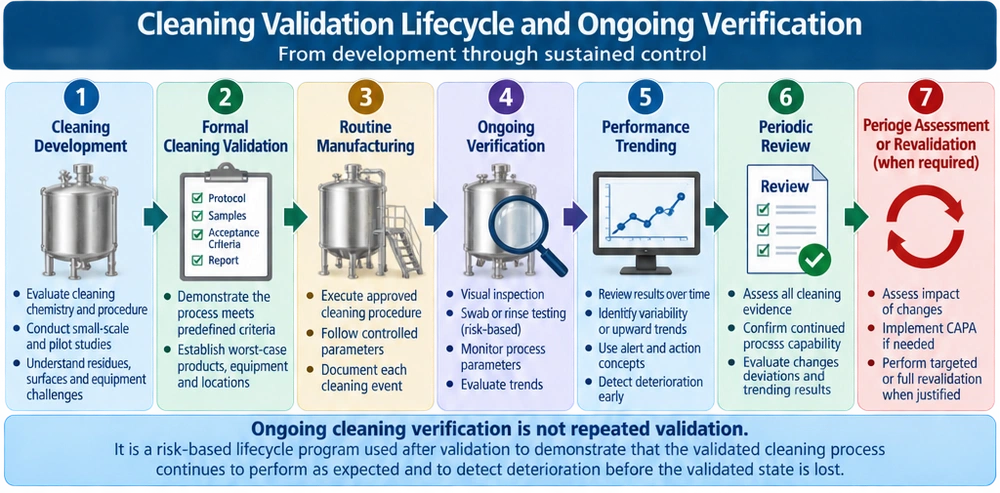
Formal cleaning validation and ongoing verification have related but different objectives. Validation demonstrates that the defined process can reproducibly meet predetermined acceptance criteria. Ongoing verification evaluates whether routine operation continues to behave consistently with that validated performance.
The lifecycle can be viewed as: Cleaning-process development → formal cleaning validation → routine operation → ongoing verification and trending → periodic review → change assessment or revalidation when required
The validated procedure remains the foundation. Ongoing monitoring should not gradually redefine the cleaning process or replace validated operating parameters with whatever conditions happen to be observed during routine use.
Cleaning Validation Program Strategy, Scope, and Lifecycle should establish the overall governance model, while this article focuses on the evidence collected after successful validation.
Regulatory and Scientific Basis
21 CFR 211.67 — Equipment Cleaning and Maintenance requires equipment to be cleaned and maintained at appropriate intervals to prevent contamination that could alter drug-product safety, identity, strength, quality, or purity.
FDA’s current CGMP Questions and Answers — Equipment states that, following cleaning validation, a residue-monitoring program with frequency and methods determined by risk assessment is recommended to demonstrate continued consistent cleaning performance. FDA also distinguishes direct surface sampling from rinse sampling and recognizes their complementary use where appropriate.
The older but still useful FDA Guide to Inspections: Validation of Cleaning Processes recognizes indirect methods such as conductivity as potentially useful for routine monitoring after validation, provided the indirect measurement has been demonstrated to correlate with equipment condition.
ICH Q7 provides a lifecycle concept for validated systems more broadly, stating that validated systems and processes should be periodically evaluated to verify that they remain valid. Where no significant changes have occurred and quality review demonstrates consistent acceptable performance, revalidation is normally unnecessary.
For API manufacturing specifically, the ICH Q7 Q&A states that routine cleanliness monitoring at product changeover should include visual inspection, while analytical testing frequency can be established using a risk-based approach.
These sources support a lifecycle program based on continued evidence, risk assessment, and review rather than an arbitrary requirement to repeat full cleaning validation at fixed intervals.
Define the Purpose of the Ongoing Verification Program
The ongoing verification program should answer a clear question: Does routine operation continue to provide evidence that the validated cleaning process remains capable and under control?
The program should be capable of detecting meaningful deterioration in cleaning performance, including changes that may not immediately produce an acceptance-criterion failure. A progressive increase in residue levels, repeated visible residue, increasing recleaning frequency, or recurring problems at one equipment location can indicate reduced process capability before an actual cleaning-validation failure occurs.
The program should therefore evaluate both individual cleaning outcomes and longer-term patterns.
Verification Should Be Risk Based
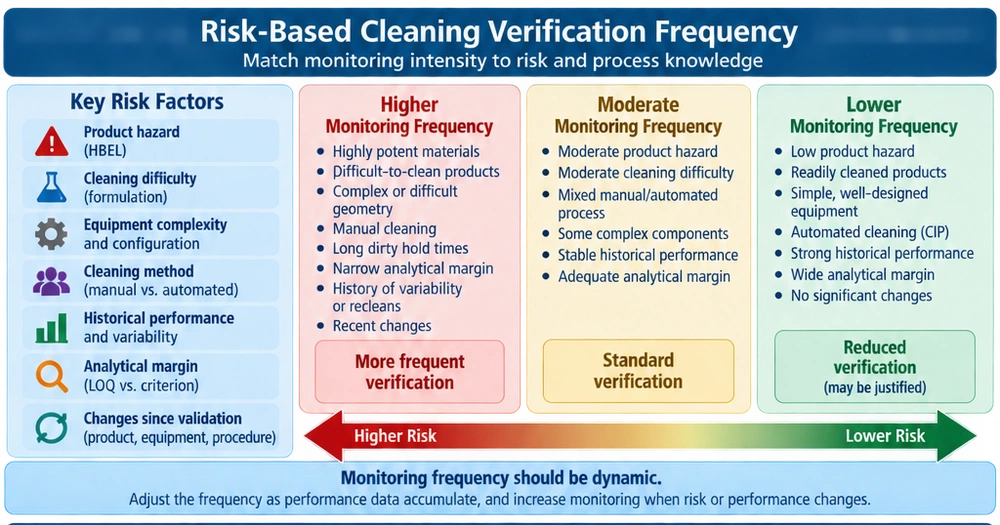
Not every validated cleaning process requires the same monitoring intensity. Frequency and method should reflect the consequences and likelihood of cleaning failure together with the amount of confidence already available from process knowledge and historical performance.
Higher monitoring intensity may be appropriate where the program involves very low HBEL-derived limits, highly potent materials, difficult-to-clean formulations, manual cleaning, complex equipment, significant operator dependence, narrow analytical margin, long dirty hold times, difficult geometry, or a history of cleaning variability.
Lower monitoring intensity may be justified where the cleaning process is automated, well characterized, highly reproducible, supported by strong process controls, and has demonstrated stable long-term performance.
Risk-based frequency should therefore be a documented decision rather than a fixed site-wide rule such as “one swab every ten cleanings.”
Factors That Can Determine Monitoring Frequency
A practical risk assessment should consider the combined cleaning challenge rather than product toxicity alone.
Important factors include the residue’s health-based limit, cleanability, formulation characteristics, equipment complexity, surface materials, cleaning mechanism, automation level, operator dependence, dirty hold time, campaign length, sampling recovery, analytical sensitivity, validation history, routine results, deviations, and changes since validation.
Worst-Case Product, Equipment, and Cleaning Condition Selection provides the underlying worst-case logic. The same factors used to identify validation challenges should inform post-validation monitoring.
Monitoring frequency can then be increased, maintained, or reduced as additional reliable performance evidence accumulates.
Monitoring Frequency Should Be Dynamic
A risk-based program should not become a permanent sampling schedule that remains unchanged regardless of performance.
For example, a newly validated manually cleaned system may initially receive relatively frequent residue verification. If routine data remain stable and comfortably below the acceptance criteria, the analytical frequency may later be reduced through documented assessment. Conversely, increasing variability, repeated high results, a new product, an equipment modification, or a cleaning deviation may justify temporarily increased monitoring.
This creates a lifecycle relationship: Initial verification frequency → accumulate performance data → assess risk and capability → maintain, reduce, or increase monitoring
Any reduction should be supported by evidence rather than by the desire to decrease laboratory workload.
Product Selection for Routine Verification
A multiproduct facility does not necessarily need analytical verification after every cleaning of every product. The program can use representative or risk-based product selection where the scientific basis remains valid.
Product selection should consider both patient-safety risk and cleaning difficulty. A product with the lowest HBEL may establish the most restrictive allowable residue but may not be the most difficult formulation to remove. Conversely, a sticky or poorly soluble product may challenge the cleaning process more severely even though its allowable residue is higher.
The ongoing monitoring strategy can therefore include more than one representative product where necessary to cover different failure mechanisms.
A new product should be assessed before being incorporated into the existing verification grouping. It should not automatically inherit the established monitoring frequency simply because it uses the same equipment.
Equipment Selection
Equipment selection should similarly be based on the actual cleaning risk. Monitoring should provide adequate representation of equipment items or trains most capable of revealing reduced cleaning performance.
Factors can include geometry, cleaning method, surface area, product-contact configuration, manual access, valve complexity, drainage, spray coverage, disassembly requirements, and previous cleaning history.
An equipment train with a vessel, pump, transfer piping, hoses, and filling components may contain several distinct cleaning challenges. Monitoring only the easiest vessel wall may provide little information about deterioration in the valve or transfer pathway.
Cleaning Validation Sampling Strategy and Worst-Case Locations should provide the approved location rationale that ongoing verification can use.
Worst-Case Locations Should Remain Visible in the Routine Program
Formal cleaning validation often identifies locations such as outlets, valves, gasket interfaces, agitator hubs, low points, spray shadows, and difficult manual-access areas as worst-case locations.
Routine monitoring does not necessarily need to sample all of these locations after every cleaning event, but the risk-based program should continue to represent them over time.
A rotation strategy can be appropriate when justified. For example, a routine verification plan may alternate several established worst-case locations so that the program accumulates evidence across the entire cleaning-risk profile rather than repeatedly sampling only one convenient site.
Rotation should not systematically avoid the most challenging location.
Visual Inspection Is a Core Routine Control
Visual inspection should remain part of routine equipment-cleanliness verification after validation. For API operations, the ICH Q7 Q&A specifically identifies visual inspection at product changeover as part of routine monitoring.
Visual inspection can identify conditions not adequately represented by limited analytical sampling, including films, powders, deposits, discoloration, cleaning-agent residue, retained water, fibers, or contamination at unexpected locations.
The visual procedure should define the conditions necessary for meaningful inspection, including equipment access, lighting, disassembly where required, and any inspection aids such as mirrors or borescopes.
A visually unacceptable surface should not be released merely because a swab or rinse result passes.
Visual Findings Are Valuable Trend Data
Visual inspection results should not be treated only as binary pass/fail information. Repeated observations such as slight film formation, residue at the same gasket, retained moisture at one outlet, or recurring need for manual touch-up can provide early evidence of cleaning deterioration.
The program should therefore capture meaningful adverse visual observations so they can be evaluated with analytical and deviation data.
Repeated visual concerns at one location may justify changes to the sampling strategy, cleaning procedure, preventive maintenance, equipment design, or operator training.
Residue Testing After Validation
Routine analytical verification can use swab, rinse, or other qualified methods depending on the equipment and residue.
Swab Sampling for Cleaning Validation provides localized direct measurement from accessible worst-case surfaces. Rinse Sampling for Cleaning Validation provides indirect evidence from inaccessible or broader equipment pathways.
FDA recommends that routine residue-monitoring frequency and methods be determined through risk assessment after cleaning validation.
The monitoring method should remain consistent with the validated sampling and analytical procedure unless a controlled change has been evaluated.
Swab Monitoring
Swab monitoring is particularly useful when the ongoing verification objective is to determine whether localized difficult-to-clean surfaces remain under control. Routine locations can include previously validated worst-case areas, rotating representative locations, or locations identified from operating history.
Results should remain traceable to the applicable surface and sample acceptance criteria through the recovery and calculation convention established during validation.
Swab and Rinse Recovery Studies for Cleaning Validation should continue to support the recovery factors used in routine interpretation.
Rinse Monitoring
Rinse monitoring can be especially efficient for closed automated systems where a defined final rinse can be sampled reproducibly as part of routine operation.
FDA’s older cleaning-validation inspection guide recognizes indirect testing such as conductivity as potentially useful for routine monitoring once the cleaning process has been validated, provided the method has been shown to correlate with equipment cleanliness.
A rinse result should still be interpreted within its known limitations. Because rinse results represent a system-level average, they can dilute localized contamination and should not automatically replace targeted direct sampling where localized residue remains a meaningful risk.
Indirect Cleaning Indicators
Validated or scientifically supported indirect measurements can provide useful routine information when they correlate with cleaning-process performance.
Examples can include:
- final-rinse conductivity;
- TOC;
- rinse pH;
- detergent concentration;
- CIP flow;
- temperature;
- contact time;
- cycle completion;
- recipe alarms;
- spray or circulation parameters.
These measurements can provide frequent process evidence without requiring full residue testing after every cleaning.
However, an indirect parameter should not be assumed to demonstrate residue removal unless the relationship has been established. For example, acceptable conductivity can demonstrate removal of an ionic cleaning agent but may provide little information about a nonionic product residue.
Cleaning Process Parameters Are Part of the Evidence
For automated or semiautomated cleaning systems, routine verification should include review of parameters identified as important to cleaning effectiveness during development and validation.
Examples include detergent concentration, wash temperature, circulation time, flow, pressure, final-rinse volume, rinse endpoint, and cycle sequence.
A cleaning cycle can produce an acceptable residue result despite an important parameter excursion. That does not necessarily demonstrate that the excursion is acceptable for future cycles.
The parameter deviation should be assessed because ongoing verification is intended to maintain the validated process, not merely to confirm a favorable analytical outcome after the process has departed from validated conditions.
Build a Useful Trending Dataset
Individual results establish whether a cleaning event met its criteria. Trending determines whether the behavior of the cleaning process is changing.
The trending dataset can integrate:
- swab results;
- rinse results;
- TOC or conductivity;
- visual inspection findings;
- cleaning deviations;
- recleaning events;
- dirty hold duration;
- cleaning parameter excursions;
- product and equipment identifiers;
- sampling location;
- repeated maintenance-related findings.
The objective is to detect meaningful patterns, not to create large amounts of data without a defined decision process.
Normalize Results Before Comparing Them
Cleaning data should be compared on a consistent basis. A result reported in µg/swab should not be trended directly against one reported in µg/cm² unless appropriately converted. Likewise, rinse concentrations from different rinse volumes may not be directly comparable without understanding how the sampling procedure changed.
Recovery convention, sampled area, analytical method, units, reporting limits, and equipment configuration should remain sufficiently consistent for meaningful trend interpretation.
Changes to analytical LOQ or reporting conventions should be considered when comparing historical datasets.
Trend Against the Acceptance Criterion Where Useful
One practical method is to express routine residue results as a percentage of the applicable acceptance criterion:
Normalized Result (%) = Measured or Recovery-Adjusted Result ÷ Acceptance Criterion × 100
For example:
- Result: 0.8 µg/cm²
- Acceptance criterion: 2.0 µg/cm²
- Normalized result: 40% of acceptance criterion
This approach can help compare results across products or locations with different absolute residue limits, provided the underlying measurements remain scientifically comparable.
Normalized values should not hide important differences in equipment or cleaning mechanism. They are a trend tool, not a replacement for technical interpretation.
Statistical Review Should Match the Dataset
Cleaning verification can benefit from statistical methods, but the method should fit the amount and quality of available data.
For larger datasets, useful tools can include control charts, moving averages, run charts, distribution review, variability analysis, or other methods capable of identifying drift, unusual patterns, and increasing variability.
For smaller datasets, graphical trend review combined with technical assessment may be more meaningful than complex statistical calculations based on too few observations.
There is no universal FDA requirement to calculate process capability indices for every cleaning-validation monitoring program. Statistical methods should support detection of meaningful changes rather than create artificial precision.
Look for Drift, Not Only Failures
A cleaning process can remain technically within the formal acceptance criterion while deteriorating.
- For example, assume a swab limit of: 2.0 µg/cm²
- Historical results: 0.15, 0.18, 0.21, 0.17, 0.20 µg/cm²
- Later results: 0.45, 0.62, 0.81, 1.05, 1.22 µg/cm²
Every later result still passes the formal criterion. However, the upward pattern represents a substantial shift in cleaning performance.
Ongoing verification should be capable of identifying this type of drift and triggering evaluation before a formal failure occurs.
Variability Can Be as Important as the Mean
Increasing result variability can also indicate reduced control.
A process that historically produces consistently low residue values but begins alternating between very low and near-limit values may be experiencing operator differences, inconsistent cleaning parameters, equipment deterioration, changing dirty-hold conditions, or sampling variability. The review should therefore consider both central tendency and dispersion.
A simple average can conceal a growing population of high results.
Alert and Action Concepts
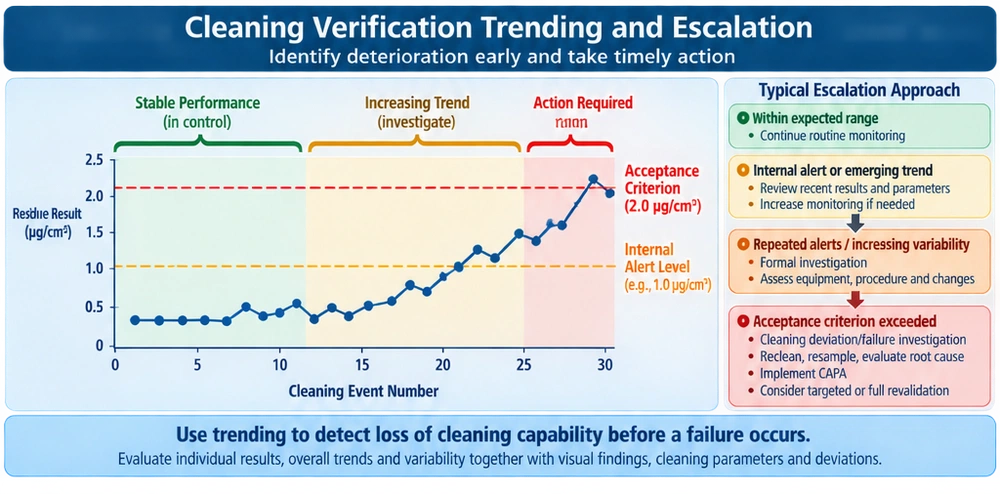
A mature cleaning-verification program can use internal alert or action concepts below the formal cleaning acceptance criterion to identify deteriorating performance.
These levels should not be confused with the health-based residue acceptance criterion. The formal acceptance criterion determines whether the cleaning result meets the established cleaning requirement. An internal alert level is a process-control tool intended to initiate review before that boundary is approached.
For example:
- Formal acceptance criterion: 2.0 µg/cm²
- Internal alert level: established from historical process performance or another justified statistical/risk-based approach.
The alert level should not be chosen arbitrarily. It should reflect the cleaning process’s demonstrated performance, normal variability, analytical capability, and available monitoring data.
Alert Level Is Not Automatically a Failure
A result above an internal alert threshold but below the approved acceptance criterion is not necessarily a cleaning failure.
It should instead trigger the response defined by the monitoring procedure. This can include review of recent results, cleaning parameters, dirty hold time, operator technique, equipment condition, product campaign, and related deviations.
Repeated alerts or a meaningful adverse trend can justify increased analytical monitoring or formal investigation even if no individual result exceeds the acceptance criterion.
This distinction prevents internal process-control levels from being confused with patient-safety boundaries.
Action or Escalation Conditions
Escalation should become progressively stronger as evidence indicates greater risk to the validated state.
A practical structure can be:
| Condition | Typical response |
|---|---|
| Stable routine performance | Continue approved monitoring |
| Isolated unusual but passing result | Technical review and trend assessment |
| Internal alert or emerging trend | Increase review and potentially monitoring frequency |
| Repeated alerts / increasing variability | Formal investigation or targeted verification |
| Acceptance-criterion failure | Cleaning deviation/failure investigation |
| Persistent or systemic deterioration | CAPA, process modification, targeted or broader revalidation |
The exact terminology and thresholds should be defined by the site’s quality system.
Analytical Failures Require Investigation
A result exceeding the approved cleaning acceptance criterion should not be treated as merely a trend signal. It is an unacceptable cleaning result requiring investigation.
The assessment should consider cleaning execution, equipment configuration, dirty hold time, visual observations, sampling method, recovery, analytical validity, equipment condition, prior trends, and other relevant evidence.
Immediate recleaning can be necessary operationally, but recleaning does not erase the original failure.
Cleaning Validation Deviations, Failures, and Investigations should define the investigation and resampling strategy.
Recleaning Frequency Is a Performance Indicator
Repeated need for recleaning can indicate declining cleaning capability even when the final post-recleaning results pass.
A system that requires frequent repeated cycles, manual touch-up, additional rinses, or unscheduled cleaning adjustments may no longer be operating with the robustness demonstrated during validation.
Recleaning frequency should therefore be included in trend review rather than considered routine housekeeping with no validation relevance.
Cleaning Deviations Should Be Integrated into Trending
Cleaning-related deviations can reveal failure modes that analytical residue results alone do not capture.
Relevant events can include incorrect detergent concentration, low CIP flow, insufficient temperature, missed manual step, wrong equipment configuration, extended dirty hold, incomplete disassembly, sampling errors, and equipment maintenance affecting product-contact surfaces.
An increasing frequency of such deviations can indicate weakening process control even if individual residue samples continue to meet criteria.
Product and Campaign Context Matters
Trend interpretation should consider the product and manufacturing history preceding each cleaning event.
A higher residue result following maximum campaign length or maximum dirty hold may be expected to represent a stronger challenge than the same result after one short production batch.
Relevant context can therefore include:
- previous product;
- campaign length;
- dirty hold time;
- cleaning method;
- equipment train;
- operator or cleaning crew where relevant;
- significant maintenance;
- analytical method.
This context allows technical interpretation rather than treating all cleaning events as identical data points.
Manual Cleaning Requires Particular Attention to Variability
Manual cleaning generally introduces greater operator-dependent variation than a well-controlled automated cycle.
Ongoing verification for manual processes should therefore pay particular attention to recurring differences among equipment locations, cleaning crews, disassembly practices, cleaning tools, contact times, visual inspection findings, and repeated need for corrective cleaning.
The purpose is not to trend individual employees unnecessarily. It is to determine whether the procedure is sufficiently defined and robust to minimize operator-dependent performance differences.
If performance depends heavily on individual technique, the underlying cleaning procedure may require improvement.
Automated Cleaning Provides Additional Monitoring Opportunities
Automated CIP or washer systems can generate large amounts of routine process data that support cleaning verification.
Useful information can include:
- recipe version;
- detergent concentration;
- temperature profile;
- flow;
- pressure;
- circulation time;
- final rinse conditions;
- alarms;
- aborted cycles;
- manual interventions.
These records can provide early evidence of process drift even when analytical residue testing is performed less frequently.
Automated data should be reviewed according to their relevance to cleaning effectiveness rather than collected without defined evaluation criteria.
Trend Review Frequency
The frequency of formal trend review should reflect the volume of cleaning activity, product risk, monitoring frequency, and process performance.
High-volume operations may benefit from monthly or quarterly reviews, while lower-volume equipment may require review based on accumulated cleaning events rather than calendar time.
The review interval should be frequent enough that meaningful deterioration is identified before large numbers of cleaning events occur under the changed condition.
Routine event-level review and formal periodic trend review serve different purposes and can operate together.
Data Integrity and Traceability
Cleaning-verification data should remain traceable to the equipment, product, cleaning event, sample location, analytical method, acceptance criterion, and applicable recovery convention.
Where automated cleaning-system data are used, records should also identify the recipe, cycle, alarms, interventions, and relevant process parameters.
FDA emphasizes that CGMP records and data should be reliable and accurate and supports risk-based strategies for maintaining data integrity.
Trend calculations should not exclude inconvenient results without documented technical justification.
Relationship to Periodic Review
Ongoing verification generates the evidence used by Cleaning Validation Periodic Review and Continued Verification.
Periodic review should integrate the accumulated cleaning data and determine whether the original validation assumptions remain valid. This includes review of product changes, equipment changes, deviations, failures, cleaning trends, analytical changes, recovery data, visual findings, and monitoring performance.
ICH Q7’s lifecycle principle is that validated systems should be periodically evaluated and that revalidation is normally unnecessary when no significant changes have occurred and review confirms continuing acceptable performance.
Ongoing verification therefore supplies the objective evidence supporting that conclusion.
Relationship to Change Control
Ongoing verification also provides information for change control. Changes affecting product residue, equipment, cleaning chemistry, procedure, analytical method, sampling strategy, dirty hold, or campaign length should be evaluated before implementation where possible.
After a significant change, the monitoring program may temporarily increase verification frequency to confirm continued performance under the revised condition.
A change that affects the validated cleaning boundary should not simply be absorbed into routine trend data without formal assessment.
Escalation to Revalidation
An adverse trend does not automatically require complete cleaning revalidation.
The appropriate response depends on the nature and extent of the evidence.
A localized increase at one gasket may justify targeted investigation, maintenance, and focused verification. A site-wide change in detergent chemistry may require broader assessment. Repeated failures across multiple products or equipment items may indicate systemic loss of cleaning control and justify broader revalidation.
Revalidation should therefore be the result of a documented technical assessment rather than a fixed calendar event.
Establish a Monitoring Plan
The ongoing verification program should be documented sufficiently to explain what is monitored, why it is monitored, and what happens when performance changes.
A useful plan should define the equipment and products covered, verification methods, sampling locations, frequency or risk logic, applicable acceptance criteria, visual inspection requirements, analytical methods, recovery treatment, data-review method, internal alert concepts where used, escalation rules, responsibilities, and periodic review.
The plan can operate at site, cleaning-group, equipment-train, or procedure level depending on the complexity of the manufacturing operation.
Common Deficiencies
A common weakness is stopping analytical residue monitoring entirely after initial validation without a documented risk assessment supporting the routine strategy. FDA specifically recommends risk-based residue monitoring after validation.
Another weakness is performing the same fixed sample after every cleaning event without considering whether it remains representative of the important cleaning risks. Routine convenience should not gradually replace the worst-case rationale established during validation.
Other deficiencies include relying only on pass/fail results without trending, ignoring repeated results close to the limit, excluding recleaning events from performance review, treating visual observations as undocumented operator comments, and failing to integrate cleaning deviations into the trend assessment.
Programs can also become unnecessarily complex by establishing arbitrary alert values with no relationship to historical performance or by applying sophisticated statistical calculations to very small datasets. The monitoring system should remain technically meaningful and proportionate to the available evidence.
A further weakness is automatically treating any internal alert excursion as a cleaning-validation failure. Internal alert concepts are process-control tools; the approved acceptance criterion remains the formal cleaning boundary unless the site procedure defines otherwise.
Key Principles
- Ongoing cleaning verification provides lifecycle evidence that a validated cleaning process continues to perform consistently during routine manufacturing. It is not a requirement to repeat full cleaning validation after every cleaning event.
- FDA recommends a residue-monitoring program after validation with frequency and methods determined through risk assessment. For API manufacturing, ICH Q7 guidance similarly supports risk-based analytical monitoring together with routine visual inspection.
- Monitoring intensity should reflect product hazard, cleanability, equipment complexity, cleaning method, operator dependence, historical performance, analytical margin, and changes since validation. Frequency can be adjusted as process knowledge accumulates, but reductions should be supported by evidence.
- Visual inspection, swab monitoring, rinse monitoring, indirect cleaning indicators, cleaning-process parameters, deviations, and recleaning history can provide complementary forms of ongoing evidence.
- Trend review should evaluate more than individual pass/fail decisions. Increasing residue levels, greater variability, repeated visual findings, frequent recleaning, or recurring cleaning deviations can indicate deterioration while results remain below the formal acceptance criterion.
- Internal alert or action concepts can provide early process-control signals below the approved acceptance boundary, but they should be scientifically justified and should not be confused with the health-based cleaning acceptance criterion.
- Ongoing verification data should feed periodic review, change control, CAPA, and revalidation decisions so that cleaning validation remains a lifecycle process rather than a one-time qualification exercise.