

Analytical Method Selection for Cleaning Validation
Cleaning validation requires analytical evidence capable of demonstrating that product residues, cleaning-agent residues, and other relevant contaminants have been reduced to scientifically justified levels. Selecting an analytical method is therefore not simply a laboratory decision based on available instruments. It is a validation-design decision that connects the residue of concern, cleaning acceptance criterion, sampling strategy, analytical capability, and final determination of whether the cleaning process is acceptable.
The appropriate method depends on what must be measured and why. A cleaning study may require specific quantitation of an active pharmaceutical ingredient (API), measurement of detergent residue, detection of total organic material, or confirmation that an ionic cleaning agent has been adequately removed. Each application presents a different analytical problem. The objective is to select a technique capable of producing reliable evidence at the concentration relevant to the cleaning-validation decision without introducing unnecessary complexity.
Within the broader Cleaning Validation Program Strategy, Scope, and Lifecycle, analytical method selection should occur after residues of concern and preliminary acceptance criteria have been identified, but before formal cleaning-validation execution. Sampling and analytical capability should be established as an integrated measurement strategy rather than developed independently.
Regulatory and Scientific Basis
21 CFR 211.67 requires manufacturing equipment to be cleaned and maintained at appropriate intervals to prevent contamination that could affect drug-product safety, identity, strength, quality, or purity. The regulation does not prescribe a specific analytical technology, so the manufacturer must establish scientifically justified methods capable of demonstrating that the cleaning process achieves its defined requirements.
Laboratory controls are further addressed by 21 CFR 211.160, which requires scientifically sound specifications, sampling plans, and test procedures. FDA’s Guide to Inspections: Validation of Cleaning Processes specifically identifies analytical-method sensitivity and sampling procedures as elements that should be defined in the cleaning-validation protocol.
Analytical-procedure development and validation principles are addressed in FDA’s final ICH Q14 Analytical Procedure Development and ICH Q2(R2) Validation of Analytical Procedures guidances. Q14 provides a science- and risk-based framework for analytical procedure development, while Q2(R2) provides the framework for demonstrating that the resulting procedure performs appropriately for its intended use.
Start with the Residue and the Required Decision
Method selection should begin by defining the residue or contaminant that must be controlled. Relevant materials may include an API, intermediate, degradation product, formulation component, excipient, detergent, cleaning chemical, processing aid, lubricant, or other material capable of remaining on product-contact surfaces. The chemical characteristics of the residue determine which analytical principles are likely to be useful.
The analytical requirement must then be connected to the applicable cleaning limit. Health-Based Exposure Limits for Cleaning Validation: HBEL, PDE, and ADE provides the toxicological basis for controlling product carryover, while Maximum Allowable Carryover (MACO) and Residue Limit Calculations translates that toxicological basis into an allowable quantity of residue. Cleaning Validation Acceptance Criteria and Surface, Swab, and Rinse Limits then converts the allowable carryover into measurable criteria appropriate to the equipment and sampling method.
The analytical method should therefore be selected against the concentration expected in the actual sample, not simply against the total residue limit for the equipment. Surface area sampled, rinse volume, extraction volume, dilution, recovery, and other sample-preparation factors can substantially change the concentration presented to the analytical instrument.
Specific Versus Nonspecific Analytical Methods
One of the most important decisions is whether the application requires measurement of a specific compound or whether a nonspecific measurement can provide adequate and conservative evidence of cleaning effectiveness.
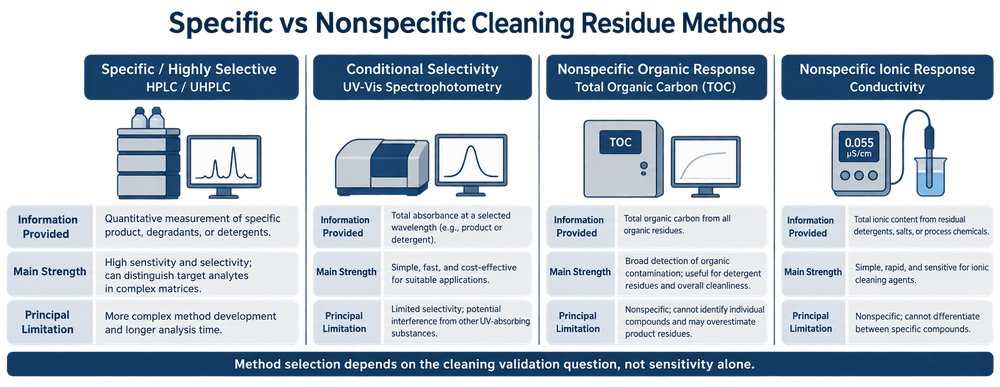
A specific or highly selective analytical method measures the target residue independently from other components that may be present. Chromatographic techniques such as HPLC or UHPLC are commonly used when a particular API or other defined substance must be quantified in the presence of excipients, detergents, degradation products, swab extractables, or other interfering materials. These techniques are particularly useful when the acceptance criterion applies directly to one identified compound.
A nonspecific analytical method measures an aggregate property rather than a particular compound. Total organic carbon (TOC), for example, measures organic carbon from substances capable of contributing to the TOC response. Conductivity measures the ionic character of a solution rather than identifying the individual ionic compound responsible for the response. These techniques can be appropriate when the relationship between the measured property and the residue-control objective is scientifically understood.
Nonspecific methods should not be treated as inherently inferior. In some applications they provide a simpler and more conservative control strategy because all measurable organic or ionic residue is assigned to the residue of concern. The limitation is that the result does not identify the individual substance producing the response. The validation strategy must therefore establish why the aggregate measurement is suitable for the cleaning decision.
HPLC and UHPLC
High-performance liquid chromatography (HPLC) and ultra-high-performance liquid chromatography (UHPLC) are strong choices when a defined residue must be separated from other sample components and quantitatively measured. Chromatographic separation allows the target analyte to be distinguished from many excipients, cleaning-agent components, degradation products, and matrix-derived signals.
Cleaning-validation applications frequently operate at concentrations significantly below those used in finished-product assay methods. An existing product assay should therefore not automatically be assumed suitable for cleaning samples. The intended concentration range, extraction solvent, swab materials, detergent residues, degradation products, and expected sample matrix may be different from those used for the original analytical procedure.
The cleaning application should be evaluated independently to determine whether the existing method can be appropriately extended, modified, or partially revalidated. Where HPLC or UHPLC is selected, the associated system should also remain qualified and controlled for its GMP intended use as described in HPLC and UHPLC System Qualification and Lifecycle Control.
UV-Visible Spectrophotometry
UV-visible spectrophotometry can provide a relatively simple quantitative method when the residue has suitable absorbance and the required cleaning limit falls within a reliable analytical range. It may be effective when the target material has a strong response at a selected wavelength and other components in the cleaning-validation sample do not produce significant interference.
The principal limitation is the absence of chromatographic separation. Other product components, detergents, extraction solvents, degradation products, or swab-derived materials may also absorb at the selected wavelength. Method selection should therefore evaluate whether the measured response can be attributed to the residue with adequate selectivity.
Where the matrix is simple and the analytical response is sufficiently characteristic, UV-visible analysis may provide an efficient and defensible approach. Where interference is significant or the required limit approaches the practical quantitative capability of the technique, a chromatographic method may be more appropriate.
Total Organic Carbon
Total organic carbon is a nonspecific technique that can be useful when the residue of concern is organic and can be adequately represented through its carbon contribution. TOC can support product-residue or cleaning-agent testing when the target material is sufficiently oxidizable under the analytical conditions and background carbon can be adequately controlled.
FDA specifically recognizes TOC as a potentially suitable approach for cleaning validation and residue monitoring when its applicability has been demonstrated. FDA also emphasizes that the analytical and sampling methods used for cleaning validation should be scientifically sound and capable of supporting the intended determination.
TOC can be particularly useful for multiproduct systems because one nonspecific method may conservatively represent several organic residues rather than requiring separate compound-specific methods for every product. This advantage depends on controlling contributions from water, solvents, swabs, containers, detergents, and other sources of organic carbon.
TOC is less appropriate when the residue is poorly oxidized, contains insufficient measurable carbon relative to the required limit, or when background organic carbon prevents reliable discrimination at the required concentration.
Conductivity
Conductivity measures the ability of a solution to conduct electrical current and is primarily responsive to ionic species. It can be useful for alkaline or acidic cleaning agents, salts, and other ionic residues where a reproducible relationship exists between residue concentration and conductivity.
Conductivity is frequently used in automated cleaning-in-place systems because it is rapid, simple, and readily integrated with rinse monitoring. Water quality, temperature, background ionic content, rinse volume, and other process variables must nevertheless be controlled because each can influence conductivity independently from the target residue.
Conductivity may be particularly useful as an endpoint or routine monitoring parameter after the relationship between conductivity response and an acceptably clean condition has been established. It should not be treated as a universal substitute for direct residue measurement simply because the instrument is already installed in the CIP system.
Other Analytical Techniques
Other techniques may be appropriate when supported by the residue characteristics and required analytical decision. Gas chromatography can be useful for volatile or semi-volatile residues and certain solvents. Ion chromatography can provide more selective measurement of ionic residues than general conductivity. Other spectroscopic, electrochemical, biochemical, or compound-specific techniques may also be appropriate when they provide adequate specificity, sensitivity, quantitative capability, and matrix tolerance.
The appropriate technique should be chosen because its measurement principle fits the validation requirement. Availability of laboratory equipment, historical familiarity with a technique, or low testing cost should not be the primary basis for method selection when the technology cannot reliably support the established cleaning limit.
Product Residues Versus Cleaning-Agent Residues
Product residues and cleaning-agent residues do not necessarily require the same analytical method. A product residue may be controlled through an HBEL-derived criterion linked to patient exposure, while a detergent or other cleaning chemical may have a separate toxicological, quality, or process-based limit.
An HPLC method optimized for a particular API may provide excellent API specificity while providing no information about residual detergent. Conversely, TOC may respond to both API and organic detergent residues without identifying which material produced the signal. Conductivity may provide strong sensitivity to an ionic detergent but little useful information about a poorly ionized API.
The validation strategy should therefore identify all residue categories requiring control and determine whether one analytical method can conservatively address multiple materials or whether separate procedures are required. A method should not be credited with controlling a residue that it does not meaningfully measure.
Integration with the Sampling Strategy
Analytical method selection cannot be separated from the cleaning-validation sampling strategy. Cleaning Validation Sampling Strategy and Worst-Case Locations establishes where and how evidence should be collected based on equipment geometry, residue behavior, accessibility, and cleaning difficulty.
Swab Sampling for Cleaning Validation provides localized information from a defined surface area but introduces variables associated with swab material, solvent, operator technique, extraction efficiency, and surface characteristics. Rinse Sampling for Cleaning Validation can provide broader coverage, particularly for inaccessible equipment, but may substantially dilute the residue and can mask localized contamination.
FDA states that rinse sampling alone is generally insufficient where direct surface measurement is feasible and that a combination of direct and rinse sampling can be appropriate when scientifically justified. The analytical method must therefore be selected in the context of the sample that will actually reach the laboratory.
Sampling recovery is another critical component. Swab and Rinse Recovery Studies for Cleaning Validation evaluate the ability of the sampling process to remove residue from the representative surface and transfer it into a form that can be analyzed. High instrument sensitivity cannot compensate for a sampling method that fails to recover the residue adequately.
Analytical Capability Relative to the Cleaning Limit
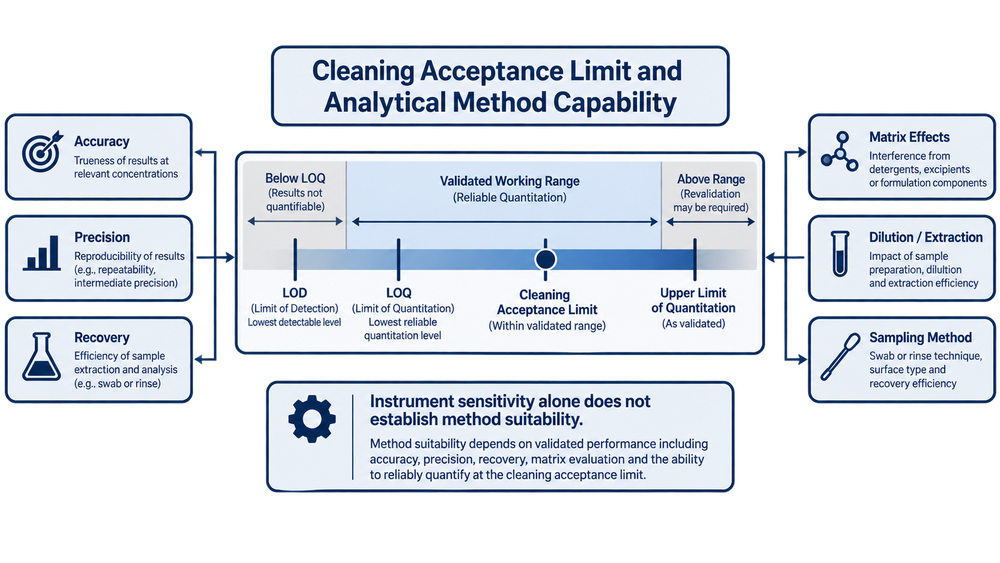
Analytical sensitivity should be evaluated against the actual cleaning acceptance criterion. The method must provide reliable measurement at the concentration required to distinguish acceptable from unacceptable cleaning performance.
Analytical Sensitivity and Quantitation Limits in Cleaning Validation addresses the lowest levels at which the residue can be detected or quantitatively measured. For quantitative cleaning decisions, the limit of quantitation is particularly important because the method must produce sufficiently reliable numerical results in the region where the acceptance decision is made.
The instrument specification alone is not the controlling measure of capability. Accuracy, precision, sampling recovery, extraction efficiency, dilution, matrix interference, background response, sample stability, and analytical working range all influence the ability of the complete procedure to support the cleaning acceptance criterion.
FDA has also stated that the required cleanliness should not be driven by the most sensitive analytical technology available. Cleaning requirements should be based on scientifically justified safe residue levels rather than continuously decreasing because analytical technology becomes capable of measuring lower concentrations.
Practical Method-Selection Decision Process
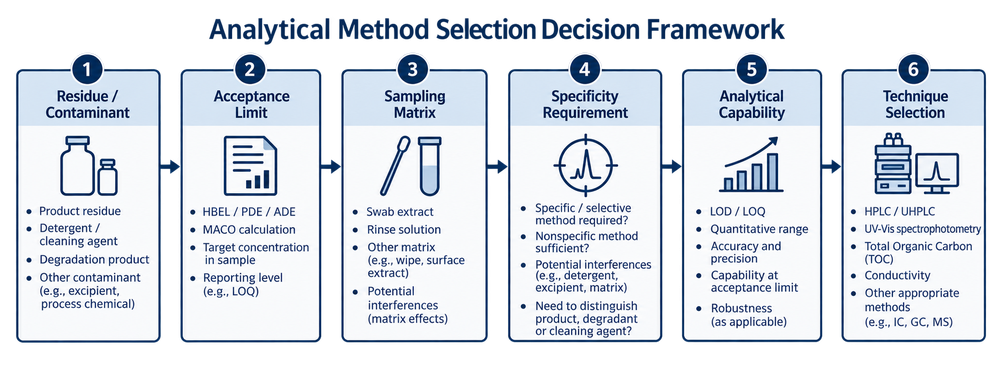
A structured decision process reduces the risk of selecting an analytical technique that later proves incapable of supporting the validation study. The first step is to define the residue or residue group and the applicable acceptance requirement. The chemical and physical characteristics of the residue—including solubility, stability, carbon content, ionic behavior, volatility, UV absorbance, and potential degradation—are then evaluated.
The sampling matrix is considered next. Swab extracts, final rinse samples, dedicated analytical rinses, and other sample types can produce substantially different concentrations and background responses. Potential interference from detergents, excipients, swab materials, extraction solvents, containers, and process-derived compounds should be identified before selecting the measurement technology.
The need for specificity is then determined. Where an individual compound must be quantified independently, a highly selective method such as HPLC/UHPLC may be appropriate. Where total organic residue provides a scientifically conservative measure, TOC may be sufficient. Conductivity may be appropriate for ionic cleaning agents, while UV-visible analysis may be suitable when absorbance characteristics and sample composition provide adequate selectivity.
The anticipated concentration in the laboratory sample should then be compared with the expected analytical range. Dilution, extraction volume, rinse volume, sampled surface area, recovery, and sample preparation must be incorporated into this assessment. The technique should provide adequate capability with reasonable margin around the acceptance decision, but the method should not be made unnecessarily complex solely to achieve lower analytical limits that have no relationship to the cleaning requirement.
Operational considerations such as laboratory throughput, analyst training, availability of qualified instruments, method complexity, data handling, sample stability, and the burden of maintaining multiple product-specific methods can also influence the final choice. These factors become relevant only after scientific suitability has been established.
Method Selection Versus Method Validation
Selection of an analytical technology does not demonstrate that the analytical procedure is validated. Method selection identifies a measurement approach that appears capable of supporting the intended cleaning-validation use. Analytical development then defines the detailed procedure, and validation demonstrates that the procedure performs as required.
Selecting HPLC because a specific API must be quantified does not establish that the resulting HPLC procedure has adequate specificity, accuracy, precision, range, or lower-level quantitative capability in a cleaning sample. Likewise, choosing TOC does not demonstrate that the target residue is adequately oxidized, that background carbon is controlled, or that the required concentration can be measured reliably.
These characteristics are addressed separately in Analytical Method Validation for Cleaning Residue Testing. That article is the consolidated replacement for the legacy Method Specificity and Selectivity and Quantitative Method Capability articles.
ICH Q14 describes analytical procedure development as part of an analytical lifecycle, while ICH Q2(R2) addresses evaluation of the performance characteristics needed to demonstrate suitability for the intended use. Cleaning-validation methods should apply those principles to the actual residue, sample matrix, recovery process, concentration range, and cleaning acceptance requirement.
Documentation of the Selection Rationale
The method-selection rationale should be documented before formal cleaning-validation execution. Documentation should identify the residue being measured, the applicable limit, proposed sampling approach, expected concentration in the sample, selected analytical technique, required specificity, potential interferences, anticipated quantitative range, and scientific basis for concluding that the technology is appropriate.
For a nonspecific method, the rationale should clearly explain what contributes to the analytical signal and why that aggregate measurement provides adequate or conservative control of the residue of concern. Background contributions and assumptions used to translate the analytical response into a cleaning conclusion should be defined.
Where an existing analytical method is leveraged, its original intended use should be compared with the cleaning-validation application. Differences in concentration range, sample matrix, extraction process, interfering substances, sample stability, and acceptance criteria should determine the extent of additional development or validation required.
Lifecycle and Change Control
Analytical method suitability should be reassessed when conditions affecting the original method-selection rationale change. Relevant changes include introduction of a new worst-case product, revision of an HBEL or cleaning acceptance limit, modification of cleaning chemistry, new equipment materials, changes in sampling solvent or swab type, changes in extraction or rinse volume, introduction of new matrix components, or significant modification of the analytical technology.
A method that was adequate for the original cleaning program may become unsuitable if a new product introduces a substantially lower residue limit or new interference. Conversely, accumulated process and analytical knowledge may support a simplified or more broadly applicable analytical approach when the scientific basis is documented.
The analytical method should therefore be treated as part of the validated cleaning measurement system rather than as an isolated laboratory test. Changes affecting sampling or analysis should be evaluated for their potential impact on prior and future cleaning-validation conclusions.
Common Method-Selection Deficiencies
Common deficiencies include selecting a technique simply because it is already available, using a finished-product assay without evaluating the lower cleaning-validation range, relying on TOC without understanding carbon contribution and background, using conductivity without establishing its relationship to the cleaning residue or endpoint, and choosing a method whose quantitative capability does not support the established acceptance criterion.
Other weaknesses include treating instrument sensitivity as equivalent to complete method capability, failing to account for dilution in rinse samples, neglecting swab or solvent interference, selecting a nonspecific method when compound-specific information is required, and maintaining multiple highly complex product-specific methods where a justified conservative nonspecific approach could provide equal or better control.
These problems originate during method selection. A technically well-executed analytical validation study cannot correct a measurement principle that is fundamentally inappropriate for the intended cleaning decision.
Key Principles
Analytical method selection for cleaning validation should be driven by the residue, cleaning acceptance criterion, sampling approach, sample matrix, specificity requirement, and quantitative capability needed to make the validation decision. HPLC/UHPLC, UV-visible spectroscopy, TOC, conductivity, and other techniques can each be appropriate when their measurement principles match the intended use.
Specific analytical methods are generally favored when an individual residue must be distinguished from other sample components. Nonspecific methods can provide effective and sometimes conservative control when the relationship between the aggregate analytical response and the residue requirement is scientifically justified.
The method must be evaluated as part of the complete sampling and analytical system. Sampling recovery, extraction, dilution, matrix effects, accuracy, precision, LOD, LOQ, and working range determine whether the final result can support the cleaning acceptance criterion. The objective is not to select the most sensitive or sophisticated instrument, but to establish a scientifically justified measurement strategy capable of demonstrating that the validated cleaning process meets its defined requirements.