
Cleaning Validation Acceptance Criteria and Residue Limits
Cleaning-validation acceptance criteria convert patient-safety, product-quality, and process-control requirements into measurable limits that can be applied during validation and routine cleaning verification. A defensible program does not begin with an arbitrary swab number. It begins with a scientifically justified basis for what amount of residue is acceptable, then translates that basis into equipment limits, surface limits, sample limits, and analytical criteria that can be executed in practice.
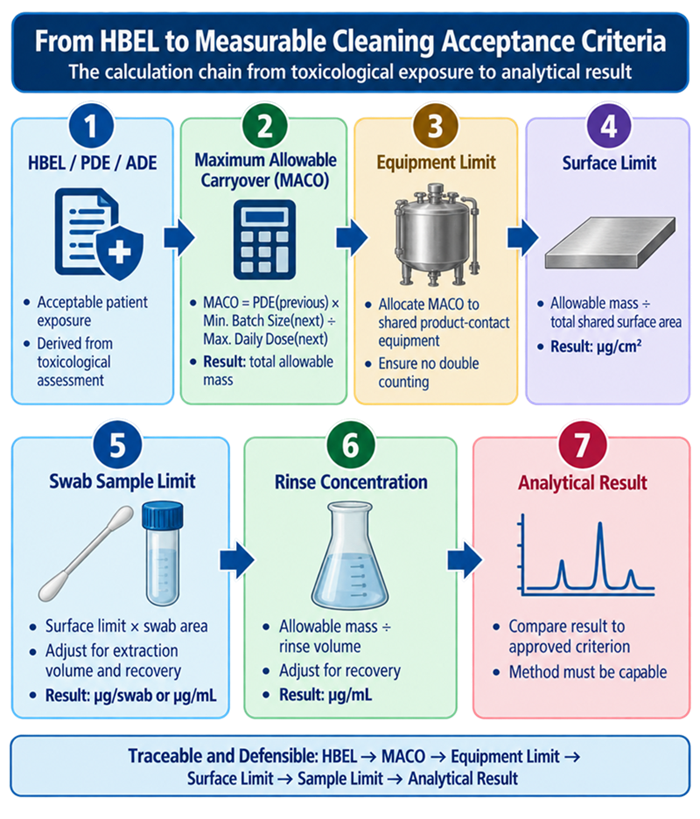
For product residues, the normal calculation chain is: HBEL / PDE / ADE → MACO → equipment allocation → surface limit → swab or rinse criterion → analytical result
Each step answers a different question. A health-based exposure limit establishes acceptable patient exposure to a residue. Maximum allowable carryover translates that exposure into the maximum mass of previous-product residue that may enter a defined subsequent-product manufacturing scenario. Acceptance-criteria calculations then convert that allowable mass into limits that can be applied to the actual equipment, surfaces, and samples used in cleaning validation.
Cleaning limits should not be set merely because a laboratory method can measure a certain low concentration. FDA states that equipment does not need to be cleaned to a residue level determined by the most sensitive analytical method available. The required level should instead be documented as safe, should not create product-quality concerns, and should leave no visible residue.
Regulatory Basis and General Expectations
21 CFR 211.67 requires equipment and utensils to be cleaned and maintained at appropriate intervals to prevent contamination that could alter the safety, identity, strength, quality, or purity of drug products. Written procedures should define the cleaning methods and materials used.
The FDA Guide to Inspections: Validation of Cleaning Processes does not prescribe universal cleaning specifications because equipment, products, and processes vary. Instead, FDA expects the manufacturer’s residue limits to be logical, practical, achievable, and verifiable. The same FDA guidance also emphasizes that residues from the cleaning process itself, including detergents and solvents, must be controlled.
FDA’s CGMP Questions and Answers — Equipment makes two important points. First, equipment should be cleaned to a residue limit documented as safe and not compromising quality. Second, there is no universal detergent-residue specification; the manufacturer must establish and justify its own cleaning-agent limits.
For health-based residue control, the EMA guideline on setting health-based exposure limits provides the most widely cited framework for deriving exposure limits such as PDE or ADE. The related EMA HBEL Q&A also makes an important distinction: the calculated health-based limit does not have to become the routine operating target. A lower practical or alert limit can be used when justified.
Acceptance Criteria Form a Hierarchy
Cleaning-validation acceptance criteria should be treated as a hierarchy rather than as one number repeated in different units. The hierarchy typically includes a health-based exposure limit, a carryover limit, an equipment or surface allocation, a surface residue limit, a swab or rinse criterion, and an analytical decision limit.
A typical product-residue structure is:
- HBEL / PDE / ADE: acceptable patient exposure to the previous product
- MACO: acceptable total carryover of that previous product into the next product
- Equipment allocation: allowable mass assigned to the relevant shared product-contact pathway
- Surface limit: allowable residue per unit area, such as µg/cm²
- Swab criterion: allowable residue associated with the sampled area and extract
- Rinse criterion: allowable residue concentration or mass in a defined rinse
- Analytical criterion: concentration presented to the analytical method after sample preparation
- Visual criterion: no visible residue under defined inspection conditions
The distinction matters because the HBEL is not a surface limit, MACO is not a swab limit, and an analytical LOQ is not the cleaning acceptance criterion. Each serves a different function and should be documented separately.
From Health-Based Exposure Limit to MACO
The health-based exposure limit is the toxicological starting point. Health-Based Exposure Limits for Cleaning Validation explains how an HBEL, PDE, or ADE is derived and why it represents acceptable daily patient exposure to the previous product rather than a residue result on equipment.
A commonly used PDE-based carryover relationship is: MACO(A→B) = PDE(A) × Minimum Batch Size(B) ÷ Maximum Daily Dose(B)
In this equation, Product A is the previous product and Product B is the subsequent product. The PDE or ADE belongs to the previous product because that is the contaminant. The minimum batch size and maximum daily dose belong to the subsequent product because they determine patient exposure to any carryover.
Maximum Allowable Carryover (MACO) in Cleaning Validation addresses the sequence logic, units, and typical calculation mistakes in detail. For the present article, the important point is that MACO is the total allowable residue mass before it is allocated to equipment surfaces or translated into sample-specific acceptance criteria.
From MACO to an Equipment or Surface Limit
Once MACO is known, it must be converted into a limit relevant to the actual shared equipment train. A common approach is to allocate the allowable mass across the total relevant shared product-contact surface area.
Assume the following example:
- PDE = 10 µg/day
- minimum next-product batch size = 100 kg
- maximum next-product daily dose = 5 g/day
This gives: MACO = 10 µg/day × 100,000 g ÷ 5 g/day = 200,000 µg = 200 mg
Now assume the relevant shared product-contact surface area is 80,000 cm². The theoretical surface limit becomes:
- Surface Limit = MACO ÷ Shared Surface Area
- Surface Limit = 200,000 µg ÷ 80,000 cm² = 2.5 µg/cm²
This number is not a claim that residues are actually distributed uniformly across all surfaces. It is an allocation basis that converts the total allowable carryover into a usable surface criterion. Cleaning Validation Sampling Strategy and Worst-Case Locations should still direct sampling to the most difficult-to-clean locations rather than to convenient flat surfaces.
Equipment Allocation Should Not Double Count the MACO
One frequent error is to assign the full MACO independently to every equipment item in a train. If the shared train includes a vessel, transfer line, pump, filter, and filler, each item should not normally receive the full allowable carryover mass unless a separate scientifically justified exposure model supports that approach.
The safer approach is to calculate a common surface criterion across the defined shared product-contact pathway:
Surface Limit = MACO ÷ Total Shared Surface Area
Each equipment item then receives an implied allowable mass proportional to its surface area, and the total across the train remains equal to the original MACO. This is particularly important for large integrated systems and for cleaning groups in which several equipment items are cleaned together and can all contribute to potential carryover.
From Surface Limit to a Swab Criterion
A surface limit in µg/cm² is not yet the same as a swab-sample acceptance criterion. It must first be translated to the actual sampled area and then to the concentration presented to the analytical method.
Assume:
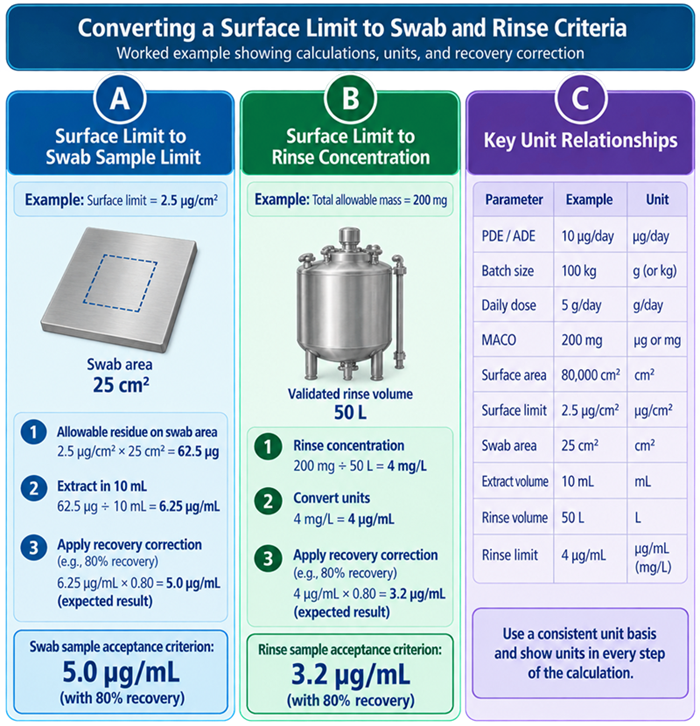
- Surface limit = 2.5 µg/cm²
- Swab area = 25 cm²
The allowable residue associated with the swabbed area is:
- Swab Area Limit = Surface Limit × Swab Area
- 2.5 µg/cm² × 25 cm² = 62.5 µg
If that swab is extracted in 10 mL, the nominal extract concentration becomes:
Extract Criterion = 62.5 µg ÷ 10 mL = 6.25 µg/mL
If the method includes additional dilution, the analytical concentration changes further. For example, a fivefold dilution would reduce the expected analytical concentration to 1.25 µg/mL. This is why acceptance criteria must be translated through the entire sample-preparation process rather than stopping at the surface limit.
Swab Sampling for Cleaning Validation should define the sampling technique, area control, swab material, extraction approach, and documentation needed to ensure that the swab criterion is applied consistently.
Recovery Correction
Sampling recovery is part of the translation from a theoretical surface residue to an actual sample result. If a validated swab recovery is 80%, a surface exactly at the theoretical limit would be expected to yield less than the full theoretical extract concentration unless results are mathematically corrected.
Using the previous example:
- Theoretical extract criterion before recovery treatment = 6.25 µg/mL
- Recovery = 80%
If results are reported without recovery correction, the expected measured concentration at the limit becomes:
6.25 µg/mL × 0.80 = 5.0 µg/mL
A site may handle recovery in different ways. One approach is to correct the analytical result mathematically. Another is to establish the sample acceptance criterion on an uncorrected basis using the validated recovery factor. The important requirement is consistency. Recovery should not be applied twice, and the reporting convention should be defined prospectively in the procedure and protocol.
Swab and Rinse Recovery Studies for Cleaning Validation should establish recovery on representative surfaces and define how recovery is incorporated into the acceptance-criteria calculation.
Swab Acceptance Criteria Should Be Fully Defined
A swab limit should never appear as an unexplained number in a protocol or report. The documentation should identify the basis of the limit and the conditions under which it applies.
At minimum, the swab acceptance criterion should identify:
- the residue being controlled;
- the source MACO or surface limit;
- sampled area;
- swab material;
- extraction solvent and volume;
- dilution factor, if any;
- recovery treatment;
- analytical units;
- final acceptance criterion.
A statement such as “Swab limit = 5 µg” is incomplete unless the sampled area, recovery convention, and analytical reporting basis are also defined.
From MACO to a Rinse Criterion
Rinse limits are derived differently because they are based on an allowed residue mass distributed into a defined rinse volume rather than a known directly sampled area.
Assume:
- allowable residue mass assigned to the rinsed system = 200 mg
- defined rinse volume = 50 L
Then:
Rinse Concentration Limit = 200 mg ÷ 50 L = 4 mg/L . Since 1 mg/L = 1 µg/mL, the same criterion can be written as: 4 µg/mL
This is a theoretical concentration limit corresponding to the defined rinse condition. Recovery, distribution, solubility, and system design still matter. A rinse sample can provide useful broad evidence, especially for closed or inaccessible systems, but it can also dilute localized contamination. Rinse Sampling for Cleaning Validation should address these limitations and define when rinse sampling is appropriate as a primary or supplemental method.
Swab and Rinse Criteria Need Not Be Numerically Similar
Swab and rinse methods provide different evidence. A swab directly samples a known surface area and is useful for worst-case locations. A rinse indirectly represents a system or part of a system and is influenced by rinse coverage, residue solubility, and rinse volume. Even when both are derived from the same MACO, their numerical criteria will usually differ because the sample geometry, preparation, and units differ.
The objective is not to make swab and rinse numbers look similar. The objective is to make both traceable to the same scientifically justified allowable residue basis.
Worked Example
Using the example above:
| Parameter | Value |
|---|---|
| PDE | 10 µg/day |
| MACO | 200 mg |
| Shared surface area | 80,000 cm² |
| Surface limit | 2.5 µg/cm² |
| Swab area | 25 cm² |
| Allowable residue in swab area | 62.5 µg |
| Extraction volume | 10 mL |
| Theoretical extract criterion | 6.25 µg/mL |
| Recovery | 80% |
| Uncorrected analytical criterion | 5.0 µg/mL |
| Rinse volume | 50 L |
| Theoretical rinse criterion | 4 µg/mL |
The same underlying allowable carryover can therefore produce different but traceable forms of acceptance criteria: a surface limit, a swab limit, an analytical extract criterion, and a rinse concentration limit.
Analytical Capability and the Role of LOQ
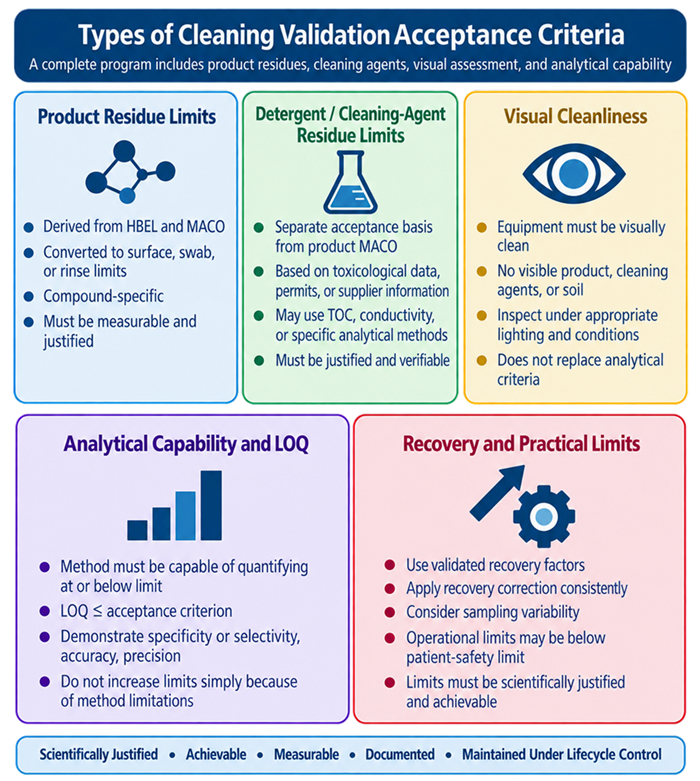
The analytical method must be quantitatively capable at the sample concentration corresponding to the cleaning acceptance criterion. If the calculated swab-extract criterion is 5.0 µg/mL, the method should demonstrate suitable specificity or selectivity, accuracy, precision, range, and sensitivity in that concentration region. Instrument response alone is not enough. The complete procedure matters, including extraction, background, matrix effects, and recovery.
Analytical Method Selection for Cleaning Validation should determine the appropriate analytical technology, Analytical Sensitivity and Quantitation Limits in Cleaning Validation should assess whether the method can quantify at the needed level, and Analytical Method Validation for Cleaning Residue Testing should demonstrate full-procedure suitability.
The analytical LOQ should not automatically become the cleaning acceptance limit. The LOQ defines the lower boundary of reliable quantitation. The cleaning acceptance criterion defines the maximum residue permitted based on toxicology, product quality, or other scientifically justified factors. If the LOQ is much lower than the cleaning limit, the cleaning limit does not need to be reduced to match it. If the LOQ is above the cleaning limit, the method may not be suitable for the intended use.
Visual Cleanliness
Visual inspection remains an independent and important GMP acceptance criterion. FDA states that equipment should have no visible residue in addition to meeting a residue limit that is safe and not compromising quality. Visual inspection can detect localized residue, films, powder, discoloration, droplets, fibers, or other contamination that may not be represented by a small number of analytical samples.
The criterion should normally be stated clearly: No visible residue under defined inspection conditions
If visual inspection is used as a formal release control, the procedure should define the inspection conditions, including lighting, access, surface condition, disassembly status, viewing distance, and any tools used such as mirrors, lights, or borescopes. Visual inspection does not replace analytical testing when a quantitative residue limit is required, but it remains an essential part of a complete cleaning-validation decision.
Product Residue, Detergent Residue, and Other Criteria
A complete cleaning-validation program may require more than one type of residue criterion. Product-residue limits are commonly driven by HBEL and MACO logic. Detergent and cleaning-agent residues require a separate acceptance basis because the product-residue MACO does not automatically control residues from the cleaning chemistry itself.
FDA explicitly states that there is no universal acceptable detergent-residue level. Manufacturers should establish and justify detergent criteria based on toxicological information, supplier data, composition, concentration in use, expected carryover, product-quality impact, and the analytical technology used. Depending on the detergent and cleaning process, possible methods include compound-specific chromatography, TOC, conductivity, pH, or other justified techniques.
Other criteria may also be relevant depending on process risk, including microbiological limits, endotoxin limits, rinse-endpoint controls, dryness requirements, or equipment-protection requirements after cleaning. The final cleaning-validation conclusion should consider all applicable criteria rather than focusing only on the primary product-residue swab result.
Practical and Operational Limits
The HBEL-derived limit represents a health-based boundary. Routine cleaning does not need to operate directly at that boundary. A site may deliberately adopt a lower internal operating target or alert limit if that provides a stronger process-control margin and remains scientifically justified and achievable.
For example, if the calculated health-based surface limit is 2.5 µg/cm², routine cleaning may consistently achieve results below 0.5 µg/cm². The organization can choose to manage to the lower level operationally while retaining the HBEL-derived limit as the formal patient-safety boundary. This distinction should be kept explicit:
- Health-based limit: maximum scientifically justified allowable residue
- Operational limit or alert level: lower internal control level used to maintain process capability
The lower operational limit should not be misrepresented as a second toxicological threshold. It is a process-control decision, not a separate exposure assessment.
Documentation in Protocols and Reports
Cleaning-validation protocols should define acceptance criteria prospectively. At minimum, the protocol should identify the residue being controlled, the basis of the limit, the carryover calculation, the shared equipment train, the total surface area, the calculated surface criterion, the sampling approach, the swab area or rinse volume, the recovery convention, the analytical method, and the final sample-specific acceptance criteria.
Reports should show enough information for an independent reviewer to reconstruct the logic from the source toxicological or product-quality basis through the final laboratory result. This is especially important where several calculation conversions occur between the HBEL, MACO, surface limit, and sample criterion.
Lifecycle Control of Acceptance Criteria
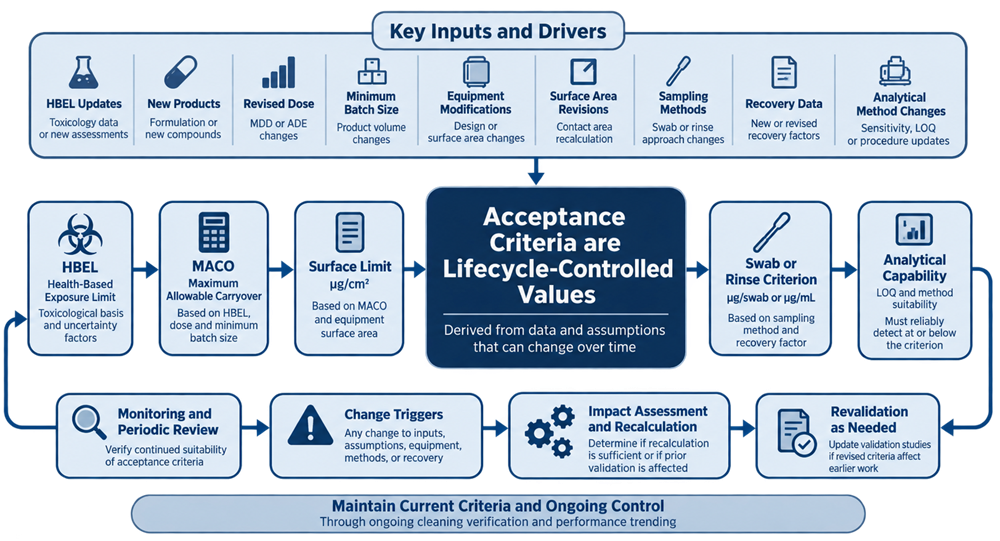
Cleaning acceptance criteria are not permanent numbers that never change. They depend on data and assumptions that can change over time, including HBEL updates, new products, revised doses, new minimum batch sizes, equipment modifications, surface-area revisions, changed sampling methods, revised extraction volumes, new recovery data, and analytical-method changes.
When an upstream value changes, the downstream acceptance criteria may also change:
HBEL → MACO → surface limit → swab or rinse criterion → analytical capability
A formal change assessment should determine whether recalculation alone is sufficient or whether the revised criteria affect the validity of earlier cleaning-validation work. Cleaning Validation Periodic Review and Continued Verification and Ongoing Cleaning Verification and Performance Trending should confirm that the acceptance criteria remain current and that routine cleaning performance remains comfortably within them.
Common Mistakes
Common mistakes include treating the HBEL as though it were directly a swab limit, using incorrect previous-product and next-product parameters in the MACO calculation, assigning the full MACO separately to every equipment item, omitting relevant product-contact surfaces from the area calculation, and confusing a surface limit with a swab limit.
Other frequent errors include ignoring extraction volume, failing to account for dilution, applying recovery twice, mixing corrected and uncorrected reporting conventions, treating rinse and swab criteria as interchangeable, setting detergent limits without a scientific basis, and using the analytical LOQ as the cleaning limit.
Excessive numerical precision is another weakness. A criterion such as 2.483716 µg/cm² implies a level of certainty not supported by toxicological assessments, surface-area estimates, recovery studies, and routine analytical variability. Rounding rules and significant figures should be defined and scientifically appropriate.
Key Principles
Cleaning-validation acceptance criteria should remain traceable from the underlying patient-safety or product-quality basis to the actual analytical result used for the cleaning decision.
For product residues, the normal chain is:
HBEL / PDE / ADE → MACO → equipment allocation → surface limit → swab or rinse criterion → analytical result
The HBEL is not a swab limit, MACO is not a surface limit, and an LOQ is not the cleaning acceptance criterion. Each serves a different purpose and should be documented distinctly.
Surface criteria should be based on the relevant shared product-contact pathway and should avoid double counting of the allowable carryover across multiple equipment items.
Swab and rinse criteria should account for sampling area or rinse volume, extraction, dilution, recovery, and analytical reporting convention. Recovery should be handled consistently and should not be applied twice.
Visual cleanliness remains an independent GMP expectation. Product residues, detergent residues, and any other required controls should each have a separately justified acceptance basis.
A health-based boundary does not have to be the routine operating target. Lower practical or alert limits can be used for process control when justified, achievable, and clearly distinguished from the toxicological boundary.
Acceptance criteria should remain under lifecycle control. Changes to toxicological values, products, doses, equipment, sampling, recovery, or analytical methods should trigger documented reassessment of the existing cleaning limits and validation evidence.