
Swab and Rinse Recovery Studies for Cleaning Validation
Recovery studies determine how effectively a cleaning-validation sampling and measurement procedure can recover residue from the surface or equipment system being evaluated. They are essential because the analytical instrument measures only the material that reaches the laboratory sample. Residue can be lost during surface collection, rinse extraction, transfer, sample preparation, or other steps before analysis.
A low cleaning-validation result therefore cannot be interpreted reliably unless the recovery characteristics of the sampling method are understood. A result of 5 µg does not necessarily mean that only 5 µg was present on the equipment. If the validated overall recovery is 50%, the actual surface-equivalent residue represented by that result may be approximately twice the measured amount, depending on the approved recovery convention.
FDA specifically directs manufacturers to challenge the analytical method together with the sampling method to demonstrate that contaminants can be recovered from equipment surfaces and to establish the degree of recovery. FDA notes that an apparent negative result can reflect poor sampling rather than absence of contamination. ICH Q7 similarly requires sampling methods capable of quantitatively measuring residue remaining after cleaning and states that the attainable recovery level of sampling and analytical methods should be established.
Recovery studies should therefore be treated as validation of the complete residue-recovery pathway, not simply as a laboratory exercise performed on convenient stainless-steel coupons.
What Recovery Represents
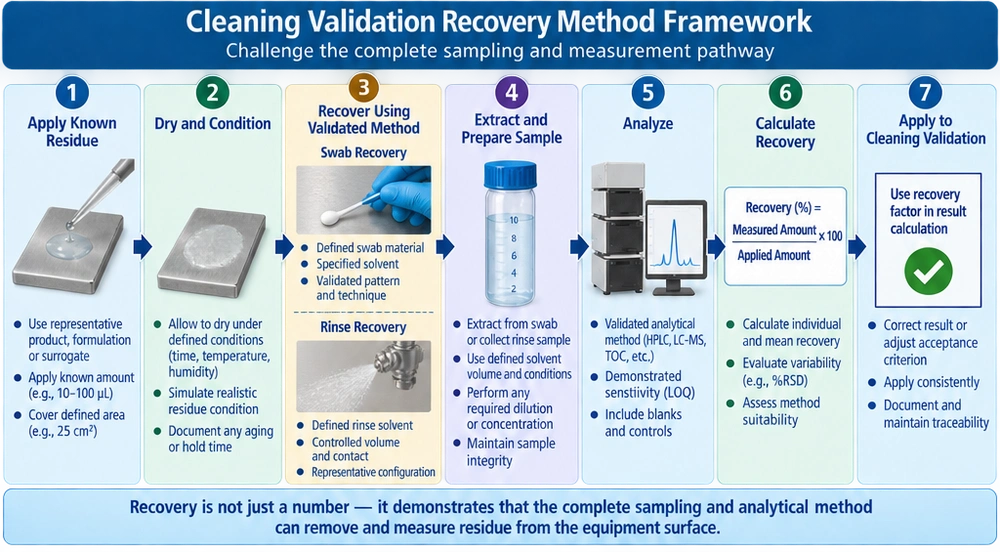
For direct swab sampling, the complete recovery pathway is conceptually: Known residue on representative surface → swab collection → transfer to extraction container → extraction from swab → sample preparation → analytical measurement
For rinse sampling, the pathway is different: Known residue on representative surface or system → contact with rinse liquid → dissolution or physical removal → transport through the equipment → sample collection → sample preparation → analytical measurement
Recovery is commonly expressed as: Recovery (%) = Measured Amount ÷ Applied Amount × 100
If 100 µg of residue is applied to a representative surface and 80 µg is measured through the complete sampling and analytical procedure: Recovery = 80 ÷ 100 × 100 = 80%
The corresponding recovery fraction is: 0.80
This fraction can then be incorporated into the cleaning-validation calculation using the recovery convention established by the site.
Recovery Is Part of the Measurement System
Recovery should not be considered separately from the analytical procedure. FDA’s cleaning-validation inspection guide explicitly describes the need to challenge the sampling and analytical methods together.
For a swab method, total measured recovery can be affected by:
- pickup of residue from the equipment surface;
- transfer of residue onto the swab;
- retention of residue on the swab material;
- extraction from the swab;
- adsorption to the extraction container;
- sample dilution or concentration;
- analytical measurement.
For a rinse method, recovery can additionally depend on:
- residue solubility or extractability;
- rinse-liquid contact;
- hydraulic distribution;
- contact time;
- system configuration;
- drainage;
- recovery of the rinse itself.
A recovery study that evaluates only analytical accuracy in solution does not establish surface-sampling recovery.
Regulatory and Scientific Basis
21 CFR 211.160(b) — General Requirements for Laboratory Controls requires laboratory controls to include scientifically sound specifications, sampling plans, and test procedures designed to assure appropriate quality standards.
FDA’s Guide to Inspections: Validation of Cleaning Processes states that manufacturers should establish the effectiveness of the analytical method in combination with the sampling method and specifically refers to determining whether recovery is, for example, 50% or 90%. FDA’s concern is not that one particular percentage must be achieved, but that recovery is known before negative or low results are interpreted.
FDA’s current CGMP Questions and Answers — Equipment states that cleaning-validation sampling and analytical methods should be scientifically sound. For rinse methods, FDA further expects demonstration that the rinse solvent can dissolve the residue of concern and is suitable for the sampled surfaces.
ICH Q7 requires sampling methods capable of quantitatively measuring residue on equipment surfaces and states that the attainable recovery level of sampling and analytical methods should be established.
FDA also specifically states that recovery studies are necessary when TOC is used for cleaning validation and emphasizes control of background carbon and sample holding-time effects.
Swab Recovery and Rinse Recovery Are Different Studies
Swab and rinse sampling recover residue through different physical mechanisms and should not automatically share one recovery factor.
- A swab recovery study evaluates physical removal of residue from a defined surface and subsequent extraction from the swab.
- A rinse recovery study evaluates removal or extraction of residue using a controlled liquid contact procedure.
Even where the same analytical method is used for both samples, the sampling recoveries may be substantially different.
For example, an HPLC method may demonstrate 99% accuracy for a residue standard in solution while:
- swab recovery from stainless steel is 82%;
- swab recovery from an elastomer gasket is 61%;
- rinse recovery from piping is 74%.
The analytical method itself may be performing well while the total sampling procedures exhibit very different recovery characteristics.
Swab Sampling for Cleaning Validation and Rinse Sampling for Cleaning Validation should therefore use recovery values appropriate to their respective procedures.
Coupon Selection
Recovery studies commonly use coupons because they provide controlled surfaces onto which a known amount of residue can be applied.
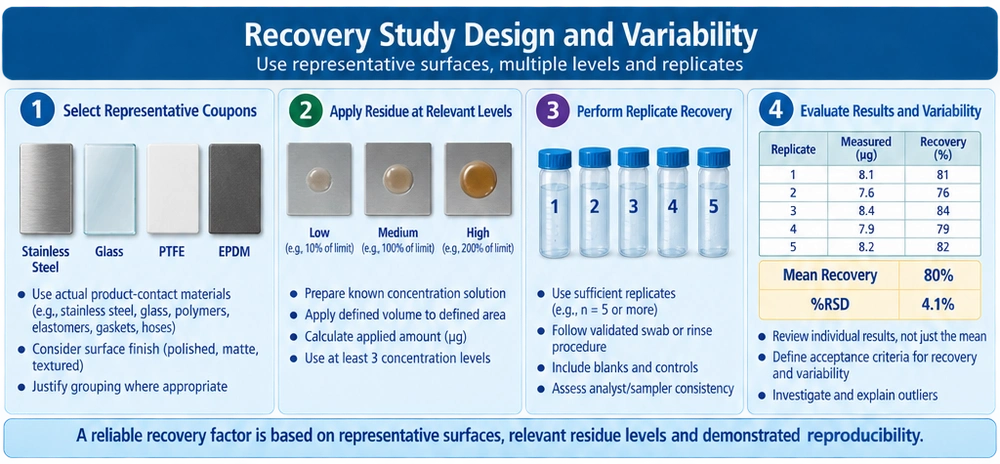
Coupons should represent the product-contact surfaces actually sampled during cleaning validation. Typical materials can include:
- 316L stainless steel;
- glass;
- polymers;
- elastomers;
- coated surfaces;
- hose materials;
- gasket materials;
- other site-specific product-contact materials.
The study does not necessarily need a separate coupon for every material in the facility. Scientifically justified grouping may be appropriate where materials have comparable surface properties and recovery behavior.
However, a recovery result generated only on polished stainless steel should not automatically be applied to materially different surfaces such as glass, PTFE, silicone, EPDM, or other elastomers.
FDA inspection observations have specifically criticized recovery studies that failed to include representative process soils and product-contact materials such as glass that were actually sampled during cleaning validation.
Surface Finish Matters
Material identity alone may not fully characterize the sampling surface.
Recovery can be affected by:
- roughness;
- polishing;
- scratches;
- machining;
- porosity;
- coatings;
- surface wear;
- chemical attack;
- corrosion;
- repeated cleaning exposure.
A highly polished laboratory coupon can produce better recovery than an aged or textured production surface.
Where surface finish materially affects residue retention or sampling efficiency, the recovery program should use representative surface condition or otherwise justify why the coupon adequately represents the production equipment.
This does not mean deliberately damaging coupons to simulate every possible equipment defect. It means the surface model should be appropriate for the equipment condition on which the recovery factor will be applied.
Representative Product-Contact Materials
The recovery-study inventory should be developed from the actual equipment and sampling map rather than from a generic list of materials.
Cleaning Validation Sampling Strategy and Worst-Case Locations should identify which locations and surfaces are sampled. Recovery studies should then demonstrate that the sampling method is suitable for those surfaces.
For example, if routine validation samples include:
- stainless-steel vessel wall;
- glass sight port;
- elastomer gasket;
- polymer hose;
the recovery program should establish whether one recovery grouping can scientifically represent these materials or whether separate values are required.
The relationship should be traceable: Sampling location → surface material → applicable recovery study → recovery factor
Selecting the Residue
The residue used in the recovery study should represent the substance being measured during cleaning validation.
For a compound-specific method, this may be the API or another defined marker. For a nonspecific method such as TOC, the study may need to represent the actual product, cleaning agent, or other organic material whose carbon response is used for the cleaning decision.
The residue selected should reflect the intended measurement objective rather than simply use a convenient analytical standard. Where formulation components materially affect residue adhesion or recovery, pure API may not adequately represent the actual manufacturing soil.
This distinction is especially important for formulations containing:
- polymers;
- oils;
- proteins;
- binders;
- coatings;
- high solids;
- sticky excipients;
- suspending agents.
Cleaning Procedure Development and Efficacy Studies should establish the relevant soil characteristics and can provide useful information for selecting representative recovery-study material.
Representative Soil Versus Analytical Marker
The sampling recovery question should be distinguished from the analytical specificity question.
If cleaning acceptance is based specifically on API residue, the recovery study should establish how effectively that API is recovered from the sampled surfaces. If the analytical method measures TOC from the complete product formulation, recovery may need to be assessed using representative product soil rather than pure API alone.
The study protocol should therefore state clearly:
- What material is applied to the coupon?
- What analyte is measured?
- What residue does the resulting recovery factor represent?
Ambiguity at this stage can make the recovery factor difficult to apply correctly during validation.
Residue Application
A known amount of residue should be applied to the coupon in a controlled and reproducible manner. The application should produce a measurable and appropriately distributed deposit without allowing substantial loss from the coupon before sampling.
Relevant controls include:
- solution or suspension concentration;
- applied volume;
- application device;
- coupon area;
- residue amount;
- drying conditions;
- storage before recovery.
The applied amount should be calculated from a qualified or otherwise appropriately characterized solution.
For example:
- Residue solution concentration: 10 µg/mL
- Applied volume: 100 µL = 0.100 mL
- Applied residue: 10 µg/mL × 0.100 mL = 1.0 µg
This applied amount becomes the denominator for the recovery calculation.
Uniform Application and Realistic Residue
Laboratory residue application should be controlled, but it should not create a model completely unrelated to production conditions.
A very dilute solution spread evenly over a polished coupon may be easy to recover, while an actual manufacturing residue may dry as a concentrated film or deposit. The appropriate degree of realism depends on the purpose of the study. Recovery studies are intended primarily to characterize the sampling procedure, not to repeat full cleaning-efficacy studies.
The residue should nevertheless be deposited in a condition sufficiently representative that the sampling method encounters the type of surface interaction expected during actual cleaning validation.
Drying Conditions
Residue should normally be allowed to dry or equilibrate before recovery unless the actual sampling application specifically involves a wet surface.
Drying conditions can influence:
- adhesion;
- crystallization;
- film formation;
- adsorption;
- residue stability;
- physical removability.
The study should therefore define drying time and environmental conditions sufficiently to ensure reproducibility. An undefined instruction such as “allow coupon to dry” can produce significant variability from one analyst or study day to another.
FDA inspection findings have specifically identified recovery studies as inadequate where coupon drying conditions were undefined and did not represent relevant dirty-hold conditions.
Relationship to Dirty Hold Time
Recovery-study drying should be scientifically related to the intended sampling application, but it should not automatically become a second dirty-hold study.
Dirty Hold Time and Clean Hold Time Studies evaluates whether residue aging affects the ability of the cleaning process to remove the soil. Recovery studies evaluate whether the sampling method can recover the residue remaining after cleaning. The objectives differ.
However, if aging materially changes residue adhesion to the sampled surface, the recovery study should use a drying condition that remains representative of the residue state expected during validation. Otherwise, recovery demonstrated from freshly dried residue may overestimate recovery from the actual surface.
Recovery Should Be Evaluated at Relevant Concentrations
Recovery can vary with residue loading. A method demonstrating acceptable recovery at a very high concentration may perform poorly near the cleaning acceptance limit.
Recovery studies should therefore include residue levels relevant to the intended quantitative range.
A practical design can include:
- a level near the cleaning acceptance criterion;
- a lower level where method performance near the quantitative boundary is important;
- a higher level to characterize performance across the intended range.
The exact levels should be selected according to the cleaning criterion, analytical range, sampling method, and expected residue.
There is no universal FDA requirement to use a particular set of percentages such as 50%, 100%, and 150% of the cleaning limit. The selected levels should be scientifically justified.
Concentration and Surface Loading
Recovery levels should be expressed in a way that preserves their relationship to the actual cleaning criterion.
If the surface criterion is: 2.0 µg/cm² and the coupon recovery area is: 25 cm² , the residue amount corresponding to the acceptance limit is: 2.0 µg/cm² × 25 cm² = 50 µg
A recovery study designed around approximately 50 µg per 25 cm² directly represents the surface loading associated with the cleaning criterion. This is stronger than selecting an arbitrary applied concentration without considering the surface area and acceptance limit.
Recovery at Very Low Residue Levels
At very low residue levels, recovery can become difficult to distinguish from analytical background.
Potential contributors include:
- swab extractables;
- solvent background;
- container contamination;
- TOC background;
- analytical noise;
- environmental contamination.
The recovery study should therefore be designed together with Analytical Sensitivity and Quantitation Limits in Cleaning Validation so that the applied and recovered levels remain quantitatively meaningful.
A recovery percentage calculated from data below the reliable quantitative capability of the method can provide false precision.
Replicate Recovery
Recovery should be evaluated using sufficient replicates to characterize repeatability and variability. A single coupon result does not establish reliable method recovery.
Replicates provide information about:
- average recovery;
- range;
- standard deviation;
- relative variability;
- occasional low recovery;
- analyst consistency.
The number of replicates should be predefined and appropriate to the intended use of the recovery factor. There is no universal FDA-required replicate number applicable to every cleaning-validation recovery study.
The study should provide enough information to demonstrate that the procedure performs consistently rather than rely solely on a favorable mean.
Mean Recovery Alone Can Conceal Poor Performance
Consider three replicate recoveries: 95%, 82%, 48% . The mean is: 75%. A program that considers only the mean may conclude that the method provides 75% recovery. However, the 48% replicate indicates substantial variability or an uncontrolled aspect of the method.
Recovery assessment should therefore consider:
- individual results;
- mean;
- variability;
- outliers;
- technical explanation for unusual results.
A stable recovery of approximately 70% may provide more dependable cleaning-validation evidence than a nominal 90% mean generated by results ranging from 50% to 120%.
There Is No Universal Regulatory Minimum Recovery Percentage
FDA does not prescribe one universal recovery acceptance value such as 70%, 80%, or 90% for pharmaceutical cleaning validation. FDA’s inspection guide gives examples of establishing whether recovery is 50% or 90%, emphasizing knowledge of the actual recovery rather than prescribing a particular threshold.
The recovery method should be:
- sufficiently effective;
- reproducible;
- quantitatively understood;
- compatible with the cleaning limit;
- suitable for the intended decision.
A low but reproducible recovery may sometimes be usable if appropriately accounted for, although very low recovery increases uncertainty, reduces practical sensitivity, and may indicate that the sampling procedure should be improved.
The site should establish its own scientifically justified recovery acceptance criteria prospectively.
Recovery Variability
Recovery studies should define acceptable variability as well as average recovery. Important metrics can include:
- mean recovery;
- standard deviation;
- coefficient of variation;
- range;
- individual-replicate criteria.
The appropriate statistical treatment depends on the number of replicates and study design.
The objective is not to create an unnecessarily complex statistical model. It is to establish that the method recovers residue with sufficient consistency for the cleaning-validation decision.
Analyst and Operator Effects
Swab recovery contains a manual component. Different operators may apply different:
- swab pressure;
- stroke pattern;
- swab angle;
- overlap;
- swab rotation;
- sampling speed.
Recovery studies should determine whether analyst or sampler technique creates meaningful variability.
The objective is not necessarily to statistically compare every technician at the site. The study should demonstrate that the approved sampling procedure can be executed reproducibly by representative trained personnel.
Where operator effect is significant, controls can include:
- more detailed sampling instructions;
- visual training aids;
- sampling templates;
- standardized swab wetting;
- practical qualification;
- periodic retraining.
The technique used in recovery studies should match the technique used during actual cleaning validation.
Laboratory Analyst Versus Field Sampler
The person performing surface sampling may not be the person analyzing the extracted sample. These roles create different potential sources of variability.
The field sampler controls:
- sampled location;
- area;
- swab wetting;
- stroke pattern;
- pressure;
- sample transfer.
The laboratory analyst controls:
- extraction;
- dilution;
- instrument preparation;
- analysis;
- calculation.
Recovery-study design should ensure that the complete procedure represents the actual operating model. An optimized method performed only by the scientist who developed it may not represent routine validation execution.
Swab Recovery Study Design
A typical swab recovery study can follow this sequence: Select representative coupon → apply known residue → dry under defined condition → swab defined area using approved procedure → transfer swab to extraction container → extract using defined conditions → analyze → compare measured versus applied amount
The study should document:
- residue;
- solution concentration;
- applied volume;
- applied mass;
- coupon material;
- coupon surface finish;
- sampled area;
- drying time;
- swab type;
- sampling solvent;
- swabbing technique;
- extraction solvent;
- extraction volume;
- extraction conditions;
- analytical procedure;
- measured amount;
- recovery calculation.
This information should be sufficient for another qualified person to reproduce the study.
Rinse Recovery Study Design
Rinse recovery requires a different approach because recovery depends on liquid contact and system configuration. At the simplest laboratory level, residue can be applied to representative coupons and recovered using the proposed rinse liquid and contact condition.
Where equipment hydraulics are important, the study may need to challenge:
- flow;
- circulation;
- spray coverage;
- system orientation;
- valves;
- low points;
- drainage;
- collection efficiency.
Rinse Sampling for Cleaning Validation should define the rinse configuration that the recovery study needs to represent.
A coupon immersed in a beaker of solvent may demonstrate chemical extractability but does not necessarily establish recovery from a long transfer line or complex equipment train.
Coupon Recovery Versus System Recovery
For rinse sampling, two concepts should be distinguished.
- Coupon recovery evaluates how effectively the rinse liquid extracts residue from a representative material.
- System recovery evaluates how effectively the complete equipment rinse process extracts, transports, and collects residue.
System recovery can be lower because residue may remain in:
- valves;
- dead legs;
- low points;
- filters;
- hoses;
- piping;
- poorly drained surfaces.
Where rinse sampling is relied upon for large or complex inaccessible systems, hydraulic and equipment effects should be considered in addition to coupon extractability.
Extraction Recovery
For swab methods, it can sometimes be useful during development to distinguish: surface pickup recovery from: extraction recovery from the swab
For example:
Swab extraction from a directly fortified swab may demonstrate: 95% , while overall surface-to-result recovery is: 76% . This suggests that most loss occurs during removal from the surface rather than extraction from the swab.
Such information can help optimize the sampling method. For routine cleaning-validation calculations, however, the overall recovery is generally the most useful value because it represents the complete process experienced by the validation sample.
Overall Method Recovery
The recovery factor applied to cleaning-validation results should correspond to what the recovery study actually measures. If a known residue is applied to a coupon and the complete swab, extraction, and analytical procedure is performed, the resulting value is an overall method recovery.
It would generally be inappropriate to then apply separate additional corrections for swab pickup and extraction efficiency unless those values were intentionally used to construct the overall recovery model. The recovery calculation should avoid stacking overlapping correction factors.
Recovery Correction
Recovery can be incorporated into cleaning-validation decisions using different controlled conventions.
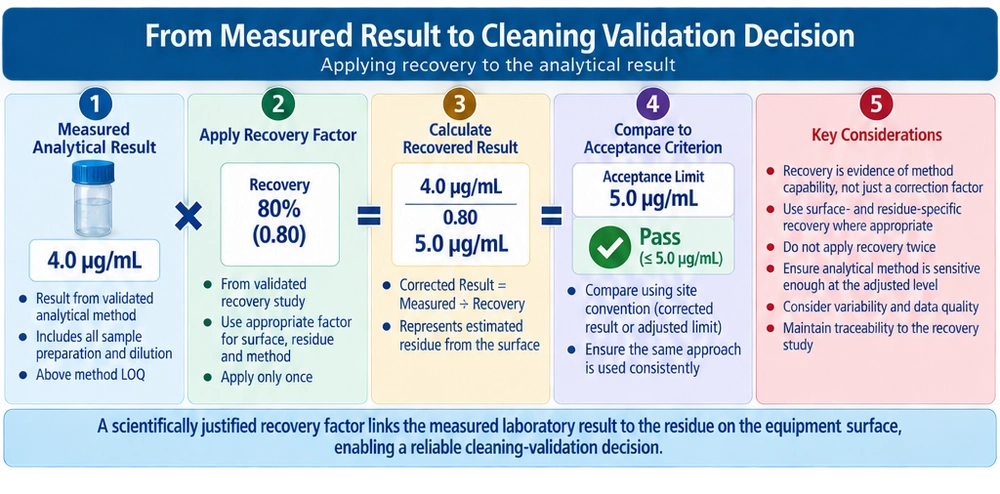
Assume:
- Measured result: 4.0 µg/mL
- Validated recovery: 80% = 0.80
A recovery-corrected result can be calculated as:
- Corrected Result = Measured Result ÷ Recovery Fraction
- 4.0 µg/mL ÷ 0.80 = 5.0 µg/mL
Alternatively, the acceptance criterion itself can be adjusted downward to reflect expected recovery and the laboratory result can remain uncorrected. Both approaches can be mathematically defensible when applied consistently.
Cleaning Validation Acceptance Criteria and Residue Limits should establish the site convention.
Do Not Apply Recovery Twice
If the acceptance criterion has already been adjusted for recovery, the reported result should not also be divided by the same recovery factor before comparison unless the entire calculation methodology was specifically designed that way.
For example:
- Theoretical sample criterion: 6.25 µg/mL
- Recovery: 80%
Uncorrected analytical criterion: 6.25 × 0.80 = 5.0 µg/mL
A measured uncorrected result should then be compared directly with: 5.0 µg/mL
Dividing that result again by 0.80 would apply recovery twice.
Every controlled calculation should clearly state: Recovery treatment: corrected result or adjusted criterion
Which Recovery Value Should Be Used?
Where recovery varies by surface, residue, or concentration, the program should establish how the applicable recovery factor is selected.
Possible scientifically justified approaches include:
- surface-specific recovery;
- residue-specific recovery;
- conservative recovery representing a validated group;
- another documented value supported by the study data.
The most favorable individual recovery should not be selected merely because it produces the easiest acceptance criterion. Where several surfaces are grouped, the selected factor should adequately protect against the poorer recovery characteristics within that group.
Conservative Recovery Factors
Using a lower validated recovery value can provide a conservative approach when multiple comparable surfaces or conditions are grouped.
For example:
- Stainless steel recovery: 88%
- Glass recovery: 84%
- Polymer recovery: 79%
If grouping is otherwise scientifically appropriate, a site might apply 79% as a conservative group recovery rather than maintaining three separate values. This simplifies implementation while avoiding use of an average that overstates recovery for the least efficient surface. The grouping rationale should be documented.
Recovery Above 100%
Individual measured recoveries can occasionally exceed 100% because of analytical and sampling variability.
A result such as 104% does not mean the procedure recovered more physical residue than was applied in an absolute sense. It reflects measurement variability around the known nominal amount.
Repeated or substantially elevated recoveries can indicate:
- standard-preparation error;
- applied-volume error;
- calibration bias;
- background contamination;
- integration or calculation error.
Such results should be evaluated rather than automatically capped at 100%.
Method Suitability at the Acceptance Limit
Recovery should ultimately demonstrate that the complete sampling and analytical procedure is fit for its cleaning-validation purpose.
Consider a surface acceptance limit of: 0.5 µg/cm² , with a 25 cm² sample area: 0.5 × 25 = 12.5 µg
If recovery is only 30%, the expected measured amount at the cleaning limit is: 12.5 × 0.30 = 3.75 µg
If the analytical method cannot reliably quantify this amount after extraction and dilution, the complete procedure is not suitable even though recovery itself has technically been characterized. Recovery, sampling area, extraction volume, and analytical LOQ should therefore be evaluated together.
Recovery and Analytical Sensitivity
A low recovery factor reduces effective procedure sensitivity.
If the laboratory LOQ is: 1.0 µg/mL , and recovery is: 50% , the equivalent surface residue represented by that quantitative capability is higher than if recovery were 90%.
This relationship is addressed in Analytical Sensitivity and Quantitation Limits in Cleaning Validation. Improving recovery can sometimes be a more effective solution than purchasing a more sensitive instrument.
Recovery and Analytical Method Validation
Recovery studies and analytical-method validation overlap but are not identical. Analytical Method Validation for Cleaning Residue Testing should demonstrate characteristics such as:
- accuracy;
- precision;
- specificity/selectivity;
- range;
- quantitative capability;
- robustness;
- matrix suitability.
Recovery studies specifically challenge the sampling interface with the equipment surface or rinse system.
A laboratory method can demonstrate excellent accuracy in prepared solutions while the field sampling method recovers residue poorly. Both bodies of evidence are required for a defensible cleaning-validation measurement system.
Recovery Study Acceptance Criteria
Recovery-study acceptance criteria should be established before execution.
They can address:
- minimum acceptable recovery;
- allowable replicate variability;
- performance at each concentration;
- performance by surface;
- blank requirements;
- analytical-system suitability.
The criteria should reflect the intended cleaning-validation application and the ability of the procedure to support the required acceptance limit. No universal regulatory recovery percentage should be presented as though FDA mandates it. The rationale should instead explain why the selected recovery performance and variability provide sufficient quantitative confidence.
Handling Unacceptable Recovery
An unacceptable recovery result should first prompt evaluation of the method rather than immediate acceptance of a large correction factor.
Potential improvements include:
- different swab material;
- different sampling solvent;
- revised swabbing technique;
- larger sampled area;
- improved extraction;
- different rinse solvent;
- longer or more representative rinse contact;
- improved analytical method.
Extremely poor recovery can make the cleaning-validation result highly uncertain even when mathematically corrected. The objective should be a practical, reproducible measurement procedure, not simply a numerical factor that allows any sampling method to be used.
Blank and Background Controls
Recovery studies should include controls appropriate to the analytical method.
Possible controls include:
- coupon blank;
- swab blank;
- solvent blank;
- extraction blank;
- rinse-water blank;
- container blank;
- method blank.
Background becomes particularly important when recovery is evaluated near low cleaning limits. For TOC methods, FDA specifically expects background carbon to be minimized and states that recovery studies are necessary. Blank treatment should be predefined rather than adjusted retrospectively to improve recovery percentages.
Sample Stability and Holding Time
Recovery can be underestimated if the residue degrades, adsorbs, precipitates, or otherwise changes between sampling and analysis. The supporting method should therefore establish appropriate holding conditions where samples are not analyzed immediately.
Relevant factors include:
- time before extraction;
- time after extraction;
- storage temperature;
- light protection;
- container material;
- residue stability.
FDA specifically notes sample holding-time evaluation for TOC where extended storage can affect accuracy and quantitation capability.
Documentation of Recovery Studies
The final recovery report should allow an independent reviewer to determine exactly what recovery value was established and where it can be applied.
The report should identify:
- residue;
- product or material represented;
- analytical method;
- coupon material;
- coupon finish;
- sampled area;
- applied concentration and volume;
- applied mass;
- drying conditions;
- swab or rinse procedure;
- extraction conditions;
- individual replicate results;
- mean recovery;
- variability;
- blank results;
- deviations;
- analyst or sampler information where relevant;
- applicable recovery factor;
- approved grouping rationale;
- study limitations.
The report should conclude explicitly which surface/residue/sampling combinations are supported.
Recovery Matrix
For a larger multiproduct cleaning-validation program, a controlled recovery matrix can help maintain traceability.
For example:
| Residue | Surface | Sampling method | Recovery | Applicable group |
|---|---|---|---|---|
| Product A | 316L SS | Swab | 86% | Stainless-steel surfaces |
| Product A | Glass | Swab | 82% | Glass |
| Product A | EPDM | Swab | 71% | Elastomer group |
| Product A | 316L SS | Rinse | 78% | Rinse method R-01 |
| Detergent | 316L SS | Rinse | 92% | Final rinse method |
The matrix should be controlled so changes in products, sampling materials, solvents, or equipment surfaces trigger appropriate reassessment.
Recovery and Change Control
Changes that can invalidate or alter recovery include:
- new swab material;
- new supplier or swab design;
- different sampling solvent;
- changed extraction solvent;
- changed extraction volume;
- changed swabbing technique;
- new surface material;
- changed surface finish;
- new analytical method;
- new residue or formulation;
- changed rinse volume;
- changed rinse flow path;
- changed sample container.
Not every change requires a complete new recovery study. The impact assessment should determine whether existing data remain representative or whether targeted bridging work is sufficient.
Periodic Review
Recovery studies do not normally need to be repeated on an arbitrary calendar interval if the validated sampling system remains unchanged and performs as expected. Periodic review should instead confirm that:
- swabs remain the same;
- solvents remain controlled;
- equipment materials remain represented;
- recovery factors remain current;
- analytical methods remain suitable;
- sampling techniques remain unchanged;
- changes have been assessed appropriately.
Ongoing Cleaning Verification and Performance Trending can also identify unusual shifts in sampling results that suggest sampling or recovery performance should be reassessed.
Common Deficiencies
A common deficiency is using a recovery factor generated only on stainless steel for all equipment surfaces despite the presence of glass, polymers, elastomers, hoses, or gasket materials.
Other deficiencies include using pure API when the analytical measurement represents a substantially different formulation residue; applying residue at concentrations far above the cleaning acceptance limit; undefined drying conditions; using fresh residue when actual residue is aged; and evaluating only one concentration.
Study-design weaknesses include insufficient replication, relying solely on mean recovery despite large variability, performing the study only with the method developer, and failing to consider operator effects for manual swabbing.
Calculation weaknesses include applying recovery twice, using a favorable average that overstates recovery on a poorer surface, combining independent recovery factors incorrectly, and applying a coupon extraction factor as though it represents full-system rinse recovery.
A further deficiency is treating analytical solution accuracy as equivalent to surface recovery. The analytical method may recover nearly 100% of a prepared standard while the complete surface-sampling method recovers substantially less.
FDA inspection observations provide practical examples: investigators have cited recovery studies that omitted representative manufacturing soils and sampled surface materials, and studies with undefined coupon drying conditions that were not representative of relevant residue aging.
Key Principles
- Recovery studies establish how much residue the complete cleaning-validation sampling and analytical procedure can recover from representative equipment surfaces or systems.
- Swab recovery and rinse recovery should be evaluated separately because the recovery mechanisms differ.
- Coupons should represent actual product-contact materials and, where relevant, surface finish. Stainless steel should not automatically represent glass, elastomers, polymers, or other materially different surfaces.
- The applied residue should represent the analyte or soil controlled by the cleaning-validation method. Drying conditions should be defined and sufficiently representative of the residue condition expected during sampling.
- Recovery should be evaluated at residue levels relevant to the cleaning acceptance criterion and with sufficient replication to characterize variability. The individual results are as important as the mean.
- FDA does not prescribe one universal pharmaceutical cleaning-validation recovery percentage. The site should establish scientifically justified acceptance criteria for recovery and variability based on method suitability.
- The sampling technique used during recovery studies should match the procedure used in actual cleaning validation, including swab, solvent, area, technique, extraction, and analytical measurement.
- Recovery factors can be applied by correcting the measured result or by adjusting the analytical acceptance criterion. The selected convention should be controlled, traceable, and applied only once.
- Very low or highly variable recovery should normally drive improvement of the sampling method rather than reliance on increasingly large mathematical correction factors.
- Recovery data should remain under lifecycle control as sampling materials, surfaces, products, rinse conditions, extraction procedures, and analytical methods change.