

Process Characterization for Process Validation
Process characterization is the scientific work used to understand how a manufacturing process behaves before it is formally demonstrated through commercial Process Performance Qualification (PPQ). It connects product and material knowledge with unit-operation behavior, process parameters, equipment characteristics, scale effects, sources of variability, and product-quality responses.
Within FDA’s lifecycle model, this work is principally associated with Stage 1 — Process Design. FDA states that the commercial manufacturing process should be defined using knowledge obtained through development and scale-up and specifically emphasizes understanding sources of variation, their magnitude, their effect on product attributes, and how that variation will be controlled.
FDA’s Process Validation: General Principles and Practices also makes an important distinction: successful process validation cannot be based only on qualification activities. The manufacturer needs sufficient process understanding to justify the proposed commercial process and its control strategy.
Process characterization therefore answers a broader question than whether individual experimental runs were acceptable: What do we know about how the process works, what makes it vary, how much variability it can tolerate, and what must be controlled when the process is transferred to commercial manufacturing?
For the overall validation lifecycle, see General Principles of Process Validation and Lifecycle Integration and Knowledge Management in Process Validation.
Role of Process Characterization in Stage 1
FDA defines Stage 1 Process Design as the activity of defining a commercial manufacturing process suitable for routine operation and capable of consistently delivering the intended product quality. Development studies, scale-up experiments, prior knowledge, modeling, risk assessment, and characterization all contribute to this objective.
Process characterization should build sufficient understanding to support decisions concerning:
- the sequence and design of unit operations;
- relevant material attributes;
- process parameters and their operating ranges;
- relationships between process inputs and Critical Quality Attributes (CQAs);
- sources of process variability;
- parameter interactions;
- process robustness;
- hold times and intermediate storage conditions;
- scale-dependent effects;
- commercial equipment selection and configuration;
- the process control strategy;
- residual uncertainty requiring confirmation during PPQ; and
- subsequent Continued Process Verification (CPV).
Characterization is therefore not simply a set of development experiments. Its value depends on how the resulting knowledge is converted into the commercial process design and later transferred into validation.
Start With the Product and Process, Not a List of Parameters
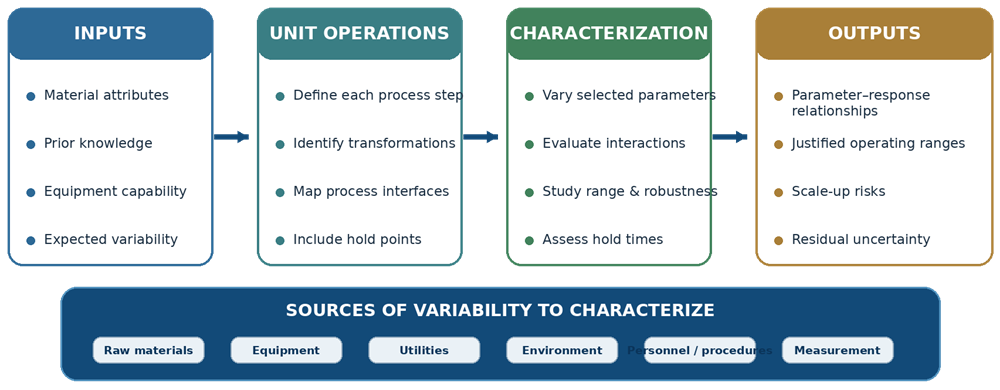
Characterization should begin with an understanding of the product, intended process, and transformation that occurs at each manufacturing step. For every significant unit operation, the development team should understand:
Inputs → Transformation → Process Conditions → Outputs → Downstream Impact
For example, a blending step may receive powders with defined particle-size, density, moisture, and flow characteristics. The process transformation is development of an acceptably uniform mixture. Agitation speed, loading pattern, fill level, blending time, equipment geometry, and order of addition may influence the result. The outputs may include blend uniformity, segregation tendency, or downstream compression behavior.
A filtration operation may instead depend on characteristics such as feed concentration, viscosity, temperature, filter area, membrane properties, pressure, flux, and loading.
The specific variables differ by process. The characterization strategy should therefore be unit-operation specific rather than based on a generic list of “CPPs.”
Material Attributes and Process Parameters
Material attributes and process parameters are related but should not be treated as interchangeable. Material attributes describe properties of incoming materials, intermediates, components, or process streams that can influence manufacturing behavior or product quality. Examples may include:
- particle-size distribution;
- moisture;
- viscosity;
- concentration;
- pH;
- density;
- potency;
- impurity profile;
- bioburden;
- morphology;
- flow characteristics;
- excipient functionality; and
- other product- or process-specific properties.
Process parameters describe conditions imposed or controlled during manufacturing, such as:
- temperature;
- pressure;
- flow;
- mixing speed;
- mixing time;
- addition rate;
- feed rate;
- agitation;
- vacuum;
- filtration pressure;
- drying time;
- compression force;
- pH adjustment;
- conductivity;
- dissolved oxygen;
- aeration;
- hold time; or
- other process-specific conditions.
ICH Q8(R2) Pharmaceutical Development specifically describes the need to understand relationships among material attributes, process parameters, and product CQAs. It also recognizes that this understanding can be progressively increased through experimentation, modeling, and lifecycle knowledge.
Not every investigated variable becomes a CPP, and not every material attribute becomes a CMA. Characterization establishes scientific relationships; risk assessment and accumulated evidence are then used to determine the significance and required level of control.
The detailed criticality framework is addressed in CQA, CPP, and Material Attribute Risk Assessment.
Critical Quality Attributes Are an Input to Characterization
A common error is to describe development as though CQAs are discovered solely through process risk assessment. CQAs originate primarily from product and quality understanding: the characteristics that must be appropriately controlled to assure the intended product quality. Process characterization then evaluates how material attributes and process conditions affect those CQAs.
Risk assessment helps prioritize:
- which variables require additional study;
- which relationships represent greater uncertainty;
- where failure could have meaningful quality consequences; and
- where experimental effort should be concentrated.
ICH Q8 describes CQA identification as an iterative activity involving product knowledge, risk assessment, and experimentation rather than a one-time binary classification.
Sources of Process Variability
Understanding variability is one of the central objectives of development and characterization. FDA specifically recommends that manufacturers understand sources of variation, detect their presence and degree, determine their potential effect on process and product attributes, and control variability in proportion to its risk.
Potential variability sources include:
| Source | Examples |
|---|---|
| Materials | supplier, lot, potency, moisture, particle size, viscosity, purity |
| Equipment | geometry, scale, wear, configuration, control response |
| Utilities | temperature, pressure, gas quality, water quality, flow |
| Environment | temperature, humidity, classified-area conditions where relevant |
| Personnel and procedures | manual additions, timing, technique, interventions |
| Measurement | sensor uncertainty, analytical variability, sampling |
| Process sequence | order of addition, hold periods, transfer delays |
| Scale | mixing, heat transfer, mass transfer, shear, residence time |
Characterization should distinguish between variability that can be eliminated, variability that should be constrained, and variability that must be accommodated by the process control strategy.
For example, incoming raw-material variability may not always be eliminated through narrow specifications. A sufficiently understood process may instead be designed to compensate for relevant variation while continuing to achieve product quality. ICH Q8 explicitly recognizes this relationship between process understanding and adaptable control.
Characterization Study Strategy
There is no single mandatory sequence of characterization experiments. A practical strategy normally progresses from existing knowledge and exploratory studies toward more structured quantitative evaluation.
Prior Knowledge
Relevant prior knowledge can include:
- platform-process experience;
- similar products;
- previous formulations;
- related equipment;
- historical manufacturing experience;
- established process mechanisms;
- published scientific understanding;
- supplier knowledge; and
- previous characterization or validation data.
Prior knowledge can reduce unnecessary experimentation, but its relevance should be justified. Data from a different formulation, equipment geometry, scale, supplier, or operating mechanism should not automatically be assumed to apply.
Screening and Exploratory Studies
Early studies may identify which variables are likely to influence process performance. These can include:
- one-factor-at-a-time studies;
- engineering trials;
- parameter screening;
- range finding;
- mechanistic experimentation;
- modeling; and
- small-scale challenge studies.
These studies can efficiently identify factors that warrant more rigorous evaluation.
Structured Multivariable Studies
Where interactions are plausible or quantitative relationships are needed, Design of Experiments (DOE) can evaluate multiple factors simultaneously. FDA specifically notes that DOE can reveal relationships and multivariable interactions between process inputs and resulting outputs. Detailed design selection, interaction analysis, response surfaces, and multivariate modeling are addressed separately in Design of Experiments for Process Characterization and Validation.
DOE is an important tool, but it is not synonymous with process characterization. Characterization also includes mechanistic studies, scale-up work, hold-time evaluation, equipment/process interaction, prior knowledge, transfer studies, and other evidence.
Parameter Ranges
Development studies often evaluate parameters across ranges broader than those intended for routine manufacturing. These ranges should be described carefully because several different concepts may exist.
| Range concept | Meaning |
|---|---|
| Experimental or studied range | Range deliberately investigated during development |
| Normal operating range | Range intended for routine process operation |
| Proven Acceptable Range | Characterized range for an individual parameter under defined conditions |
| Design space | Multidimensional combination and interaction of variables demonstrated to assure quality |
These concepts should not be used interchangeably.
ICH Q8 explicitly states that a combination of independent Proven Acceptable Ranges does not automatically constitute a design space. A design space reflects multidimensional relationships and interactions among material attributes and process parameters.
A development study should therefore document not only the range tested but also:
- why that range was selected;
- what other variables were held constant;
- whether interactions were evaluated;
- which responses were measured;
- whether scale affects the relationship;
- whether the entire studied range is suitable for routine operation; and
- whether the range is intended as knowledge, an operating range, or part of an approved design space.
The detailed treatment of these distinctions is provided in Process Control Strategy and Design Space Development.
Edge Conditions and Process Failure
Characterization may deliberately evaluate operating conditions approaching the edges of the intended process window to understand process sensitivity and robustness. This does not mean every manufacturing process must be experimentally driven to failure.
FDA specifically states that it does not generally expect manufacturers to develop and test a process until it fails. Laboratory studies, pilot studies, models, and scientifically justified experimentation can provide the information needed to understand process behavior without requiring destructive failure studies in every case. Edge-of-range studies are useful when they answer a relevant scientific question, such as:
- when a CQA begins to become sensitive;
- how much operational margin exists;
- whether an interaction changes near a boundary;
- whether process instability increases;
- whether an equipment limitation is reached; or
- whether the proposed operating range is sufficiently robust.
The experimental objective should determine the extent of challenge.
Hold-Time Studies
Hold times are part of process design because material can continue to change while it waits between unit operations. Relevant holds may include:
- prepared solution hold;
- bulk product hold;
- granulation hold;
- blend hold;
- filtered-solution hold;
- intermediate storage;
- pre-filling hold;
- post-process hold;
- equipment or process waiting periods; and
- other product-specific stages.
The study should evaluate conditions that can reasonably influence material or product quality, which may include:
- time;
- temperature;
- light exposure;
- agitation or lack of agitation;
- container or vessel configuration;
- headspace;
- oxygen exposure;
- microbiological conditions;
- repeated access or sampling; and
- storage environment.
Responses should be selected based on the material and process. Examples include potency, degradants, physical properties, pH, viscosity, appearance, concentration, microbial quality, bioburden, or other relevant CQAs or intermediate attributes. A justified maximum hold time should include adequate operating margin. Routine manufacturing should not be designed to operate routinely at the exact experimental failure boundary. Hold-time knowledge should also transfer into PPQ sampling and execution where the duration or condition can affect process performance.
Scale Dependence
Development-scale behavior is not automatically equivalent to commercial-scale behavior. FDA explicitly states that laboratory- and pilot-scale models can be used to estimate commercial variability, but manufacturers should understand how representative those models are and what differences could affect the relevance of the conclusions.
ICH Q8 similarly requires justification of the relevance of small- or pilot-scale knowledge to proposed production scale and consideration of scale-up risk.
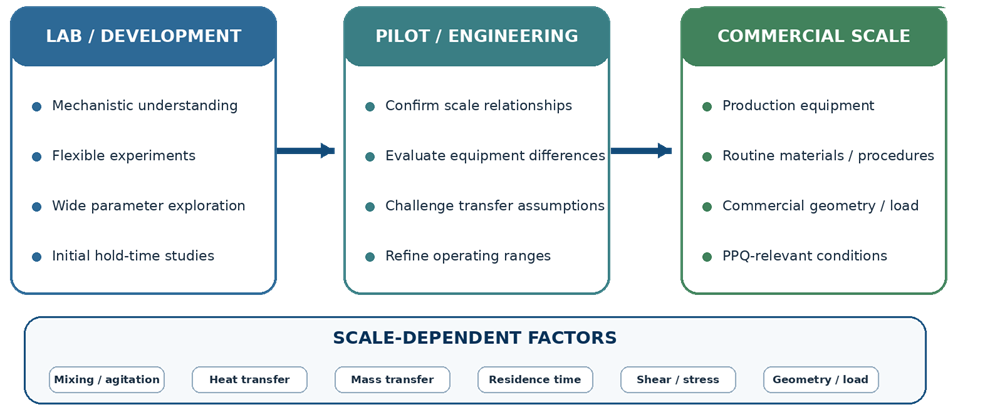
Scale-dependent considerations can include:
- mixing time;
- tip speed;
- power per unit volume;
- impeller geometry;
- vessel aspect ratio;
- shear rate;
- heat-transfer area;
- mass-transfer coefficient;
- oxygen-transfer capability;
- filter area and flux;
- bed depth;
- residence-time distribution;
- drying surface area;
- fill volume;
- equipment dead volume; and
- process hold or transfer time.
Not all of these factors apply to every process. The correct scale-up criterion should be derived from the mechanism governing the particular unit operation.
For example, maintaining the same agitation rpm between scales may be scientifically inappropriate if the important factor is shear, power per unit volume, mixing time, or mass transfer.
Scale-Down Models
A scale-down model can be particularly valuable when commercial-scale experimentation is impractical, expensive, or disruptive. A representative model can support:
- parameter characterization;
- robustness studies;
- evaluation of interactions;
- worst-case investigations;
- hold-time studies;
- failure-mode understanding; and
- post-commercial investigations.
Its usefulness depends on demonstrating which commercial-process characteristics it reproduces and which it does not. Model qualification should focus on scientific representativeness, not simply geometric similarity. Where model limitations exist, those limitations should be explicit so that conclusions are not applied beyond the evidence.
Commercial Relevance of Development Studies
A development experiment only supports commercial validation when the relationship to the commercial process is understood. Commercial relevance should consider:
- material grade and supplier;
- formulation or composition;
- equipment operating principle;
- equipment geometry;
- scale;
- batch size;
- automation and control;
- sampling;
- process sequence;
- hold periods;
- utilities;
- processing environment; and
- analytical methods.
If these differ materially from the commercial process, the development conclusion may still be useful, but additional bridging evidence may be necessary.
A study does not become irrelevant merely because it was conducted at small scale. Nor does it become commercially representative merely because the same parameter name appears in both processes. The scientific relationship is what matters.
Documentation Expectations for Development Studies
FDA recognizes that early process-design experiments are not necessarily performed under the same CGMP conditions expected for Stage 2 and Stage 3 commercial activities. FDA nevertheless expects those studies to use sound scientific methods and good documentation practices, and decisions and control rationales should be documented and internally reviewed so that the knowledge can be preserved and used later in the lifecycle.
Development documentation should therefore preserve:
- study objective;
- scientific rationale;
- variables studied;
- ranges and conditions;
- materials and equipment;
- scale;
- analytical methods;
- raw data;
- statistical methods;
- deviations or unexpected observations;
- model assumptions;
- results;
- conclusions;
- limitations; and
- downstream decisions.
FDA specifically recommends documenting which variables were studied for a unit operation and the rationale for identifying significant variables because this information becomes useful during Process Qualification, CPV, and later process changes.
Unexpected results should not automatically be removed from the knowledge base. ICH Q8 recognizes that unexpected experimental findings may provide useful development knowledge.
Converting Characterization Results Into Stage 1 Decisions
Characterization should produce actionable conclusions. Typical outputs include:
- defined commercial unit operations;
- identified sources of variability;
- relationships between material attributes and process behavior;
- relationships between process parameters and CQAs;
- justified operating ranges;
- understanding of parameter interactions;
- scale-up criteria;
- equipment requirements;
- hold-time limits;
- material-control requirements;
- updated risk assessments;
- inputs to the control strategy;
- residual uncertainties; and
- questions that must be confirmed during PPQ.
This is the point where development evidence becomes a process-design decision. Risk assessment should then be updated using the new evidence. ICH Q9(R1) Quality Risk Management provides the framework for evaluating risk using the available scientific evidence and revisiting risk as knowledge develops.
Process Characterization and the Control Strategy
Process characterization does not end by producing a list of significant parameters. The information must ultimately answer:
- What should be controlled?
- How should it be controlled?
- Where should it be monitored?
- What variability is acceptable?
- What variability requires compensation or intervention?
- What material controls are necessary?
- What alarms or procedural controls are needed?
- What information should be collected during PPQ and CPV?
The resulting strategy may include combinations of:
- raw-material controls;
- equipment design;
- automated process controls;
- parameter limits;
- operating ranges;
- in-process testing;
- PAT or other measurements;
- procedural controls;
- sampling;
- alarms;
- intermediate acceptance criteria; and
- finished-product testing.
ICH Q8 defines the control strategy as being derived from current product and process understanding, reinforcing the direct connection between characterization and operational control.
Transfer of Development Knowledge Into PPQ
Development studies should not remain isolated within development reports. Their conclusions must be transferred into the commercial validation strategy.
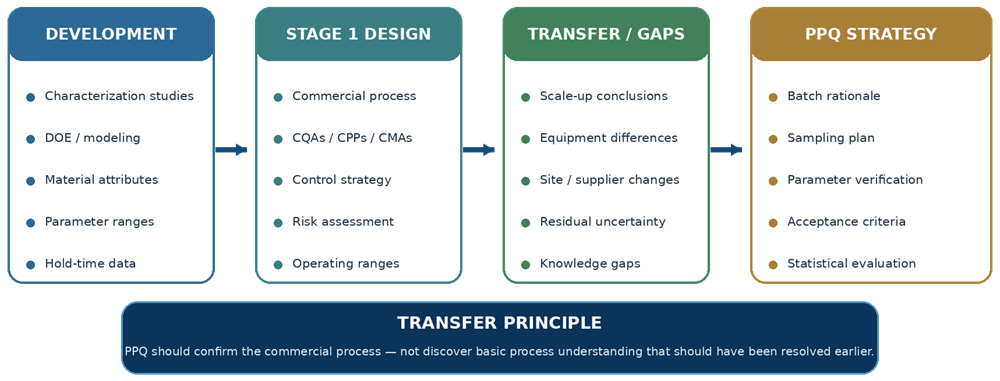
A development-to-PPQ knowledge package should make clear:
- What is already understood: Examples include established parameter relationships, known material effects, scale-up relationships, robust operating ranges, and known process failure mechanisms.
- What has been translated into the commercial process: This includes commercial equipment, batch size, process sequence, operating ranges, control strategy, material requirements, hold times, and sampling locations.
- What uncertainty remains: Some relationships may not be fully confirmable until commercial-scale execution.
- What PPQ must demonstrate: PPQ should focus on reproducibility and confirmation of the integrated commercial process rather than being used to discover fundamental process relationships that should have been resolved earlier.
See Process Performance Qualification (PPQ) Strategy and Batch Selection for the detailed Stage 2 strategy.
Using Characterization to Define PPQ Sampling
Process characterization should influence where, when, and how intensively PPQ data are collected. Known variability can identify:
- beginning-middle-end effects;
- spatial variability;
- worst-case locations;
- time-dependent changes;
- equipment zones;
- sensitive unit operations;
- material-related variability;
- process-transition points; and
- hold-time risks.
These findings provide the scientific rationale for PPQ sampling rather than relying on generic sample counts.
See PPQ Sampling Plan and Data Collection Strategy for detailed application.
Characterization Findings and PPQ Acceptance Criteria
Development data can support PPQ acceptance criteria, but development limits should not automatically become PPQ acceptance criteria without considering commercial relevance. Acceptance criteria should account for:
- product specifications;
- process knowledge;
- expected commercial variability;
- operating ranges;
- sampling strategy;
- measurement capability;
- known scale effects; and
- the purpose of the PPQ assessment.
Statistical methods should likewise be selected to answer the validation question rather than being applied mechanically.
The detailed framework is addressed in PPQ Acceptance Criteria and Statistical Evaluation.
Confirming Development Conclusions During PPQ
PPQ provides an opportunity to determine whether the assumptions developed during Stage 1 remain valid under commercial conditions.
This includes confirmation that:
- commercial equipment performs as predicted;
- material variability remains adequately controlled;
- CPPs remain within justified ranges;
- CQAs behave consistently;
- scale-dependent effects were adequately understood;
- hold times remain appropriate;
- sampling captures expected variability;
- the control strategy performs as intended; and
- residual uncertainty has been adequately resolved.
See Verification of CPPs and Process Control Strategy During PPQ for the detailed verification framework.
Development Knowledge Continues After PPQ
Process characterization is most intensive during development and Stage 1, but process understanding should not be considered permanently complete after PPQ. Commercial manufacturing can reveal:
- long-term raw-material variability;
- seasonal behavior;
- equipment aging effects;
- supplier differences;
- rare process interactions;
- new failure mechanisms;
- drift;
- unexpected control-strategy weaknesses; or
- opportunities for improvement.
FDA’s lifecycle model specifically expects knowledge generated during routine manufacturing to feed back into process understanding and control. CPV therefore extends the characterization knowledge base rather than simply checking whether the process remains within predetermined limits.
Key Principles
- Process characterization is a core Stage 1 activity used to build scientific process understanding.
- Characterization should be organized around unit operations and process mechanisms, not a generic CPP checklist.
- CQAs originate from product-quality understanding; characterization establishes how process and material variables affect them.
- Material attributes, process parameters, equipment characteristics, and variability should be evaluated together.
- DOE is an important characterization tool but is only one component of the overall development strategy.
- Experimental ranges, normal operating ranges, Proven Acceptable Ranges, and design space are different concepts.
- FDA does not generally expect every process to be experimentally driven to failure.
- Hold times should be scientifically justified based on product, intermediate, process, and microbiological risk where applicable.
- Small-scale knowledge requires assessment of commercial relevance.
- Scale-up should preserve the scientifically important process relationship rather than mechanically preserve individual equipment settings.
- Development studies should document assumptions, limitations, and unexpected findings.
- Characterization outputs should directly inform risk assessment and the process control strategy.
- Residual uncertainty should be explicitly identified and transferred into PPQ planning.
- PPQ should confirm the integrated commercial process, not substitute for inadequate process development.
- Commercial data and CPV should continue to refine process understanding throughout the lifecycle.