

Process Control Strategy Lifecycle Management
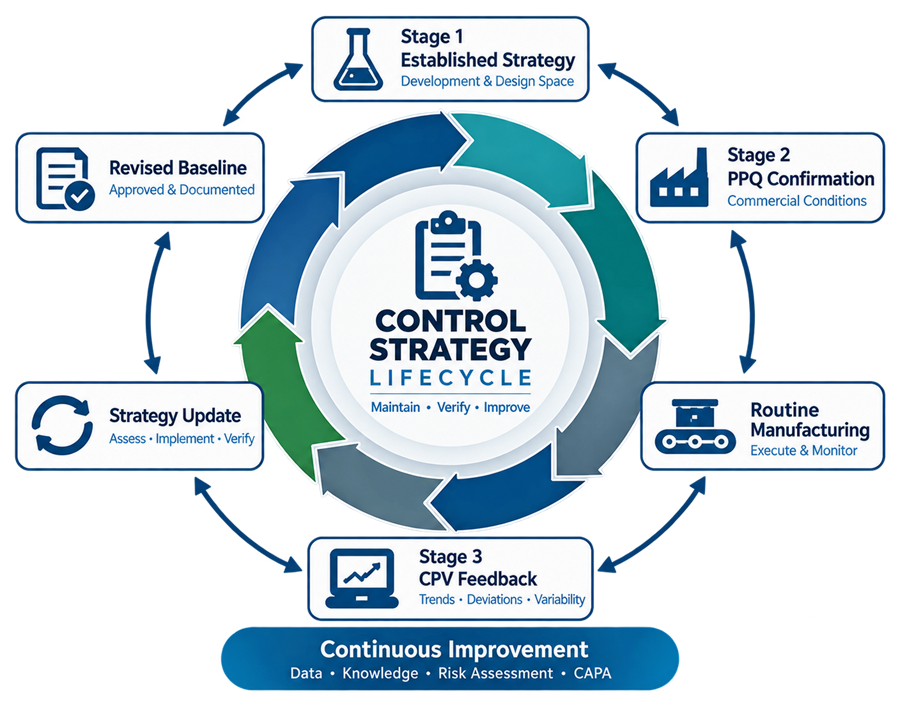
A process control strategy should not become static once Stage 1 development is complete. After the commercial process has been defined, the control strategy becomes a controlled lifecycle baseline that must be implemented in manufacturing, confirmed during Process Performance Qualification (PPQ), monitored during Continued Process Verification (CPV), and revised when commercial evidence shows that a control is no longer adequate or can be improved.
ICH Q8(R2) Pharmaceutical Development defines a control strategy as a planned set of controls derived from current product and process understanding that assures process performance and product quality. Those controls can include material and component attributes, facility and equipment operating conditions, in-process controls, finished-product specifications, and the associated monitoring methods and frequencies.
Initial development of CPPs, operating ranges, material controls, design space, and the overall control strategy is addressed in Process Control Strategy and Design Space Development.
The lifecycle question is different: Does the established strategy continue to control the actual commercial process, and how should it be updated as process knowledge increases?
From Stage 1 Strategy to Controlled Lifecycle Baseline
Stage 1 converts development knowledge into the initial commercial control strategy. That work establishes the intended material controls, Critical Process Parameters (CPPs), operating ranges, in-process controls, specifications, automation, procedural controls, and monitoring approach. Process Control Strategy and Design Space Development addresses how those controls are scientifically selected; this article addresses what happens once they become part of the approved manufacturing process.
FDA’s Process Validation: General Principles and Practices specifically states that process understanding developed during Stage 1 is useful not only during Process Qualification and Continued Process Verification but also when process design is revised or the strategy for control is refined or changed. FDA further notes that decisions regarding the type and extent of process controls can be supported by risk assessment and then enhanced as process experience is gained.
PPQ Confirms the Strategy Under Commercial Conditions
PPQ provides the first systematic commercial-scale confirmation that the control strategy actually performs as intended. The evaluation should extend beyond checking whether CPPs remained inside predefined limits; it should determine whether the combination of material controls, operating ranges, in-process controls, equipment functions, automation, procedures, and product-quality outcomes provides reproducible process control.
This relationship is covered in detail in Verification of CPPs and Process Control Strategy During PPQ. The important lifecycle output is a defined post-PPQ control-strategy baseline: which controls have been confirmed, which assumptions remain uncertain, and which parameters or attributes require heightened attention during early CPV.
A PPQ campaign may therefore confirm the strategy substantially as designed while still identifying follow-up actions. For example, a material attribute may require enhanced monitoring, an alarm limit may need refinement, or a process parameter may show less operating margin than development studies suggested. These observations should be carried into the lifecycle strategy rather than disappearing when the PPQ report is approved.
Implementing the Control Strategy in Routine Manufacturing
An established control strategy has little value unless it is translated into executable manufacturing controls. The strategy should be reflected in the operational documents and systems that actually govern production, including master production records, batch records, specifications, sampling instructions, automation recipes, alarm settings, laboratory controls, SOPs, and training.
21 CFR 211.186 requires master production and control records to include complete manufacturing and control instructions, sampling and testing procedures, specifications, special notations, and precautions. 21 CFR 211.186 — Master Production and Control Records These requirements provide an important GMP interface between the scientifically defined control strategy and routine manufacturing execution.
A lifecycle-managed strategy should therefore answer not only what controls exist, but also where each control is implemented, who owns it, how it is monitored, what constitutes an abnormal condition, and what action is expected when performance departs from the intended state.
The Control Strategy Is More Than CPPs
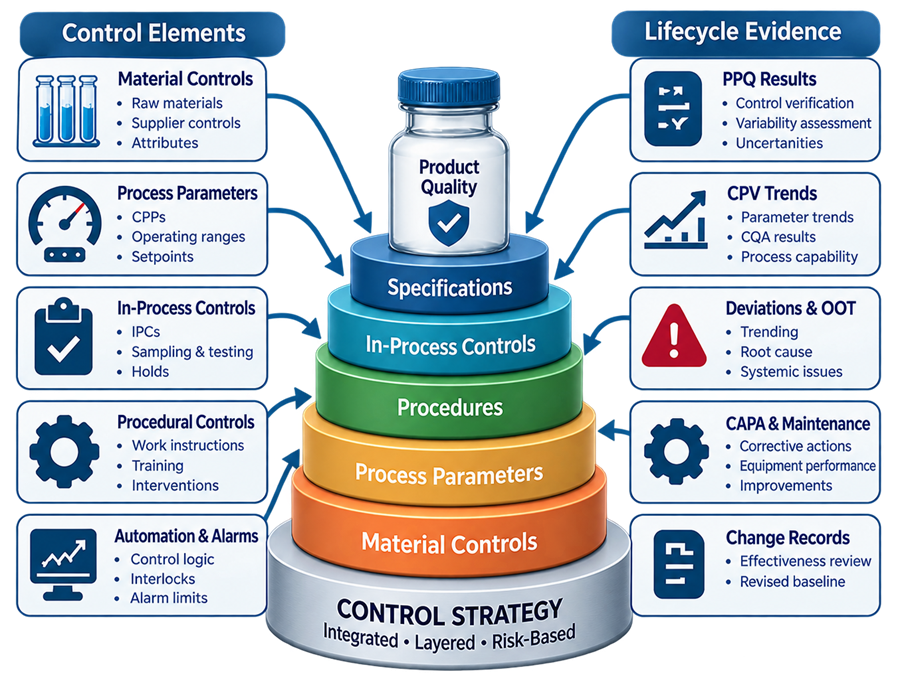
A lifecycle control strategy remains a layered system. Depending on the process, it can include:
- material and supplier controls;
- CPP setpoints and operating ranges;
- control of other important process parameters;
- in-process sampling and testing;
- intermediate specifications;
- finished-product specifications;
- equipment operating conditions;
- automation and process-control logic;
- alarms and interlocks;
- procedural controls;
- hold-time controls;
- monitoring frequency;
- analytical methods; and
- defined responses to abnormal conditions.
ICH Q8 and ICH Q10 deliberately define control strategy broadly because consistent quality normally depends on multiple layers rather than one parameter category.
Material Controls
Material controls should be reviewed as commercial experience accumulates because the range of variability encountered during routine supply can exceed what was observed during development or PPQ. Supplier changes, manufacturing-site changes, shifts in particle size, moisture, viscosity, potency, morphology, purity, or other relevant attributes may alter process behavior even when incoming material continues to satisfy its formal specification.
The lifecycle review should therefore evaluate whether existing material specifications and supplier controls continue to protect the process adequately. CPV data may demonstrate that an apparently noncritical material attribute strongly influences processing time or a product CQA, while other material controls may prove more conservative than necessary.
Such findings should not automatically lead to a specification change. The first question is whether the observed relationship is scientifically credible and whether the current material-control strategy remains adequate. Any proposed adjustment should then proceed through the site’s formal change-control process.
Process Parameters and Operating Ranges
Commercial manufacturing creates a much larger dataset for understanding how CPPs and other process parameters behave within their approved ranges. The lifecycle review should examine actual operating distributions, proximity to range boundaries, adjustment frequency, process drift, parameter interactions, and relationships with CQAs or other process responses.
A parameter can remain technically within its approved range while still revealing deteriorating control. For example, increasing operation near one boundary, greater manual adjustment, or progressive movement of the routine process center may indicate reduced margin even before a formal excursion occurs.
Conversely, long-term commercial data may demonstrate that a parameter initially treated conservatively during PPQ is highly stable and less influential than originally expected. Such knowledge can support refinement of the control strategy, provided the change is scientifically justified and appropriately controlled.
In-Process Controls
In-process controls (IPCs) should be reviewed for continued usefulness rather than retained indefinitely simply because they were included in the original PPQ protocol. The lifecycle question is whether each IPC continues to provide information that supports a meaningful manufacturing or quality decision.
A useful IPC may detect process drift, confirm an intermediate state, trigger an adjustment, or provide assurance before the final product result becomes available. An IPC that routinely produces identical results and has no practical relationship to process decisions may eventually deserve reassessment, while an IPC showing increasing variability may indicate deterioration elsewhere in the process.
Changes to laboratory specifications, sampling plans, or test procedures remain subject to Quality Unit review and approval under 21 CFR 211.160 — Laboratory Control Requirements . The regulation also requires scientifically sound specifications, sampling plans, and test procedures.
Specifications
Specifications are part of the overall control strategy but should not be viewed as substitutes for process control. Routine conformance to specifications does not demonstrate that the underlying manufacturing process remains equally robust.
Lifecycle review should consider specification performance together with process centering, variability, statistical trends, OOT behavior, and operating margin. A CQA can remain within specification while moving consistently toward one limit, which may indicate a developing process issue rather than an acceptable stable condition.
Where commercial evidence supports a proposed specification change, the decision should consider scientific justification, analytical capability, regulatory commitments, material/process relationships, and the broader effect on the control strategy. This article should identify the control-strategy implication; the formal change and regulatory-impact process belongs in Process Change Control, Revalidation, and Lifecycle Management.
Procedural Controls
Some control-strategy elements depend primarily on procedural execution rather than automation. Examples include order of addition, manual adjustments, hold management, material transfer, sampling, line setup, interventions, or operator response to process conditions.
Lifecycle review should determine whether these procedural controls remain consistently executable. Repeated deviations, frequent operator clarification, recurring timing errors, excessive reliance on experienced individuals, or variation among shifts can indicate that the control is not sufficiently robust even if the finished product continues to meet specification.
The appropriate response may be improved instructions, training, redesign of the procedure, automation, or modification of another upstream control that reduces dependence on human intervention.
Automation, Alarms, and Interlocks
Automation can be an important control-strategy layer when it maintains parameters, controls sequence, enforces recipes, performs calculations, manages process states, or responds automatically to measured conditions. Lifecycle evaluation should therefore consider not only whether the automation system remains technically qualified but whether its control functions remain suitable for the current process.
Useful evidence includes controller behavior, alarm frequency, alarm effectiveness, interlock events, overrides, bypasses, recipe changes, sensor performance, and recurring manual intervention. A rising frequency of alarms or corrective control action can indicate process deterioration or poorly positioned control thresholds before a formal batch failure occurs.
The full computerized-system lifecycle belongs within the applicable computerized-system validation framework. This article focuses specifically on whether automation continues to perform its intended process-control function.
Alarm Effectiveness
Alarm limits should provide useful information and prompt an appropriate response. An alarm that activates constantly during acceptable routine operation may become normalized and lose its intended protective function; an alarm that never activates despite emerging process problems may be poorly positioned or based on outdated process knowledge.
Alarm review should therefore consider frequency, recurrence, operator response, associated deviations, process conditions, and whether the alarm provides timely detection of the condition it was designed to identify. Changes should be evaluated together with the underlying process risk and automation configuration.
The goal is not to minimize alarm count. It is to maintain a rational alarm strategy that supports effective process control.
CPV Is the Primary Feedback Mechanism
Continued Process Verification (CPV) Program and Monitoring Strategy provides the principal commercial evidence for determining whether the established control strategy continues to work. CPV integrates CPP and CQA trends with material data, process responses, deviations, yields, alarms, interventions, equipment behavior, and other relevant information.
FDA states that Stage 3 should provide ongoing assurance that the process remains in a state of control and recommends continued monitoring of process trends and the quality of incoming materials, in-process materials, and finished products.
The important distinction is that CPV does not merely check compliance with the existing strategy. It also tests whether the strategy itself remains appropriate as commercial knowledge increases.
Drift and Statistical Signals
A control strategy can become less effective gradually rather than through an obvious failure. Increasing variability, sustained shifts, adverse trends, repeated OOT signals, growing adjustment frequency, or declining process capability may all indicate that the current strategy is losing margin.
These signals should be evaluated through the investigation approach described in Process Drift, Statistical Signals, and CPV Investigation. The resulting investigation may confirm that the existing controls remain adequate, identify an assignable cause that can be corrected without changing the strategy, or demonstrate that a control needs to be revised.
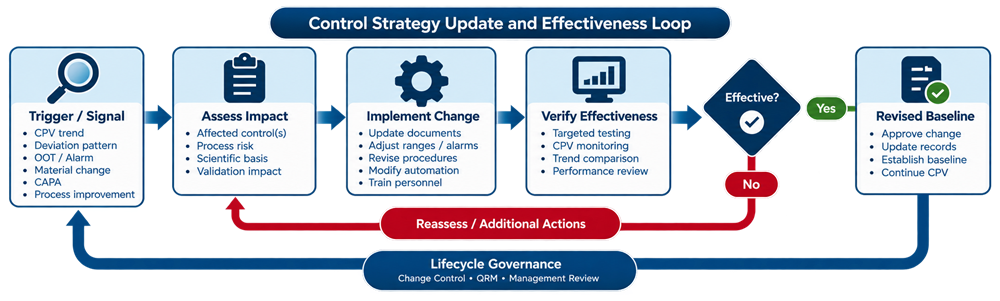
This is one of the core lifecycle loops: CPV signal → investigation → control-strategy assessment → change if justified → effectiveness verification → updated CPV baseline
Deviations as Control-Strategy Evidence
Deviation trending provides another important source of evidence. A single isolated deviation may have little relevance to the broader strategy, but repeated events involving the same parameter, material, equipment function, procedure, or alarm can indicate a systemic weakness.
21 CFR 211.192 — Production Record Review and Investigation requires thorough investigation of unexplained discrepancies and specification failures and requires investigation records to include conclusions and follow-up. For lifecycle management, the value of these investigations extends beyond disposition of the affected batch: recurring findings should be considered when evaluating whether the control strategy remains adequate.
A sequence of individually closed deviations should not prevent recognition of an aggregate trend.
CAPA and the Control Strategy
Corrective and Preventive Action (CAPA) can modify the control strategy directly or indirectly. Examples include changing an operating range, strengthening material controls, revising a procedure, adding automation, altering alarm logic, increasing sampling, changing maintenance strategy, or introducing a new monitoring requirement.
The lifecycle assessment should determine whether the CAPA addresses an isolated failure or changes a fundamental part of how the process is controlled. This distinction influences the amount of verification required and whether existing validation evidence continues to represent the process.
ICH Q10 positions CAPA, process-performance monitoring, change management, and management review as interacting elements of the pharmaceutical quality system, supported throughout the lifecycle by knowledge management and QRM. ICH Q10 Pharmaceutical Quality System
Control Strategy Effectiveness Review
Control-strategy effectiveness should be reviewed periodically using integrated lifecycle evidence rather than only after a significant failure. The review can be incorporated into CPV reporting, product review, management review, or another controlled lifecycle process.
A useful review asks whether material controls continue to accommodate observed variability, CPP ranges remain appropriate, IPCs provide useful discrimination, specifications remain suitable, procedures are consistently executable, automation performs reliably, alarms remain meaningful, and deviations or trends indicate emerging weaknesses.
The purpose is not to redesign every control periodically. It is to confirm that the current baseline still represents the best supported understanding of how the process should be controlled.
When the Strategy Does Not Need to Change
Not every statistical signal, deviation, investigation, or equipment event requires a change to the control strategy. Sometimes the investigation confirms an isolated assignable cause and demonstrates that the existing controls remain adequate.
For example, a one-time sensor failure corrected through maintenance may not justify modification of CPP limits or product specifications. The appropriate lifecycle action may simply be equipment repair, documented assessment, and confirmation that routine monitoring returns to expected behavior.
Avoiding unnecessary change is also part of lifecycle control. The strategy should evolve because evidence supports a better control approach, not because every abnormal event triggers redesign.
When the Strategy Should Change
A change should be considered when accumulated evidence demonstrates that an established control no longer provides adequate or efficient assurance of process performance and product quality. Typical triggers include recurring deviations, persistent CPV trends, underestimated material effects, reduced operating margin, ineffective alarms, new equipment behavior, changed process capability, new scientific knowledge, CAPA findings, or deliberate process improvement.
ICH Q10 describes an effective change-management system as one that uses product and process understanding and QRM to evaluate proposed changes and then assesses the change after implementation to confirm that intended objectives were achieved without detrimental effect on product quality.
Article 410 should identify what element of the control strategy needs to change and why. The broader governance of approval, validation impact, regulatory assessment, and revalidation belongs in Process Change Control, Revalidation, and Lifecycle Management.
Control Strategy Change Versus Revalidation
A modification to the control strategy does not automatically require full process revalidation. The required evidence depends on the significance of the change and how strongly existing process knowledge continues to apply.
A minor procedural clarification may require document revision and training. A revised alarm setpoint may require targeted functional and process verification. A material specification change affecting a known CQA relationship may require development work, additional PPQ evidence, or broader revalidation.
The lifecycle-management role of Process Control Strategy Lifecycle Management is to maintain the integrity, effectiveness, and traceability of the established control strategy through lifecycle changes. Process Change Control, Revalidation, and Lifecycle Management determines the appropriate validation response, including targeted verification, qualification, PPQ, or broader revalidation.
Effectiveness Verification After a Change
Implementation is not the end of a control-strategy change. The organization should verify that the revised control performs as intended and does not create unintended adverse effects.
Post-change evidence may include targeted testing, enhanced CPV monitoring, trend review, alarm-performance review, comparison of process variability before and after the change, CAPA effectiveness checks, or additional PPQ evidence where warranted. ICH Q10 specifically expects post-implementation evaluation to confirm that change objectives were achieved and that product quality was not adversely affected.
A revised control strategy should become the new baseline only after the applicable evidence supports that conclusion.
Maintaining the Controlled Baseline
The organization should be able to determine which version of the control strategy is currently approved and how it differs from earlier versions. Relevant changes may be distributed across batch records, SOPs, automation configuration, material specifications, laboratory procedures, alarm databases, sampling plans, and validation documents, which makes lifecycle traceability important.
A practical control-strategy record can summarize the principal controls, scientific basis, implementation location, PPQ confirmation, current monitoring approach, change history, and latest effectiveness evidence. The purpose is not to duplicate every controlled document, but to preserve the relationships among them.
This baseline becomes especially useful when evaluating later deviations, supplier changes, equipment replacement, process improvements, or revalidation decisions.
Documentation and Traceability
A useful lifecycle trace is:
Development knowledge → Established control → PPQ confirmation → Routine implementation → CPV evidence → Investigation / change → Effectiveness verification → Revised baseline
Documentation should allow the organization to reconstruct why a control exists, where it is implemented, what evidence originally supported it, how its performance has been monitored, and why any subsequent modification was made.
This connection should also be reflected in Process Validation Documentation and Traceability so that the lifecycle history does not depend solely on individual change records or institutional memory.
Relationship With Quality Risk Management
Quality Risk Management in Process Validation provides the decision framework for evaluating whether a control remains adequate and how much evidence a proposed change requires. This article applies that QRM logic specifically to maintenance of the established process-control strategy.
Higher uncertainty, greater potential impact, weaker existing evidence, or more fundamental changes to the control mechanism generally justify stronger verification. Routine low-impact updates supported by mature process knowledge may require less formal evidence.
Risk assessment should therefore support lifecycle decisions without becoming a replacement for actual process-performance data.
Relationship With Sampling and Statistics
Lifecycle control also depends on whether the monitoring strategy is capable of detecting meaningful changes. Sampling and Statistical Strategy for Process Validation provides the cross-lifecycle framework for representativeness, statistical methods, variability, and interpretation.
Statistical evidence can justify refining monitoring frequency, changing sampling locations, revising alert criteria, or strengthening controls. However, statistical significance should be interpreted together with process mechanism, product-quality impact, operating margin, and the broader evidence base.
A control strategy should not be changed solely because a statistical test reports a significant difference if the difference is scientifically trivial and does not affect process control.
Management Review
ICH Q10 places management review alongside process-performance monitoring, CAPA, and change management within the pharmaceutical quality system. Significant control-strategy issues should therefore be visible at a governance level appropriate to their potential impact.
Management review should focus on whether the strategy continues to maintain a state of control, whether recurring weaknesses require resources or cross-functional action, whether important lifecycle changes have been adequately verified, and whether new knowledge creates opportunities to improve process robustness.
This closes the loop between routine manufacturing evidence and lifecycle governance.
Key Principles
- Process Control Strategy Lifecycle Management begins with an established control strategy; initial strategy development is covered in Process Control Strategy and Design Space Development.
- The control strategy should be maintained as a controlled lifecycle baseline, not a static development output. PPQ confirms that the integrated strategy performs as intended under commercial manufacturing conditions.
- Routine implementation should remain traceable through materials, CPPs, IPCs, specifications, procedures, automation, alarms, sampling, and other operating controls.
- CPV provides the primary lifecycle feedback for evaluating control effectiveness, process drift, variability, recurring deviations, and emerging weaknesses.
- Material controls, operating ranges, IPCs, procedures, specifications, automation, alarms, and interlocks should be reassessed as commercial knowledge increases.
- Repeated deviations, OOT patterns, alarms, interventions, and process adjustments should be evaluated collectively rather than as isolated events.
- Not every abnormal event requires a control-strategy change, and a change to one control does not automatically require full revalidation.
- Control-strategy updates should be scientifically justified, implemented through controlled change, and supported by effectiveness evidence before becoming the new baseline.
- Process Change Control, Revalidation, and Lifecycle Management governs the broader validation-impact, approval, and revalidation decisions associated with significant changes.