
Cleaning Validation Deviations, Failures, and Investigations
Cleaning-validation deviations and unacceptable residue results require investigation because they can indicate anything from a documented execution error to a genuine loss of cleaning-process capability. The investigation should determine what actually occurred, whether the original result remains valid, whether the equipment was adequately cleaned, whether previously manufactured or subsequently exposed product could be affected, and whether the validated state remains supportable.
Not every protocol deviation represents a cleaning failure. A documentation error, missed sample, incorrect rinse volume, analytical instrument malfunction, or demonstrable sampling error can invalidate or limit particular evidence without proving that the cleaning process failed. Conversely, a residue result above the approved acceptance criterion, visible residue remaining after the defined cleaning procedure, or failure of an important cleaning parameter can provide direct evidence that the cleaning process did not perform as validated.
The investigation therefore should not begin by trying to classify the event as harmless or to obtain a passing replacement result. It should preserve the original evidence, determine whether the problem arose from cleaning execution, sampling, analysis, equipment, or another cause, and establish the impact before recleaning, resampling, retesting, or changing the validation conclusion.
FDA’s cleaning-validation inspection guide specifically identifies repeated testing and resampling until equipment appears clean as an unacceptable practice for a validated cleaning process except in rare, scientifically justified circumstances. FDA notes that repeated unacceptable results followed by passing retests can demonstrate that the cleaning process itself is not adequately validated rather than justify ignoring the earlier failures.
Regulatory and Scientific Basis
21 CFR 211.67 — Equipment Cleaning and Maintenance establishes the fundamental CGMP requirement that equipment be cleaned and maintained at appropriate intervals to prevent contamination capable of altering drug-product safety, identity, strength, quality, or purity. Cleaning-validation investigations should therefore ultimately determine whether the event calls into question the adequacy of the approved cleaning process or the suitability of equipment for subsequent use.
21 CFR 211.160 — General Requirements for Laboratory Controls requires laboratory sampling plans and test procedures to be scientifically sound and requires deviations from written laboratory controls to be recorded and justified. This is particularly relevant when a cleaning-validation event involves incorrect sample collection, analytical preparation, test execution, or another laboratory-controlled activity.
Where a cleaning discrepancy can affect associated manufacturing or product quality, 21 CFR 211.192 — Production Record Review provides the broader CGMP investigation principle that unexplained discrepancies and failures to meet specifications should be thoroughly investigated, with the investigation extending to other potentially associated batches or products where appropriate.
ICH Q7 likewise states that departures from established procedures should be documented and explained and that critical deviations should be investigated with documented conclusions. Its cleaning-validation section requires predefined acceptable cleaning levels, controlled parameters, suitable sampling, and analytical methods capable of quantitatively measuring residues.
FDA’s Investigating Out-of-Specification Test Results for Pharmaceutical Production is written primarily for pharmaceutical laboratory OOS investigations rather than specifically for cleaning validation. Nevertheless, its principles concerning preservation of the original result, evidence-based invalidation, predetermined retesting, and restrictions on resampling are directly relevant when investigating a cleaning-residue laboratory result. FDA states that passing retests do not provide a scientific basis for invalidating an initial OOS result when no laboratory or calculation error has been demonstrated.
Distinguish a Deviation from a Cleaning Failure
A cleaning-validation deviation is a departure from the approved protocol, sampling procedure, analytical method, cleaning instruction, or defined study condition. The deviation requires assessment, but the existence of the deviation alone does not establish that equipment was inadequately cleaned.
Examples include collection of a sample from the wrong mapped location, an incorrectly documented swab area, delayed sample analysis, an incorrect rinse volume, a cleaning parameter outside its protocol range, or failure to complete a required visual inspection. The investigation should determine what evidence was compromised and whether the deviation affected the cleaning challenge or only the ability to demonstrate it.
A cleaning failure occurs when evidence shows that the defined cleaning process did not achieve an applicable requirement. Examples include residue exceeding an approved acceptance criterion, visible product or cleaning-agent residue after completion of the cleaning procedure, failure of a required cleaning endpoint, or a process execution error that is known to prevent adequate cleaning.
The distinction matters because the corrective response is different. A sampling error may require evaluation of the affected validation evidence. A true cleaning-process failure requires investigation of the cleaning process itself and assessment of the validated state.
Classification Should Follow Evidence
The event should initially be treated as an unresolved cleaning-validation discrepancy. Classification should follow the investigation rather than precede it.
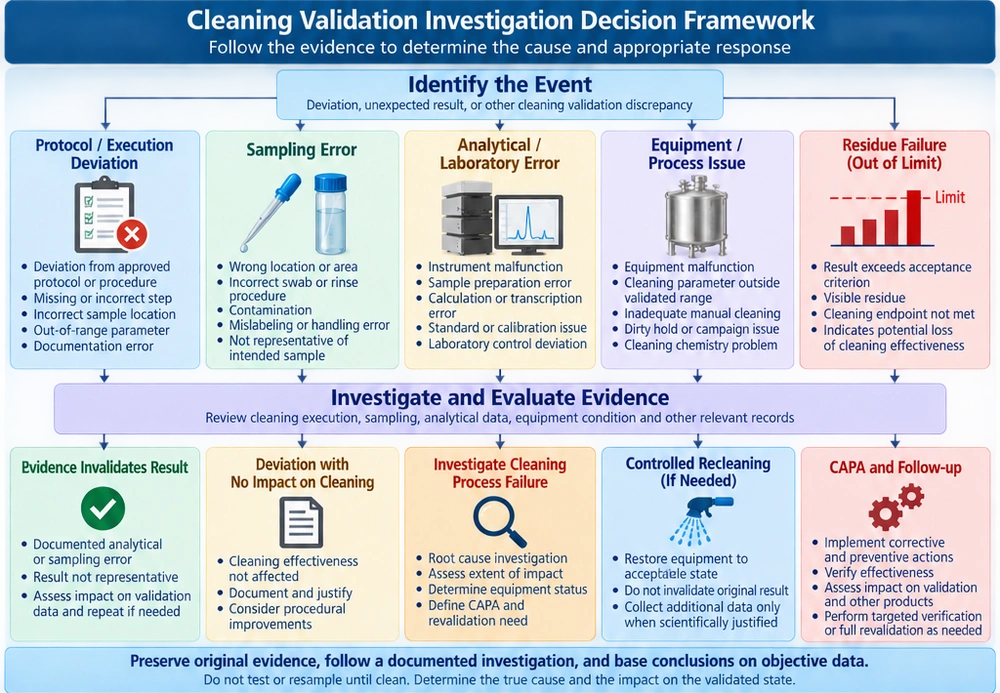
A useful investigation structure considers whether the event originated from the cleaning process, equipment, sampling, analytical testing, protocol execution, or another external factor. More than one contributing cause can be present.
For example, an unexpectedly high swab result could reflect genuine residue caused by inadequate cleaning, excessive dirty hold time, poor access to a valve, incorrect manual technique, failed CIP circulation, or equipment damage. It could also result from sample misidentification, contamination during collection, incorrect extraction volume, standard-preparation error, calculation error, or analytical malfunction. The investigation should discriminate among these possibilities using objective evidence.
Initial Response and Containment
The initial response should preserve the condition and evidence needed for investigation. Equipment status should be controlled so that it is not inadvertently released for manufacturing before the event has been evaluated. Relevant samples, raw data, instrument records, cleaning records, batch information, equipment configuration, and electronic records should be retained.
Where practical and safe, equipment should not immediately be recleaned before potentially useful investigative evidence has been documented. Visual condition, equipment configuration, cleaning parameters, alarms, valve positions, residue location, photographs, and other observations can become impossible to reconstruct once another cleaning cycle is performed.
Operational requirements may sometimes make recleaning necessary before the investigation is complete. If so, the original failure should remain fully documented, and the investigation should clearly distinguish the failed cleaning event from the subsequently successful recleaning event.
Out-of-Limit Cleaning Residue Results
Some organizations use the term out-of-limit (OOL) for a cleaning residue result above an established cleaning acceptance criterion. OOL can be useful internally, but it is not a standardized FDA cleaning-validation term equivalent to regulatory OOS terminology.
The technically important fact is that the result exceeded the approved cleaning acceptance criterion.
For example:
- Acceptance criterion: ≤ 2.0 µg/cm²
- Reported result: 2.8 µg/cm²
The initial conclusion should be: Cleaning residue result exceeds the approved acceptance criterion — investigation required.
The result should not immediately be labeled sampling error, laboratory error, or cleaning failure until the investigation establishes the cause.
Review the Original Result Before Additional Testing
The first investigative step should determine whether the original analytical result is technically valid.
The review should address the raw data, calculations, chromatograms or instrument output, sample preparation, dilution, extraction volume, standards, instrument condition, method suitability, blanks, recovery convention, sample identity, and analyst execution. Instrument audit trails or other electronic records should be reviewed where relevant.
A documented laboratory error can provide a legitimate reason to invalidate a result. Examples include use of the wrong dilution factor, demonstrable sample preparation error, instrument malfunction, transcription error, incorrect standard concentration, or another specific problem supported by evidence.
A vague conclusion such as “analyst error suspected” is not an adequate basis for discarding an unfavorable result.
FDA’s OOS guidance emphasizes that when no laboratory or calculation error is identified, there is no scientific basis for simply replacing the initial result with passing retest results.
Analytical Error Versus Cleaning Failure
The laboratory investigation should determine whether the analytical result represents the sample accurately. It should not attempt to determine whether the equipment was clean by repeatedly testing until an acceptable number appears.
If a clear analytical error is demonstrated, appropriately controlled retesting of the original sample can be justified according to an approved investigation procedure.
If the analytical method performed correctly and the sample is valid, the investigation should move toward the cleaning process, equipment, sampling location, and operating conditions rather than continue laboratory retesting without a defined scientific purpose.
Analytical Method Validation for Cleaning Residue Testing and Analytical Sensitivity and Quantitation Limits in Cleaning Validation should establish the analytical capability against which such investigations are evaluated.
Sampling Error
Sampling error is possible, particularly with manual swab sampling, but it should be demonstrated rather than assumed.
Potential sampling problems include incorrect location, wrong sampled area, wrong swab material, wrong sampling solvent, contaminated swab, improper swabbing technique, failure to follow the established pattern, sample-labeling error, incorrect extraction container, or another documented departure from Swab Sampling for Cleaning Validation.
Rinse sampling can similarly be compromised by incorrect volume, wrong solvent, wrong valve configuration, insufficient circulation, incomplete equipment coverage, wrong collection point, or improper handling. These factors should be evaluated against Rinse Sampling for Cleaning Validation.
The investigation should determine whether the sampling error biases the result high, biases it low, or simply makes the sample uninterpretable. The presence of a sampling deviation does not automatically mean that an unfavorable result should be discarded.
Recovery Problems
An unexpected cleaning result can also originate from an incorrect or inappropriate recovery factor.
The investigation should confirm that the recovery factor used is applicable to the residue, surface material, sampling method, concentration range, and analytical procedure represented by the sample. The calculation should also verify that recovery was applied according to the approved convention and was not inadvertently applied twice.
Swab and Rinse Recovery Studies for Cleaning Validation should provide traceability between each sampling condition and the applicable recovery evidence.
A recovery-study problem can invalidate the quantitative interpretation of the result, but it does not by itself demonstrate that the equipment surface was clean.
Resampling Requires Particular Caution
Resampling is fundamentally different from retesting an existing laboratory sample. It collects new evidence from the equipment after the original sampling event.
For swab sampling, the original swab physically removes some residue from the surface. A second swab of exactly the same area therefore does not reproduce the original condition. A passing second swab can simply reflect residue removed by the first sample.
For rinse sampling, the problem is more substantial. A rinse sample itself removes residue from the equipment. A second rinse therefore occurs after the first rinse has already extracted and transported material from the system. Repeated rinsing can progressively clean the equipment.
Resampling should therefore be used only when scientifically justified by the investigation and should not be used to erase an unfavorable original result.
FDA’s cleaning-validation inspection guide specifically cautions against repeated testing and resampling until an acceptable residue result is obtained and states that such practices can show that the cleaning process is not validated.
When Resampling May Be Justified
Resampling can be appropriate when the investigation establishes that the original sample was not representative or was improperly collected and when the new sample can answer a legitimate investigative question.
For example, an operator may have documented that the wrong valve was swabbed while the intended worst-case location remains untouched. Collecting the originally required sample may then be justified.
Another example is a sample container that was demonstrably contaminated before collection. Replacement sampling may be appropriate if the equipment condition has not been materially altered.
The justification should identify why the original sample is not representative, what information the replacement sample will provide, and how the equipment condition has been preserved.
The purpose should be to resolve a defined investigation question, not simply to obtain another opportunity to pass.
Do Not Average a Failure Away
A failing result should not be averaged with passing results to produce an acceptable mean unless the approved sampling and acceptance methodology was prospectively designed around such an average. Cleaning contamination can be localized. A high residue result from a valve, gasket, outlet, or other worst-case location can reveal a legitimate local cleaning problem even when surrounding surfaces are clean.
Averages can therefore conceal exactly the type of localized failure that worst-case sampling was intended to detect.
Cleaning Validation Sampling Strategy and Worst-Case Locations should define how individual sample results contribute to the validation conclusion.
Recleaning Does Not Erase the Failure
Recleaning can be appropriate to restore equipment to an acceptable state. It is not a mechanism for invalidating the original result. The sequence should be understood clearly:
Validated cleaning cycle → unacceptable result → investigation → controlled recleaning when authorized → verification of equipment cleanliness
The successful result after recleaning demonstrates that the recleaned equipment meets the applicable requirement. It does not establish that the original cleaning cycle was successful.
This distinction is critical during validation. If equipment repeatedly requires a second cleaning cycle to meet acceptance criteria, then the effective cleaning process may actually consist of two cycles. The approved cleaning procedure and validation strategy should be reconsidered rather than describing the first cycle as successful.
Repeated Recleaning Is a Process Signal
A single recleaning event can arise from an isolated and understood deviation. Recurring recleaning indicates a broader process-control problem. Repeated need for additional wash cycles, manual touch-up, extra rinses, or operator intervention can indicate that the validated cleaning process lacks adequate robustness.
These events should be included in Ongoing Cleaning Verification and Performance Trending rather than counted only as successfully resolved cleaning events.
A system that eventually becomes clean every time is not necessarily a validated cleaning process if the number or nature of cleaning steps varies unpredictably from event to event.
Manual Cleaning and Operator Variability
Manual cleaning deserves particular attention because operator technique can directly affect cleaning effectiveness. FDA’s cleaning-validation inspection guide specifically identifies manual process variability and operator performance as matters that should be evaluated when residue results are variable.
Investigation of manual cleaning can include review of equipment disassembly, solution preparation, detergent concentration, cleaning-tool selection, mechanical action, contact time, rinsing, sequence of cleaning steps, access to difficult surfaces, and operator training.
The conclusion should avoid automatically assigning an event to operator error. If a trained operator can reasonably interpret or perform the procedure in multiple ways, the root cause may instead be inadequate procedural design.
A robust cleaning procedure should minimize reliance on individual judgment where variation could affect cleaning effectiveness.
Operator Error Should Have a Specific Mechanism
The term operator error is a conclusion only when the investigation identifies what the operator did differently and why.
For example: Weak conclusion: Operator failed to clean equipment adequately.
Stronger conclusion: The operator omitted manual brushing of the valve cavity required by Step 17 because the valve was not included on the disassembly checklist.
The stronger conclusion identifies both the immediate error and a potential systemic cause.
CAPA may then address the checklist, procedure design, training, visual aids, or equipment configuration rather than relying only on retraining the operator.
Automated Cleaning Failures
Automated or semiautomated cleaning reduces some operator variability but introduces equipment, automation, and process-parameter failure modes. Investigation should review parameters identified as important to cleaning effectiveness, including as applicable detergent concentration, wash temperature, circulation time, flow, pressure, spray operation, rinse volume, rinse endpoint, valve sequencing, recipe version, alarms, and manual interventions.
A cleaning cycle that completed in the control system is not necessarily a successful cleaning cycle if an important parameter was outside its validated range.
Relevant electronic records, trends, alarms, recipes, and audit trails should be retained as investigation evidence.
Equipment Malfunction and Mechanical Condition
Equipment condition can cause localized or systemic cleaning failures. Potential causes include blocked spray devices, worn pump components, incorrectly positioned valves, damaged gaskets, fouled filters, failed temperature sensors, reduced flow, altered spray pattern, obstructed piping, poor drainage, surface damage, or incorrect equipment assembly.
Maintenance history should therefore be part of the investigation where equipment performance could plausibly contribute to the event.
Evidence of mechanical deterioration should also trigger assessment of previous cleaning events because the exact point at which the condition began may not be known.
Dirty Hold Time and Campaign Conditions
The investigation should confirm that the cleaning challenge remained within validated conditions. A cleaning failure after an unusually long dirty hold, maximum campaign length, high residue loading, or another severe operating condition may indicate that the process challenge exceeded its validated boundary.
Dirty Hold Time and Clean Hold Time Studies should establish applicable hold-time claims, while Worst-Case Product, Equipment, and Cleaning Condition Selection should identify the relevant product and operating challenges.
The investigation should determine whether the event represents failure within the validated range or use of the cleaning process outside its approved range. Both require action, but their root causes and validation implications differ.
Root Cause Should Address the Cleaning System
The root-cause investigation should look beyond the immediate observation and determine why the cleaning-control system allowed the event to occur.
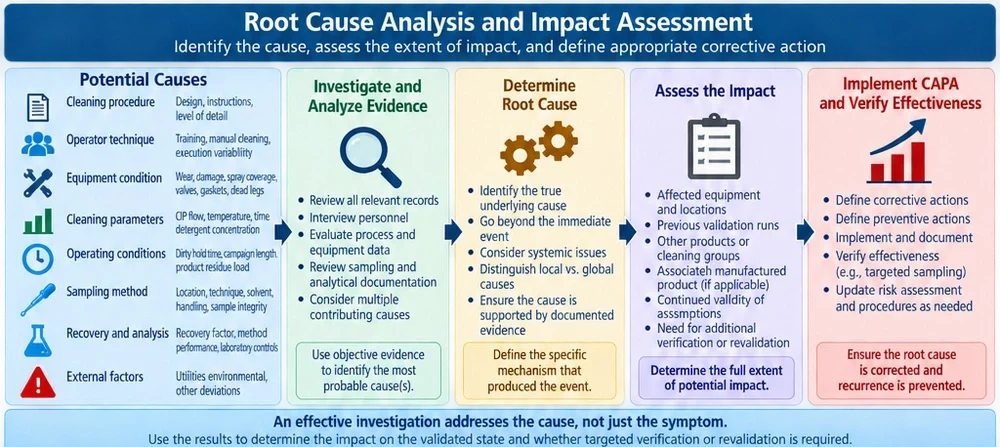
Potential causal areas include cleaning-procedure design, equipment design, cleaning chemistry, manual technique, automation, maintenance, dirty hold, campaign length, sampling, recovery, analytical testing, training, documentation, change control, or inadequate development knowledge.
For example, residue found inside the same valve after multiple cleaning events may initially appear to be operator-related. Investigation may instead show that the valve geometry prevents adequate mechanical access or CIP coverage. Retraining would not resolve that root cause.
Likewise, repeatedly low rinse recovery may reflect inadequate sample-method design rather than cleaning performance.
Impact Assessment
The investigation should determine the impact on more than the single validation result. The scope should reflect the nature and timing of the failure.
The assessment can include the affected equipment, cleaning procedure, product or cleaning group, earlier validation runs, subsequent equipment use, associated product batches, similar equipment, other sampling locations, and the assumptions supporting the existing validated state.
Where a discrepancy can affect associated manufactured product, the broader principle in 21 CFR 211.192 is that investigations should extend to other batches or products that may have been associated with the failure.
The investigation should therefore determine the earliest point at which the failure mechanism could reasonably have existed and what manufacturing or cleaning events occurred after that point.
Assess the Existing Validation Evidence
A failure during initial validation directly affects the validation conclusion. The study should determine whether the failed run demonstrates insufficient process reproducibility, an isolated assignable deviation, or inadequacy of the validation design itself.
A failure after validation raises a different question: Does the event challenge the continued validated state?
A single clearly assigned equipment malfunction that was corrected may justify targeted verification. Repeated residue failures without a clear isolated cause may indicate that the cleaning process is not consistently capable and may require broader revalidation.
The assessment should consider the totality of evidence rather than apply an automatic rule that every failure requires complete revalidation.
Impact on Other Products and Cleaning Groups
Where products are grouped or bracketed, a failure involving the representative worst case can affect the scientific basis for the entire group. Similarly, failure of a shared cleaning process on one equipment item may call into question other equipment using the same cleaning method if the failure mechanism is common.
For example, an incorrect detergent concentration in one manually prepared solution may be isolated to one cleaning event. A detergent-preparation procedure that routinely produces uncontrolled concentration can affect multiple equipment systems.
The investigation should distinguish local from systemic causes before defining the CAPA and revalidation scope.
CAPA Should Address the Established Cause
Corrective and preventive actions should be proportional to the root cause and risk.
Potential actions include revision of the cleaning procedure, equipment modification, improved CIP parameters, replacement or redesign of components, revised detergent concentration, increased mechanical action, procedural clarification, sampling-method revision, analytical-method improvement, preventive maintenance, additional operator qualification, increased verification, or changes to dirty-hold or campaign limits.
CAPA should not automatically default to retrain operator. Retraining is appropriate when inadequate knowledge or failure to follow a clear procedure is actually demonstrated.
Where the root cause is uncertain, CAPA may need to include additional monitoring or structured study to increase knowledge rather than claim a level of certainty the investigation does not support.
Effectiveness Verification
Significant CAPA should include an appropriate method of verifying effectiveness.
For a modified manual cleaning procedure, effectiveness verification may include targeted cleaning runs and sampling of the location associated with the failure. For equipment repair, it may include cleaning verification after repair and assessment of affected product-contact surfaces. For an analytical or sampling correction, it may require recovery or method bridging.
Effectiveness verification should test whether the CAPA addresses the actual failure mechanism.
Routine passing results alone may be insufficient if the CAPA was intended to correct a very specific worst-case condition that is rarely sampled.
Targeted Verification Versus Revalidation
Not every cleaning investigation should conclude with complete cleaning revalidation.
Targeted verification can be appropriate when the root cause is well understood, localized, corrected, and does not undermine the broader validation assumptions. For example, replacement of a damaged gasket followed by verification of that interface may be sufficient where the remainder of the validated process remains unaffected.
Broader revalidation becomes more appropriate when the failure reveals a systemic weakness, materially changes the cleaning procedure, changes critical cleaning parameters, invalidates worst-case assumptions, or demonstrates inadequate reproducibility.
ICH Q7’s lifecycle principle states that validated systems should be periodically evaluated and that revalidation is generally unnecessary when no significant changes have occurred and review confirms continued acceptable operation. Conversely, significant changes or evidence that the process is no longer operating validly can justify revalidation.
Recleaning, Resampling, and Revalidation Serve Different Purposes
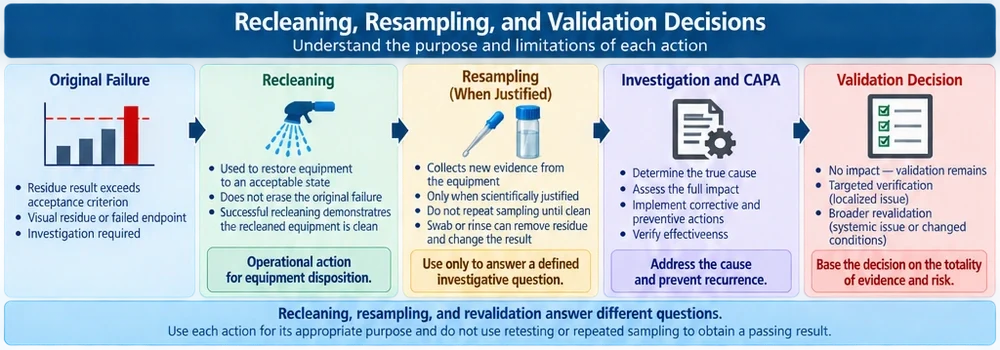
These activities should not be confused.
- Recleaning restores equipment to an acceptable state.
- Resampling collects additional investigative evidence where scientifically justified.
- Revalidation demonstrates that the cleaning process is capable under defined conditions.
One does not substitute automatically for another.
A successful recleaning result can permit equipment disposition but does not necessarily resolve the validation concern. A successful resample can provide useful evidence but does not invalidate an original valid failure. Revalidation addresses the process capability question when the investigation indicates that the established validation evidence is no longer adequate.
Validation Run Failure
A failed validation run should not automatically be removed from the validation dataset because an assignable cause appears plausible.
The investigation should determine whether the cause is conclusively demonstrated and whether the affected run remains representative of the process being validated.
If the failure resulted from execution outside the approved protocol, the run may not provide valid evidence of the intended process. However, the deviation itself may reveal that the routine procedure is insufficiently robust or difficult to execute correctly.
If the cleaning procedure was followed correctly and residue still exceeded the criterion, the failure directly challenges cleaning-process capability.
One Passing Replacement Run Is Not Automatically Enough
Where a failed validation run has been legitimately invalidated because of a demonstrated extraneous cause, the validation strategy should determine what replacement evidence is necessary.
The replacement should restore the intended study design rather than merely add one passing run.
If investigation identifies a process change or CAPA, additional runs may be required to demonstrate the revised process rather than simply replacing the numerical count of the failed run.
The validation conclusion should be based on scientific evidence of reproducibility, not on achieving a predetermined number of passing reports after removing inconvenient data.
Trend the Investigations
Cleaning deviations and failures should feed the lifecycle monitoring program. Repeated individually explainable events can reveal a common pattern that is not visible when each investigation is reviewed in isolation.
Ongoing Cleaning Verification and Performance Trending should therefore include residue failures, adverse visual findings, repeated alerts, recleaning events, cleaning parameter deviations, sampling problems, and CAPA effectiveness.
Five separate investigations attributed to different operators at the same valve may ultimately indicate an equipment-design or procedure-design problem. Trend review helps expose that systemic relationship.
Investigation Report
The investigation report should allow an independent reviewer to understand the original event, evidence reviewed, root-cause logic, impact assessment, disposition, and effect on the validated state.
The report should normally document the original observation or result, applicable acceptance criterion, equipment and product involved, cleaning condition, immediate containment, review of cleaning execution, sampling and analytical assessment, root cause or most probable cause, scope of impact, CAPA, equipment disposition, validation impact, and any required verification or revalidation.
The report should retain all relevant original data, including unfavorable results that were subsequently invalidated for a documented reason.
The conclusion should clearly state whether the event represents a cleaning-process failure, a compromised validation sample, an analytical error, a protocol deviation without impact on cleaning effectiveness, or another supported classification.
Common Deficiencies
A major deficiency is assuming that a failing residue result is laboratory error simply because nearby samples passed. Localized residue is exactly what worst-case direct sampling is designed to detect.
Another weakness is immediate resampling without first investigating the original result. This is particularly problematic for swabs because the original sample removes residue from the surface and for rinses because repeated rinsing can progressively clean the equipment.
Testing until clean is another significant deficiency. FDA explicitly warns that repeated testing and resampling until an acceptable result is obtained can demonstrate inadequacy of the validated cleaning process.
Other deficiencies include averaging a high worst-case sample with low samples, treating successful recleaning as proof that the first cleaning passed, closing investigations as operator error without identifying a mechanism, overlooking maintenance or equipment-design causes, failing to extend impact assessment to associated products or equipment, and implementing retraining as the default CAPA without evidence that training was causal.
A further weakness is treating every deviation as either automatically harmless or automatically requiring complete revalidation. Investigation should determine the actual effect on cleaning evidence and the validated state.
Key Principles
- A cleaning-validation deviation is a departure from an approved procedure or study condition. It requires assessment but does not automatically establish cleaning failure. A true cleaning failure is supported by evidence that the approved cleaning process did not achieve an applicable requirement.
- An initial residue result above the approved cleaning criterion should remain valid unless a specific, evidence-based reason supports invalidation. Passing retests alone do not establish that the original unfavorable result was erroneous. FDA’s broader OOS guidance reinforces this investigation principle.
- Sampling and analytical errors should be investigated separately from cleaning-process causes. A demonstrable sampling or laboratory problem can compromise particular evidence, but unsupported assumptions of sampling or analyst error should not be used to invalidate unfavorable results.
- Resampling requires particular caution because swabbing and rinsing physically alter the condition being measured. Replacement sampling should answer a defined investigative question and should not become testing until clean.
- Recleaning is an operational action used to restore acceptable equipment condition. It does not erase evidence that the original cleaning process failed.
- Root cause should identify the technical mechanism responsible for the event and should evaluate procedure design, equipment, cleaning chemistry, operator technique, process parameters, hold conditions, sampling, recovery, and analytical testing as appropriate.
- Impact assessment should determine whether the event affects only the immediate cleaning event or also previous validation evidence, related products, other equipment, cleaning groups, or the continued validated state.
- CAPA and revalidation scope should follow the established cause and impact. Targeted verification may be sufficient for an isolated and corrected problem, whereas systemic loss of cleaning capability can require broader revalidation.