

Biopharmaceutical Manufacturing Validation Requirements
Regulatory validation requirements are central to maintaining control over biopharmaceutical manufacturing. Biological products are structurally complex, sensitive to manufacturing conditions, and frequently dependent on living cells or biological source materials. Product quality therefore cannot be assured through finished-product testing alone.
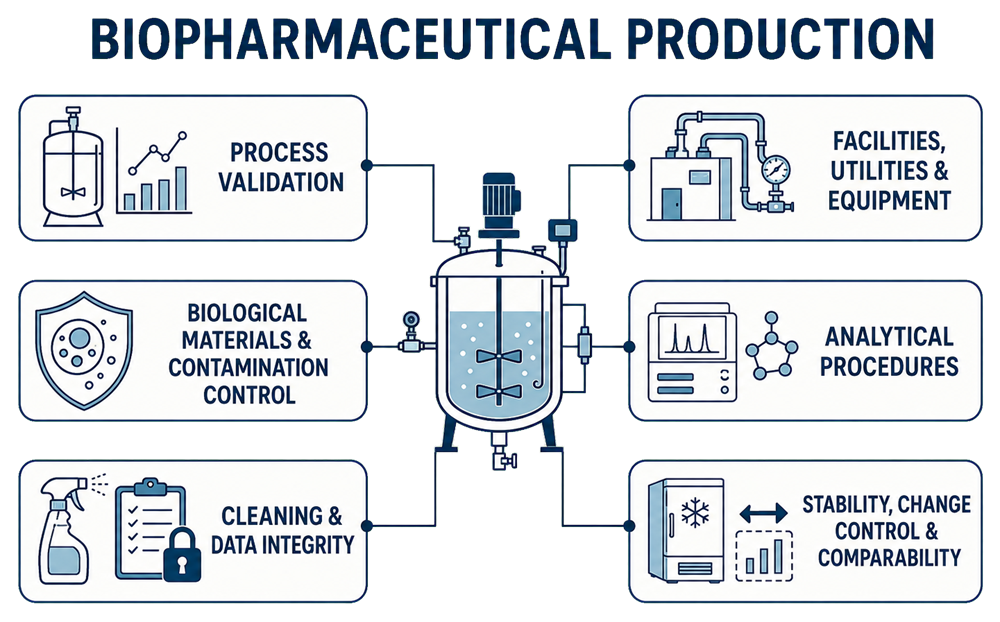
Manufacturers must establish documented control over raw and biological source materials, cell substrates, facilities, utilities, equipment, upstream and downstream processes, aseptic operations, cleaning procedures, analytical methods, storage conditions, and computerized systems. A structured validation lifecycle provides documented evidence that these systems and processes are suitable for their intended uses and consistently support the required identity, strength, quality, purity, and potency of the product.
Regulatory Authority and Applicable Regulations
Biopharmaceutical products in the United States may be regulated under both the Federal Food, Drug, and Cosmetic Act (FD&C Act) and the Public Health Service Act (PHS Act). The applicable regulatory framework depends on the product type, manufacturing activities, and regulatory pathway.
Drug products that are also biological products are subject to the applicable current good manufacturing practice requirements in 21 CFR Parts 210 and 211. They are also subject to applicable biologics requirements in Parts 600 through 680, including licensing, testing, labeling, and product-specific provisions. These requirements supplement one another unless a regulation expressly provides otherwise.
Commonly applicable requirements include:
- 21 CFR Parts 210 and 211 — CGMP requirements governing manufacturing, processing, packing, holding, laboratory controls, records, equipment, facilities, production, and process control.
- 21 CFR Part 600 — General requirements applicable to biological products and licensed establishments.
- 21 CFR Part 601 — Biologics licensing requirements, including Biologics License Applications and certain post-approval changes.
- 21 CFR Part 610 — General biological-product standards, including applicable requirements for testing, potency, sterility, purity, identity, and labeling.
- Other Parts within 600–680 — Product-specific requirements that apply according to the type of biological product.
- 21 CFR Part 11 — Requirements applicable when electronic records and electronic signatures are used to satisfy FDA record requirements.
A manufacturer must determine the complete regulatory framework applicable to its products and operations. The approved application, registered manufacturing process, established specifications, regulatory commitments, and post-approval change requirements are also essential components of the control strategy.
FDA’s regulations establish that Parts 210 and 211 and the biologics regulations supplement one another. See 21 CFR § 210.2, 21 CFR § 211.1, and 21 CFR Parts 600–680.
Key Validation Requirements
Process Validation
Process validation is the collection and evaluation of data, from process design through commercial production, establishing scientific evidence that a process can consistently deliver quality product. FDA’s lifecycle approach applies to biological products as well as conventional drug products.
A biopharmaceutical process-validation program should address, as applicable:
- Process design and development of process knowledge
- Identification of critical quality attributes
- Identification and control of critical process parameters
- Raw-material and biological-source-material variability
- Cell-bank and cell-culture controls
- Upstream and downstream processing
- Harvest, purification, filtration, formulation, and filling operations
- In-process controls and process hold times
- Process Performance Qualification
- Continued Process Verification
- Deviations, investigations, change control, and process trends
A documented risk assessment for CPP and CQA identification should connect product-quality attributes with material characteristics, process parameters, sources of variability, and the controls required to manage them.
Process Performance Qualification should demonstrate that the integrated commercial process performs reproducibly under routine operating conditions using qualified facilities, utilities, equipment, trained personnel, approved procedures, established materials, and the intended control strategy.
FDA does not require a universal fixed number of PPQ batches. The number of batches and amount of supporting evidence should be scientifically justified using process knowledge, expected variability, risk, manufacturing experience, and the evidence needed to demonstrate reproducibility.
Following successful PPQ, Continued Process Verification should use production and quality data to confirm that the process remains in a state of control. Monitoring should detect adverse trends, increasing variability, loss of process capability, and other signals requiring investigation or corrective action.
FDA describes Process Design, Process Qualification, and Continued Process Verification in its Process Validation: General Principles and Practices guidance.
Facilities, Utilities, and Equipment Qualification
Facilities, utilities, and equipment must be designed, installed, operated, maintained, and qualified for their intended uses. The qualification strategy should reflect the product, process, contamination risks, system criticality, and controls described in the approved manufacturing application.
The facility qualification lifecycle should establish that the manufacturing environment is properly designed, constructed, commissioned, qualified, operated, and maintained. Biopharmaceutical operations commonly require qualification and lifecycle control of:
- Classified manufacturing areas and cleanrooms
- HVAC systems and pressure cascades
- Purified Water and Water for Injection systems
- Clean-steam systems
- Process gases and compressed air
- Bioreactors and fermenters
- Chromatography and filtration systems
- Centrifugation and harvest equipment
- Formulation, filling, and lyophilization equipment
- Cold rooms, freezers, incubators, and storage systems
- Cleaning-in-place and sterilization-in-place systems
- Environmental and process-monitoring systems
Utility systems should be assessed according to their intended use and potential direct or indirect effect on product quality. Critical parameters such as chemical quality, microbiological quality, endotoxin, pressure, temperature, flow, and supply reliability must be controlled where applicable.
Facility and equipment qualification must demonstrate more than mechanical operation. It must establish that systems perform consistently within defined limits and do not introduce contamination, cross-contamination, or uncontrolled process variability.
Biological-Source Materials and Contamination Control
Biopharmaceutical manufacturing may involve cell substrates, microbial systems, animal-derived materials, human-derived materials, or other biological sources. Their identity, suitability, traceability, storage, testing, and control can directly affect product quality and process consistency.
The control strategy should address, as applicable:
- Master and working cell-bank qualification
- Cell-substrate identity and characterization
- Raw-material and supplier controls
- Adventitious-agent risk
- Viral safety and viral-clearance studies
- Bioburden and endotoxin control
- Segregation and cross-contamination prevention
- Closed-system and sterile-boundary controls
- Environmental and personnel monitoring
- Material and personnel flows
- Contamination-control investigations
An effective endotoxin control strategy should connect raw-material controls, water and utility quality, equipment cleaning, process controls, environmental conditions, sampling, laboratory testing, investigations, and established acceptance criteria.
Biological-source and contamination controls should be integrated with process validation rather than treated as separate administrative programs.
Analytical Procedure Validation and Lifecycle Control
Analytical procedures used for release, stability, in-process control, process characterization, and comparability must be suitable for their intended purposes. Validation or verification requirements depend on the procedure, its intended use, regulatory status, and whether it is compendial or noncompendial.
Biopharmaceutical analytical procedures may need to measure or evaluate:
- Identity
- Potency or biological activity
- Purity and product-related impurities
- Quantity or concentration
- Molecular and structural characteristics
- Aggregation and degradation
- Host-cell proteins and residual DNA
- Residual process materials
- Sterility, bioburden, and endotoxin
- Viral and adventitious-agent contamination, where applicable
Relevant performance characteristics may include accuracy, precision, specificity, sensitivity, range, robustness, detection or quantitation capability, and system suitability.
Analytical-procedure performance should be monitored throughout its lifecycle, particularly after method transfer, process changes, specification changes, laboratory changes, or significant analytical-system modifications. Instruments and associated software must also be qualified or validated for their intended uses, but instrument qualification does not replace analytical-procedure validation.
FDA provides specific recommendations in Analytical Procedures and Methods Validation for Drugs and Biologics.
Cleaning Validation
Cleaning validation must demonstrate that established cleaning procedures consistently reduce product residues, process materials, cleaning agents, and microbiological contamination to scientifically justified levels.
For biopharmaceutical manufacturing, the cleaning-validation program should consider:
- Protein and product-related residues
- Product potency and toxicological information
- Bioburden and endotoxin risks
- Cleaning-agent residues
- Equipment design and product-contact surfaces
- Campaign manufacturing
- Dirty and clean hold times
- Manual and automated cleaning steps
- Worst-case product and equipment selection
- Recovery studies and sampling-method suitability
- Analytical-procedure sensitivity and specificity
- Acceptance criteria linked to product and patient risk
The sampling strategy may include rinse, direct-surface, or swab sampling, depending on equipment design, residue characteristics, surface accessibility, analytical capability, and the objectives of the study. Recovery must be demonstrated from representative surfaces where quantitative results are required.
Cleaning validation should be maintained through change control, periodic review, routine monitoring, investigation of failures, and revalidation when required. Visual cleanliness is necessary but does not by itself establish that chemical, product, and microbiological acceptance criteria have been met.
FDA inspections may closely evaluate cleaning procedures, validation evidence, equipment design, investigations, and the scientific justification for residue and microbiological acceptance criteria.
Computerized Systems and Data Integrity
Computerized systems that control manufacturing processes, collect process data, manage laboratory results, maintain electronic records, or support product-quality decisions must be validated for their intended uses.
Computerized system validation planning should address:
- Intended use and system boundaries
- GxP impact and risk classification
- User and functional requirements
- System configuration
- Interfaces and data transfers
- Security and access control
- Audit trails
- Electronic records and electronic signatures
- Calculation and reporting functions
- Data backup, restoration, and retention
- Testing and requirements traceability
- System release
- Change control and periodic review
- Supplier and service-provider responsibilities
Validation must establish that the complete computerized system—including software, hardware, configuration, interfaces, procedures, records, and user controls—reliably performs its intended GxP functions.
Data used to establish process capability, product release, stability, comparability, or continued process control must remain complete, accurate, attributable, contemporaneous, original or appropriately preserved, and available throughout the required retention period.
Stability Testing
Stability studies must provide evidence that the biological drug substance and drug product maintain appropriate quality throughout the proposed storage period. Because biological products can be particularly sensitive to temperature, light, oxidation, agitation, freeze-thaw exposure, and other environmental conditions, stability-indicating procedures must be capable of detecting relevant changes.
The stability program should address, as applicable:
- Product-specific stability-indicating attributes
- Potency or biological activity
- Purity, aggregation, and degradation
- Physicochemical and biochemical characteristics
- Container-closure compatibility
- Storage temperature and environmental conditions
- In-use and hold-time stability
- Shipping and temperature-excursion assessments
- Supporting data for expiration dating or shelf life
- Ongoing stability commitments
- Evaluation of significant changes and adverse trends
Stability protocols, acceptance criteria, test intervals, storage conditions, and analytical procedures should be scientifically justified and consistent with the approved application.
Biological products requiring controlled-temperature distribution should be supported by an appropriate cold-chain qualification program covering packaging, transportation lanes, shipping durations, seasonal conditions, temperature monitoring, excursion management, and distribution risks.
FDA’s ICH Q5C guidance specifically addresses stability testing for biotechnological and biological products.
Change Control and Comparability
Biological products can be highly sensitive to changes in raw materials, equipment, facilities, manufacturing scale, process parameters, analytical procedures, container-closure systems, or manufacturing sites. A technically minor manufacturing change may affect product quality in ways that are not immediately apparent through routine release testing.
Formal change control should evaluate:
- The potential effect on critical quality attributes
- The effect on critical process parameters and the control strategy
- Whether qualification or revalidation is required
- Whether analytical comparability studies are required
- Whether stability commitments must be revised
- Whether additional characterization or process studies are necessary
- Whether computerized-system testing is required
- Whether specifications or analytical procedures must change
- Whether the change requires FDA reporting before or after implementation
The extent of comparability evidence should reflect the nature of the change, existing process and product knowledge, product complexity, and the potential effect on safety, purity, and potency.
Change approval should not be based only on confirmation that the modified process still meets routine release specifications. Additional characterization, process validation, stability, or comparability evidence may be required to demonstrate that product quality remains adequately controlled.
Bottom Line
Biopharmaceutical validation requires coordinated lifecycle control of facilities, utilities, equipment, biological source materials, manufacturing processes, cleaning procedures, analytical methods, computerized systems, storage conditions, and process changes.
Parts 210 and 211 and the applicable biologics regulations in Parts 600 through 680 establish complementary requirements. A scientifically justified validation program should demonstrate that the commercial manufacturing process remains capable, controlled, and consistent with the approved application throughout the product lifecycle.
Effective Continued Process Verification, change control, comparability assessment, stability monitoring, data-integrity controls, and periodic review provide the evidence needed to maintain compliance and support FDA inspection readiness.