

Biological Indicators for Sterilization Validation
Biological indicators, or BIs, are microbiological test systems containing viable microorganisms with defined resistance to a specified sterilization process. They are used during process development, validation, qualification, routine monitoring, and requalification to challenge the microbial-inactivation capability of the process.
A BI is not an independent test of product sterility. A negative BI result means that no growth was detected from that indicator under the defined recovery and incubation conditions. The result is meaningful only when the BI was suitable for the sterilization method, properly stored, correctly placed, exposed as intended, successfully recovered and incubated, and interpreted together with the physical process data.
Effective BI control therefore extends from organism and format selection through supplier qualification, certificate review, storage, placement, exposure, incubation, result interpretation, failure investigation, trending, and change control.
Purpose and Scope
This article addresses:
- Selection of a BI organism and strain
- Population and resistance requirements
- D-value and z-value considerations
- BI formats and carrier systems
- Inoculated carriers and inoculated products
- Self-contained biological indicators
- Process challenge devices
- Certificate and lot review
- Storage, handling, and expiry control
- Worst-case BI placement
- Recovery and incubation
- Positive controls
- Reduced incubation time
- Positive BI results and invalid tests
- Routine monitoring and requalification
- Supplier, lot, and lifecycle control
The underlying relationship among microbial population, D-value, lethality, survivor curves, and sterility assurance level is addressed separately.
What a Biological Indicator Demonstrates
A BI provides a defined microbiological challenge to a sterilization process. When the challenge is appropriately selected and located, the result helps demonstrate that the process delivered sufficient microbial lethality at a difficult-to-sterilize location.
BI evidence may support:
- Sterilization-cycle development
- Fractional or partial-cycle studies
- Overkill-process development
- Equipment operational qualification
- Performance qualification
- Load-family qualification
- Process challenge device qualification
- Routine cycle monitoring
- Periodic requalification
- Post-change verification
- Investigation of process performance
The BI result must be evaluated with:
- Time, temperature, pressure, concentration, humidity, or dose data
- Sterilant-distribution or penetration evidence
- Load configuration
- Sensor locations
- Equipment alarms
- Cycle deviations
- Chemical indicators where used
- Calibration status
- Positive-control results
- BI handling and incubation records
A negative BI cannot compensate for unacceptable physical process data. If a critical process parameter failed its acceptance criterion, the cycle cannot normally be accepted merely because the exposed BIs showed no growth.
What a Biological Indicator Does Not Demonstrate
A BI does not independently demonstrate:
- Sterility of every processed item
- Achievement of the required SAL throughout the entire load
- Correct exposure at locations where no BI was placed
- Acceptability of unmonitored critical process parameters
- Product or material compatibility
- Sterilant-residue acceptability
- Container-closure integrity
- Endotoxin reduction or depyrogenation
- Sterility of a fluid processed by filtration
- Continued control after the sterile boundary has been opened
BIs challenge microbial inactivation. They do not replace sterilization-process development, physical monitoring, equipment qualification, load control, or lifecycle management.
Biological-Indicator Selection-and-Use Lifecycle
BI control should follow a defined sequence:
- Define the sterilization process, required outcome, load, and intended BI use.
- Select a suitable organism, strain, population, resistance, carrier, and BI format.
- Review and accept the supplier, lot, certificate, storage conditions, and expiry.
- Identify and document worst-case BI locations.
- Expose, retrieve, activate, recover, and incubate the indicators under controlled conditions.
- Interpret BI results with the physical cycle evidence.
- Investigate positive results, invalid tests, damaged indicators, and handling deviations.
- Trend performance and reassess suitability after changes.
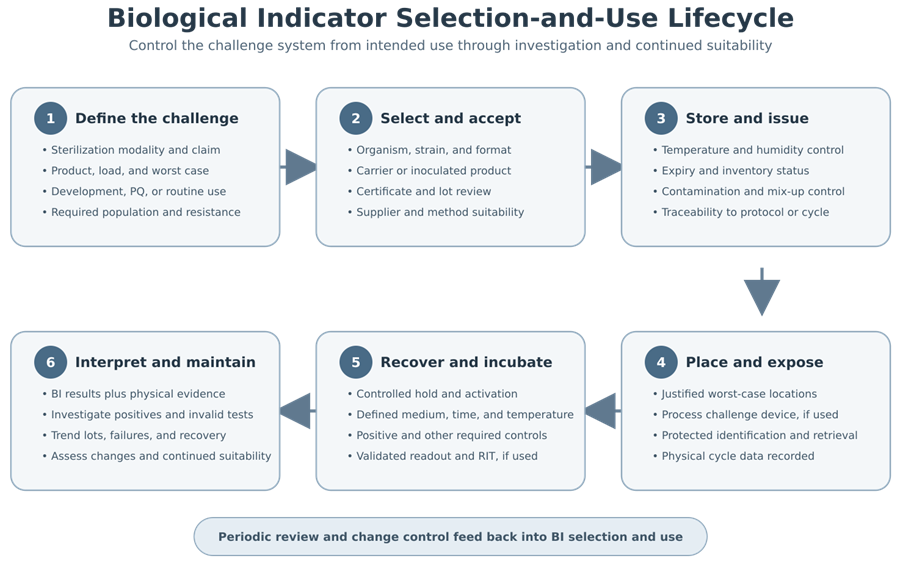
The selected BI strategy must remain traceable to the process-development rationale, qualification protocol, approved load configuration, operating procedure, and routine monitoring strategy.
Selecting the Test Organism
The test organism should be resistant to the specified sterilization method and suitable for the intended application. Selection should consider:
- Sterilization mechanism
- Process temperature
- Sterilant concentration
- Humidity
- Carrier material
- Product or load environment
- Expected product bioburden
- Process-development approach
- Required biological challenge
- Applicable pharmacopoeial or consensus standard
- Supplier resistance data
- Site-generated development data
Common organism associations include:
| Sterilization process | Commonly used BI organism | Important qualification |
|---|---|---|
| Saturated steam and other moist-heat processes | Geobacillus stearothermophilus | Resistance must be established under the applicable moist-heat conditions |
| Ethylene oxide | Bacillus atrophaeus | Resistance depends on temperature, humidity, EtO concentration, carrier, and recovery conditions |
| Dry heat | Bacillus atrophaeus | Resistance must be characterized at the applicable dry-heat temperature |
| Low-temperature steam and formaldehyde | Geobacillus stearothermophilus commonly used | Process-specific requirements and resistance conditions must be defined |
| Vaporized hydrogen peroxide | Geobacillus stearothermophilus commonly used | Resistance can vary substantially with carrier, packaging, humidity, concentration, and exposure conditions |
| Radiation | Classical BIs are not normally the principal basis for dose establishment | Bioburden, dose-establishment methods, dosimetry, dose mapping, and dose audits are generally more important |
These associations are starting points, not automatic selections. The actual organism, strain, carrier, population, and resistance characteristics must be suitable for the defined process.
If routine product bioburden includes microorganisms more resistant than the selected BI under actual process conditions, the BI strategy and sterilization cycle may require reassessment.
Population of the Biological Indicator
The BI population is the number of viable test organisms present on or in the indicator before sterilization exposure.
A population of approximately 10⁶ spores is commonly used for overkill applications, but 10⁶ should not be presented as a universal BI population. Other populations may be appropriate depending on:
- Sterilization method
- Cycle-development approach
- Required log reduction
- Product bioburden
- BI resistance
- Applicable standard
- Fractional-cycle design
- Routine monitoring objective
- Product or material exposure limits
The population should be:
- Defined for the specific lot
- Expressed using an appropriate logarithmic value
- Established using a qualified enumeration method
- Within the supplier’s approved specification
- Suitable for the intended challenge
- Traceable to the certificate and BI lot
- Considered when calculating survival and kill characteristics
The nominal label population should not be used without reviewing the lot-specific certified population.
Resistance and D-Value
The D-value is the exposure required under specified conditions to reduce the viable BI population by one log₁₀.
For an idealized log-linear process:
Log₁₀ reduction = exposure ÷ D-value
A D-value is meaningful only when the exposure conditions are stated. Relevant conditions may include:
- Temperature
- Sterilant concentration
- Relative humidity
- Pressure
- Carrier material
- Product environment
- Recovery medium
- Enumeration method
- Test equipment or resistometer conditions
A higher D-value indicates greater resistance under the specified conditions. It does not establish that the same resistance will apply under different temperatures, carrier systems, products, sterilant concentrations, or humidity conditions.
A certificate D-value generated under reference conditions must therefore be distinguished from resistance under actual load conditions. Carrier materials, inoculation method, drying, packaging, product chemistry, and sterilant accessibility can change the apparent resistance of the test organism.
z-Value
For thermal sterilization, the z-value is the temperature change required to change the D-value by a factor of ten.
The z-value may be used to:
- Relate resistance measurements obtained at different temperatures
- Support thermal lethality calculations
- Evaluate resistance across a defined temperature range
- Establish survival and kill characteristics
- Assess the effect of temperature variation
The z-value should be supported by resistance data generated at multiple temperatures. It should not be treated as an interchangeable resistance parameter for EtO, VHP, radiation, or other processes governed by different kinetic relationships.
Detailed D-value, z-value, and lethality concepts are addressed in Sterility Assurance Level and Sterilization Kinetics.
Survival and Kill Times
A BI certificate may provide calculated or experimentally confirmed survival and kill times.
The survival time represents an exposure at which viable test organisms are expected to remain recoverable. The kill time represents an exposure at which complete inactivation is expected under the defined test conditions.
These values can support:
- Incoming lot assessment
- Fractional-cycle development
- Resistometer testing
- Confirmation of resistance characteristics
- Evaluation of an unexpected result
Survival and kill times are characteristics of the BI under specified test conditions. They do not define the production-cycle exposure and do not substitute for load-specific sterilization validation.
Biological-Indicator Formats
Biological indicators are available in several formats.
Inoculated Carrier
An inoculated carrier contains a defined microbial population deposited on a material such as:
- Paper
- Stainless steel
- Glass
- Polymer
- Thread
- Coupon
- Other qualified substrate
The carrier may be supplied in a primary package that permits sterilant access while protecting the indicator during handling.
Carrier material can affect:
- Microbial resistance
- Sterilant penetration
- Moisture retention
- Chemical absorption
- Spore recovery
- Static behavior
- Handling durability
The carrier and primary package must be appropriate for the sterilization modality. A BI designed for steam exposure should not be assumed suitable for dry heat, EtO, VHP, or another process.
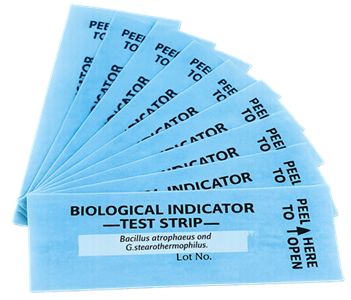
Spore Strips
Spore strips are inoculated carriers, commonly paper strips enclosed in permeable packaging. They can be placed in difficult load locations or incorporated into a process challenge device.
After exposure, the strip is aseptically transferred to recovery medium. The transfer operation introduces handling and contamination risks that must be controlled.
Self-Contained Biological Indicators
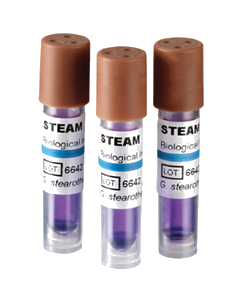
A self-contained biological indicator, or SCBI, combines the inoculated carrier and recovery medium within one unit.
After exposure, the BI is typically activated so that the carrier contacts the growth medium. Depending on the design, growth may be detected through:
- Visual color change
- Turbidity
- Fluorescence
- Enzymatic response
- Automated reader output
SCBIs reduce some transfer-related contamination risk but introduce other controls, including:
- Activation technique
- Internal ampoule integrity
- Sterilant effects on the recovery medium
- Reader compatibility
- Incubator loading
- Readout interpretation
- Instrument maintenance
- Software or electronic-record controls where applicable
An SCBI, incubator, and automated reader may constitute a qualified test system. Substitution of one component can require formal assessment.
Spore Suspensions and Inoculated Products
A characterized spore suspension may be used to inoculate a product, component, carrier, or representative material.
Direct inoculation can provide a more product-specific challenge by accounting for:
- Product composition
- Surface characteristics
- Protective material effects
- Occluded or internal locations
- Drying conditions
- Packaging
- Sterilant absorption
- Recovery difficulty
The inoculation and recovery method must be qualified. The study should address:
- Inoculum preparation
- Applied volume
- Population uniformity
- Inoculation location
- Drying conditions
- Hold time before exposure
- Effect of the product on resistance
- Recovery efficiency
- Neutralization or dilution
- Product antimicrobial activity
- Aseptic handling
- Disposal and decontamination
A commercial BI attached to the outside of a product may not represent organisms located within a lumen, closure interface, filled container, porous material, or other protected location.
Process Challenge Devices
A process challenge device, or PCD, positions a BI within a defined physical configuration intended to represent a known sterilization challenge.
Examples include:
- Porous test packs
- Lumen devices
- Restricted pathways
- Wrapped assemblies
- Representative product configurations
- Simulated closures or interfaces
- Defined VHP or gas penetration challenges
A PCD must be qualified for its intended use. It should not be described as a worst case merely because it appears difficult to sterilize.
The qualification should establish that the PCD challenge is:
- Relevant to the actual products or loads
- Equal to or greater than the represented routine challenge
- Reproducible
- Compatible with BI recovery
- Traceable to development data
- Sensitive to meaningful process deterioration
A PCD developed for one sterilizer, cycle, load family, or sterilization modality should not automatically be transferred to another application.
Certificate and Lot Review
Each BI lot should be supported by a manufacturer’s certificate or equivalent controlled documentation.
The review should address, as applicable:
| Certificate element | Review objective |
| Manufacturer and product identification | Confirm the approved supplier and correct BI product |
| BI lot number | Establish traceability |
| Organism and strain | Confirm identity and process suitability |
| Carrier and primary packaging | Confirm compatibility with the intended exposure |
| Certified population | Confirm the challenge level |
| Population range or uncertainty | Understand permitted lot variability |
| D-value and test conditions | Confirm resistance and the conditions under which it was measured |
| z-value | Review thermal-resistance relationship where applicable |
| Survival and kill times | Confirm consistency with the population and resistance data |
| Test method or resistometer conditions | Understand how resistance was established |
| Incubation temperature and duration | Define recovery requirements |
| Recovery medium | Confirm compatibility with the BI system |
| Readout method | Confirm visual, fluorescence, enzymatic, or automated interpretation |
| Reduced incubation time claim | Confirm the applicable BI, process, and readout |
| Storage conditions | Define warehouse and laboratory controls |
| Expiration date | Prevent use beyond the qualified shelf life |
| Certificate approval or authorization | Confirm document authenticity and release status |
Certificate acceptance should be documented before the lot is used.
Routine re-enumeration or resistance testing of every commercial BI lot is not automatically necessary when a qualified supplier and appropriate certificate are used. The site procedure should define when independent confirmation is required based on risk, applicable compendial requirements, supplier history, intended use, and previous performance.
Supplier Qualification
A BI supplier should be evaluated as a provider of a critical microbiological challenge system.
Supplier assessment may include:
- Quality-system information
- Manufacturing controls
- Organism and strain control
- Population and resistance methods
- Traceability to spore crops
- Carrier and packaging controls
- Shelf-life program
- Transportation studies
- Change-notification agreement
- Deviation and complaint handling
- Certificate controls
- Regulatory status where applicable
- History of lot consistency
- Support for reduced incubation time or automated readout claims
Changes made by the supplier can affect BI suitability even when the catalog number remains unchanged.
Receipt, Storage, and Inventory Control
Biological indicators contain viable microorganisms and must be stored under the conditions stated by the manufacturer or established by site qualification.
Controls should address:
- Receipt inspection
- Shipping-condition assessment
- Temperature excursions
- Humidity where relevant
- Quarantine and release status
- Lot segregation
- Expiration control
- First-expire-first-use practices
- Protection from sterilants and cleaning chemicals
- Protection from excessive heat or moisture
- Prevention of cross-contamination
- Prevention of mix-ups among organisms or process types
- Access control
- Inventory reconciliation
- Disposal and decontamination
BIs should not be stored near sterilizers, VHP generators, EtO areas, disinfectants, or other conditions that could reduce viability or resistance.
A storage excursion requires assessment of potential effects on population, resistance, recovery, and remaining shelf life.
Placement and Worst-Case Challenge
BI placement must be based on process and load knowledge. Arbitrary distribution throughout a chamber does not demonstrate that the true worst-case locations were challenged.
Placement should consider:
- Results of empty-chamber distribution studies
- Loaded heat- or sterilant-penetration data
- Load density
- Product mass
- Packaging
- Porosity
- Lumens and restricted pathways
- Mated or occluded surfaces
- Entrapped air
- Condensate
- Humidity equilibration
- Distance from the sterilant source
- Vapor or gas absorption
- Shielded regions
- Minimum, maximum, partial, and mixed loads
- Routine loading variability
For moist heat, relevant locations may include:
- Difficult-to-heat load locations
- Areas affected by entrapped air
- Long hoses or lumens
- Wrapped or porous assemblies
- Drain-associated cold regions
- Internal product or container locations
BI placement should be coordinated with load-development studies and temperature mapping and heat-penetration studies.
For EtO or VHP processes, placement may be driven by:
- Sterilant concentration
- Humidity
- Temperature
- Packaging permeability
- Gas or vapor flow
- Material absorption
- Occlusion
- Aeration behavior
- Distance from injection or circulation points
The hardest-to-sterilize location may not be the chamber location with the lowest measured temperature. Worst-case placement must reflect the actual microbial-inactivation mechanism.
Each BI location should be identifiable and traceable to:
- A load diagram
- Product or component identity
- Orientation
- PCD configuration
- Physical sensor location where applicable
- Protocol step
- Incubation record
- Final result
BI Exposure and Retrieval
The protocol or procedure should define:
- BI lot and expiration date
- Number of indicators
- Placement locations
- Load configuration
- Identification method
- Positive-control quantity
- Exposure conditions
- Retrieval responsibilities
- Maximum holding time before incubation
- Transport conditions
- Activation or transfer method
- Incubation requirements
- Acceptance criteria
- Handling of missing or damaged indicators
Identification should remain legible after sterilization exposure. Labels, inks, adhesives, or external packaging should not interfere with sterilant penetration or BI recovery.
All planned BIs should be accounted for after the cycle. A missing BI is a protocol deviation and potential contamination-control concern; it should not simply be replaced in the record with an assumed negative result.
Incubation and Recovery
Incubation conditions must support recovery of surviving, potentially injured test organisms.
The controlled method should define:
- Recovery medium
- Aseptic transfer technique where required
- SCBI activation method
- Time from exposure to incubation
- Incubation temperature
- Incubation duration
- Incubator identification
- Incubator calibration or qualification
- Loading limitations
- Observation frequency
- Readout method
- Positive-control handling
- Result documentation
- Final disposition of cultures
The effect of sterilization exposure on the recovery system must be considered. For example:
- Heat may damage SCBI medium or packaging.
- EtO or VHP residues may inhibit recovery.
- Product ingredients may possess antimicrobial activity.
- Delayed activation may affect recovery.
- Excessive heating during incubation may reduce viability.
- Incorrect activation may prevent contact between the carrier and medium.
Recovery conditions should be those established for the specific BI system, not generic conditions copied from another organism or supplier.
Positive Controls
At least one unexposed BI from the applicable lot is commonly incubated as a positive control according to the approved method.
The positive control demonstrates that:
- The BI organisms were viable
- The recovery medium supported growth
- The incubation temperature was suitable
- The incubation duration was adequate
- The activation or transfer method was functional
The positive control should be handled to avoid contaminating exposed indicators or the incubation area.
If the required positive control does not demonstrate growth, the negative results from exposed BIs cannot automatically be accepted. The test may be invalid because the viability of the BI or suitability of the recovery conditions was not demonstrated.
An uninoculated medium or other negative control may also be appropriate when required by the method, investigation, or laboratory procedure.
Reduced Incubation Time
A reduced incubation time, or RIT, allows a final BI result to be reported before completion of the conventional reference incubation period.
RIT may be supported through:
- Growth-based detection
- Fluorescent detection
- Enzyme-based detection
- Automated reader technology
- A validated shortened visual incubation period
The RIT must be established for the specific:
- BI organism and strain
- BI product
- Carrier
- Recovery medium
- Readout technology
- Incubation temperature
- Sterilization modality
- Exposure conditions
- Reader or incubator system
A reduced incubation claim cannot automatically be transferred:
- Between BI manufacturers
- Between BI products from the same manufacturer
- From one organism to another
- From steam to VHP, EtO, or dry heat
- From fluorescence to visual interpretation
- From one recovery medium to another
- From a self-contained BI to a spore strip
- From one reader system to another
ISO 11138-8:2021 provides a method for establishing or confirming RIT for BIs used with moist heat and EtO. Its stated scope does not include dry heat, low-temperature steam-formaldehyde, or VHP processes.
Use of a supplier-supported RIT should be documented in the site procedure and assessed for the intended BI system. If the site establishes or independently confirms a reduced incubation time, the study requires a predefined protocol, suitable fractional exposures, adequate recovery, multiple lots where appropriate, and comparison with the reference incubation period.
Result Interpretation
BI results should be classified according to the approved method.
Possible outcomes include:
| BI outcome | Interpretation |
| Exposed BI shows no growth; positive control grows; physical data acceptable | Supports successful microbial-inactivation performance at the tested location |
| Exposed BI shows growth during a full-cycle qualification or routine cycle | Potential process, placement, handling, BI, or laboratory failure requiring investigation |
| Positive control fails to grow | Test may be invalid; negative exposed-BI results are not independently acceptable |
| BI is damaged, missing, improperly activated, or incubated outside limits | Deviation requiring documented impact assessment |
| Growth occurs during an intentionally fractional cycle | May be expected if defined by the development protocol |
| Automated result conflicts with visual or secondary result | Investigate the BI system, reader, timing, and approved interpretation rules |
Results should not be recorded only as “pass” or “fail.” The record should retain:
- BI identity and lot
- Location
- Exposure cycle
- Incubation conditions
- Observation or readout time
- Positive-control result
- Physical cycle disposition
- Deviations
- Reviewer approval
Unexpected Positive Biological Indicator
Growth from an exposed BI during a full sterilization cycle requires prompt investigation.
For a routine production cycle, the affected load should remain controlled pending evaluation and disposition.
The investigation should consider:
Sterilization-Process Performance
- Critical process parameters
- Cycle alarms
- Temperature, pressure, concentration, humidity, or dose data
- Air-removal performance
- Sterilant supply
- Load configuration
- Equipment malfunction
- Utility interruption
- Recent maintenance
- Calibration status
BI Placement and Exposure
- Correct location
- Correct load and orientation
- PCD configuration
- Packaging integrity
- Sterilant access
- Contact with wet surfaces or condensate
- Retrieval time
- Identification accuracy
BI Material
- Correct organism and BI type
- Lot and expiration date
- Certificate acceptance
- Storage history
- Shipping excursion
- Damaged packaging
- Population or resistance concern
- Supplier complaints or alerts
Laboratory Handling
- Aseptic transfer
- SCBI activation
- Recovery medium
- Incubation temperature and time
- Incubator performance
- Reader status
- Cross-contamination
- Transcription or identification error
- Positive-control handling
Organism Identification
Identification of the recovered organism may help determine whether growth is consistent with:
- The BI test organism
- Environmental or handling contamination
- Laboratory contamination
- Another BI lot or organism
- An atypical process contaminant
An initial positive result should not be invalidated merely because repeat testing is negative. Repetition may provide investigation information, but it does not erase the original result. Any conclusion that the result was caused by laboratory or BI handling error requires evidence.
The investigation should determine:
- Cycle and load disposition
- Product-impact assessment
- Extent of condition
- Need to assess adjacent cycles or loads
- Corrective and preventive actions
- Need for maintenance or calibration
- Need for targeted or comprehensive requalification
- Supplier notification
- Regulatory or quality escalation where applicable
Biological Indicators During Cycle Development
Fractional or partial cycles may intentionally produce a mixture of positive and negative BI results. Such studies can be used to:
- Estimate process resistance
- Confirm BI challenge
- Develop survivor curves
- Establish minimum exposure
- Support half-cycle or overkill approaches
- Validate reduced incubation time
- Compare load locations
- Evaluate process margin
A positive BI in an intentionally sublethal study is not automatically a failure. Its acceptability depends on the objective and predefined acceptance criteria of the protocol.
Development results must not be confused with full-cycle PQ or routine-cycle acceptance criteria.
Use During Qualification
BI studies during performance qualification should be integrated with physical measurements and defined load configurations.
The qualification strategy should establish:
- BI selection rationale
- Population and resistance
- Lot acceptance
- Placement rationale
- PCD design where applicable
- Number of BIs per run
- Positive controls
- Number of replicate runs
- Minimum and maximum load conditions
- Fractional- and full-cycle requirements
- Incubation and readout method
- Acceptance criteria
- Deviation handling
- Traceability to development data
For steam sterilization, BI evidence is only one part of the steam-sterilizer qualification lifecycle. Heat distribution, heat penetration, lethality, air removal, steam quality, drainage, alarms, and load reproducibility must also be addressed.
Routine Monitoring
The need and frequency for routine BI monitoring depend on:
- Sterilization modality
- Product and application
- Applicable regulation or standard
- Validation approach
- Release strategy
- Equipment design
- Process capability
- Historical performance
- Site procedure
- Risk assessment
Routine BI use should not become a substitute for review of critical physical parameters. Each routine cycle should still be evaluated against the validated process limits.
Where BIs are used routinely, procedures should define:
- Cycle types requiring BIs
- Locations and PCDs
- BI quantity
- Positive controls
- Incubation method
- Release implications
- Handling of delayed results
- Investigation requirements
- Trending
- Inventory and lot control
Lifecycle Control
BI suitability must be maintained throughout the sterilization-process lifecycle.
Changes requiring assessment may include:
- BI manufacturer
- BI product or catalog number
- Organism or strain
- Spore crop
- Population specification
- D-value or resistance range
- Carrier material
- Primary packaging
- Recovery medium
- SCBI design
- Reader or incubator
- Incubation temperature or duration
- Reduced incubation time
- Storage conditions
- PCD design
- BI location
- Load configuration
- Sterilization cycle
- Sterilizer equipment
- Sterilant supplier or concentration
- Product or packaging material
- Contract laboratory
- Contract sterilization site
The change assessment should determine whether existing development and qualification data remain representative.
Relevant lifecycle decisions should connect with sterilization requalification and continued verification and GMP change-control impact assessment.
Periodic Review and Trending
Periodic review should evaluate:
- BI lots used
- Certificate acceptance
- Storage excursions
- Expired or rejected indicators
- Positive-control failures
- Unexpected positive exposed BIs
- Damaged or missing indicators
- Incubation deviations
- Reader or incubator failures
- Supplier changes
- Complaints and recalls
- Resistance or population trends
- PCD changes
- Investigation outcomes
- Requalification results
- Procedure and training status
Trending should distinguish genuine process signals from laboratory, handling, supplier, or documentation failures.
Repeated invalid tests can indicate weak control even when no sterilization failure is confirmed.
Common Biological-Indicator Errors
Common weaknesses include:
- Selecting a BI based only on organism name
- Assuming every BI contains 10⁶ spores
- Using a certificate D-value without its test conditions
- Applying thermal z-value concepts to unrelated sterilization methods
- Assuming the supplier D-value represents resistance inside the product
- Using a carrier incompatible with the sterilization process
- Ignoring the effect of product material on BI resistance or recovery
- Treating chamber cold spots as the only possible worst-case locations
- Placing BIs without a documented rationale
- Assuming a maximum load is always the worst case
- Using an unqualified PCD
- Failing to reconcile all placed BIs
- Using expired or improperly stored indicators
- Incubating outside the approved temperature or duration
- Applying an RIT to an unqualified BI or readout system
- Accepting exposed-BI negatives when the positive control failed
- Treating a negative BI as proof of load sterility
- Accepting failed physical parameters because the BIs were negative
- Invalidating a positive BI solely through passing repeat tests
- Failing to identify organisms recovered during an investigation
- Failing to assess supplier, carrier, medium, or reader changes
- Using BIs as evidence of depyrogenation or sterile filtration
- Treating initial BI qualification as permanent
Regulatory and Standards Framework
For US drug manufacturing, 21 CFR 211.113(b) requires written procedures designed to prevent microbiological contamination of sterile drug products, including validation of all aseptic and sterilization processes.
FDA’s Sterile Drug Products Produced by Aseptic Processing guidance addresses sterilization validation and use of appropriate biological indicators in pharmaceutical applications.
FDA’s Biological Indicator Premarket Notification guidance addresses BI performance characteristics, carrier materials, holding time, recovery, incubation, shelf life, test packs, and reduced incubation time. Its regulatory purpose is medical-device premarket review; pharmaceutical manufacturers may use its technical content where relevant without treating it as a universal pharmaceutical requirement.
Relevant standards include:
- ISO 11138-1:2017 — General BI requirements
- ISO 11138-2:2017 — BIs for EtO sterilization
- ISO 11138-3:2017 — BIs for moist-heat sterilization
- ISO 11138-4:2017 — BIs for dry-heat sterilization
- ISO 11138-5:2017 — BIs for low-temperature steam and formaldehyde
- ISO 11138-7:2019 — Guidance for BI selection, use, and result interpretation
- ISO 11138-8:2021 — Validation of reduced incubation time for moist-heat and EtO BIs
ISO 11138-7 does not cover filtration and specifically excludes atmospheric VHP isolator and room bio-decontamination from its scope. VHP BI use must therefore be supported by the actual application, equipment, supplier data, process-development studies, and applicable standards.
Relevant USP chapters include:
- General Chapter
<55>— Biological Indicators—Resistance Performance Tests - General Chapter
<1229>— Sterilization of Compendial Articles - General Chapter
<1229.5>— Biological Indicators for Sterilization
Standards and pharmacopoeial chapters should be applied according to their official status, technology, product, and regulatory scope. The wider framework is addressed in Sterilization Regulations, Standards, and Validation Lifecycle.
Conclusion
A biological indicator is a controlled microbiological challenge system. Its value depends on the relationship among the organism, population, resistance, carrier, product environment, placement, sterilization exposure, recovery method, incubation conditions, and physical process evidence.
A negative BI result does not independently prove product sterility or achievement of SAL throughout a load. A positive result does not identify its own cause. Both require interpretation within the complete sterilization control strategy.
A defensible BI program controls supplier and lot acceptance, storage, placement, exposure, incubation, positive controls, reduced incubation time, investigations, trending, changes, and continued suitability throughout the sterilization-process lifecycle.