

Ethylene Oxide Sterilization Validation and Lifecycle
Ethylene oxide sterilization validation demonstrates that a defined process consistently delivers the required sterility assurance for approved products and loads while controlling product residuals, material effects, packaging integrity, worker exposure, and environmental emissions.
Validation cannot be established from chamber temperature, pressure, humidity, EtO dose, and exposure time alone. The evidence must connect:
- Product and packaging characteristics
- Product bioburden
- Product-family rationale
- Load configuration and density
- Preconditioning and transfer
- Sterilizer equipment capability
- Moisture and EtO penetration
- Physical process parameters
- Biological-indicator resistance and placement
- Aeration and residual dissipation
- Routine monitoring and release
- Deviations, changes, and requalification
- Contract-sterilizer responsibilities
The process phases, sterilizer architecture, gas delivery, evacuation, washing, aeration, safety systems, and emission controls are addressed in Ethylene Oxide Sterilization Process and Equipment. This article focuses on validation and maintenance of the validated state.
Validation Lifecycle Position
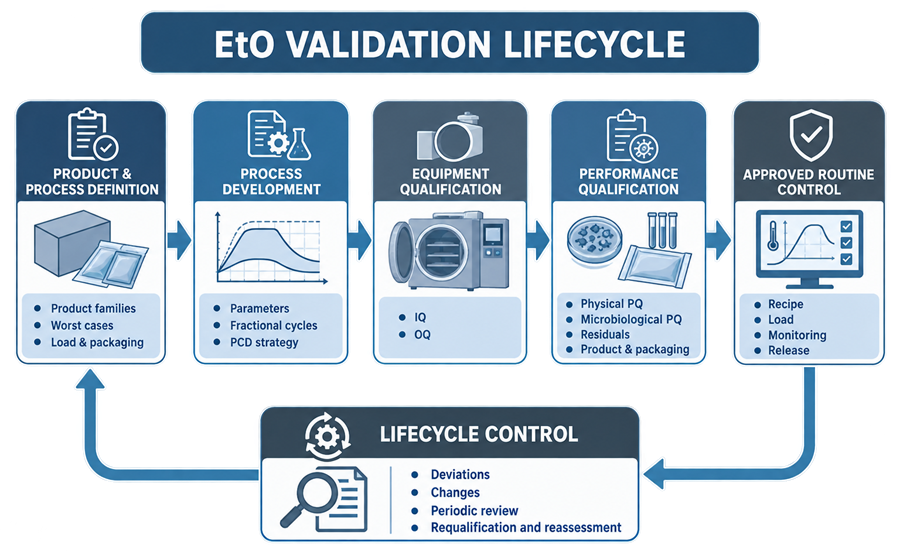
Insert the new EtO Validation Lifecycle illustration here.
EtO validation is a lifecycle rather than a single performance-qualification exercise. The lifecycle normally includes:
- Product and process definition
- Product-family and processing-category development
- Bioburden and microbiological characterization
- Equipment installation and operational qualification
- Process development
- Process-challenge-device development
- Validation-method selection
- Physical performance qualification
- Microbiological performance qualification
- Aeration and residual evaluation
- Validation review and process release
- Routine monitoring and product release
- Change control and product adoption
- Periodic review and requalification
- Process retirement or transfer
Each stage should produce evidence supporting the next stage. PQ should not be used to discover basic product, equipment, load, or cycle characteristics that should have been resolved during development.
Regulatory and Standards Framework
For medical devices, the principal standard is ISO 11135:2014, including Amendment 1:2018. It defines requirements for development, validation, and routine control of EtO sterilization processes.
ISO confirmed the 2014 edition in 2024, so it remains current as of August 2026. A replacement edition has reached the final-draft stage but has not yet replaced the published 2014 edition. Validation procedures should be reassessed when the new edition is formally published.
FDA currently recognizes ANSI/AAMI/ISO 11135:2014 with Amendment 1:2018. FDA’s recognition record also identifies supporting documents addressing physical process characteristics, microbiological aspects, material compatibility, product adoption, contract sterilization, and process equivalence. The current recognition status should be verified when preparing a regulatory submission because recognition may not immediately follow publication of a new ISO edition.
Other applicable standards include:
- ISO 10993-7:2026 for allowable EtO and ethylene-chlorohydrin residuals and related conformity assessment
- ISO 11138-1 and ISO 11138-2 for biological indicators and EtO-specific BI requirements
- ISO 11737-1 for determination and characterization of product bioburden
- ISO 11737-2 for sterility tests used in sterilization-process development, validation, and maintenance
- ISO 11607-1 and ISO 11607-2 for sterile-barrier systems and packaging-process validation
- ISO/TS 21387 for EtO parametric-release applications
- AAMI TIR14 for contract EtO sterilization
- AAMI TIR15 for physical aspects of EtO sterilization
- AAMI TIR16 for microbiological aspects of EtO sterilization
- AAMI TIR17 for material compatibility
- AAMI TIR28 for product adoption and process equivalence
For US medical devices, the Quality Management System Regulation under 21 CFR Part 820 applies together with device-specific requirements and regulatory-submission commitments. QMSR became effective on February 2, 2026, incorporating ISO 13485:2016 by reference with FDA-specific provisions.
Application of these requirements is discussed in Medical Device Validation Requirements Under QMSR.
EtO use for pharmaceutical, biologic, or combination-product applications requires assessment of the applicable drug, biologic, device, and combination-product requirements. Conformity with a medical-device sterilization standard does not by itself establish suitability for a drug product.
The broader framework is addressed in Sterilization Regulations, Standards, and Validation Lifecycle.
Validation Governance
An approved validation plan or equivalent strategy should define:
- Products and product families included
- Sterilization site and chamber
- Processing category
- Approved load configurations
- Product and packaging boundaries
- Sterility-assurance objective
- Product bioburden strategy
- Validation method
- BI and process-challenge-device strategy
- Physical and microbiological PQ requirements
- Residual-testing strategy
- Aeration qualification
- Equipment-qualification prerequisites
- Acceptance criteria
- Number and sequence of studies
- Routine monitoring
- Routine release method
- Deviation handling
- Change-control requirements
- Requalification strategy
- Contract-sterilizer responsibilities
- Regulatory-submission implications
Responsibilities should be assigned among:
- Device manufacturer
- Sterilization specialist
- Microbiology
- Quality assurance
- Engineering
- Packaging engineering
- Product development
- Toxicology
- Analytical laboratory
- Contract sterilizer
- Regulatory affairs
The validation strategy should distinguish product-process validation from sterilizer-equipment qualification. A qualified chamber does not establish that every product and load can be sterilized. Conversely, a successful product study does not compensate for inadequate equipment qualification.
Validation Prerequisites
Formal PQ should begin only when applicable prerequisites have been approved or confirmed.
These may include:
- Product design substantially established
- Product materials defined
- Sterile-barrier system defined
- Packaging configuration established
- Manufacturing and assembly conditions defined
- Product bioburden data available
- Product-family rationale approved
- Worst-case product and load rationale approved
- Sterilizer IQ and OQ completed
- Preconditioning and aeration systems qualified
- Calibration completed
- Maintenance status acceptable
- Approved cycle-development data available
- Critical process parameters defined
- BI system selected
- Process challenge device established
- Laboratory methods qualified or validated
- Residual-extraction and analytical methods established
- Protocols approved
- Deviations from prerequisite activities resolved or formally assessed
Use of representative or simulated product should be justified. The simulation must represent the characteristics relevant to heat transfer, moisture absorption, EtO penetration, gas absorption, evacuation, microbial challenge, and residual dissipation.
Product and Process Definition
The validated process should be linked to an approved product and process specification.
Product Definition
The product definition should identify:
- Product name and model
- Intended use
- Patient-contact category
- Materials of construction
- Product dimensions and mass
- Internal cavities
- Lumens and restricted pathways
- Mated surfaces
- Closures and caps
- Absorbent materials
- Lubricants
- Adhesives
- Coatings
- Electronic components
- Batteries or sensors
- Manufacturing environment
- Cleaning or washing operations
- Presterilization holding conditions
- Bioburden controls
- Primary packaging
- Secondary packaging
- Carton and shipper configuration
- Pallet configuration
- Labeling and inserts
- Maximum permitted reprocessing or sterilization exposures
The characteristics affecting microbial lethality may differ from those affecting residuals, material compatibility, or packaging. One product should not automatically be designated as worst case for every validation objective.
Process Definition
The process definition should identify:
- Preconditioning temperature and humidity
- Minimum and maximum preconditioning time
- Maximum transfer time
- Chamber-conditioning sequence
- Vacuum and pressure profile
- Humidification inputs
- EtO dose
- Gas-concentration basis
- Exposure temperature
- Exposure time
- Wash sequence
- Final evacuation or purge conditions
- Door-unlock permissives
- Transfer to aeration
- Aeration temperature
- Aeration airflow
- Minimum aeration time
- Maximum permitted process holds
- Alarm and abort criteria
- Permitted process tolerances
- Routine monitoring requirements
- Product-release criteria
Setpoints, processing ranges, acceptance criteria, alarm limits, and abort limits should be separately defined. A cycle may remain within equipment-operating capability while failing a validated process requirement.
Product Families and Processing Categories
A product family groups products that can be represented by common validation evidence because they share relevant sterilization characteristics.
Family assignment should be based on technical comparison rather than product name, commercial category, or intended use alone.
Relevant characteristics include:
- Materials and EtO absorption
- Product mass
- Product density
- Lumen length and diameter
- Internal pathways
- Mated or occluded surfaces
- Protective caps
- Number of components
- Assembly complexity
- Microbial access
- Bioburden level and resistance
- Primary package permeability
- Number of packaging layers
- Carton construction
- Paper content
- Pallet wrapping
- Load density
- Required aeration
- Residual dissipation
- Material compatibility
- Sterile-barrier performance
A processing category may include multiple product families that are processed using a common sterilization specification. The category should define which products, loads, packaging configurations, and process ranges are permitted.
Family Representative
A family representative may be:
- A marketed product
- A deliberately constructed master product
- A simulated product
- A reference load
- A combination of products representing different challenges
The representative should present an equal or greater challenge than other family members for the attribute being evaluated.
A narrow lumen may be the greatest challenge to sterilant penetration. A dense absorbent product may be more difficult to condition or aerate. A lightweight, less absorbent load may produce a different gas-concentration condition. Separate representatives may therefore be required.
Product Adoption
Adding a product to an established family requires documented product adoption rather than administrative assignment.
The assessment should compare the proposed product with the validated family for:
- Product geometry
- Materials
- Sterilant access
- Bioburden
- Packaging
- Load configuration
- Moisture response
- EtO absorption
- Residual dissipation
- Material compatibility
- Required sterility assurance
- Regulatory commitments
Possible outcomes include:
- Adoption without additional testing
- Adoption with limited confirmatory testing
- Residual or material testing
- PCD comparison
- Partial PQ
- Establishment of a new product family
- Full validation under a separate process
The rationale should identify the evidence supporting the decision. A spreadsheet score without technical explanation is insufficient.
Worst-Case Selection
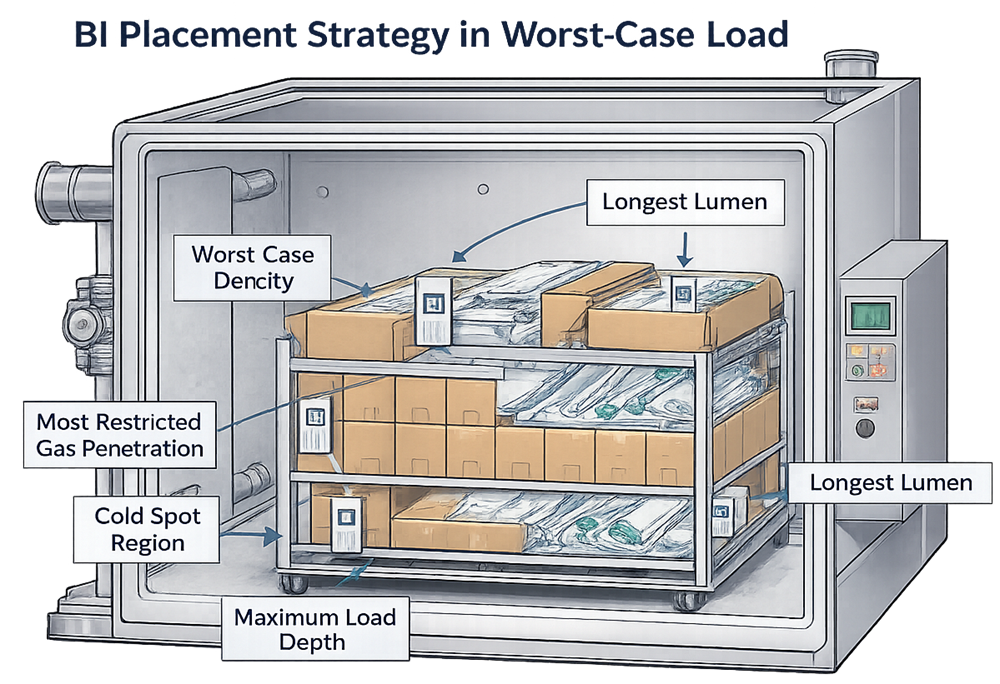
Insert existing EtO-Worst-Case-Load.webp here.
Worst-case selection should be specific to the validation question.
| Validation objective | Potential challenge factors |
|---|---|
| Preconditioning | High mass, dense cartons, low starting temperature, moisture-resistant packaging |
| Moisture penetration | Restricted pathways, hydrophobic materials, dense packaging, short conditioning time |
| EtO penetration | Narrow lumens, occluded surfaces, multiple packaging layers, restrictive pallet wrap |
| Gas distribution | Dense load, blocked circulation path, chamber position, minimum gas movement |
| Microbial lethality | High-resistance BI, internal inoculation site, difficult PCD, minimum exposure conditions |
| Evacuation and washing | EtO-absorbing materials, closed pathways, dense product or packaging |
| Residual dissipation | Absorbent polymers, large mass, limited ventilation, dense packaging |
| Maximum exposure | Minimum or low-absorption load, high process parameters, extended conditioning or exposure |
| Packaging performance | Weakest seal, sensitive material, maximum vacuum and humidity exposure |
| Material compatibility | Sensitive polymer, adhesive, coating, electronics, repeated exposure |
The largest load is not necessarily the only worst case. Validation may need to address:
- Maximum load
- Minimum load
- Maximum-density load
- Mixed load
- Maximum paper content
- Maximum absorbent-material load
- Most restrictive packaging
- Least absorbent load
- Maximum permitted transfer delay
- Cold product entering preconditioning
- Maximum and minimum aeration load
- Products permitted at different chamber positions
Worst-case claims should be traceable to product and load data. The diagram identifies representative challenge locations; it should not be interpreted as establishing universal BI locations for every chamber and load.
Process Challenge Devices
A process challenge device is designed to present a defined microbiological resistance to the sterilization process. It normally contains a biological indicator or inoculated carrier placed within a physical configuration that restricts access of EtO, moisture, or both.
PCDs may be:
- Internal PCDs located within the product, package, or load
- External PCDs positioned where they can be recovered more easily
- Product PCDs using the actual product
- Simulated-product PCDs representing difficult product features
- Routine PCDs used for ongoing monitoring
- Validation PCDs used during development or PQ
Internal PCD
An internal PCD should represent the most difficult location within the product or load. Examples include:
- Longest or narrowest validated lumen
- Mated surface
- Restricted fluid pathway
- Closed or capped region
- Densely packaged location
- Multiple packaging layers
- Lowest-moisture location
- Most difficult gas-access location
The internal PCD should be compared with actual product bioburden and product resistance. It should provide a known and appropriate challenge without creating an artificial condition unrelated to the marketed product.
External PCD
An external PCD may be used for routine monitoring when it has been demonstrated to provide a challenge at least as great as the internal PCD it represents.
Correlation should address:
- BI organism and lot
- BI population
- BI resistance
- PCD construction
- Location in the load
- Recovery method
- Fractional-cycle response
- Reproducibility
- Product and load applicability
An external PCD should not be adopted merely because it is easier to place and retrieve.
Representative Performance Challenge Device
A routine PCD should remain representative of the validated internal challenge. Changes to the BI carrier, packaging, PCD materials, inoculation location, dimensions, assembly, or placement require assessment.
Detailed BI selection, resistance, handling, recovery, incubation, controls, and positive-result investigation are addressed in Biological Indicators for Sterilization Validation.
Validation-Method Selection
The validation plan should identify the selected microbiological method and explain why it is appropriate for the product, bioburden, process, and claimed sterility-assurance level.
Common approaches include:
- Overkill or half-cycle approach
- Combined biological-indicator and bioburden approach
- Bioburden-based or absolute-bioburden approach
These approaches should not be mixed without a defined scientific basis.
Overkill Approach
The overkill approach uses a resistant biological indicator to demonstrate a microbial-inactivation capability substantially greater than required for the expected product bioburden.
It is generally appropriate when:
- Product and packaging tolerate the resulting process
- A suitable resistant BI is available
- The process can provide substantial lethality margin
- Excessive exposure does not create unacceptable material or residual risks
The approach can simplify the relationship between product bioburden and process lethality, but it does not eliminate the need to establish and control bioburden.
Combined BI and Bioburden Approach
This approach considers both:
- Resistance and population of the biological indicator
- Population and resistance characteristics of product bioburden
It can permit a process tailored more closely to the actual microbiological challenge. It requires sufficient evidence that the selected BI and process provide the necessary margin relative to product bioburden.
Bioburden-Based Approach
A bioburden-based approach relies more directly on knowledge of the actual product microbial population and resistance.
It requires strong control of:
- Bioburden sampling
- Recovery efficiency
- Microbial identification
- Resistance characterization
- Manufacturing variability
- Seasonal or supplier effects
- Product-family differences
- Change management
This method may reduce unnecessary sterilization exposure but generally requires more extensive microbiological knowledge and control.
Process Development
Development should establish a process capable of achieving microbial lethality, product compatibility, residual acceptance, and routine reproducibility.
Studies may evaluate:
- Temperature range
- Humidity or moisture input
- Conditioning time
- Transfer time
- Vacuum depth
- Pressure transition
- EtO dose and concentration
- Exposure time
- Load density
- Chamber position
- Gas circulation
- Evacuation and wash sequence
- Aeration temperature and duration
- BI response
- Product bioburden
- Residual dissipation
- Material and packaging response
Development should evaluate interactions among process variables. Reducing EtO concentration, for example, may require changes to humidity, temperature, exposure time, load configuration, or PCD design. It cannot be justified by nominal dose reduction alone.
Fractional Cycles
A fractional cycle uses an exposure shorter than the proposed routine exposure to produce partial microbial inactivation.
Fractional cycles can help:
- Identify difficult BI or product locations
- Compare internal and external PCDs
- Estimate process lethality
- Evaluate relative BI resistance
- Differentiate among candidate worst cases
- Support exposure-time selection
- Demonstrate that the challenge is not so weak that every location is immediately inactivated
Fractional cycles should produce interpretable microbiological differentiation. A cycle in which every BI is negative provides limited information for comparing locations. A cycle in which every BI is positive may show insufficient exposure but may not identify the relative worst case.
Physical conditions during fractional studies should remain representative of the aspects being evaluated. Shortening exposure should not inadvertently change other process phases so substantially that the study no longer represents the intended process.
Equipment Qualification
EtO sterilization equipment qualification should cover the complete installed system supporting the validated process.
Installation Qualification
IQ may include verification of:
- Sterilization chamber
- Doors and seals
- Heating system
- Internal circulation
- Humidification system
- EtO supply and delivery
- Vaporizer
- Vacuum system
- Gas-wash supply
- Aeration system
- Ventilation
- Emission-control interfaces
- Gas detection
- Safety interlocks
- Utilities
- Instruments
- Calibration
- Materials of construction
- Piping and instrumentation drawings
- Control-system configuration
- Approved recipes
- Software and firmware versions
- Data acquisition and reporting
- Backup and recovery
- Maintenance requirements
- Spare-part controls
Operational Qualification
OQ should demonstrate operation across approved ranges and credible challenge conditions.
Testing may include:
- Chamber leak rate
- Vacuum depth and evacuation rate
- Pressure control
- Humidification delivery
- Temperature control
- EtO injection accuracy
- Gas-concentration calculation or measurement
- Circulation-system operation
- Empty-chamber temperature distribution
- Empty or representative humidity distribution
- Wash sequence
- Aeration temperature and airflow
- Alarm and interlock functions
- Door locking
- Aborted cycles
- Power failure
- Instrument failure
- Gas-supply failure
- Vacuum-system failure
- Exhaust or abatement failure
- Data-record completeness
- Recipe and access controls
- Restart and recovery
OQ establishes equipment capability. It does not replace physical or microbiological PQ using the approved product and load.
Performance Qualification Strategy
PQ should demonstrate that the defined process operates reproducibly with approved products and loads under representative and justified worst-case conditions.
Physical PQ and microbiological PQ serve different purposes:
| PQ component | Primary purpose |
|---|---|
| Physical PQ | Demonstrates that specified process parameters are delivered throughout the defined load |
| Microbiological PQ | Demonstrates microbial inactivation at the defined challenge locations |
| Residual evaluation | Demonstrates that EtO and ethylene chlorohydrin are reduced to applicable limits |
| Product and packaging evaluation | Demonstrates that processing does not create unacceptable functional or sterile-barrier effects |
These activities may be performed concurrently when the protocol preserves their separate objectives, data requirements, and acceptance criteria.
The required number of runs should follow the selected validation method, applicable standard, regulatory commitments, and approved strategy. Consecutive successful cycles are commonly used to demonstrate reproducibility, but repeating a failed run until the desired number succeeds is not acceptable.
Physical Performance Qualification
Physical PQ should demonstrate that the load receives the defined process conditions.
The study may measure or verify:
- Product starting temperature
- Preconditioning-room temperature
- Preconditioning humidity
- Preconditioning duration
- Product temperature and moisture response
- Transfer time
- Chamber temperature
- Product temperature
- Pressure and vacuum profile
- Humidification input
- Relative humidity or other justified moisture indicator
- EtO dose
- EtO concentration
- Exposure time
- Gas-distribution behavior
- Wash sequence
- Aeration temperature
- Aeration time
- Aeration airflow
- Chamber and aeration load configuration
Sensors should be positioned based on development data, chamber geometry, load configuration, product characteristics, and risk.
Locations may include:
- Chamber corners
- Door regions
- Supply and return locations
- Center of load
- Upper and lower pallet positions
- Dense cartons
- Load edges
- Internal product locations
- Areas distant from humidification or gas entry
- Previously identified limiting positions
Humidity Evidence
Humidity measurement during EtO processing can be difficult because of vacuum, temperature changes, gas composition, sensor limitations, and local moisture absorption.
The study should define:
- Sensor technology
- Calibration basis
- Range and accuracy
- Response time
- Sensor protection
- Measurement location
- Interpretation of relative humidity under the tested conditions
- Supporting evidence from water addition, pressure response, dew point, or product moisture studies
A displayed chamber-relative-humidity value should not be accepted without evidence that the measurement is meaningful under actual cycle conditions.
Gas-Concentration Evidence
EtO concentration may be measured directly or supported by validated calculation using:
- EtO mass admitted
- Effective chamber volume
- Chamber temperature
- Pressure response
- Gas composition
- Load displacement
- Product and packaging absorption
- Leakage
- Measurement uncertainty
EtO dose and chamber concentration are related but are not interchangeable.
Microbiological Performance Qualification
Microbiological PQ demonstrates microbial inactivation at locations representing the greatest validated challenge.
The protocol should define:
- BI organism
- BI manufacturer and lot
- Carrier
- Population
- Resistance
- Certificate review
- PCD design
- Inoculation method where applicable
- PCD placement
- Number of BIs
- Positive controls
- Transport and storage
- Recovery method
- Incubation conditions
- Incubation duration
- Growth interpretation
- Handling of damaged or missing indicators
- Acceptance criteria
- Investigation of positive results
The organism commonly used for EtO BI systems is Bacillus atrophaeus, but organism name alone does not establish suitability. Population, D-value, carrier, PCD configuration, recovery, and exposure conditions affect the actual challenge.
Negative BI results demonstrate no detected growth under the defined recovery conditions. They do not prove that every product unit is sterile and do not compensate for failed physical acceptance criteria.
Half-Cycle and Overkill Validation
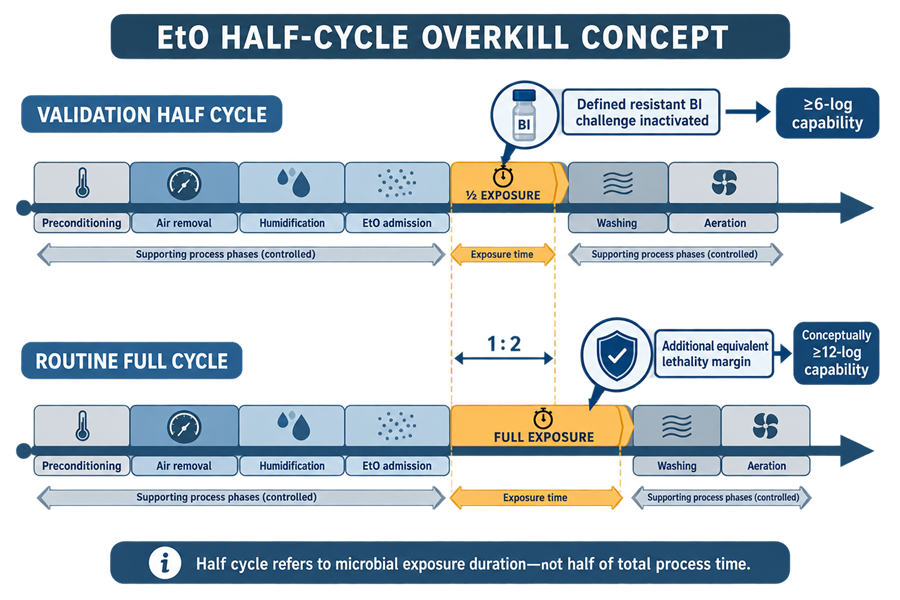
Insert the new Corrected EtO Half-Cycle Concept illustration here.
Under a half-cycle overkill strategy, the reduced exposure cycle is developed to demonstrate complete inactivation of the defined resistant BI challenge at the most difficult validated locations. The routine full exposure is then established to provide an additional equivalent exposure margin.
For a BI population of approximately 106, the conceptual basis is: Half-cycle capability≥6-log reduction
and, where equivalent inactivation kinetics and exposure are justified: Full-cycle capability≥12-log reduction
The theoretical relationship supports an SAL of 10−6, but the numerical model does not eliminate the need for physical process control, BI suitability, product-family definition, and representative load studies.
“Half cycle” should mean half of the established routine microbial-exposure duration under otherwise defined conditions. It should not mean half of total chamber-cycle time, because preconditioning, evacuation, humidification, washing, and aeration are not necessarily divided in half.
The protocol should define which cycle phases remain unchanged and which exposure element is reduced.
Half-Cycle Acceptance
Acceptance may require:
- All physical process criteria met
- Required preconditioning conditions achieved
- Required chamber temperature achieved
- Required moisture input achieved
- Required EtO dose or concentration achieved
- Defined half-exposure duration achieved
- No growth from required validation PCDs
- Positive controls demonstrate growth
- No unexplained missing, damaged, or compromised indicators
- Complete and acceptable process record
- All deviations resolved
A negative BI result from a cycle that failed its physical parameters does not establish acceptable half-cycle performance.
Full-Cycle Confirmation
One or more full-cycle studies may be required by the validation strategy to confirm:
- Routine process execution
- Product and packaging compatibility
- Maximum exposure effects
- Aeration performance
- Residual levels
- Routine record configuration
- Load handling
- Release requirements
The full-cycle studies should use the approved routine recipe rather than a manually reconstructed exposure.
Residual Testing and Aeration Validation
Sterility assurance and residual safety are separate acceptance requirements.
Residual evaluation should address applicable EtO and ethylene-chlorohydrin limits under ISO 10993-7 and the device’s:
- Contact category
- Contact duration
- Patient population
- Intended use
- Materials
- Product mass
- Packaging
- Aeration conditions
The residual strategy should define:
- Product family
- Residual worst case
- Sample selection
- Sample quantity
- Sampling time
- Aeration duration
- Aeration temperature
- Extraction method
- Analytical method
- Detection and quantitation limits
- Calculation method
- Acceptance limits
- Handling of nondetects
- Retesting rules
- Product-release basis
The sterility worst case may not be the residual worst case. Dense or absorbent materials can be easy to expose to EtO yet slow to release retained sterilant.
Aeration Validation
Aeration studies should evaluate:
- Minimum aeration time
- Minimum aeration temperature
- Maximum aeration load
- Load arrangement
- Airflow
- Air exchanges
- Transfer time from chamber
- Product and packaging temperature
- Product density
- Seasonal or ambient effects where applicable
- Temporary holds or interruptions
- Residual dissipation over time
Residual samples should represent routine commercial handling. Extended laboratory storage or uncontrolled additional aeration before testing can invalidate the relationship to commercial release.
Product and Packaging Evaluation
Validation should confirm that the complete EtO process does not create unacceptable effects on:
- Product functionality
- Mechanical strength
- Dimensions
- Optical properties
- Electronics
- Batteries
- Sensors
- Adhesives
- Lubricants
- Coatings
- Drug or biologic components
- Packaging seals
- Porous packaging
- Labels and inks
- Sterile-barrier integrity
Evaluation should represent:
- Minimum and maximum process exposure
- Repeated exposure where permitted
- Aging
- Distribution
- Storage
- Maximum permitted aeration temperature
- Reprocessing or resterilization claims
Sterilization validation and packaging validation should be linked but should retain their distinct acceptance criteria.
Validation Acceptance and Report
The validation report should integrate physical, microbiological, residual, product, and packaging evidence.
It should include:
- Approved protocol and amendments
- Product and family definition
- Processing-category definition
- Worst-case rationale
- Load diagrams
- Equipment identification
- Calibration status
- BI certificates
- PCD specifications
- Raw physical data
- Microbiological results
- Positive-control results
- Residual results
- Product and packaging results
- Deviations
- Investigations
- Statistical or kinetic evaluations
- Comparison with acceptance criteria
- Unresolved limitations
- Approved routine process specification
- Routine monitoring requirements
- Release method
- Requalification requirements
- Change-control requirements
- Final conclusion and approval
The report should identify exactly what has been validated. A statement that “the EtO process is validated” is incomplete without the approved products, families, loads, chambers, sites, recipes, PCDs, and aeration conditions.
Routine Monitoring and Release
The routine-control specification should be derived from validation.
Each load should be traceable to:
- Product and lot
- Product family
- Load configuration
- Pallet and carton pattern
- Sterilizer site and chamber
- Approved recipe
- Preconditioning record
- Transfer time
- Chamber parameters
- EtO dose
- Gas-concentration basis
- Exposure time
- Wash sequence
- PCD and BI results where applicable
- Aeration location
- Aeration parameters
- Residual status
- Alarms and interruptions
- Deviations
- Final disposition
Conventional Release
Conventional release may consider:
- Complete physical process record
- Compliance with validated parameter limits
- BI or routine PCD results where required
- Preconditioning compliance
- Aeration compliance
- Residual-control status
- Alarm review
- Deviation review
- Correct product and load configuration
- Approved recipe version
- Data completeness
A cycle-complete indication does not establish product acceptability.
Parametric Release
Parametric release uses documented physical process parameters as the principal basis for release without relying on routine BI results.
It requires a specifically validated and controlled system capable of demonstrating that all required process conditions were delivered. It should not be adopted merely to shorten incubation time.
The strategy should address:
- Direct or justified measurement of critical parameters
- Instrument accuracy and redundancy
- Sensor failure detection
- Gas-concentration determination
- Moisture control
- Data completeness
- Automated-system reliability
- Alarm and abort logic
- Calibration
- Preventive maintenance
- Change control
- Periodic review
- Personnel authorization
- Deviation handling
ISO/TS 21387 provides additional guidance for EtO parametric release. Regulatory commitments and market-specific requirements must also be assessed.
Deviations and Failed Studies
Validation and routine deviations should be investigated before the affected study or load is accepted.
Examples include:
- Positive BI
- Failed positive control
- Missing BI
- Damaged PCD
- Incorrect BI placement
- Temperature excursion
- Humidity failure
- Incorrect EtO dose
- Short exposure
- Transfer-time excursion
- Vacuum or pressure deviation
- Wrong load configuration
- Unapproved product
- Alarm or cycle interruption
- Data gap
- Aeration failure
- Residual failure
- Laboratory error
- Equipment malfunction
The investigation should address:
- What occurred
- When it occurred
- Affected cycle phase
- Root cause
- Physical process impact
- Microbiological impact
- Product and packaging impact
- Residual impact
- Other potentially affected loads
- Data reliability
- Corrective action
- Need for repeat testing
- Need for requalification
- Product disposition
- Regulatory impact
A failed validation run should not simply be excluded from the required sequence. Repetition is appropriate only after the failure is understood and the effect on the validation conclusion is resolved.
Positive BI Investigation
A positive BI investigation may evaluate:
- BI identity
- Growth confirmation
- Organism identification
- Positive and negative controls
- Incubation conditions
- Recovery handling
- BI population and resistance
- BI placement
- PCD integrity
- Cycle physical data
- Moisture and EtO delivery
- Load configuration
- Laboratory contamination
- Equipment performance
- Comparable BIs and locations
- Prior and subsequent cycles
A presumed laboratory error should be supported by evidence. Sterility testing or additional BI testing should not be used to test the affected commercial load into acceptance.
Change Control
Changes that may affect the validated state include:
- New or modified product
- Product-family reassignment
- Material change
- Component supplier change
- Manufacturing-process change affecting bioburden
- Packaging change
- Carton or pallet change
- Load-density change
- New mixed-load configuration
- BI or PCD change
- Cycle-parameter change
- EtO concentration reduction
- Humidity-strategy change
- Preconditioning change
- Aeration change
- Chamber modification
- Chamber or site transfer
- Control-system change
- Sensor replacement or relocation
- Gas-supply change
- Vacuum-system modification
- Circulation-system change
- Emission-control change
- Extended shutdown
- Regulatory-submission change
The impact assessment should consider:
- Microbial lethality
- Product bioburden
- PCD suitability
- Physical process parameters
- Product and load family
- Residuals
- Materials
- Packaging
- Worker safety
- Emissions
- Equipment qualification
- Routine monitoring
- Regulatory submissions
- Need for targeted or comprehensive requalification
General principles are addressed in GMP Change Control and Validation Impact Assessment.
Periodic Review and Requalification
Periodic review should determine whether the accumulated evidence continues to support the validated process.
Review inputs may include:
- Routine cycle records
- Parameter trends
- BI and PCD results
- Positive BI investigations
- Product bioburden
- Residual data
- Product and packaging complaints
- Deviations
- Aborted cycles
- Maintenance
- Calibration
- Equipment repairs
- Software and recipe changes
- Chamber leak performance
- Preconditioning and aeration performance
- Product-family additions
- Supplier changes
- Contract-sterilizer performance
- Audit findings
- Regulatory changes
- Cumulative changes
- Requalification history
ISO 11135 requires review and requalification controls, but the strategy should distinguish:
- Routine annual or defined-period review
- Event-driven assessment
- Targeted requalification
- Broader periodic requalification
Requalification scope may include:
- Review only with documented justification
- Calibration and equipment-function confirmation
- Targeted OQ
- Physical PQ
- Microbiological PQ
- PCD correlation
- Residual confirmation
- Product or packaging testing
- Full process revalidation
The decision should be based on affected functions, uncertainty, historical performance, change magnitude, and available evidence. Automatically repeating the complete original validation may waste effort, while omitting tests without documented justification can leave a validation gap.
Applicable decision principles are addressed in Risk-Based Requalification of GMP Equipment.
Outsourced-Process Governance
Contract sterilization transfers execution of specified activities but does not transfer the manufacturer’s responsibility for product suitability, supplier control, regulatory commitments, change assessment, and release authorization.
The manufacturer should qualify and oversee the contract sterilizer through:
- Supplier evaluation
- Technical capability assessment
- Quality-system review
- Audit
- Approved technical or quality agreement
- Validation-document review
- Change-notification controls
- Performance monitoring
- Deviation escalation
- Periodic review
- Business-continuity planning
Quality Agreement
The agreement should define responsibility for:
- Product-family assignment
- Cycle development
- Protocol preparation and approval
- Equipment qualification
- Physical and microbiological PQ
- BI and PCD procurement
- BI placement
- Laboratory testing
- Residual testing
- Routine load configuration
- Batch-record review
- Product release
- Deviation investigation
- Positive BI investigation
- Change control
- Requalification
- Record retention
- Data access
- Regulatory inspection support
- Site or chamber transfer
- Disaster recovery and alternate processing
A contract sterilizer’s standard cycle should not be accepted without confirming its applicability to the manufacturer’s product, packaging, load, and regulatory commitments.
Chamber and Site Equivalence
Transfer to another chamber or site should assess:
- Chamber geometry and volume
- Heating capability
- Humidification
- EtO delivery
- Gas concentration
- Vacuum and pressure performance
- Internal circulation
- Load arrangement
- Preconditioning
- Aeration
- PCD location and response
- Equipment control ranges
- Routine monitoring
- Residual performance
- Validation evidence
- Regulatory-submission impact
Using the same nominal recipe does not establish process equivalence.
FDA states that changes to the sterilization method, process, or facility may require regulatory assessment. Applicable resources include FDA’s sterility-information guidance for 510(k) submissions and the transitional policy for certain Class III EtO sterilization-facility changes.
Data Integrity and Record Control
Validation and routine records should preserve:
- Original sensor data
- BI identity and location
- Incubation records
- Positive-control results
- Cycle recipes
- Recipe versions
- Alarm history
- Manual interventions
- Audit trails
- Calculation methods
- EtO dose records
- Residual chromatograms
- Deviations and investigations
- Approvals
- Product and load traceability
Electronic controls should address:
- User access
- Segregation of duties
- Recipe authorization
- Audit trails
- Time synchronization
- Data backup
- Record retention
- Interface verification
- Review of changed or deleted data
- System recovery
Transcribed summaries should not replace reviewable raw data.
Common Validation Errors
Frequent deficiencies include:
- Beginning PQ before product and process definition is complete
- Treating chamber qualification as product-process validation
- Grouping products by commercial category rather than sterilization characteristics
- Using one worst case for lethality, residuals, and material compatibility without justification
- Defining only the maximum load
- Ignoring minimum or mixed loads
- Selecting BI locations because they are easy to retrieve
- Failing to establish internal and external PCD correlation
- Changing a PCD without impact assessment
- Using BI organism identity as the only resistance criterion
- Failing to control product bioburden
- Calling an exposure a half cycle when total cycle time was merely divided in half
- Shortening conditioning, washing, or aeration without technical justification
- Accepting negative BIs when physical parameters failed
- Treating acceptable physical data as a substitute for microbiological PQ
- Using a sterility-test result to release a failed cycle
- Repeating failed cycles without investigation
- Assuming three successful cycles erase an earlier unexplained failure
- Confusing EtO dose with chamber concentration
- Relying on an unqualified chamber-humidity display
- Failing to evaluate product temperature and moisture equilibration
- Testing residuals after uncontrolled additional aeration
- Assuming the sterility worst case is the residual worst case
- Omitting product and packaging effects
- Using automatic cycle-complete status as the sole release basis
- Adopting parametric release without adequate measurement and data controls
- Adding products to a family without documented adoption
- Treating matching recipes as proof of chamber equivalence
- Allowing a contract sterilizer to change equipment, process, or site without notification
- Omitting regulatory assessment for sterilization changes
- Performing calendar-based requalification without reviewing actual lifecycle evidence
- Omitting requalification tests without documenting why prior evidence remains applicable
Conclusion
EtO sterilization validation must connect the product, packaging, bioburden, load, process, equipment, microbiological challenge, aeration, and routine control strategy.
Product families and worst cases establish what the validation represents. Process development defines the physical and microbiological operating window. Equipment qualification demonstrates system capability. Physical PQ confirms delivery of the specified process, while microbiological PQ demonstrates inactivation at the defined challenge locations. Residual and product studies establish that the process remains safe and compatible with the finished device.
Validation is maintained through routine record review, bioburden control, PCD monitoring, calibration, maintenance, deviations, product adoption, change control, periodic review, and justified requalification.
For outsourced processing, the device manufacturer remains responsible for ensuring that the contract sterilizer’s equipment, cycle, load configuration, records, deviations, and changes remain consistent with the approved validation and regulatory commitments.