

Parts-Washer Qualification and Lifecycle Control
Pharmaceutical parts-washer qualification demonstrates that the installed equipment, utilities, instruments, automation, racks, and cycle functions can consistently operate as intended and support approved cleaning processes.
Qualification should not be limited to confirming that the washer fills, heats, sprays, rinses, and dries. Testing must address the functions and failure conditions that determine whether cleaning solution reaches the load, required parameters are achieved, cycle exceptions are detected, electronic records are reliable, and only successfully completed loads are released.
This article addresses qualification strategy, design review, Installation Qualification, Operational Qualification, performance verification, load and spray-coverage testing, computerized controls, failure challenges, release, routine verification, change control, periodic review, and requalification.
Pharmaceutical Parts Washers: Types, Design, and System Architecture addresses washer configurations, hydraulic architecture, racks, utilities, detergent dosing, drying, and equipment selection. Parts-Washer Cleaning Cycle Development and Process Control addresses residue characterization, chemistry selection, parameter development, rinsing, drying, and establishment of the approved recipe.
Parts-washer qualification supports cleaning validation but does not replace it. Equipment qualification demonstrates that the washer can execute and control the cleaning process. Cleaning validation demonstrates that the approved process consistently reduces specified product residues, cleaning agents, and other contaminants to justified acceptance criteria.
Qualification Objective and System Boundary
The qualification objective is to establish documented evidence that the washer is correctly designed and installed, operates according to approved requirements, controls the defined cleaning parameters, identifies unacceptable conditions, and produces reliable cycle records.
The qualification boundary should identify all equipment, utilities, controls, and external interfaces that can affect performance.
The boundary may include:
- Washer chamber
- Doors and door seals
- Load carts, racks, baskets, and fixtures
- Spray arms and nozzles
- Injection manifolds and rack connections
- Sump or wash reservoir
- Circulation pumps
- Strainers and filters
- Water inlets
- Detergent storage and dosing
- Heating system or heat exchanger
- Drain and neutralization interfaces
- Drying-air system
- Exhaust system
- Temperature, pressure, flow, level, and conductivity instruments
- Programmable logic controller
- Human-machine interface
- Recipe management
- Cycle-report generation
- Alarm and event records
- Electronic data storage
- Interfaces with building systems, historians, or manufacturing systems
- Facility utilities supporting operation
Boundary drawings should distinguish washer-supplied equipment from facility systems. Interface responsibility should be clear for water quality, steam, compressed air, electrical power, drains, exhaust, room pressure, and data transfer.
Regulatory and Lifecycle Basis
21 CFR 211.63 requires equipment to be appropriately designed, adequately sized, and suitably located for its intended use, cleaning, and maintenance.
21 CFR 211.67 establishes requirements for equipment cleaning, maintenance, written cleaning procedures, inspection, and records.
21 CFR 211.68 addresses automatic, mechanical, and electronic equipment, including requirements for routine calibration, inspection, or checks according to written programs and controls over changes to records or data.
FDA’s Process Validation: General Principles and Practices describes a lifecycle approach in which qualified facilities and equipment support process performance and remain in a state of control during routine operation.
FDA’s Guide to Inspections: Validation of Cleaning Processes emphasizes written procedures, difficult-to-clean locations, scientifically justified acceptance criteria, suitable sampling, control of cleaning delays, and documented evidence that cleaning processes are effective and reproducible.
The regulations do not prescribe one universal washer-qualification protocol. Qualification scope should be based on intended use, system design, cleaning-process requirements, failure risk, automation complexity, load configuration, and the controls needed to protect product quality and data integrity.
Qualification Lifecycle
Parts-washer qualification should connect requirements and design decisions with installation verification, functional testing, performance evidence, release, routine monitoring, change control, periodic review, and requalification.
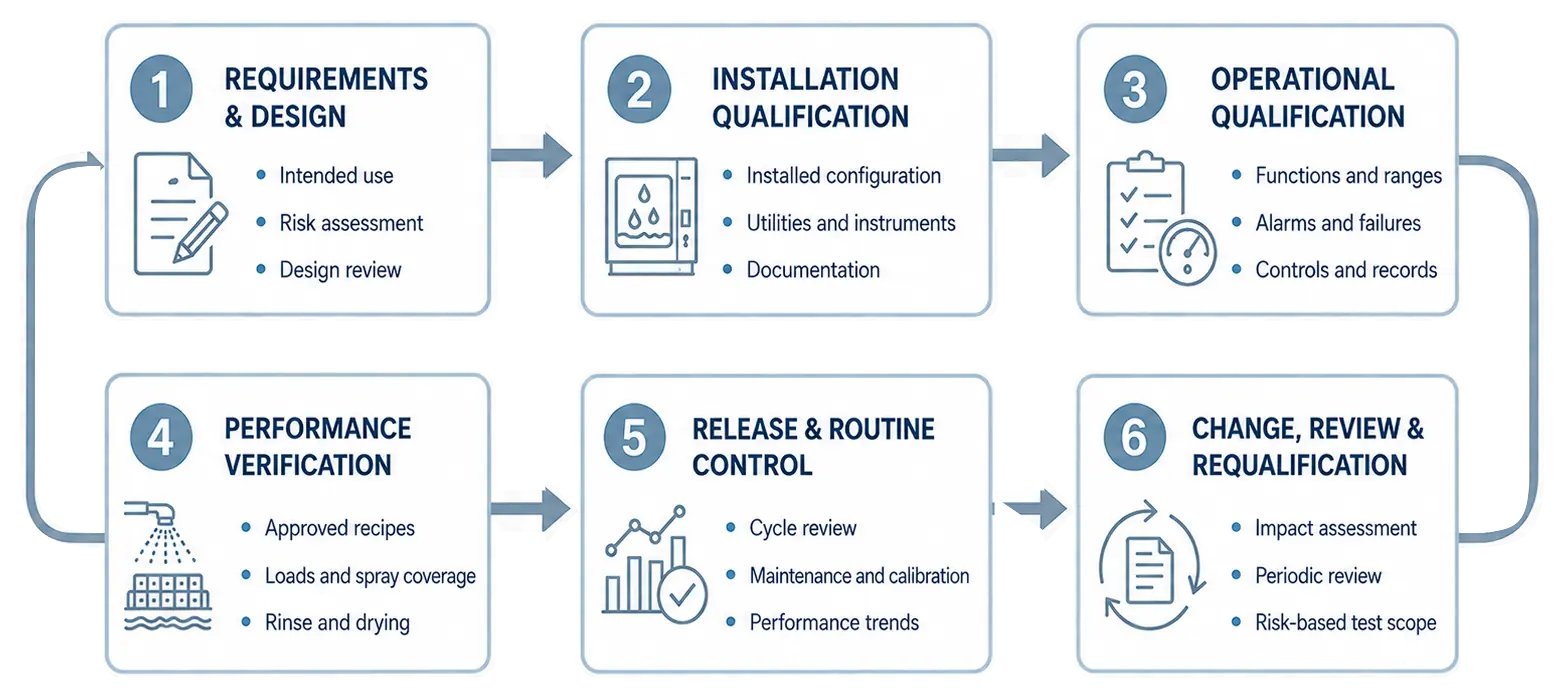
A lifecycle approach prevents qualification from becoming an isolated startup exercise. The original qualification package establishes the baseline against which future changes, failures, repairs, and performance trends are assessed.
User Requirements and Intended Use
Qualification begins with an approved intended-use statement and user requirements.
The requirements should identify:
- Types of components and utensils to be cleaned
- Component materials
- Maximum dimensions and weight
- Component families and representative loads
- Internal cavities, lumens, hoses, and injection requirements
- Residues and soil characteristics
- Maximum dirty hold time
- Required pre-cleaning and disassembly
- Required water qualities
- Cleaning-agent requirements
- Wash and rinse operating ranges
- Drying requirements
- Clean hold time
- Required throughput
- Dirty-side and clean-side material flow
- Containment requirements
- Recipe-management needs
- Cycle-record requirements
- Alarm and event requirements
- Electronic-record retention
- User-access requirements
- Required external interfaces
- Maintenance and calibration access
- Qualification and requalification needs
Requirements should be testable or otherwise verifiable. Statements such as “the washer shall provide effective cleaning” are insufficient unless supported by defined loads, parameters, operating conditions, and acceptance criteria.
Risk Assessment and Qualification Scope
A documented risk assessment should identify the washer functions, components, parameters, records, and failure conditions that can affect cleaning performance or load disposition. Potential failure modes include:
- Circulation-pump failure
- Reduced spray pressure or flow
- Blocked or damaged nozzles
- Spray-arm failure
- Incorrect rack installation
- Disconnected injection manifold
- Open or blocked injection position
- Incorrect detergent dose
- Wrong detergent selection
- Failure to achieve temperature
- Incorrect phase duration
- Incomplete rinse
- Drain blockage
- Residual water after drying
- Door-interlock failure
- Unauthorized recipe change
- Sensor failure or calibration drift
- Data-recording failure
- Loss of power or communication
- Cycle interruption followed by improper restart
- Release of an aborted or failed load
The assessment should connect each significant risk with:
- Preventive control
- Detection method
- Alarm or interlock
- Qualification test
- Acceptance criterion
- Routine control
- Required response
Risk assessment does not justify omitting testing merely because a vendor tested the function. Supplier evidence may be leveraged after documented assessment, but site qualification must address the installed configuration, intended use, facility utilities, approved recipes, actual racks, and GMP operating environment.
Design Qualification and Design Review
Design Qualification or an equivalent documented design review should confirm that the proposed washer can satisfy the approved requirements. The review should address:
- Chamber dimensions and load capacity
- Construction materials
- Internal surface finish
- Chamber geometry and drainage
- Door configuration
- Door seals and interlocks
- Spray-arm arrangement
- Nozzle accessibility
- Pump capacity
- Flow and pressure capability
- Injection-manifold design
- Rack recognition and connection
- Water-supply arrangement
- Detergent dosing
- Heating capacity
- Temperature uniformity
- Filtration and straining
- Drain arrangement
- Drying-air capacity and filtration
- Exhaust requirements
- Instrument selection and location
- Automation architecture
- Recipe controls
- Electronic records
- Maintenance access
- Calibration access
- Cleanability of the washer itself
- Ability to inspect difficult locations
- Utility consumption
- Recovery from interruptions
- Pass-through boundary requirements where applicable
Design review should also confirm that the washer can accommodate the actual load inventory. Chamber capacity alone is not sufficient. The selected racks must provide spray access, internal injection where needed, load stability, drainage, and repeatable positioning.
Factory Acceptance Testing may verify selected mechanical, electrical, and control functions before shipment. Site Acceptance Testing may confirm the installed configuration before formal qualification. These activities can reduce duplicate testing, but they should be planned and leveraged according to documented criteria.
Installation Qualification
Installation Qualification verifies that the washer and associated systems are installed according to approved design information, manufacturer requirements, drawings, specifications, and site standards.
Equipment Identification and Configuration
IQ should verify:
- Manufacturer
- Model
- Serial number
- Equipment identification
- Chamber dimensions
- Door configuration
- Rack and cart types
- Spray-arm configuration
- Injection-manifold configuration
- Pump identification
- Heater or heat-exchanger identification
- Detergent system
- Drying system
- Control-system hardware
- Software or firmware version
- Installed instruments
- Filters and strainers
- Safety devices
The installed configuration should be compared with approved drawings, specifications, bills of material, and vendor documentation.
Materials and Construction
Verification may include:
- Chamber material
- Product-contact or load-contact materials
- Surface-finish documentation
- Weld documentation where required
- Seal and gasket materials
- Rack and fixture materials
- Piping materials
- Instrument wetted materials
- Detergent-system compatibility
- Drain-system materials
Material verification should reflect intended use. Documentation should not be collected without determining whether the specified materials are suitable for the cleaning agents, temperatures, water quality, residues, and required lifecycle.
Utilities
IQ should verify applicable utility connections:
- Electrical supply
- Potable, softened, or process water
- Purified Water
- Water for Injection
- Plant steam
- Compressed air
- Drying air
- Exhaust
- Drain
- Neutralization system
- Network connection
Utility identification, pipe size, pressure range, flow capability, temperature, water quality, connection location, valve arrangement, and drainage should be documented as applicable.
Utility qualification remains separate from washer qualification. For example, confirming that a Purified Water connection exists does not establish that the water system is qualified or that delivered water meets its specification.
Instruments
The instrument inventory should identify:
- Tag number
- Manufacturer and model
- Serial number
- Measurement range
- Accuracy
- Location
- Function
- Calibration requirement
- Calibration range
- Reference standard
- Data or control use
Instruments used to control, monitor, alarm, or document critical cleaning parameters should be calibrated across a range appropriate for actual operation.
Documentation
Required documentation may include:
- Approved drawings
- Piping and instrumentation diagrams
- Electrical drawings
- Control-system architecture
- Instrument list
- Alarm list
- Input/output list
- Component manuals
- Maintenance instructions
- Spare-parts list
- Software documentation
- Material certificates
- Calibration certificates
- Weld and surface-finish records
- Backup and recovery instructions
Documentation discrepancies should be corrected or formally assessed before qualification closure.
Operational Qualification
Operational Qualification demonstrates that the installed washer operates according to approved functional requirements across defined operating ranges. OQ should test normal operation, boundary conditions, alarms, interlocks, failures, recovery, and data recording.
Mechanical and Hydraulic Functions
Testing should address:
- Chamber filling
- Sump-level control
- Circulation-pump operation
- Spray-arm rotation
- Nozzle condition
- Spray distribution
- Injection-manifold operation
- Rack connection
- Strainer or filter function
- Heating
- Recirculation
- Phase drainage
- Drying-air operation
- Door operation
- Load-cart engagement
Pump operation should be evaluated under representative hydraulic conditions. A pump-running indication alone does not demonstrate adequate flow or spray delivery.
Where pressure or flow is a required cleaning parameter, the measurement location and acceptance range should reflect the actual hydraulic requirement. Pressure at the pump discharge may not represent conditions at a distant nozzle or injection connection.
Cycle Sequence and Phase Logic
Each approved recipe type should be verified for:
- Initial drain
- Fill
- Pre-rinse
- Detergent dosing
- Heating
- Wash recirculation
- Intermediate rinse
- Final rinse
- Drain
- Drying
- Cooling where applicable
- Cycle completion
- Record generation
Testing should confirm:
- Correct phase sequence
- Required transition conditions
- Setpoint achievement
- Phase timing
- Effective exposure timing
- Hold logic
- Endpoint logic
- Alarm response
- Abort behavior
- Restart restrictions
- Cycle-complete criteria
The test should distinguish total phase duration from effective exposure time when the cycle requires temperature, concentration, flow, or another condition to be achieved before effective timing begins.
Temperature Verification
Temperature testing should confirm:
- Sensor accuracy
- Displayed temperature
- Recorded temperature
- Control response
- Heating rate
- Achievement of required minimums
- Prevention of unacceptable high temperature
- Alarm and abort response
- Temperature performance under representative load conditions
Multiple temperature sensors or independent data loggers may be used to evaluate chamber, sump, rack, or load conditions where temperature distribution is important.
The study design should reflect the washer type and cleaning process. A single sump sensor may adequately control solution temperature but may not demonstrate the thermal condition experienced by all load locations.
Detergent Dosing
Testing should verify:
- Correct chemical selection
- Dosing-pump operation
- Delivered quantity
- Dosing timing
- Tank-level indication
- Low-level alarm
- Empty-container response
- Line priming
- Prevention of unintended dosing
- Concentration measurement where applicable
- Recipe-specific dosing controls
A pump command does not prove that chemical reached the wash solution. Qualification should challenge credible failures such as an empty chemical container, loss of prime, closed valve, disconnected line, or failed concentration response where these conditions could go undetected.
Rinse Functions
Rinse verification should address:
- Correct water source
- Rinse-water quality designation
- Rinse volume
- Rinse duration
- Number of rinse stages
- Once-through or recirculated operation
- Conductivity or other endpoint where applicable
- Drain completion
- Carryover between phases
- Final-rinse sample location
Conductivity, pH, TOC, time, or volume may support rinse control when appropriately justified. No single measurement should be treated as universal proof that every product and cleaning-agent residue has been removed.
Drying Functions
Drying testing may include:
- Air temperature
- Airflow
- Filter installation and integrity where applicable
- Drying duration
- Air-path operation
- Vacuum performance where applicable
- Condensate or moisture removal
- Load dryness
- High-temperature protection
- Fan or airflow failure response
Acceptance criteria should reflect the actual load and downstream use. A dry chamber does not establish that hollow components, hoses, recessed parts, or upward-facing cavities are dry.
Automation and Data Integrity
The washer control system should be evaluated according to intended use and GMP impact. Relevant functions may include:
- User authentication
- Role-based access
- Recipe creation
- Recipe approval
- Recipe version control
- Parameter entry
- Alarm management
- Event recording
- Cycle-data acquisition
- Cycle-report generation
- Time synchronization
- Electronic signatures
- Data export
- Audit trails
- Backup and recovery
- Interfaces with external systems
Testing should verify that only authorized users can create or modify recipes and critical parameters.
The system should preserve traceability for:
- Recipe name and version
- Operator
- Load or batch identifier
- Cycle start and completion time
- Actual parameter values
- Alarms
- Acknowledgments
- Overrides
- Phase advances
- Aborted cycles
- Repeated phases
- Changes to recipes or configuration
- Final cycle status
A printed report should not be assumed complete merely because it contains a “cycle complete” message. The report should provide sufficient information to determine whether all required phases and acceptance conditions were achieved.
Backup and recovery testing should demonstrate that configuration, recipes, user data, and cycle records can be restored according to approved procedures.
Alarm, Interlock, and Failure Testing
Qualification should challenge failures that could affect cleaning performance, operator safety, equipment protection, or load disposition. Potential tests include:
- Failure to fill
- Low water level
- High water level
- Failure to heat
- High temperature
- Low circulation pressure
- Low flow
- Pump trip
- Spray-arm failure where monitored
- Detergent low level
- Detergent dosing failure
- Conductivity endpoint not achieved
- Drain failure
- Drying-air failure
- Door-open condition
- Door-interlock failure
- Rack not engaged
- Injection connection missing
- Instrument-signal failure
- Communication failure
- Printer or report failure
- Data-storage failure
- Power interruption
- Emergency stop
For each challenged condition, testing should verify:
- Detection
- Alarm message
- Alarm timing
- Required interlock
- Cycle response
- Data recording
- Operator instructions
- Recovery behavior
- Final cycle status
- Load disposition
An aborted or failed cycle should not be reported as successfully completed. Restart logic should prevent a partially processed load from bypassing required phases without documented assessment and authorized disposition.
Spray-Coverage Verification
Spray-coverage testing evaluates whether cleaning solution reaches the required chamber, rack, and load surfaces under defined operating conditions.
Riboflavin or another suitable fluorescent material may be applied to selected surfaces. The test cycle is then executed, and the surfaces are inspected under ultraviolet light.
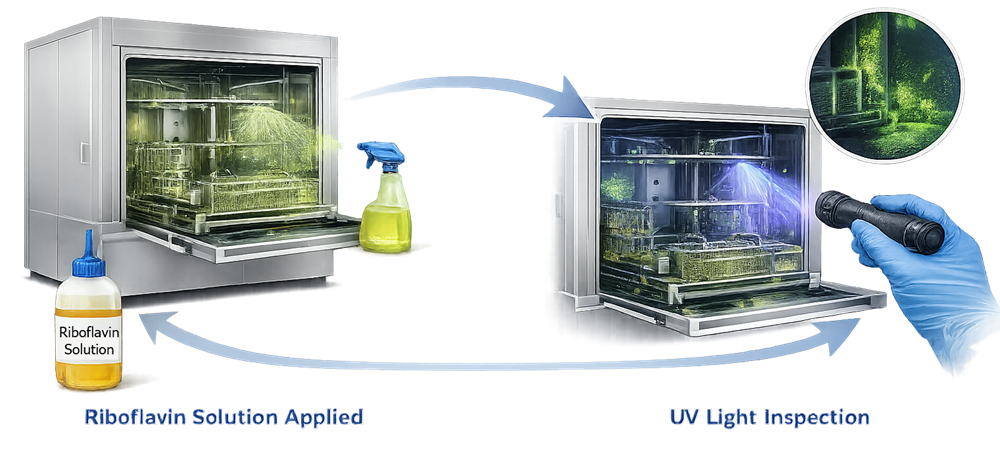
The protocol should define:
- Riboflavin concentration
- Application method
- Application coverage
- Drying condition before testing
- Test cycle
- Water and detergent conditions
- Rack configuration
- Load configuration
- Inspection method
- Ultraviolet-light requirements
- Inspection locations
- Acceptance criteria
- Documentation method
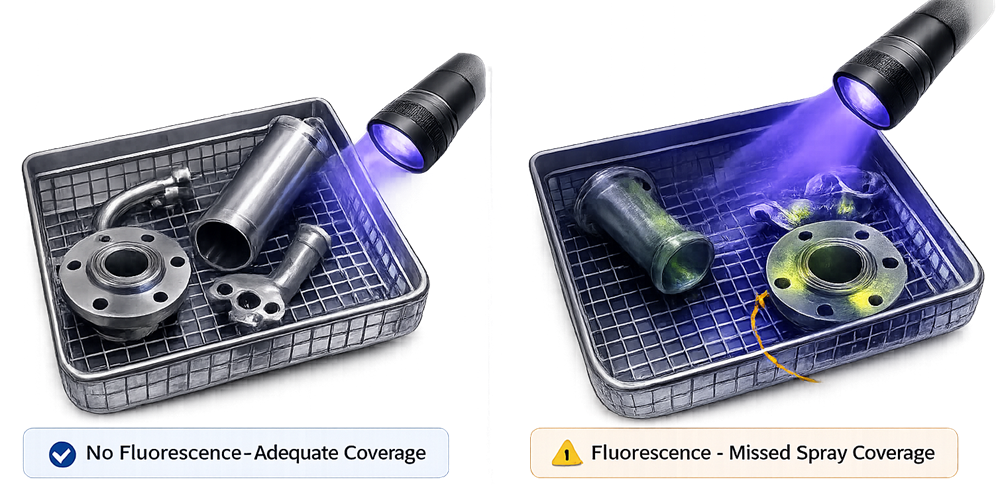
Spray-coverage testing can identify:
- Shadowed surfaces
- Blocked nozzles
- Inadequate spray-arm distribution
- Improper rack positioning
- Disconnected injection paths
- Shielding by large components
- Unexposed internal surfaces
- Poor drainage or retained fluorescent solution
Coverage testing has defined limitations:
- It demonstrates wetting or spray exposure under the tested conditions.
- It does not demonstrate removal of actual product residue.
- It does not establish cleaning-agent effectiveness.
- It does not replace analytical residue testing.
- It does not replace cleaning validation.
- It does not establish coverage for untested load arrangements.
The test should be performed using representative or challenging rack and load arrangements. An empty-chamber test does not establish coverage of a loaded configuration.
Rack, Fixture, and Load Verification
Racks and fixtures are part of the qualified cleaning configuration. Verification should confirm:
- Rack identity
- Rack dimensions
- Connection to the hydraulic system
- Correct engagement
- Injection-manifold alignment
- Positioning repeatability
- Mechanical stability
- Component restraint
- Spray access
- Drainability
- Prevention of component contact or nesting
- Compatibility with door closure
- Recognition by the control system where applicable
Dedicated racks should be tested with the components for which they were designed.
General baskets should have defined loading limitations. Qualification should not approve uncontrolled combinations of parts merely because they fit inside the chamber.
Load verification should address:
- Minimum and maximum load
- Large shielding components
- Densely populated racks
- Hollow components
- Hoses and lumens
- Heavy components
- Recessed surfaces
- Mixed loads
- Component orientation
- Unused injection positions
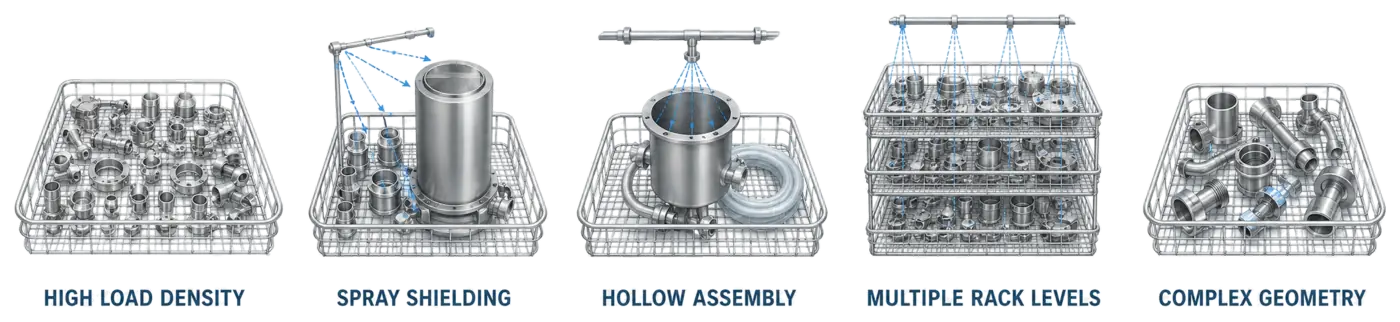
A qualification load should be challenging but physically representative. Intentionally stacking parts in a manner prohibited by routine procedures does not demonstrate routine performance. It demonstrates only that an invalid load can fail.
Worst-case selection should be based on the most difficult approved configuration rather than on an arrangement that the operating procedure does not permit.
Performance Qualification and Cleaning Performance Verification
Performance Qualification demonstrates that the washer, approved recipe, racks, utilities, procedures, and representative loads operate together under defined conditions.
The term PQ should be used carefully. Equipment PQ can demonstrate integrated equipment performance using representative loads and challenge soils. Formal cleaning validation separately demonstrates removal of actual or scientifically justified product residues against health- or process-based acceptance criteria.
Performance verification may include:
- Approved recipe execution
- Representative load families
- Challenging load configurations
- Maximum dirty hold time
- Defined challenge soil
- Visual inspection
- Rinse evaluation
- Drying verification
- Repeatability
- Cycle-record review
- Operator execution
Challenge soils should be selected for the study objective. Standardized soils can support equipment-performance testing but may not represent the actual product residue used in cleaning validation.
Repeat studies should demonstrate consistent performance. The number of runs should be justified according to intended use, variability, risk, development knowledge, and the evidence already available.
Rinse-Effectiveness Verification
Rinse-effectiveness testing evaluates whether the rinse sequence removes cleaning-agent residues and displaced soil from the washer and load.
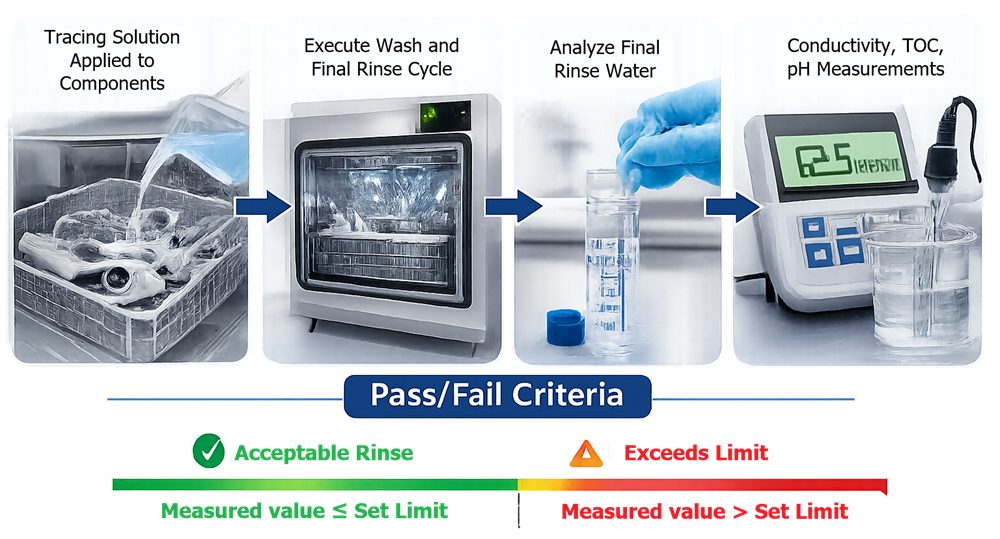
Potential measurements include:
- Conductivity
- pH
- Total organic carbon
- Cleaning-agent-specific assay
- Product-specific assay
- Visual inspection
- Rinse volume
- Rinse duration
The test design should define:
- Incoming-water baseline
- Sample location
- Sample timing
- Rinse volume
- Applicable temperature correction
- Instrument range and accuracy
- Acceptance criterion
- Relationship to load surfaces
- Relationship to cleaning validation
A final-rinse sample represents the collected rinse at the sampling point. It should not automatically be treated as proof that every isolated surface is free of residue.
Rinse Sampling addresses the capabilities and limitations of rinse sampling within cleaning validation.
Acceptance Criteria and Deviations
Acceptance criteria should be approved before protocol execution and should be specific to each test.
Criteria should be:
- Objective
- Measurable where practical
- Traceable to requirements
- Supported by development or design information
- Appropriate for the installed configuration
- Clear about data rounding and measurement uncertainty
- Clear about permitted adjustments or retesting
Examples include:
- Installed components match approved drawings.
- Instruments are calibrated across their operating ranges.
- Cycle phases execute in the approved sequence.
- Required temperatures and exposure times are achieved.
- Detergent dosing remains within the approved range.
- Alarms and interlocks produce the specified response.
- Aborted cycles cannot be reported as successful.
- Coverage testing shows no retained fluorescence at required locations.
- Rinse results meet predefined criteria.
- Required drying conditions are achieved.
- Electronic cycle records are complete and retrievable.
Deviations should be documented and assessed for:
- Test validity
- Effect on other executed tests
- Root cause
- Corrective action
- Need for repeat testing
- Effect on qualification status
- Effect on cleaning validation
- Effect on release
Testing should not be repeated only to obtain a passing result. The cause of the original failure and the effect of any adjustment must be understood and documented.
Qualification Release
Release should occur only after:
- Required protocols are executed
- Deviations are resolved or acceptably dispositioned
- Critical documents are approved
- Calibration is current
- Required procedures are effective
- Operators and reviewers are trained
- Recipes are approved and protected
- Backup is completed
- Open items are assessed
- The final report is approved
- Quality-unit approval is obtained where required
Conditional release should be used only when remaining items do not compromise intended use, cleaning performance, product quality, data integrity, or regulatory compliance. Each open item should have an owner, due date, interim control, and documented justification.
Routine Operation and Continued Verification
Routine controls should confirm that each cycle operated within the approved state.
Cycle review may include:
- Correct washer and rack
- Correct recipe and version
- Load identity
- Operator
- Cycle start and completion
- Required phase completion
- Actual temperature
- Effective exposure time
- Detergent dosing
- Rinse endpoint
- Alarms
- Overrides
- Repeated phases
- Aborts
- Final cycle status
- Visual inspection
- Load disposition
Routine verification may also include:
- Spray-arm inspection
- Nozzle inspection
- Rack-connection checks
- Filter or strainer inspection
- Detergent-system checks
- Door-seal inspection
- Instrument calibration
- Preventive maintenance
- Backup verification
- User-access review
- Alarm and deviation trending
Cycle completion should not be reduced to a single status field. Review should confirm that the recorded data support successful execution.
Change Control
Changes should be assessed before implementation unless managed through an approved emergency-change process.
Potential changes include:
- New component or load family
- New rack or fixture
- Rack repair
- Nozzle replacement
- Spray-arm modification
- Pump replacement
- Heater modification
- Instrument replacement
- Calibration-range change
- Detergent change
- Water-source change
- Recipe change
- Software or firmware update
- Alarm-setting change
- User-role change
- Data-interface change
- Door or seal modification
- Drying-system modification
- Utility modification
- Relocation of the washer
The impact assessment should determine whether the change requires:
- Documentation update
- Calibration
- Inspection
- Targeted functional testing
- Repeat temperature testing
- Repeat detergent-dosing verification
- Repeat spray coverage
- Repeat load verification
- Computerized-system testing
- Cleaning-validation assessment
- Targeted requalification
- Comprehensive requalification
A like-for-like designation should be supported by technical comparison. Matching a component’s general description does not establish equivalence of material, range, accuracy, flow capacity, control behavior, software revision, or installation effect.
Periodic Review
Periodic review should determine whether the washer remains suitable for its intended use and whether the qualified state remains supported by current evidence. Review inputs may include:
- Changes
- Deviations
- Cleaning failures
- Aborted cycles
- Alarm trends
- Maintenance history
- Calibration history
- Instrument drift
- Nozzle and spray-arm condition
- Pump repairs
- Rack repairs and modifications
- Recipe changes
- User-access review
- Audit-trail review where applicable
- Backup and recovery status
- Cycle-data trends
- Rinse-result trends
- Visual-inspection findings
- Cleaning-validation monitoring
- Vendor support status
- Software and hardware obsolescence
- Open corrective actions
Periodic review is not merely confirmation that preventive maintenance and calibration were completed. It should evaluate whether performance, configuration, documentation, and operating controls continue to support the approved intended use.
Requalification
Requalification scope should be based on change impact, failure history, performance trends, applicable procedures, and the condition of the qualified baseline.
Potential requalification triggers include:
- Major maintenance
- Pump or spray-system modification
- Rack redesign
- Repeated coverage failures
- Repeated rinse failures
- Adverse temperature trends
- Instrument replacement
- Control-system change
- Recipe-logic change
- Utility modification
- Washer relocation
- Extended shutdown
- Significant cleaning failure
- New load family outside the qualified range
- Loss of qualification records
- Periodic review finding
Requalification may be:
- Documentation-only assessment
- Targeted testing
- Partial requalification
- Comprehensive requalification
The rationale should identify both tests selected for repetition and tests not repeated. Unchanged functions should not automatically be retested without assessing whether existing evidence remains valid. Conversely, the absence of a direct change does not justify omitting testing when adverse trends or repeated failures indicate loss of control.
Risk-Based Requalification of GMP Equipment, Systems, and Utilities addresses the broader trigger-to-scope decision process.
Qualification Documentation
The qualification package may include:
- Intended-use statement
- User Requirements Specification
- System boundary
- Risk assessment
- Design review or Design Qualification
- Factory Acceptance Testing
- Site Acceptance Testing
- Installation Qualification
- Operational Qualification
- Performance Qualification
- Spray-coverage protocol and report
- Load diagrams
- Temperature-study records
- Detergent-dosing verification
- Rinse-effectiveness records
- Alarm and interlock tests
- Computerized-system testing
- Calibration records
- Deviations and corrective actions
- Traceability matrix
- Approved recipes
- Procedures
- Training records
- Final qualification report
- Release approval
- Change controls
- Periodic reviews
- Requalification assessments
The package should allow a reviewer to trace the installed system and approved operating state from requirements through qualification and routine lifecycle control.
Common Qualification Weaknesses
Common weaknesses include:
- Qualification limited to IQ and basic cycle execution
- Vendor testing accepted without site-specific assessment
- Empty-chamber testing used to represent loaded conditions
- Spray coverage confused with residue removal
- Detergent-pump operation accepted without verifying delivered quantity
- Total phase time confused with effective exposure time
- No testing of aborted-cycle status
- Alarm testing limited to message display
- No challenge of credible sensor failures
- Undefined rack and load configurations
- Rinse conductivity treated as universal proof of cleanliness
- Drying assessed only by chamber condition
- Recipe security and audit trails omitted
- Backup performed without recovery testing
- Deviations closed without assessing related tests
- Changes classified as like-for-like without technical comparison
- Requalification performed only by calendar without considering changes and trends
- Qualification and cleaning validation treated as interchangeable
These weaknesses create gaps between equipment operation, cleaning-process control, cycle records, and load-release decisions.
Conclusion
Parts-washer qualification should demonstrate more than mechanical operation. It should establish that the installed washer, utilities, instruments, automation, recipes, racks, and procedures can execute the approved cleaning process, detect unacceptable conditions, generate reliable records, and support controlled load release.
A defensible lifecycle begins with requirements and design review, verifies installation, challenges normal and abnormal operation, evaluates spray coverage and load configuration, confirms rinse and drying functions, and establishes the approved baseline.
Routine cycle review, maintenance, calibration, change control, periodic review, and risk-based requalification then provide continuing evidence that the washer remains suitable for its intended use.